
Dunaliella Salina Market (2026-2036)
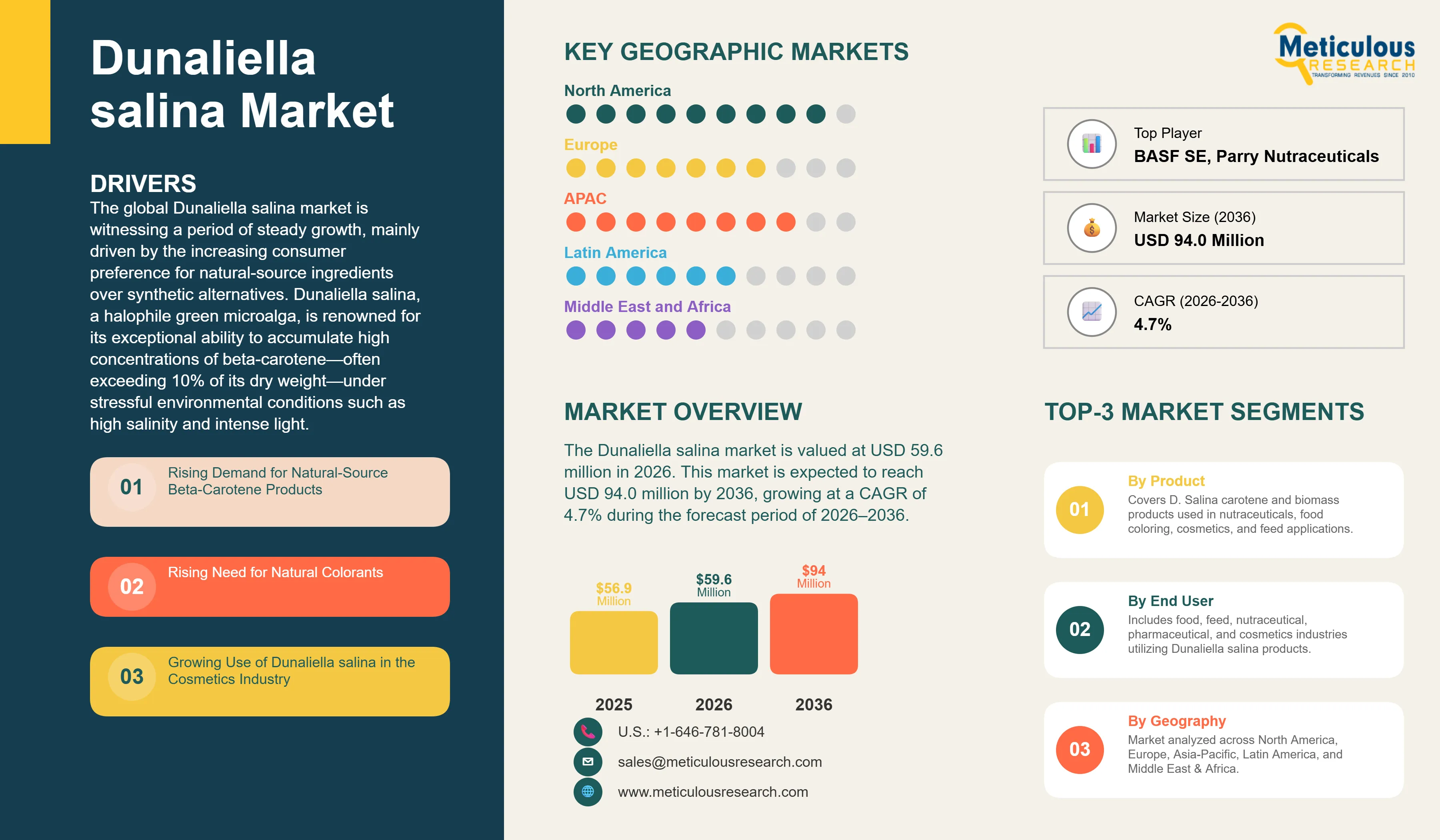
The global Dunaliella salina market is valued at USD 59.6 million in 2026. This market is expected to reach USD 94.0 million by 2036, growing at a CAGR of 4.7% during the forecast period of 2026–2036.
- Published
- Jun 2026
- Pages
- 95
- Format
- PDF + Excel
- Report ID
- MR-474
- Base year
- 2025
- 2026 · ESTIMATED
- $59.6M
- 2036
- $94.0M
- CAGR 2026–2036
- 4.7%
2025 baseline · 2026–2036 forecast at 4.7% CAGR · hover a bar for the value
Key highlights
The global Dunaliella salina market is projected to reach USD 94 million by 2036.
The market is expected to grow at a CAGR of 4.7% during the forecast period 2026–2036.
The global Dunaliella salina market is estimated at USD 59.6 million in 2026.
Dunaliella salina is the richest natural source of beta-carotene, containing up to 14% of its dry weight.
The nutraceutical and dietary supplement segment holds the largest share of the market, driven by the demand for natural antioxidants.
The cosmetics and personal care segment is projected to witness the fastest growth due to the rising trend of algae-based skincare.
North America and Europe combined account for approximately 45% of the global market share.
Australia and Israel remain the global leaders in high-quality Dunaliella salina production and biotechnology innovation.
Report summary
| Particulars | Details |
|---|---|
| Base Year | 2025 |
| Estimated Year | 2026 |
| Forecast Period | 2026–2036 |
| Market Size (2026) | USD 59.6 million |
| Market Size (2036) | USD 94.0 million |
| CAGR (2026–2036) | 4.7% |
| Format | PDF, Excel & Cloud Portal · 95 pages |
| Segments Covered | By Product: D. Salina Biomass & Powder, D. Salina Carotene · By End User: Food & Beverage, Feed & Aquaculture, Nutraceutical & Dietary Supplement, Pharmaceutical, Cosmetics & Personal Care |
| Key Companies | Parry Nutraceuticals, Hangzhou OuQi Food Co., Ltd., Seagrass Tech Private Limited, Algatechnologies Ltd |
Report overview
Segments covered: product, end user.
The global Dunaliella salina market is witnessing a period of steady growth, mainly driven by the increasing consumer preference for natural-source ingredients over synthetic alternatives. Dunaliella salina, a halophile green microalga, is renowned for its exceptional ability to accumulate high concentrations of beta-carotene—often exceeding 10% of its dry weight—under stressful environmental conditions such as high salinity and intense light. This unique characteristic makes it the premier biological source for natural beta-carotene, which is widely utilized as a provitamin A supplement, a natural food colorant, and a potent antioxidant in the nutraceutical and cosmetics industries. The growth of this market is further driven by the global clean-label movement, where food and beverage manufacturers are actively replacing synthetic dyes like E160a with algae-derived pigments to meet the demands of health-conscious consumers.
The nutraceutical and dietary supplement sector is the primary consumer of Dunaliella salina products, leveraging its high antioxidant profile to address the growing demand for supplements that support immune health, vision, and skin protection. Beyond its carotene content, the biomass of Dunaliella salina is rich in essential fatty acids, proteins, and glycerol, which are increasingly being explored for applications in specialized animal feed and aquaculture. In the aquaculture industry, the addition of Dunaliella salina to feed is prized for its ability to enhance the pigmentation and nutritional value of fish and crustaceans. Furthermore, the cosmetics industry is emerging as a significant growth avenue, with Dunaliella salina extract being integrated into high-end skincare formulations for its proven ability to protect skin cells from oxidative stress and UV-induced damage.
Cultivation of Dunaliella salina primarily occurs in large-scale open-pond systems, which are strategically located in regions with high solar radiation and available hypersaline water sources. While open-pond systems are cost-effective, they are subject to environmental variability and contamination risks, leading to an increasing interest in closed photobioreactor technologies for producing high-purity extracts for pharmaceutical applications. The market is also characterized by a high degree of geographic concentration, with major production hubs in Australia, Israel, and China. These regions benefit from ideal climatic conditions and established algae biotechnology ecosystems, allowing them to supply the global demand for high-quality Dunaliella-derived products.
Despite the positive outlook, the market faces challenges related to high production costs and competition from other natural beta-carotene sources such as palm oil and carrots. The energy-intensive nature of harvesting and drying microalgae biomass remains a significant factor in the final product pricing. However, continuous advancements in harvesting technologies and the development of multi-product biorefinery models, where glycerol and other valuable co-products are recovered alongside carotene, are expected to improve the economic viability of Dunaliella salina production. As the market moves toward 2036, the integration of sustainable cultivation practices and the expansion into emerging economies in the Asia-Pacific and Latin American regions are expected to be key strategic priorities for leading market players.
The global Dunaliella salina market is valued at USD 59.6 million in 2026. This market is expected to reach USD 94.0 million by 2036, growing at a CAGR of 4.7% during the forecast period of 2026–2036.
Market dynamics
7 factors across 5 forcesThe rising demand for natural-source beta-carotene
products is the primary driver for the Dunaliella salina market. As health awareness grows, consumers are increasingly avoiding synthetic food additives and seeking natural alternatives with proven health benefits. Dunaliella-derived beta-carotene is highly valued for its purity and high bioavailability compared to synthetic versions. Additionally, the growing need for natural colorants in the food and beverage industry, fueled by regulatory restrictions on synthetic dyes in several European and North American countries, is significantly boosting market demand.
Another key driver is the increasing
use of Dunaliella salina in the cosmetics and personal care industry. The alga's high concentration of antioxidants and its ability to protect against UV radiation make it an ideal ingredient for anti-aging and sun-protection products. The shift toward 'blue beauty' and sustainable, marine-derived ingredients is further propelling the adoption of Dunaliella salina extracts by major global cosmetics brands.
Table of contents
10 chapters · 96 sections · 95 pages · click to expandSegmental analysis
| Segment | Largest share (2026) | Fastest growth (2026–2036) |
|---|---|---|
| By Product | Salina Carotene | Salina Biomass & Powder |
| By End User | Nutraceutical & Dietary Supplement Companies | Cosmetics & Personal Care |
By Product
- D. Salina Carotene to Hold Largest Share
- The D.
- Salina market is segmented into D.
- Salina Biomass & Powder and D.
- Salina Carotene.
- The D.
- Salina Carotene segment is expected to hold the largest share of the market.
- This dominance is due to the strong demand for natural beta-carotene in the food, beverage, and supplement industries, where it is used as both a nutritional ingredient and a high-value colorant.
- The high concentration of carotene in Dunaliella salina makes this segment the primary revenue generator for the industry.
- The D.
- Salina Biomass & Powder segment is projected to register the fastest CAGR during the forecast period.
- This growth is driven by the increasing use of whole-algae biomass in specialized animal feed, aquaculture, and as a natural ingredient in vegan food products that require the full nutritional profile of the alga beyond just its carotene content.
By End User
- Nutraceutical & Dietary Supplement Companies to Lead
- The D.
- Salina market is segmented into Food & Beverage Companies, Feed & Aquaculture Companies, Nutraceutical & Dietary Supplement Companies, Pharmaceutical Companies, and Cosmetics & Personal Care Companies.
- The Nutraceutical & Dietary Supplement segment is expected to hold the largest share of the market.
- This is because Dunaliella salina is primarily consumed for its high provitamin A and antioxidant content, which are essential components of modern health supplements aimed at vision and immune support.
- The Cosmetics & Personal Care segment is projected to witness the fastest growth during the forecast period.
- The rising demand for natural and effective anti-aging ingredients in skincare, combined with the alga's proven ability to protect against environmental stressors, is driving its rapid adoption by premium cosmetics manufacturers globally.
Geographic analysis
North America
North America is expected to hold a significant share of the global Dunaliella salina market in 2026, driven by a mature nutraceutical industry and high consumer awareness regarding the benefits of natural antioxidants. The U.S. is a major market for dietary supplements, with a strong presence of health-conscious consumers and leading supplement brands.
Asia-Pacific
Fastest growthAsia-Pacific is projected to witness the fastest growth during the forecast period. This is driven by the presence of major production hubs in China and Australia, increasing investments in algae biotechnology, and the growing demand for natural food colorants in the region's expanding food and beverage industry. China is both a major producer and consumer of Dunaliella salina biomass. The key companies operating in the Asia-Pacific market are BASF (Betatene), Parry Nutraceuticals, and Hangzhou OuQi Food.
Competitive landscape
- Parry Nutraceuticals
- Hangzhou OuQi Food Co., Ltd.
- Seagrass Tech Private Limited
- Algatechnologies Ltd
Frequently asked questions
The market is projected to reach USD 94 million by 2036, growing at a CAGR of 4.7% from 2026 to 2036.
Cite this report
Meticulous Research. (2026). Dunaliella Salina Market - Global Opportunity Analysis and Industry Forecast (2026-2036) (Report No. MR-474). Meticulous Market Research Pvt. Ltd. https://www.meticulousresearch.com/reports/dunaliella-salina-market-5168