
Sunscreen Market (2025-2035)
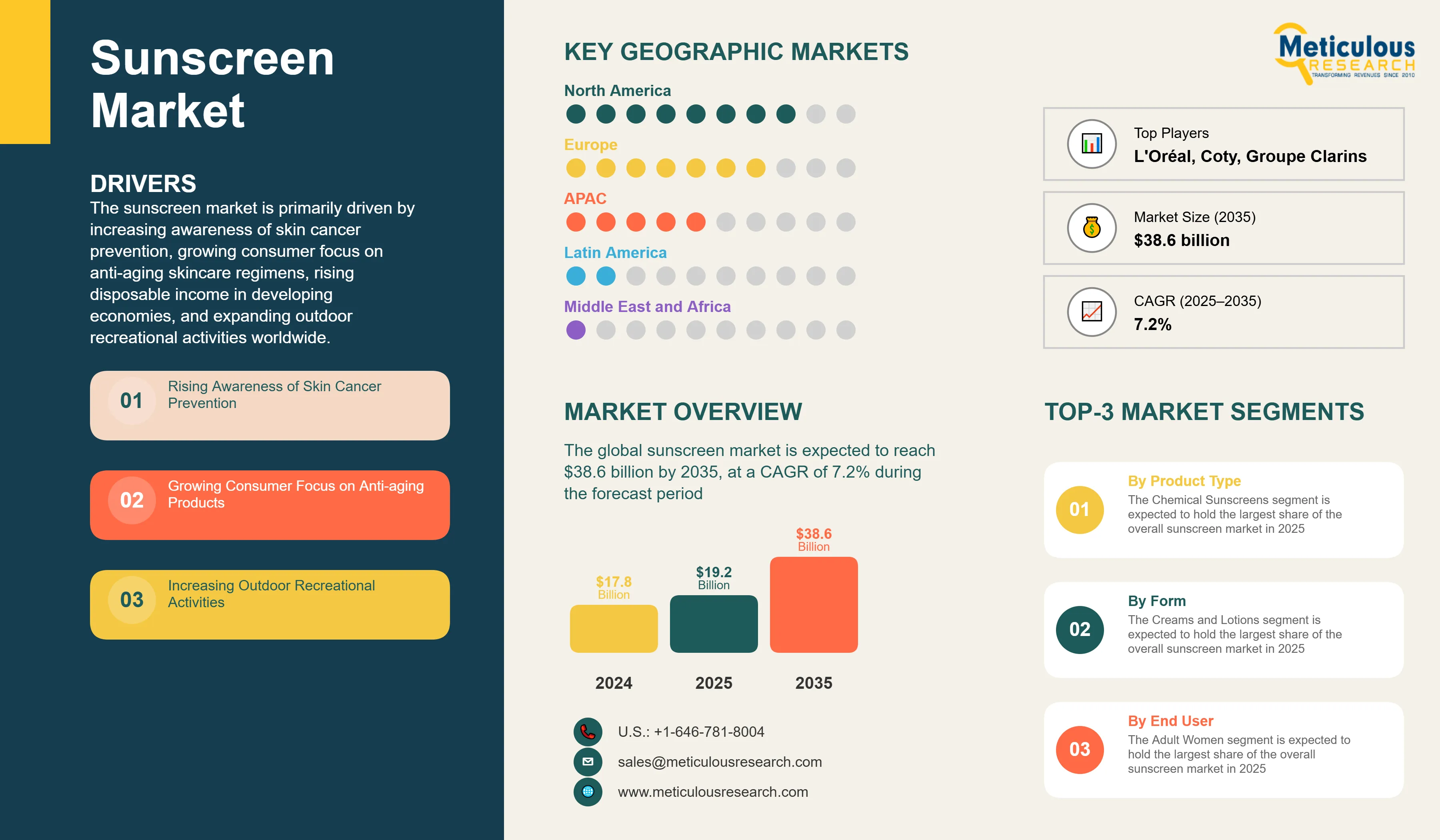
The global sunscreen market was valued at $17.8 billion in 2024. This market is expected to reach $38.6 billion by 2035, growing from an estimated $19.2 billion in 2025, at a CAGR of 7.2% during the forecast period of 2025–2035. Report Overview This report analyzes the global sunscreen market dynamics,
- Published
- May 2025
- Pages
- 212
- Format
- PDF + Excel
- Report ID
- MRCHM - 1041490
- Base year
- 2024
- 2024 · BASELINE
- $17.80B
- 2035
- $38.60B
- CAGR 2025–2035
- 7.2%
2024 baseline · 2025–2035 forecast at 7.2% CAGR · hover a bar for the value
Key highlights
The global sunscreen market was valued at $17.8 billion in 2024.
This market is expected to reach $38.6 billion by 2035, growing from an estimated $19.2 billion in 2025, at a CAGR of 7.2% during the forecast period of 2025–2035.
North America is projected to maintain the largest share of the global sunscreen market in 2025, supported by high consumer awareness of skin cancer prevention, widespread adoption of premium sun care products, a robust regulatory environment, and strong dermatological recommendations for daily sunscreen use.
Europe ranks as the second-largest market, mainly due to stringent safety regulations, high brand loyalty, and a strong focus on skin health.
Asia-Pacific, while currently the third-largest region by market value, is experiencing the fastest growth, fueled by a rising middle-class population, increasing beauty consciousness, and cultural preferences for brighter skin tones.
Report summary
| Particulars | Details |
|---|---|
| Number of Pages | 212 |
| Format | PDF & Excel |
| Forecast Period | 2025–2035 |
| Base Year | 2024 |
| CAGR (Value) | 7.2% |
| Market Size (Value) in 2025 | USD 19.2 Billion |
| Market Size (Value) in 2035 | USD 38.6 Billion |
| Segments Covered | By Product Type · Chemical Sunscreens · Physical/Mineral Sunscreens · Hybrid Sunscreens · By SPF Range · Low SPF (Up to SPF 29) · Medium SPF (SPF 30–49) · High SPF (SPF 50–69) · Very High SPF (SPF 70+) · By Form · Creams and Lotions · Sprays · Gels · Sticks · Powders · Other Forms (Oils, Wipes, etc.) · By Distribution Channel · Supermarkets and Hypermarkets · Specialty Retail Stores · Pharmacies and Drugstores · Department Stores · Online Retail · Others (Direct Selling, etc.) · By End User · Adult Sunscreen · Men · Women · Children Sunscreen · Baby Sunscreen · Professional/Occupational Use |
| Countries Covered | North America (U.S., Canada, Mexico), Europe (Germany, France, U.K., Italy, Spain, Nordics, Rest of Europe), Asia-Pacific (China, Japan, India, Australia, South Korea, Thailand, Indonesia, Rest of Asia-Pacific), Latin America (Brazil, Argentina, Colombia, Rest of Latin America), Middle East & Africa (UAE, Saudi Arabia, South Africa, Israel, Egypt, Rest of Middle East & Africa) |
| Key Companies | L'Oréal S.A. (La Roche-Posay, Garnier, L'Oréal Paris), Johnson & Johnson (Neutrogena, Aveeno), Beiersdorf AG (Nivea, Eucerin), The Estée Lauder Companies Inc., Shiseido Company, Limited, Edgewell Personal Care (Banana Boat, Hawaiian Tropic), Groupe Clarins, Coty Inc., Unilever PLC, Procter & Gamble Co., Bayer AG (Coppertone), Sun Pharmaceuticals Industries Ltd., Kao Corporation, Bioderma Laboratories, EltaMD, Inc. |
Report overview
Segments covered: product type, spf range, form, distribution channel, end user. Regions: North America, Europe, Asia-Pacific, Latin America, Middle East & Africa.
This report analyzes the global sunscreen market dynamics, evaluating how manufacturers are addressing evolving consumer preferences, skin health concerns, and sustainability requirements across diverse regions. The report provides a strategic analysis of market dynamics, growth projections until 2035, and competitive positioning across global and regional/country-level markets, with special emphasis on technological innovations, formulation advancements, and changing distribution models. The study offers deep insights into emerging market opportunities, regulatory landscapes, consumer demographics, and product segmentation across major geographic regions.
The sunscreen market is primarily driven by increasing awareness of skin cancer prevention, growing consumer focus on anti-aging skincare regimens, rising disposable income in developing economies, and expanding outdoor recreational activities worldwide. Significant shifts toward clean beauty and mineral-based formulations are reshaping industry standards, while multi-functional sun protection products that combine SPF with skincare benefits are gaining substantial traction. Additionally, integration of sunscreen into daily skincare routines, advancements in reef-safe and eco-friendly formulations, and innovations in texture and application methods are further accelerating market growth, especially in North America and Asia-Pacific regions where skin health consciousness is rapidly increasing.
Report infographic
Market dynamics
2 factors across 2 forcesThe sunscreen market presents numerous high-growth
opportunities across multiple segments. The rapidly expanding demand for natural and organic formulations is driving significant innovation in plant-based UV filters and eco-certified ingredients. Another major opportunity lies in the development of multi-functional sun protection products that combine UV protection with anti-aging, pollution defense, and blue light protection benefits. Additionally, targeted products for specific demographics (men's sunscreen, products for melanin-rich skin) and expansion in emerging markets with rising skin health awareness are creating new revenue streams. The growing e-commerce channel presents opportunities for direct-to-consumer brands with personalized offerings, while advancements in delivery systems (microencapsulation, nanoparticle technology) are enabling development of next-generation products with enhanced efficacy and sensory profiles.
Table of contents
13 chapters · 149 sections · 212 pages · click to expandGeographic analysis
North America
Largest shareNorth America is projected to maintain the largest share of the global sunscreen market in 2025, supported by high consumer awareness of skin cancer prevention, widespread adoption of premium sun care products, a robust regulatory environment, and strong dermatological recommendations for daily sunscreen use.
Europe
Europe ranks as the second-largest market, mainly due to stringent safety regulations, high brand loyalty, and a strong focus on skin health.
Asia-Pacific
Fastest growthAsia-Pacific, while currently the third-largest region by market value, is experiencing the fastest growth, fueled by a rising middle-class population, increasing beauty consciousness, and cultural preferences for brighter skin tones. Both Asia-Pacific and Latin America are expected to see rapid expansion during the forecast period, driven by growing disposable incomes, heightened awareness of skin health, increased tourism in tropical regions, and the introduction of innovative formulations by international brands tailored to local preferences and skin types.
Competitive landscape
The global sunscreen market features a diverse competitive landscape with established multinational beauty conglomerates, specialized dermatological brands, clean beauty innovators, and emerging direct-to-consumer disruptors pursuing varied approaches to product development, formulation innovation, and market penetration strategies.
The broader solution provider landscape is categorized into industry leaders, market differentiators, vanguards, and contemporary stalwarts, with each group employing distinctive strategies to maintain competitive advantage. Leading providers are focusing on integrated sun protection solutions that combine advanced UV filters with anti-aging technology, while addressing region-specific skin concerns and sustainability requirements through tailored formulations and packaging innovations.
The key players operating in the global sunscreen market are L'Oréal S.A. (La Roche-Posay, Garnier, L'Oréal Paris), Johnson & Johnson (Neutrogena, Aveeno), Beiersdorf AG (Nivea, Eucerin), The Estée Lauder Companies Inc., Shiseido Company, Limited, Edgewell Personal Care (Banana Boat, Hawaiian Tropic), Groupe Clarins, Coty Inc., Unilever PLC, Procter & Gamble Co., Bayer AG (Coppertone), Sun Pharmaceuticals Industries Ltd., Kao Corporation, Bioderma Laboratories, and EltaMD, Inc. among others.
- L'Oréal S.A. (La Roche-Posay, Garnier, L'Oréal Paris)
- Johnson & Johnson (Neutrogena, Aveeno)
- Beiersdorf AG (Nivea, Eucerin)
- Estée Lauder Companies Inc.
- Shiseido Company, Limited
- Edgewell Personal Care (Banana Boat, Hawaiian Tropic)
- Groupe Clarins
- Coty Inc.
- Unilever PLC
- Procter & Gamble Co.
- Bayer AG · Coppertone
- Sun Pharmaceuticals Industries Ltd.
- Kao Corporation
- Bioderma Laboratories
- EltaMD, Inc
Frequently asked questions
The global sunscreen market was valued at $17.8 billion in 2024. This market is expected to reach approximately $38.6 billion by 2035, growing from an estimated $19.2 billion in 2025, at a CAGR of 7.2% during the forecast period of 2025–2035.
Cite this report
Meticulous Research. (2025). Sunscreen Market - Global Opportunity Analysis and Industry Forecast (2025–2035) (Report No. MRCHM - 1041490). Meticulous Market Research Pvt. Ltd. https://www.meticulousresearch.com/product/sunscreen-market-6173