
Slide Stainers Market (2025-2032)
The Slide Stainers Market is projected to reach $5.53 billion by 2032, at a CAGR of 7.9% from 2025 to 2032.
- Published
- Feb 2025
- Pages
- 235
- Format
- PDF + Excel
- Report ID
- MRHC - 104960
- Base year
- 2024
- 2032 · FORECAST
- $5.53B
- 2032
- $5.53B
- CAGR 2025–2032
- 7.9%
2024 baseline · 2025–2032 forecast at 7.9% CAGR · hover a bar for the value
Key highlights
The Slide Stainers Market is projected to reach $5.53 billion by 2032, at a CAGR of 7.9% from 2025 to 2032.
The reagents & kits segment is expected to account for the largest share of the slide stainers market.
The hematoxylin and eosin (H&E) segment is expected to account for the largest share of the slide stainers market.
The hospitals & diagnostic centers segment is expected to account for the largest share of the slide stainers market.
The high prevalence of chronic diseases, the presence of key slide stainer companies in countries such as China, India, Singapore, and South Korea, technological advancements in slide-staining systems, and increasing government R&D spending are driving the growth of the slide stainers market in Asia-Pacific.
Report summary
| Particulars | Details |
|---|---|
| Base Year | 2024 |
| Estimated Year | 2025 |
| Forecast Period | 2025–2032 |
| Market Size (2032) | USD 5.53 billion |
| CAGR (2025–2032) | 7.9% |
| Format | PDF, Excel & Cloud Portal · 235 pages |
| Segments Covered | By Product: Reagents and Kits Grossing/Tissue Marking Dyes, Tissue Fixation Reagents, Tissue Processing Reagents, Mounting/Embedding Reagents, Stains Hematoxylin and Eosin (H&E Stains), Cytology Stains, Special Stains, Stain Controls, Automated slide Stainers, Manual Slide Stainers · By Technique: Hematoxylin and Eosin (H&E), In-situ Hybridization (ISH), Microbiology, Immunohistochemistry (IHC), Hematology, Cytology · By Application: Disease Diagnosis Infectious Diseases, Cancer, Other Diseases · By End User: Hospitals & Diagnostic Centers, Pharmaceutical & Biotechnology Companies, Academic & Research Institutes, Contract Research Organizations (CROs) |
| Countries Covered | North America (Canada, Mexico), Europe (Germany, France, Italy, U.K., Spain, Rest of Europe), Asia-Pacific (China, Japan, India, Rest of Asia-Pacific), Latin America (Brazil) |
| Key Companies | Thermo Fisher Scientific (U.S.), F. Hoffmann-La Roche AG, Danaher Corporation (U.S.), Merck KGaA, Agilent Technologies, Inc. (U.S.), Becton, Dickinson and Company (U.S.), Abcam plc. (U.K.), Siemens Healthineers, General Data Company, Inc. (U.S.), Biocare Medical, LLC. (U.S.), BioGenex (U.S.), PHC Holdings Corporation, Hardy Diagnostics (U.S.) |
Report overview
Segments covered: product, technique, application, end user. Regions: North America, Europe, Asia-Pacific, Latin America.
Slide stainers are systems that automate the staining process of prepared histology or cytology tissue specimens by diffusing dyes into the tissue samples using indirect staining, surface adsorption, direct staining, and mordant staining. These systems allow the identification of cells or tissues and microscopic study and are consequently widely used for identifying diseases in hematology, cytopathology, and histopathology.
During microscopic processes, the staining approach indicates biological tissues such as muscle fibers, connective tissue, cell populations, and organelles. Staining facilitates detecting the quantity of a specific compound in biological samples and is used frequently in processes including gel electrophoresis and flow cytometry. This equipment automates hematologic smear staining, modifies sample color, thickness, and intensity, and performs numerous staining operations simultaneously.
The growth of this market is driven by the rising geriatric population, coupled with the growing burden of chronic diseases, technological advancements in slide stainers, increasing need for personalized treatments, rising healthcare expenditure, increasing demand for automation in diagnostics and clinical research, and increasing cancer drug research. Additionally, emerging economies and rising demand for automated slide staining and diagnostic systems are expected to offer significant market growth opportunities.
However, the high cost of the slide stainer systems restrains the growth of this market. Additionally, concerns about automated slide stainers and lack of skilled professionals pose a significant challenge to the market growth.
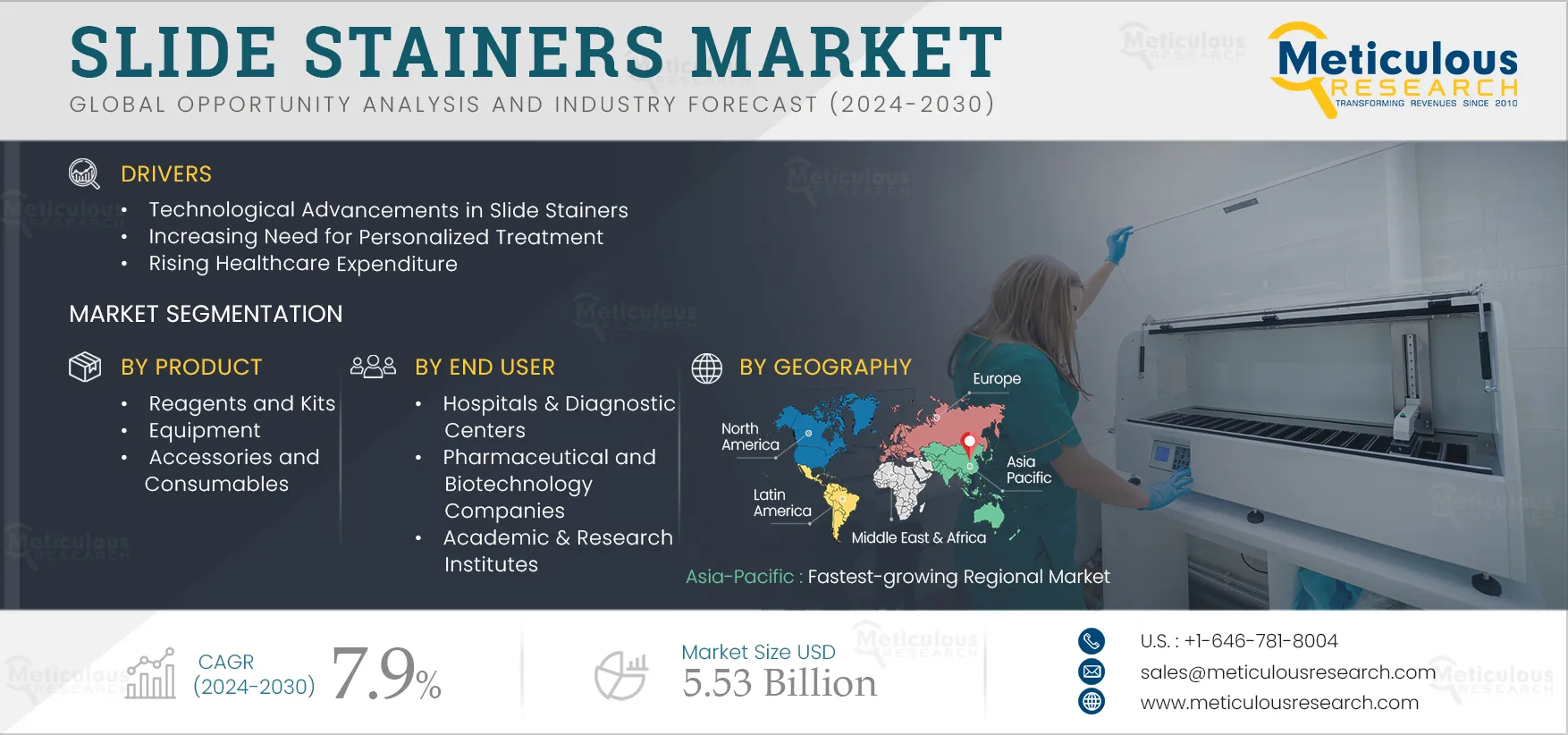
Report infographic
Market dynamics
2 factors across 2 forcesRising Geriatric Population, Coupled with the Growing Burden of Chronic Diseases, Boosts the Slide Stainers Market’s Growth
Slide stainers are essential tools in the field of pathology and histology, and they play a crucial role in the diagnosis, research, and management of chronic diseases. Chronic diseases are long-term health conditions that often require ongoing monitoring and evaluation. There has been a rise in the aged population due to rising life expectancy, improved healthcare quality, urbanization, and growing income levels, leading to greater survival rates.
According to the United Nations, there were 727 million people aged 65 years or over globally in 2020. The global share of the aged population (65 years or over) is expected to increase from 9.3% (727 million) in 2020 to 16.0% (1,548.9 million) by 2050, i.e., one in four persons living in Europe and North America could be aged 65 years or over. This remarkable growth in the geriatric population is also driven by declining fertility rates and improvements in longevity. According to the World Health Organization (WHO), in 2020, people aged 65 or above outnumbered children under five globally for the first time.
Additionally, with the rapid growth in the global geriatric population, cases of age-related chronic diseases are expected to increase globally. This demographic shift is leading to the increased prevalence of various chronic diseases. According to the WHO, in 2021, 41 million people died due to chronic diseases, equivalent to 74% of deaths worldwide. Cardiovascular diseases account for the majority of chronic disease deaths (17.9 million individuals per year), followed by chronic respiratory diseases (4.1 million), cancers (9.3 million), and other diseases. Furthermore, According to the GLOBOCAN, in 2020, 19.3 million cancer was detected worldwide. It is expected to increase to 24.6 million by 2032.
These chronic diseases necessitate rapid and accurate diagnosis, which slide staining techniques provide. Slide staining is an important step in preparing tissue samples for microscopic analysis, allowing healthcare professionals to determine the incidence and severity of disease. Staining improves cellular structure visibility and contrast, making recognizing specific characteristics of interest possible. Automated slide stainers are becoming increasingly common in modern laboratories due to their capacity to process large numbers of samples quickly and consistently while decreasing the chance of human error.
Slide stainers are integral to the study and diagnosis of chronic diseases in various ways. They help ensure the accuracy, consistency, and efficiency of histopathological examinations, immunohistochemistry studies, and other tissue-based analyses critical to understanding and managing chronic diseases. These automated tools contribute to advancing research, personalized medicine, and improved patient care in the context of chronic diseases.Top of Form
Thus, the rising geriatric population and the growing burden of chronic diseases increase the demand for accurate and timely diagnostic testing.
Table of contents
12 chapters · 113 sections · 235 pages · click to expandSegmental analysis
| Segment | Largest share (2025) | Fastest growth (2025–2032) |
|---|---|---|
| By Product | Reagents & kits | — |
| By Technique | Hematoxylin and eosin (H&E) | — |
| By End User | Hospitals & diagnostic centers | — |
By Product
- The reagents & kits segment is expected to account for the largest share of the slide stainers market.
- The rising trend toward personalized medicine necessitates the use of highly specialized reagents such as special stains, cytology stains, mounting reagents, and many others for diagnostic tests.
- It has resulted in the developing of novel and creative slide-staining reagents, such as multiplex staining reagents, which enable the simultaneous detection of numerous biomarkers on a single slide.
- Additionally, with the increasing prevalence of cancer and infectious diseases worldwide, there is a growing demand for reagents and kits for precise and effective diagnostic tests, contributing to the large share of this segment.
By Technique
- The hematoxylin and eosin (H&E) segment is expected to account for the largest share of the slide stainers market.
- Hematoxylin and eosin is frequently utilized in staining procedure in pathology and histology.
- It is a common staining technique used to visualize the structure of organs and tissues.
- The advancements in hematoxylin and eosin technology have resulted in the developing of more efficient and automated staining systems.
- This has made H&E staining more accessible to researchers and healthcare professionals, contributing to its broad use and adoption of this technology.
- Furthermore, the high demand for H&E staining drives the demand for slide stainer reagents and kits, equipment, and consumables.
By End User
- The hospitals & diagnostic centers segment is expected to account for the largest share of the slide stainers market.
- Slide stainers are significant in hospitals & diagnostic centers, particularly in pathology, histology, and laboratory medicine.
- Their use is essential for accurately diagnosing and treating a wide range of medical conditions.
- Slide stainers are essential tools in hospitals & diagnostic centers, enabling accurate and efficient pathological assessments, aiding in disease diagnosis and staging, and contributing to research and education in the medical field.
- Their automation and standardization capabilities enhance the quality of patient care and scientific discoveries.
Geographic analysis
Asia-Pacific
Fastest growthThe high prevalence of chronic diseases, the presence of key slide stainer companies in countries such as China, India, Singapore, and South Korea, technological advancements in slide-staining systems, and increasing government R&D spending are driving the growth of the slide stainers market in Asia-Pacific. Furthermore, the increasing need for automated laboratory procedures for better diagnosis also boosts the growth of this regional market. Asia-Pacific: Fastest-growing Regional Market
Competitive landscape
- Thermo Fisher Scientific (U.S.)
- F. Hoffmann-La Roche AG · Switzerland
- Danaher Corporation (U.S.)
- Merck KGaA · Germany
- Agilent Technologies, Inc. (U.S.)
- Becton
- Dickinson and Company (U.S.)
- Abcam plc. (U.K.)
- Siemens Healthineers · Germany
- General Data Company, Inc. (U.S.)
- Biocare Medical, LLC. (U.S.)
- BioGenex (U.S.)
- PHC Holdings Corporation · Japan
- Hardy Diagnostics (U.S.)
Frequently asked questions
This study offers a detailed assessment of the slide stainers market and analyzes the market sizes & forecasts based on product, technique, application, and end user. This report also involves the value analysis of various segments and subsegments of the slide stainers market at the regional and country levels.
Cite this report
Meticulous Research. (2025). Slide Stainers Market - Global Opportunity Analysis And Industry Forecast (2025-2032) (Report No. MRHC - 104960). Meticulous Market Research Pvt. Ltd. https://www.meticulousresearch.com/product/slide-stainers-market-5643