TCR-T Cell Therapy Market (2026-2036)
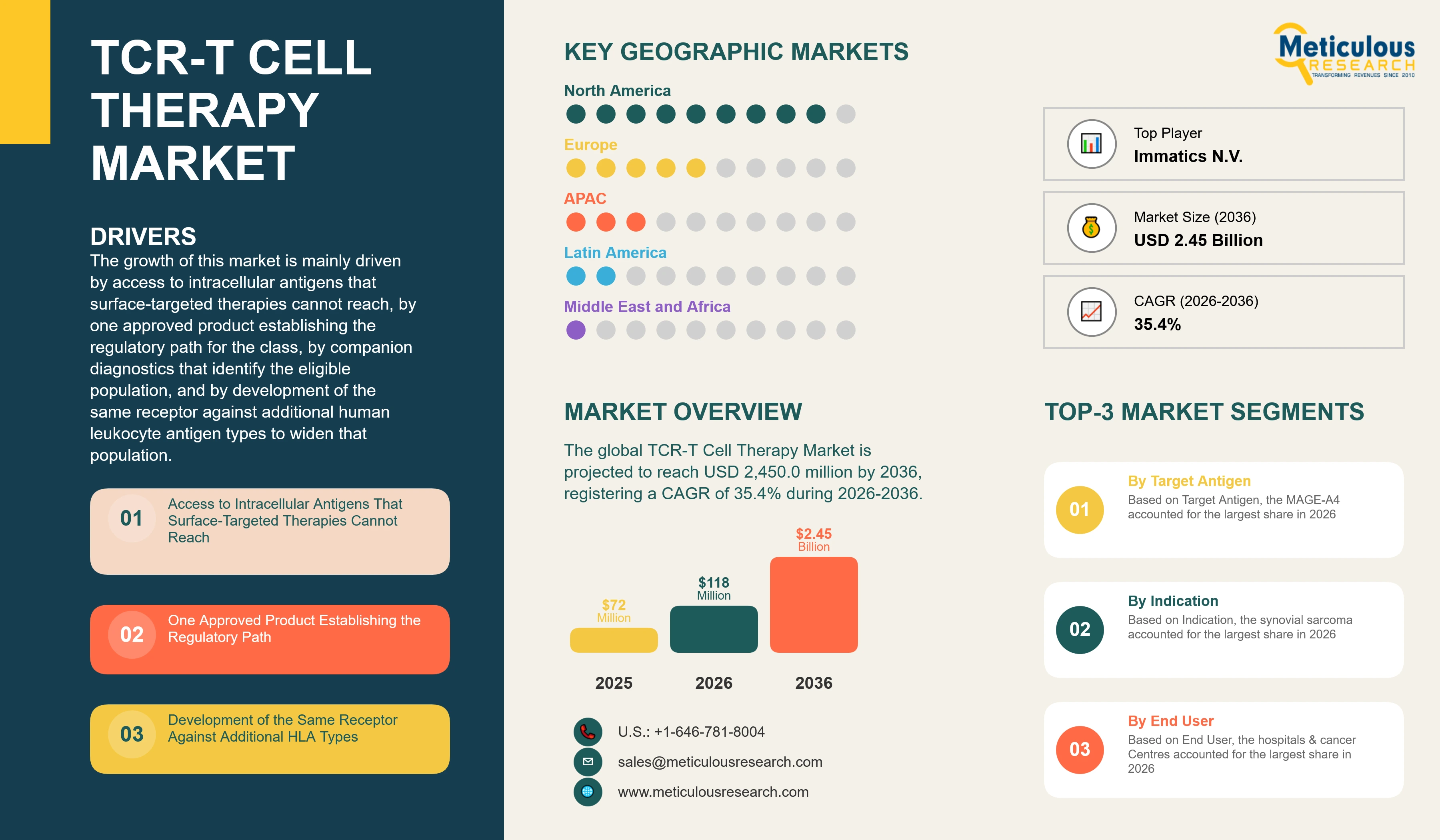
The global TCR-T Cell Therapy Market was valued at USD 72.0 million in 2025. This market is expected to reach USD 2,450.0 million by 2036 from an estimated USD 118.0 million in 2026, registering a CAGR of 35.4% during the forecast period (2026-2036).
- Published
- Nov 2026
- Pages
- 346
- Format
- PDF + Excel
- Report ID
- MRHC - 1042422
- Base year
- 2025
- 2025 · BASELINE
- $72.0M
- 2036
- $2.45B
- CAGR 2026–2036
- 35.4%
2025 baseline · 2026–2036 forecast at 35.4% CAGR · hover a bar for the value
Key highlights
The global TCR-T Cell Therapy Market is valued at USD 118.0 million in 2026 and is projected to reach USD 2,450.0 million by 2036, at a CAGR of 35.4%.
Based on target antigen, the MAGE-A4 segment is expected to account for the largest share of the market in 2026, while the NY-ESO-1 segment is projected to register the highest CAGR during the forecast period.
Based on HLA restriction, the HLA-A*02 restricted segment is expected to account for the largest share of the market in 2026, while the other HLA types segment is projected to register the highest CAGR during the forecast period.
Based on cell source, the autologous segment is expected to account for the largest share of the market in 2026, while the allogeneic segment is projected to register the highest CAGR during the forecast period.
Based on indication, the synovial sarcoma segment is expected to account for the largest share of the market in 2026, while the lung cancer segment is projected to register the highest CAGR during the forecast period.
Based on end user, the hospitals and cancer centres segment is expected to account for the largest share of the market in 2026, while the specialty clinics segment is projected to register the highest CAGR during the forecast period.
Based on geography, North America is expected to account for the largest share of the market in 2026, while Asia-Pacific is projected to register the highest CAGR during the forecast period.
Report summary
| Particulars | Details |
|---|---|
| Base Year | 2025 |
| Estimated Year | 2026 |
| Forecast Period | 2026-2036 |
| Market Size in 2025 | USD 72.0 million |
| Market Size in 2026 | USD 118.0 million |
| Market Size by 2036 | USD 2,450.0 million |
| CAGR (2026-2036) | 35.4% |
| Format | PDF, Excel & Cloud Portal · 346 pages |
| Largest Segment by Target Antigen (2026) | MAGE-A4 |
| Fastest-growing Segment by Target Antigen | NY-ESO-1 |
| Largest Segment by HLA Restriction (2026) | HLA-A*02 Restricted |
| Fastest-growing Segment by HLA Restriction | Other HLA Types |
| Largest Segment by Cell Source (2026) | Autologous |
| Fastest-growing Segment by Cell Source | Allogeneic |
| Largest Segment by Indication (2026) | Synovial Sarcoma |
| Fastest-growing Segment by Indication | Lung Cancer |
| Largest Region (2026) | North America |
| Fastest-growing Region | Asia-Pacific |
| Segments Covered | Target Antigen, HLA Restriction, Cell Source, Indication, End User, Geography |
| Company Naming Basis | Registered legal entity, with group capability attributed to its owner |
| Number of Companies Profiled | 12, plus other companies |
Report overview
Segments covered: target antigen, hla restriction, cell source, indication, end user.
The TCR-T cell therapy market covers T cell therapies engineered to express a T cell receptor directed at a tumour antigen, including autologous and allogeneic products across MAGE-A4, NY-ESO-1, PRAME, KK-LC-1 and other antigen targets, restricted to defined human leukocyte antigen types and supplied for solid tumour and haematological indications. The growth of this market is driven by access to intracellular antigens that surface-targeted therapies cannot reach, by one approved product establishing the regulatory path, by companion diagnostics identifying eligible patients, and by development of the same receptor against additional human leukocyte antigen types.
A T cell receptor recognises a short peptide presented on a human leukocyte antigen molecule rather than a protein on the cell surface, which is what allows these therapies to reach antigens held inside the cell and is the reason they can address solid tumours at all. The same mechanism restricts who can be treated, because a patient must carry the specific human leukocyte antigen type the receptor was designed against. Tecelra, afamitresgene autoleucel, received accelerated approval from the FDA on 2 August 2024 and is described by the agency as a melanoma-associated antigen A4 directed genetically modified autologous T cell immunotherapy, indicated for adults with unresectable or metastatic synovial sarcoma who have received prior chemotherapy. Eligibility requires that the patient is HLA-A*02:01P, HLA-A*02:02P, HLA-A*02:03P or HLA-A*02:06P positive and that the tumour expresses MAGE-A4, both determined by FDA-approved or cleared companion diagnostic devices, following prior systemic therapy with doxorubicin or ifosfamide or both.
Eligibility for a given product is therefore the product of two independent frequencies, the proportion of patients carrying the required human leukocyte antigen type and the proportion whose tumour expresses the antigen, and both have to be confirmed by a test before treatment can proceed. A chimeric antigen receptor product targets a surface protein directly and is not restricted by human leukocyte antigen type, so any patient expressing the antigen qualifies. The unit of commercial planning in this market is consequently a pairing of antigen and human leukocyte antigen type rather than an indication.
A T cell receptor engineered therapy works by giving the patient T cells a receptor that recognises a fragment of a tumour protein displayed on a human leukocyte antigen molecule on the surface of the cancer cell. Because the protein fragment is presented rather than exposed, the target does not have to sit on the cell surface, which opens the intracellular antigens that distinguish a tumour from normal tissue and that a surface-targeted approach cannot reach. This is the property that has allowed engineered T cells to produce responses in solid tumours. Surface antigen targets in solid tumours are scarce and largely shared with healthy tissue, which is why the surface-targeted approach has not translated from blood cancers into them.
The restriction that comes with it determines the commercial shape of this market. Tecelra, afamitresgene autoleucel, received accelerated approval from the FDA on 2 August 2024 and is described by the agency as a melanoma-associated antigen A4 directed genetically modified autologous T cell immunotherapy, indicated for adults with unresectable or metastatic synovial sarcoma who have received prior chemotherapy. Eligibility requires that the patient is HLA-A*02:01P, HLA-A*02:02P, HLA-A*02:03P or HLA-A*02:06P positive and that the tumour expresses MAGE-A4, both determined by FDA-approved or cleared companion diagnostic devices, following prior systemic therapy with doxorubicin or ifosfamide or both. A patient has to be tested for two separate things before treatment can be considered, and failing either test excludes them, so the addressable population for any one product is a fraction of the indication rather than the whole of it. The approved indication therefore describes a narrower group than the disease name suggests. Screening volumes at a treating centre run well ahead of treated patients as a result. A unit reporting its experience in this class counts patients screened alongside patients infused, because the two differ substantially. Screening effort is therefore part of the cost of treating in this class rather than an overhead before it. Centres that screen systematically identify more candidates than those that test on suspicion.
Human leukocyte antigen type varies between populations according to ancestry, which makes the addressable fraction different from one region to another for the same product. HLA-A*02 is the most frequently carried type in populations of European ancestry and is less common in several African and Asian populations, so a product restricted to it reaches a smaller proportion of patients in some countries than in others. Developers addressing those populations have worked on receptors restricted to types more common there, which is a different programme rather than a label extension. The commercial consequence is that the same product has a different market size in every country according to the ancestry of its population.
Developing the same receptor against an additional human leukocyte antigen type expands the eligible population without changing the target or the clinical rationale, and it is the most direct route to a larger market available to a company in this field. The work is substantial, since the receptor has to be isolated, validated and taken through its own clinical programme, but the biology of the target is already established and the companion diagnostic for antigen expression already exists. A company with one validated target and one restriction holds a smaller business than the same target across three restrictions, and the difference is a clinical programme rather than a discovery effort.
Companion diagnostics are written into the approved indication rather than recommended alongside it, so testing capability is a precondition for treatment and not an accessory to it. A centre without access to both human leukocyte antigen typing and a validated antigen expression assay cannot identify a candidate, which concentrates treatment at institutions holding those capabilities and makes diagnostic availability part of the market access question in every country. Reimbursement for the tests is separate from reimbursement for the therapy, and a gap in either closes the pathway. Several countries reimburse the therapy without funding the typing required to identify a candidate for it. That mismatch has delayed access in markets where the therapy itself was authorised without obstacle.
Approval rested on cohort 1 of the single-arm, open-label SPEARHEAD-1 study, in which 52 patients were enrolled and 44 received a single infusion, with an overall response rate of 43.2% and a 95% confidence interval of 28.4 to 59.0, a median time to response of 4.9 weeks, a median duration of response of 6 months, and 45.6% of responders maintaining a response for at least 6 months and 39.0% for at least 12 months. The label carries a boxed warning for serious or fatal cytokine release syndrome. The gap between 52 patients enrolled and 44 infused is the autologous manufacturing interval expressed as patients, since a proportion of those enrolled do not reach infusion, and the accelerated approval means confirmatory evidence on durability is still owed.
Duration of response is where this class is assessed most closely. A median duration of 6 months with 39.0% of responders maintaining a response for at least 12 months describes a benefit that is real and not yet established as durable, which is the position accelerated approval is designed for. Payers and clinicians read those two figures together, and a developer bringing a second product into the class is assessed against them.
Toxicity is managed rather than avoided, and the boxed warning for serious or fatal cytokine release syndrome places these products in the same supervision category as approved chimeric antigen receptor therapies. Treatment requires a centre able to recognise and manage the syndrome, which restricts administration to institutions with that experience and is a further constraint on the number of treating sites.
Antigen choice carries a risk that is specific to this mechanism, because a receptor recognising a peptide can cross-react with a similar peptide presented by healthy tissue, and the consequences of that have been severe in earlier programmes. Target selection therefore involves screening against the human peptide repertoire rather than confirming tumour selectivity alone, which lengthens preclinical work and is one reason the number of validated antigen and human leukocyte antigen pairings remains small.
Report infographic
Market dynamics
21 factors across 5 forcesAccess to Intracellular Antigens That Surface-Targeted Therapies Cannot Reach
A T cell receptor recognises a peptide presented on a human leukocyte antigen molecule rather than a protein exposed on the cell surface, so the target does not need to be on the outside of the cell. This opens the intracellular antigens that distinguish tumour tissue from normal tissue and that a surface-targeted approach cannot address, which is the reason engineered T cells have produced responses in solid tumours where surface antigen targets are scarce and shared with healthy tissue. The driver defines what this class can do that the alternative cannot. It is also why development has concentrated in solid tumours rather than in the blood cancers where surface-targeted products are established. The antigens involved are expressed across several tumour types, so one validated target supports more than one indication.
One Approved Product Establishing the Regulatory Path
Tecelra, afamitresgene autoleucel, received accelerated approval from the FDA on 2 August 2024 and is described by the agency as a melanoma-associated antigen A4 directed genetically modified autologous T cell immunotherapy, indicated for adults with unresectable or metastatic synovial sarcoma who have received prior chemotherapy. Approval rested on cohort 1 of the single-arm, open-label SPEARHEAD-1 study, in which 52 patients were enrolled and 44 received a single infusion, with an overall response rate of 43.2% and a 95% confidence interval of 28.4 to 59.0, a median time to response of 4.9 weeks, a median duration of response of 6 months, and 45.6% of responders maintaining a response for at least 6 months and 39.0% for at least 12 months. The label carries a boxed warning for serious or fatal cytokine release syndrome. An approval granted on a single-arm study of 44 infused patients establishes what evidence this class requires and how the agency treats a product whose eligibility depends on two separate tests. Developers following now design against a precedent rather than an open question, and the companion diagnostic requirement written into the indication sets the expectation for the products behind it. Accelerated approval on this evidence also signals that the agency will accept a response rate endpoint in a rare indication, which shapes how the next programmes are designed.
Companion Diagnostics Identifying Eligible Patients
Eligibility requires confirmation of both human leukocyte antigen type and antigen expression, and the approved indication names FDA-approved or cleared companion diagnostic devices as the means of determining each. Testing therefore identifies the treatable population rather than merely supporting a treatment decision, and as typing and expression assays are adopted more widely the number of patients who can be identified rises without any change to the therapy. This driver converts diagnostic infrastructure into addressable market directly. Typing performed routinely at diagnosis rather than at the point of treatment decision raises the identified population further.
Development of the Same Receptor Against Additional HLA Types
A receptor restricted to one human leukocyte antigen type reaches only the patients carrying it, and developing the same antigen target against an additional type expands the eligible population without changing the biology of the target or the clinical rationale. The companion diagnostic for antigen expression already exists and the target is already validated, so the work is confined to isolating and taking a new receptor through clinical development. This is the most direct route to a larger market available in this field and applies to every approved and investigational product in it. A developer treating restriction as a product axis rather than a constraint builds several products from one validated target. Each additional restriction also brings its own clinical programme and its own regulatory submission. The cost of that work is lower than discovering a new target and higher than extending a label. Programmes are prioritised on that basis rather than on the size of the restriction alone.
Table of contents
13 chapters · 143 sections · 346 pages · click to expandGeographic analysis
North America
Largest shareIn 2026, North America is expected to account for the largest share of the market. The large share of this region is mainly due to the only approved product in this class being licensed by the FDA, to the concentration of centres holding both the diagnostic capability and the toxicity management experience required, and to HLA-A*02 being frequently carried in much of the population, which makes the eligible fraction larger than in several other regions.
Asia-Pacific
Fastest growthHowever, Asia-Pacific is projected to register the highest CAGR during the forecast period. The rapid growth of this region is attributed to developers in Japan and China pursuing receptors restricted to human leukocyte antigen types more frequently carried in their populations, which addresses patients that HLA-A*02 restricted products cannot reach, and to the number of clinical programmes underway in China. Japan and China account for most of the regional position, with the growth reflecting locally matched programmes rather than the arrival of products approved elsewhere. South Korea and Australia contribute clinical activity, and India remains limited by the availability of human leukocyte antigen typing outside major centres. Regional revenue therefore lags regional development activity through most of the forecast period. The locally restricted programmes are what close that gap in the later years. Clinical activity in China is the largest single contributor to the regional growth rate, reflecting the number of programmes registered there against locally prevalent restrictions.
Europe
Europe holds a position in which HLA-A*02 frequency is comparable to North America and the diagnostic and treatment infrastructure is established, while national reimbursement decisions taken separately from marketing authorisation determine when patients gain access. Demand is concentrated in Germany, the United Kingdom, France, Italy and Spain, where sarcoma referral centres and cell therapy capability coincide, and the region also carries substantial development activity in this class.
Latin America
Latin America and the Middle East & Africa remain small positions in which access depends on treatment abroad or on individual funding decisions, and in which human leukocyte antigen typing is less widely available. The eligible fraction in parts of Africa is also smaller for products restricted to HLA-A*02, which compounds the access constraint, and addressing those populations requires receptors restricted to types more frequently carried there.
Competitive landscape
This field is populated by specialist developers rather than large pharmaceutical companies, and the company holding the only approved product is a mid-sized biotechnology business rather than a major. A second group develops receptor libraries against chosen antigens and positions the screening and validation capability as the asset rather than any single product. Regional developers in Japan and China pursue receptors restricted to human leukocyte antigen types frequently carried in their own populations. Large pharmaceutical companies have taken positions through partnership and licensing rather than building programmes of their own.
Validated antigen and human leukocyte antigen pairings are what separate companies in this field, because a receptor that cross-reacts with a peptide presented by healthy tissue cannot proceed and screening against the human peptide repertoire is the work that establishes it cannot. Breadth of human leukocyte antigen coverage against a single antigen separates the next tier, since it determines how much of an indication a company can address. Diagnostic partnership is a third dimension, as a product cannot be used without approved or cleared tests for both eligibility criteria.
Competition between products is limited at present because the approved indications and the human leukocyte antigen restrictions barely overlap, so two products directed at different antigens in different restrictions are not competing for the same patient. That changes where several products address the same antigen in the same restriction, which is beginning to occur in the sarcoma indications. Until then companies in this field compete for capital and for clinical trial sites rather than for prescriptions.
Key players operating in the global TCR-T Cell Therapy Market are Adaptimmune Therapeutics plc (U.K.), Immatics N.V. (Netherlands), TScan Therapeutics, Inc. (U.S.), BioNTech SE (Germany), Takara Bio Inc. (Japan), Astellas Pharma Inc. (Japan), Medigene AG (Germany), Lion TCR Pte. Ltd. (Singapore), Xiangxue Pharmaceutical Co., Ltd. (China), Eureka Therapeutics, Inc. (U.S.), Affini-T Therapeutics, Inc. (U.S.), and T-knife Therapeutics, Inc. (U.S.).
Companies are identified at registered legal entity level, and capability held within a group is attributed to the entity that owns it. Adaptimmune, LLC is not listed separately, because it is held within Adaptimmune Therapeutics plc. The companies profiled were verified as active in the development, manufacture or supply of engineered T cell receptor T cell therapies as of October 2026, and the list is deliberately confined to companies whose primary programmes are in this class. Soluble T cell receptor bispecific products that engage T cells without being cell therapies, tumour infiltrating lymphocyte therapies that are not receptor engineered, chimeric antigen receptor developers without a T cell receptor programme, companion diagnostic suppliers, and contract manufacturers supplying capacity rather than proprietary products were excluded.
- Adaptimmune Therapeutics plc (U.K.)
- Immatics N.V. · Netherlands
- TScan Therapeutics, Inc. (U.S.)
- BioNTech SE · Germany
- Takara Bio Inc. · Japan
- Astellas Pharma Inc. · Japan
- Medigene AG · Germany
- Lion TCR Pte. Ltd. · Singapore
- Xiangxue Pharmaceutical Co., Ltd. · China
- Eureka Therapeutics, Inc. (U.S.)
- Affini-T Therapeutics, Inc. (U.S.)
- T-knife Therapeutics, Inc. (U.S.)
Expert perspectives
This class is usually assessed alongside chimeric antigen receptor therapy and the two differ in a way that determines the size of the opportunity. A T cell receptor recognises a peptide presented on a human leukocyte antigen molecule, which opens the intracellular antigens that allow these therapies to address solid tumours, and restricts treatment to patients carrying the type the receptor was designed against. Tecelra, afamitresgene autoleucel, received accelerated approval from the FDA on 2 August 2024 and is described by the agency as a melanoma-associated antigen A4 directed genetically modified autologous T cell immunotherapy, indicated for adults with unresectable or metastatic synovial sarcoma who have received prior chemotherapy. Eligibility requires that the patient is HLA-A*02:01P, HLA-A*02:02P, HLA-A*02:03P or HLA-A*02:06P positive and that the tumour expresses MAGE-A4, both determined by FDA-approved or cleared companion diagnostic devices, following prior systemic therapy with doxorubicin or ifosfamide or both. Eligibility is therefore the product of two independent frequencies, both confirmed by a test before treatment, where a chimeric antigen receptor product reaches every patient expressing its surface antigen. The binding constraint is therefore shifting from whether the therapy works to how much of an indication any one product can legally reach.
Development is expected to continue moving from single receptor products towards antigen platforms able to supply several human leukocyte antigen restrictions, because that is the only route to a materially larger eligible population from a validated target. Diagnostic testing is expected to move earlier in the treatment pathway, so that eligibility is established before a therapy is considered, which increases identified patients without changing the product. Approvals are expected to continue arriving first in sarcoma indications small enough to support single-arm evidence, with the larger tumours following as comparative data accumulate. The sequence of approvals therefore reflects what the evidence requirement permits rather than where the commercial value sits. A developer planning entry should expect to begin in a rare indication whatever its eventual target market. That constraint shapes capital requirements more than the size of the eventual opportunity does.
For companies planning entry or expansion, receptors restricted to human leukocyte antigen types common outside European ancestry populations address patients that existing products cannot reach and face less competition, since most development has concentrated on HLA-A*02. Validating a new antigen opens an indication set rather than a product, and the peptide repertoire screening that limits entry protects the position afterwards. Buyers and partners should assess the eligible fraction a product can reach in the specific population they serve rather than the size of the indication, because the two differ by a factor that varies with ancestry.
Accelerated approval leaves durability unsettled, and a median duration of response of 6 months with 39.0% of responders maintaining a response for at least 12 months is a benefit that is real and not yet established, so every subsequent submission in the class is measured against figures that may themselves be revised by confirmatory evidence. Treatment capability is a second limit, since a centre must hold typing, a validated expression assay and the ability to manage the cytokine release syndrome the label carries a boxed warning for, and expanding the treated population means building that capability at new sites rather than only finding more patients.
Overall, the core of demand through the forecast period will continue to sit in autologous MAGE-A4 directed therapy restricted to HLA-A*02 and used in synovial sarcoma at hospitals and cancer centres across North America, while the fastest growth will come from NY-ESO-1 directed products, receptors restricted to other human leukocyte antigen types, allogeneic manufacture, lung cancer and other large solid tumour indications, specialty clinics and Asia-Pacific programmes.
Customer perspectives
Director, Sarcoma Unit, Comprehensive Cancer Centre
This perspective confirms that eligibility is determined by two separate tests and that most patients screened do not clear both. It supports the conclusion that the addressable population for a product is a fraction of the indication and that the unit of commercial planning is a pairing of antigen and human leukocyte antigen type rather than an indication.
Head of Cell Therapy, Teaching Hospital, East Asia
This perspective identifies human leukocyte antigen frequency as a determinant of the addressable market that varies by population. It supports the conclusion that receptors restricted to types more frequently carried outside European ancestry populations are the opportunity driving growth in Asia-Pacific, and that this requires a separate programme rather than a label extension.
Chief Development Officer, TCR-T Developer
This perspective confirms that screening against the human peptide repertoire is required before clinical development and that it limits the number of validated pairings. It supports the conclusion that this work is both the principal challenge in the field and the barrier protecting the position of companies that complete it.
Frequently asked questions
The market was valued at USD 72.0 million in 2025 and is estimated at USD 118.0 million in 2026.
Cite this report
Meticulous Research. (2026). TCR-T Cell Therapy Market - Global Opportunity Analysis and Industry Forecasts (2026-2036) (Report No. MRHC - 1042422). Meticulous Market Research Pvt. Ltd. https://www.meticulousresearch.com/product/tcr-t-cell-therapy-market-7105