Proton Therapy Market (2026-2036)
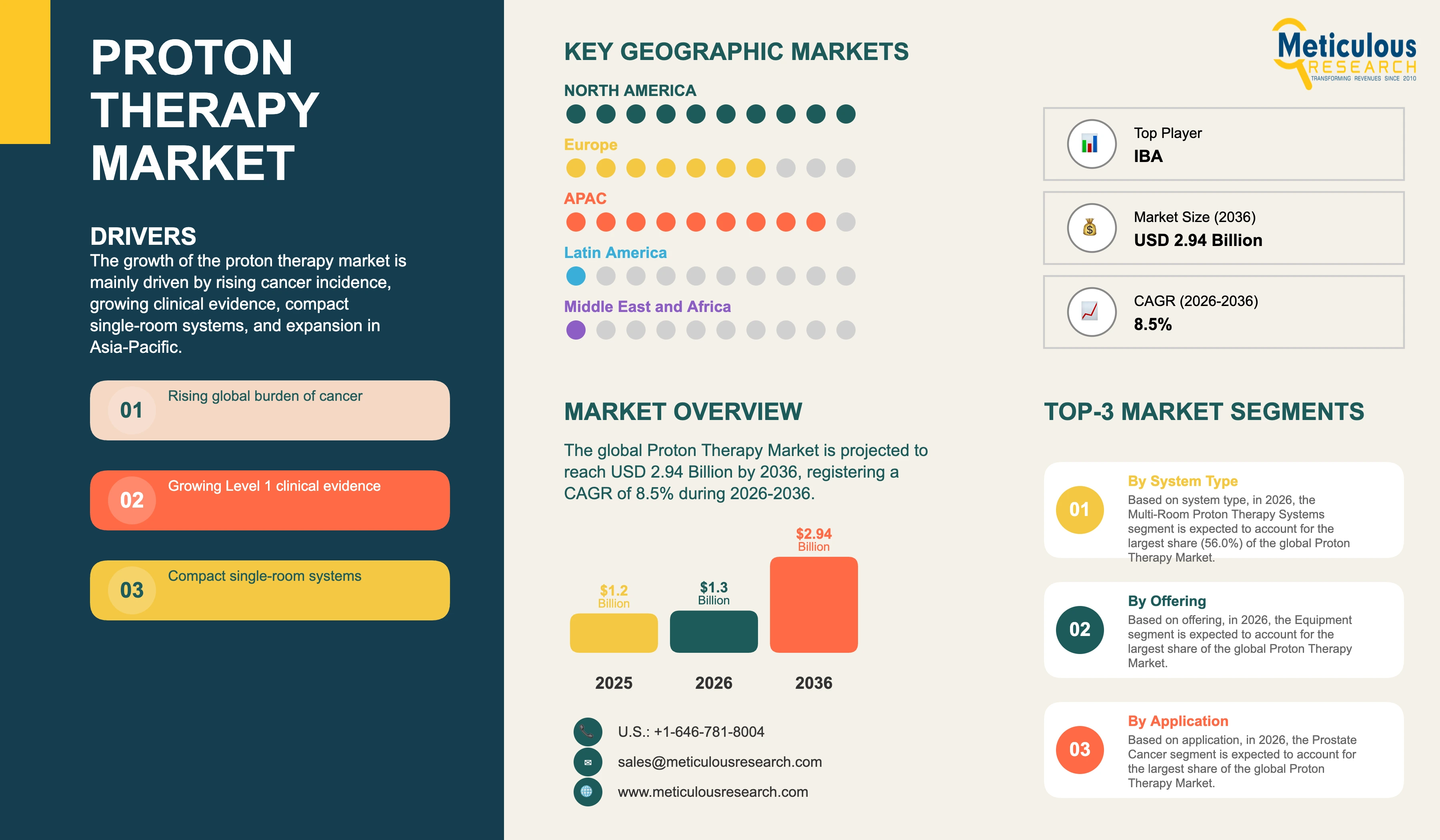
The global proton therapy market was valued at USD 1.20 billion in 2025. This market is expected to reach USD 2.94 billion by 2036 from an estimated USD 1.30 billion in 2026, registering a CAGR of 8.5% during the forecast period (2026-2036).
- Published
- Nov 2026
- Pages
- 270
- Format
- PDF + Excel
- Report ID
- MRHC - 1042630
- Base year
- 2025
- 2025 · BASELINE
- $1.20B
- 2036
- $2.94B
- CAGR 2026–2036
- 8.5%
2025 baseline · 2026–2036 forecast at 8.5% CAGR · hover a bar for the value
Key highlights
IBA, the leading supplier of proton therapy systems, reported that its proton therapy net sales grew 57% to EUR 334.3 million in 2025, and it sold 12 treatment rooms during the year, its second-best year ever, which represented 63% of the total proton therapy rooms sold globally, according to the company's full-year 2025 results and earnings call. Its proton therapy equipment order intake rose 137% to EUR 250 million, with 10 accelerator systems sold compared with 5 in 2024.
IBA's management noted that MD Anderson published the first Level 1 clinical evidence from a phase III randomized trial showing improved overall survival and reduced side effects with proton therapy compared with conventional radiation in head and neck cancer, and that early results from the RadCom phase III breast cancer trial presented at ASCO showed significantly improved patient-reported quality of life with proton therapy.
According to the National Association for Proton Therapy's 2025 annual member survey, 18,202 patients received proton therapy in the U.S. in 2024, an increase of 1,081 from 2023, and two new proton centers came online in 2024, while 66% of proton centers reported delays in patient care due to prior authorization and about one-third of prior authorization requests were initially denied, according to NAPT and AuntMinnie.
IBA reported that it sold five proton therapy rooms in the first half of 2026 and that IBA Clinical's equipment order intake more than doubled to EUR 148 million, driven by sustained adoption momentum in proton therapy, while its overall backlog remained at about EUR 1.6 billion, according to the company's half-year 2026 results.
NAPT has noted that fewer than 9% of patients who would benefit from proton therapy are currently able to access it, while an analysis of U.S. patient trends found nearly 110 proton centers operating worldwide, with growth increasingly driven by smaller one- and two-room facilities rather than large multi-room centers. These orders reflect growing demand from hospitals in the U.S. and Asia-Pacific.
By system type, multi-room proton therapy systems account for the larger share of 56.0% in 2026, while single-room proton therapy systems register the higher CAGR.
By offering, equipment accounts for the larger share in 2026 and also registers the higher CAGR.
By application, prostate cancer accounts for the largest share in 2026, while head and neck cancer registers the highest CAGR.
By end user, hospitals and academic cancer centers account for the larger share of 68.0% in 2026 and also register the higher CAGR.
By geography, North America accounts for the largest share of 36.0% in 2026, while Asia-Pacific registers the highest CAGR of 10.5%.
Report summary
| Particulars | Details |
|---|---|
| Forecast Period | 2026-2036 |
| Base Year | 2025 |
| Estimated Year | 2026 |
| CAGR (Value) | 8.5% |
| Format | PDF, Excel & Cloud Portal · 270 pages |
| Market Size (Value) in 2025 | USD 1.20 billion |
| Market Size (Value) in 2026 | USD 1.30 billion |
| Market Size (Value) by 2036 | USD 2.94 billion |
| Largest Segment by System Type (2026) | Multi-Room Systems (56.0%) |
| Largest Segment by End User (2026) | Hospitals and Academic Cancer Centers (68.0%) |
| Largest Region (2026) | North America (36.0%) |
| Fastest-Growing Region | Asia-Pacific (CAGR 10.5%) |
| Key Companies | 11 companies and other companies |
| Segments Covered | System Type, Offering, Application, End User, Geography |
| Countries Covered | U.S., Canada, Rest of North America, Germany, U.K., France, Italy, Spain, Netherlands, Belgium, Switzerland, Sweden, Denmark, Norway, Finland, Austria, Poland, Ireland, Rest of Europe, China, Japan, South Korea, Taiwan, India, Australia, Thailand, Indonesia, Singapore, Malaysia, Vietnam, Philippines, New Zealand, Rest of Asia-Pacific, Brazil, Mexico, Argentina, Colombia, Chile, Peru, Rest of Latin America, Saudi Arabia, U.A.E., Israel, South Africa, Turkey, Egypt, Rest of Middle East & Africa |
Report overview
Segments covered: system type, offering, application, end user.
The growth of this market is mainly driven by the rising global burden of cancer, growing clinical evidence supporting proton therapy, including the first Level 1 randomized phase III evidence in head and neck cancer, the shift toward compact single-room systems that lower the cost and space required to offer proton therapy, strong order momentum in North America, Europe, and Asia-Pacific, the expansion of the installed base, which generates recurring service and upgrade revenue, and technological advances such as pencil beam scanning, image guidance, adaptive therapy, and FLASH research. However, factors such as the high capital cost of proton therapy facilities, limited and inconsistent reimbursement, prior authorization barriers, long project timelines, and the need for specialized staff are expected to restrain the growth of this market to some extent.
Proton therapy is an advanced form of external beam radiation therapy that uses beams of protons, rather than X-rays, to destroy cancer cells. Protons deposit most of their energy at a specific depth, known as the Bragg peak, and release very little radiation beyond the tumor. This physical property allows proton therapy to deliver high doses to tumors while reducing radiation exposure to surrounding healthy tissues and organs. Reducing radiation to healthy tissue is particularly important for children, whose growing tissues are sensitive to radiation, and for tumors located near critical structures, such as the brain, spinal cord, eyes, heart, and salivary glands.
This report covers the global proton therapy market, including multi-room and single-room proton therapy systems, which consist of particle accelerators, such as cyclotrons, synchrocyclotrons, and synchrotrons, beam transport and delivery systems, gantries and fixed beam lines, patient positioning and imaging systems, and treatment planning and oncology software, as well as services, including installation, operation and maintenance, upgrades, and training. The market is analyzed by system type, offering, application, end user, and geography. Revenue from patient treatments delivered by proton therapy centers and heavy-ion therapy systems are not included in the market value. The market is measured on a revenue basis at manufacturer selling prices, on a sales basis in each country.
Proton therapy has been used clinically for decades, but its adoption has historically been limited by the very high cost and large size of facilities. Early proton centers used large multi-room facilities with several treatment rooms served by a single accelerator, which required investments of well over USD 100 million and large buildings. Over the past decade, manufacturers have introduced compact single-room systems, such as IBA's Proteus ONE, Mevion's S250i and S250-FIT, and Siemens Healthineers' Varian ProBeam 360, which reduce the cost, size, and complexity of proton therapy and allow hospitals to add proton therapy to existing cancer centers.
Clinical evidence supporting the use of proton therapy across a wider range of cancers has been growing steadily. Pencil beam scanning, which delivers proton beams spot by spot to shape the dose precisely to the tumor, has become the standard delivery technique, and intensity-modulated proton therapy allows highly conformal treatments. Randomized trials are increasingly providing high-level evidence, including MD Anderson's phase III trial in head and neck cancer, which demonstrated improved survival and fewer side effects compared with conventional radiation therapy, and the RadCom trial in breast cancer, which showed improved quality of life. This evidence is expected to support broader clinical acceptance and reimbursement.
Multi-room proton therapy systems account for the largest share of the market by system type, while single-room systems are the fastest-growing system type. Equipment accounts for the largest share and the highest growth by offering. Prostate cancer is the largest application, while head and neck cancer is the fastest-growing application. Hospitals and academic cancer centers are the largest and fastest-growing end user. North America accounts for the largest share of the market, while Asia-Pacific is the fastest-growing region.
The proton therapy market is concentrated among a small number of specialized manufacturers. IBA is the market leader with the largest installed base, and it accounted for 63% of proton therapy rooms sold globally in 2025. Other major manufacturers include Siemens Healthineers through Varian, Hitachi, Sumitomo Heavy Industries, and Mevion Medical Systems. Emerging companies such as P-Cure, ProTom International, B dot Medical, and Chinese manufacturers are developing compact and lower-cost systems, while companies such as Leo Cancer Care offer upright patient positioning systems that can reduce the size and cost of proton facilities.
Service revenue is an important and growing part of the proton therapy market for equipment manufacturers. Proton therapy systems require ongoing operation and maintenance support, software and hardware upgrades, and training, and many customers sign long-term service contracts. IBA reported a services backlog of more than EUR 800 million at the end of 2025, reflecting the growth of its installed base and the recurring nature of service revenue.
Over the forecast period, the proton therapy market is expected to grow steadily, supported by rising cancer incidence, growing clinical evidence, compact systems, expansion in Asia-Pacific, and service growth from the expanding installed base. The pace of growth will depend on reimbursement, financing of new centers, the speed of project execution, and the ability of manufacturers to further reduce the cost and size of systems.
Prostate cancer is expected to account for the largest share of the market in 2026, while head and neck cancer is projected to register the highest CAGR.
North America is expected to account for the largest share of 36.0% of the market in 2026, mainly due to the large number of U.S. proton centers, leading academic medical centers, high healthcare spending, and strong clinical research.
Asia-Pacific is projected to register the highest CAGR of 10.5% during the forecast period, driven by large cancer populations, strong investment in advanced cancer care, and the construction of many proton centers in China and other countries.
The report profiles 11 companies, including IBA, Siemens Healthineers (Varian), Hitachi, Sumitomo Heavy Industries, Mevion Medical Systems, ProTom International, P-Cure, B dot Medical, Toshiba Energy Systems & Solutions, Shanghai APACTRON, and Leo Cancer Care.
Proton therapy is commonly used for prostate cancer, head and neck cancer, pediatric cancers, brain and central nervous system tumors, breast cancer, lung cancer, and gastrointestinal cancers, particularly where tumors are close to critical organs.
In 2026, the hospitals and academic cancer centers segment is expected to account for the larger share of 68.0% of the proton therapy market, and it is also projected to register the higher CAGR during the forecast period.
Report infographic
Market dynamics
18 factors across 5 forcesRising global burden of cancer
Cancer incidence is rising worldwide due to population growth, aging, and lifestyle factors, and radiation therapy is used in the treatment of about half of all cancer patients. As the number of cancer patients grows, demand for advanced radiation therapy, including proton therapy, increases. Cancer survival rates are also improving, which increases the importance of reducing long-term side effects of treatment, a key advantage of proton therapy.
Childhood cancer, head and neck cancer, brain tumors, and tumors near critical organs are particularly suited to proton therapy, and the growing number of patients with these cancers is driving demand for proton therapy capacity. NAPT reported that the number of U.S. patients treated with proton therapy increased to 18,202 in 2024.
Long-term cancer survivors increasingly face the late effects of conventional radiation, such as secondary cancers, heart disease, and cognitive decline, which strengthens the case for treatments that spare healthy tissue. Oncologists are also increasingly using proton therapy to re-irradiate tumors that recur in previously treated areas, where limiting additional dose to healthy tissue is critical.
Growing clinical evidence supporting proton therapy
The clinical evidence base for proton therapy is expanding rapidly, with randomized trials now providing high-level evidence. MD Anderson's phase III randomized trial in head and neck cancer provided the first Level 1 evidence that proton therapy improves overall survival and reduces side effects compared with conventional radiation therapy, according to IBA. Early results from the RadCom phase III trial in breast cancer showed significantly improved patient-reported quality of life with proton therapy.
High-level evidence is critical for gaining the support of oncologists, payers, and health systems, and it is expected to support broader reimbursement and adoption of proton therapy. Additional randomized trials in esophageal, lung, liver, and other cancers are expected to report results during the forecast period, which could further expand the use of proton therapy.
Shift toward compact single-room systems
Compact single-room proton therapy systems have significantly reduced the cost, footprint, and complexity of offering proton therapy. These systems allow hospitals to add proton therapy to existing cancer centers, sometimes within existing radiation therapy vaults, rather than building large standalone facilities. Systems such as IBA's Proteus ONE, Mevion's S250i and S250-FIT, and Siemens Healthineers' Varian ProBeam 360 have made proton therapy accessible to a wider range of hospitals.
The growth of smaller one- and two-room facilities has been a key driver of the increase in the number of proton centers worldwide. As single-room systems become smaller and less expensive, more hospitals are expected to invest in proton therapy, which will drive market growth. Single-room systems also allow hospitals to start with one room and add capacity later as patient volumes grow, which reduces financial risk.
Strong order momentum and expansion in Asia-Pacific
Orders for new proton therapy systems have increased strongly over the past two years across several regions. IBA reported that its proton therapy equipment order intake increased by 137% to EUR 250 million in 2025, with 10 accelerator systems sold compared with 5 in 2024, and that it saw strong commercial traction in the U.S. and in Asia-Pacific. In the first half of 2026, IBA sold five more rooms.
China, Japan, South Korea, India, and other Asia-Pacific countries are investing heavily in proton therapy capacity. IBA has delivered major multi-room Proteus PLUS installations in China, including in Chengdu and Shenzhen, and Chinese manufacturers are developing domestic proton therapy systems. These investments are expected to make Asia-Pacific the fastest-growing region. The pipeline of projects in the U.S. also remains active, according to IBA.
Expansion of the installed base and service revenue
Each new proton therapy system generates long-term service revenue from operation and maintenance contracts, upgrades, and training. As the installed base grows, service revenue becomes an increasingly important part of the market, providing manufacturers with recurring revenue and visibility. IBA reported a services backlog of more than EUR 800 million at the end of 2025, supported by new orders and contract renewals.
Upgrades to existing systems, such as the addition of pencil beam scanning, cone-beam CT imaging, adaptive therapy, and new software, also generate revenue and extend the life of installed systems, which supports the growth of the services segment. Long-term service contracts are also typically renewed with the original manufacturer.
Table of contents
12 chapters · 160 sections · 270 pages · click to expandSegmental analysis
| Segment | Largest share (2026) | Fastest growth (2026–2036) |
|---|---|---|
| By System Type | Multi-room proton therapy systems | Single-room proton therapy systems |
| By Offering | Equipment | — |
| By Application | Prostate cancer | Head and neck cancer |
| By End User | Hospitals and academic cancer centers | — |
By System Type
- Proton Therapy Market Analysis by System Type
- The multi-room proton therapy systems segment is expected to account for the largest share of 56.0% of the global proton therapy market.
- The large share of this segment is mainly due to the high value of multi-room systems, which represent very large capital projects and serve several treatment rooms from a single accelerator, the large number of multi-room projects under installation in China, Spain, and other countries, the ability of multi-room centers to treat large patient volumes at major cancer centers and academic hospitals, and the large installed base of multi-room systems in the U.S., Europe, and Japan.
- IBA's Proteus PLUS, Hitachi's systems, Sumitomo Heavy Industries' systems, and Siemens Healthineers' Varian ProBeam multi-room systems are widely used in large proton centers.
- Multi-room centers are typically operated by large academic medical centers, national cancer institutes, and specialized proton therapy centers, which treat a wide range of cancers and participate in clinical research.
- Large national programs, such as Spain's investment in multiple proton therapy centers, have supported demand for multi-room systems.
- However, the single-room proton therapy systems segment is projected to register the highest CAGR during the forecast period.
- The rapid growth of this segment is driven by the lower cost, smaller footprint, and shorter installation time of single-room systems, their ability to be integrated into existing hospitals and cancer centers, growing demand from community hospitals and regional cancer centers, and continued innovation in compact accelerators, upright positioning, and gantry-less designs.
- IBA's Proteus ONE, Mevion's S250i and S250-FIT, and Siemens Healthineers' Varian ProBeam 360 are leading single-room systems, and IBA's backlog includes 36 Proteus ONE systems.
- The growth of one- and two-room facilities has been a major factor in the increase in proton centers worldwide.
- New system designs that combine single-room footprints with high throughput, such as systems with faster beam delivery and automated workflows, are also expected to blur the distinction between single-room and multi-room centers.
- Hybrid configurations are also emerging, in which hospitals start with a single treatment room and plan space for additional rooms as patient volumes grow, which allows them to manage investment risk while preparing for future expansion.
- Manufacturers are also offering financing, leasing, and operating partnerships to help hospitals fund new proton therapy projects.
By Offering
- Proton Therapy Market Analysis by Offering
- The equipment segment is expected to account for the largest share of the global proton therapy market.
- The large share of this segment is mainly due to the high value of proton therapy systems, including accelerators, beam delivery systems, gantries, patient positioning and imaging systems, and treatment planning software, the strong order momentum for new systems in North America, Europe, and Asia-Pacific, and the conversion of large equipment backlogs into revenue.
- IBA reported strong growth in proton therapy equipment sales in 2025 as it accelerated the conversion of its backlog.
- This segment is also projected to register the highest CAGR during the forecast period, driven by new orders for single-room and multi-room systems, the construction of new proton centers in Asia-Pacific and other emerging markets, and the replacement and upgrade of older systems.
- The services segment accounts for a significant share of the market, supported by long-term operation and maintenance contracts, upgrades, and training for the growing installed base, and it provides manufacturers with recurring revenue.
- IBA reported a proton therapy services backlog of more than EUR 800 million at the end of 2025.
- Equipment includes accelerators, beam transport systems, gantries, patient positioning systems, imaging systems, and treatment planning software, and new systems increasingly include cone-beam CT and adaptive therapy capabilities.
- Services are expected to grow steadily as the installed base expands and as centers sign long-term contracts for maintenance, uptime guarantees, and upgrades.
- The equipment segment is expected to account for the larger share of the proton therapy market, and it is also projected to register the higher CAGR during the forecast period.
By Application
- Proton Therapy Market Analysis by Application
- The prostate cancer segment is expected to account for the largest share of the global proton therapy market.
- The large share of this segment is mainly due to the high incidence of prostate cancer, the historical use of proton therapy for prostate cancer at many centers, particularly in the U.S. and Japan, and the ability of proton therapy to reduce radiation exposure to the rectum and bladder.
- However, the proportion of proton patients with prostate cancer has been declining as proton therapy expands to other indications, according to NAPT's ten-year trend analysis.
- However, the head and neck cancer segment is projected to register the highest CAGR during the forecast period.
- The rapid growth of this segment is driven by the publication of MD Anderson's phase III randomized trial showing improved overall survival and reduced side effects with proton therapy compared with conventional radiation therapy, the high toxicity of conventional radiation for head and neck cancers, which can cause difficulty swallowing, dry mouth, and other long-term side effects, and the expected expansion of reimbursement for head and neck cancer following the Level 1 evidence.
- The pediatric cancers segment forms an important segment, as proton therapy is widely considered the preferred radiation treatment for many childhood cancers because it reduces the risk of long-term side effects and secondary cancers.
- The brain and CNS tumors segment includes the treatment of brain tumors, skull base tumors, and spinal tumors, where sparing healthy brain tissue is critical.
- The breast cancer segment is expected to grow rapidly, supported by the RadCom trial's quality-of-life results and the potential to reduce radiation to the heart.
- The lung and thoracic cancers and the gastrointestinal and other cancers segments include lung, esophageal, liver, pancreatic, and other cancers, where randomized trials are ongoing.
- Pediatric cancers remain a core application because proton therapy reduces long-term side effects in children, and brain and central nervous system tumors are another important application because protons can spare healthy brain tissue.
- Lung, esophageal, liver, and breast cancers are expected to grow as randomized trials report results and payers expand coverage.
By End User
- Proton Therapy Market Analysis by End User
- The hospitals and academic cancer centers segment is expected to account for the largest share of 68.0% of the global proton therapy market.
- The large share of this segment is mainly due to the integration of proton therapy into hospital-based cancer centers, the leading role of academic medical centers and NCI-designated cancer centers in proton therapy and clinical research, and the growing number of single-room systems installed within existing hospitals.
- This segment is also projected to register the highest CAGR during the forecast period, driven by the shift toward compact single-room systems that can be integrated into hospital cancer centers, the ability of hospitals to combine proton therapy with conventional radiation, surgery, and systemic therapy, and the growing participation of hospitals in clinical trials.
- The standalone proton therapy centers segment accounts for the remaining share of the market and includes independent proton centers and consortium-owned facilities, which have faced financial challenges in some markets due to reimbursement and patient volume issues.
- Hospitals and academic cancer centers integrate proton therapy with surgery, chemotherapy, immunotherapy, and conventional radiation, which allows multidisciplinary teams to choose the best treatment for each patient.
- Standalone proton centers often rely on referral networks and partnerships with hospitals and oncology groups to maintain patient volumes.
Geographic analysis
North America
Largest shareIn 2026, North America is expected to account for the largest share of 36.0% of the global proton therapy market. The large share of this region is mainly due to the large number of proton therapy centers in the U.S., the presence of leading academic medical centers and cancer centers, high healthcare spending, strong clinical research, including MD Anderson's phase III trial in head and neck cancer, and strong commercial traction for new proton therapy systems in the U.S., as reported by IBA. NAPT reported that 18,202 patients received proton therapy in the U.S. in 2024 and that two new proton centers came online in 2024. However, reimbursement and prior authorization barriers remain significant challenges in the region. Canada also contributes to the regional market, with new proton therapy capacity being developed.
Asia-Pacific
Fastest growthAsia-Pacific is projected to register the highest CAGR of 10.5% during the forecast period. The rapid growth of this region is mainly driven by large and growing cancer populations, strong government and private investment in advanced cancer care, the construction of a large number of proton therapy centers in China, including IBA's Proteus PLUS installations in Chengdu and Shenzhen, the established proton therapy market in Japan, where Hitachi and Sumitomo Heavy Industries are major suppliers, and growing investment in South Korea, Taiwan, India, Thailand, and Vietnam. IBA reported strong commercial traction in Asia-Pacific in 2025.
Europe
Europe accounts for a significant share of the market, supported by national investment in proton therapy in Spain, the U.K., the Netherlands, Germany, Italy, France, and the Nordic countries, strong clinical research, and the presence of IBA, which is headquartered in Belgium. IBA's delivery of a large proton therapy project in Spain is a significant contributor to the region.
Latin America
Latin America accounts for a smaller share of the market, with initial proton therapy capacity in Brazil, Argentina, and other countries, while the Middle East & Africa accounts for the smallest share, with growing investment in advanced cancer care in Saudi Arabia, the U.A.E., and Israel. Regional differences in cancer incidence, healthcare spending, reimbursement, and government investment shape the demand for proton therapy around the world. Regions with large cancer populations and strong government investment in advanced cancer care are expected to see the fastest growth. Financing support from governments, development banks, and private investors will also influence the pace of new center construction in each region. Latin America and the Middle East & Africa account for small shares of the market but are beginning to invest in proton therapy. Brazil, Argentina, Mexico, and Chile have proton therapy projects in planning or development, while Saudi Arabia, the U.A.E., Israel, Turkey, and Egypt are investing in advanced cancer centers that include proton therapy or are evaluating it. These regions are expected to adopt compact single-room systems first, often through partnerships with international manufacturers and leading cancer centers that provide training and clinical support. Training partnerships will be essential.
Competitive landscape
The global proton therapy market is highly consolidated, with the top five players estimated to account for about 85% of the market in 2025. IBA is the clear market leader, accounting for 63% of proton therapy rooms sold globally in 2025, according to the company.
IBA offers the Proteus PLUS multi-room system and the Proteus ONE single-room system and has the largest installed base in the market. Siemens Healthineers, through Varian, offers the ProBeam multi-room and ProBeam 360 single-room systems. Hitachi and Sumitomo Heavy Industries supply proton therapy systems, particularly in Japan and Asia. Mevion Medical Systems offers compact single-room systems, including the S250i and S250-FIT. ProTom International, P-Cure, B dot Medical, Toshiba Energy Systems & Solutions, and Shanghai APACTRON Particle Equipment are developing or supplying proton and particle therapy systems, while Leo Cancer Care offers upright patient positioning solutions.
Companies in this market compete on clinical capabilities, such as pencil beam scanning, image guidance, and adaptive therapy, system footprint and cost, installation time, reliability and uptime, throughput, upgrade paths, service quality, clinical evidence support, and financing. Key strategies include developing more compact and lower-cost systems, introducing advanced treatment techniques such as arc therapy and FLASH, expanding in Asia-Pacific, strengthening service businesses, and supporting clinical research.
Recent competitive activity in the proton therapy market has focused mainly on order momentum, profitability, and technology innovation. IBA reported record order intake, a return to profitability in proton therapy in 2025, and the acquisition of PhantomX for AI-based quality assurance, while continuing to develop DynamicARC and ConformalFLASH technologies. Mevion and other companies continue to promote compact systems that can fit in existing vaults.
We expect competition to increase in the compact and single-room segment as new entrants seek to reduce the cost of proton therapy, and in Asia-Pacific as Chinese manufacturers develop domestic systems. IBA's large installed base and service business provide a strong competitive position, while cost reduction and clinical evidence will be key to the success of other players. Manufacturers are also expected to compete more intensively on service offerings, including uptime guarantees, remote monitoring, and upgrade programs, as the installed base grows.
Some of the key players operating in the proton therapy market are Ion Beam Applications SA (IBA), Siemens Healthineers AG (Varian), Hitachi, Ltd., Sumitomo Heavy Industries, Ltd., Mevion Medical Systems, Inc., ProTom International, P-Cure Ltd., B dot Medical Inc., Toshiba Energy Systems & Solutions Corporation, Shanghai APACTRON Particle Equipment Co., Ltd., and Leo Cancer Care, Inc., among others.
- —
IBA reported a 57% increase in proton therapy net sales in 2025, sold 12 rooms representing 63% of rooms sold globally, and sold five more rooms in the first half of 2026, while MD Anderson published the first Level 1 phase III evidence for proton therapy in head and neck cancer.
- S250i and S250-FIT. ProTom International
- P-Cure
- B dot Medical
- Toshiba Energy Systems & Solutions
- Shanghai APACTRON Particle Equipment
Expert perspectives
The proton therapy market is entering a more favorable phase after years in which high costs, reimbursement challenges, and financial difficulties at some centers slowed growth. Strong order intake, a return to profitability for the market leader, the shift to compact single-room systems, and the arrival of Level 1 clinical evidence are creating a stronger foundation for growth.
Over the forecast period, the market is expected to grow at a CAGR of 8.5%, from USD 1.30 billion in 2026 to USD 2.94 billion in 2036. Growth will be supported by rising cancer incidence, growing clinical evidence, compact systems, expansion in Asia-Pacific, and service growth from the expanding installed base.
Among the market segments, multi-room systems are the largest system type, while single-room systems grow fastest. Equipment is the largest and fastest-growing offering, prostate cancer is the largest application, while head and neck cancer grows fastest, and hospitals and academic cancer centers are the largest and fastest-growing end user. North America is the largest region, and Asia-Pacific is the fastest-growing region at a CAGR of 10.5%.
In our view, the most important factor for the market over the forecast period will be the impact of randomized clinical evidence on reimbursement. If payers expand coverage for head and neck, breast, and other common cancers based on Level 1 evidence, patient volumes at proton centers could increase significantly, improving the economics of proton therapy and encouraging investment in new centers. Reducing prior authorization barriers would also be important. Policy efforts in the U.S. to streamline prior authorization could help reduce treatment delays and improve patient access.
We also expect cost reduction to remain a key theme for manufacturers and customers throughout the forecast period. Compact, gantry-less, and upright systems could make proton therapy accessible to many more hospitals, while advances such as adaptive therapy, arc therapy, and FLASH could strengthen the clinical case for proton therapy. Manufacturers that can deliver systems at lower cost while maintaining clinical performance and reliability are likely to gain share, particularly among hospitals building their first proton therapy room. Service and upgrade revenue from the installed base will also provide a stable foundation for manufacturers' growth. This recurring revenue reduces the cyclicality of equipment orders.
Overall, we believe the proton therapy market will grow steadily over the forecast period, with single-room systems, head and neck cancer, hospital-based cancer centers, and Asia-Pacific providing the fastest growth. Manufacturers that combine cost-effective systems, strong service businesses, and support for clinical evidence will be best positioned to benefit. Innovative financing models will also influence the pace of adoption among hospitals.
Customer perspectives
Radiation Oncology Chair - U.S. Academic Medical Center
The phase III head and neck data changed the conversation with our payers and referring physicians. We are now planning additional proton capacity within our cancer center.
“A single-room system lets us offer protons without building a large standalone center, which made the investment realistic for our hospital.”
“Demand for advanced cancer treatment is growing quickly, and proton therapy is a priority for leading hospitals in our province.”
Frequently asked questions
The global proton therapy market was valued at USD 1.20 billion in 2025, up from USD 1.05 billion in 2024, and is estimated at USD 1.30 billion in 2026. The market includes proton therapy equipment and services but excludes patient treatment revenue.
The global proton therapy market is expected to reach USD 2.94 billion by 2036, supported by rising cancer incidence, growing clinical evidence, compact single-room systems, strong order momentum, expansion in Asia-Pacific, and service growth.
The market is expected to register a CAGR of 8.5% from 2026 to 2036.
Proton therapy is a form of external beam radiation therapy that uses protons rather than X-rays. Protons deposit most of their energy at a specific depth, which allows high doses to be delivered to tumors while reducing radiation to surrounding healthy tissue.
Market growth is mainly driven by the rising global burden of cancer, growing clinical evidence, the shift toward compact single-room systems, strong order momentum and expansion in Asia-Pacific, and the expansion of the installed base and service revenue.
The high capital cost of proton therapy facilities and limited reimbursement and prior authorization barriers restrain growth, while long project timelines and execution risk and shortages of specialized staff are key challenges.
Key growth opportunities include further miniaturization and cost reduction, expansion of indications based on randomized evidence, FLASH therapy and advanced treatment techniques, and growth in Asia-Pacific and emerging markets.
Multi-room proton therapy systems are expected to account for the largest share of 56.0% of the market in 2026, while single-room systems are projected to register the highest CAGR.
In 2026, the equipment segment is expected to account for the larger share of the proton therapy market, and it is also projected to register the higher CAGR during the forecast period.
Prostate cancer is expected to account for the largest share of the market in 2026, while head and neck cancer is projected to register the highest CAGR.
In 2026, the hospitals and academic cancer centers segment is expected to account for the larger share of 68.0% of the proton therapy market, and it is also projected to register the higher CAGR during the forecast period.
North America is expected to account for the largest share of 36.0% of the market in 2026, mainly due to the large number of U.S. proton centers, leading academic medical centers, high healthcare spending, and strong clinical research.
Asia-Pacific is projected to register the highest CAGR of 10.5% during the forecast period, driven by large cancer populations, strong investment in advanced cancer care, and the construction of many proton centers in China and other countries.
The report profiles 11 companies, including IBA, Siemens Healthineers (Varian), Hitachi, Sumitomo Heavy Industries, Mevion Medical Systems, ProTom International, P-Cure, B dot Medical, Toshiba Energy Systems & Solutions, Shanghai APACTRON, and Leo Cancer Care.
Proton therapy is commonly used for prostate cancer, head and neck cancer, pediatric cancers, brain and central nervous system tumors, breast cancer, lung cancer, and gastrointestinal cancers, particularly where tumors are close to critical organs.
IBA reported a 57% increase in proton therapy net sales in 2025, sold 12 rooms representing 63% of rooms sold globally, and sold five more rooms in the first half of 2026, while MD Anderson published the first Level 1 phase III evidence for proton therapy in head and neck cancer.
Cite this report
Meticulous Research. (2026). Proton Therapy Market - Global Opportunity Analysis and Industry Forecast (2026-2036) (Report No. MRHC - 1042630). Meticulous Market Research Pvt. Ltd. https://www.meticulousresearch.com/product/proton-therapy-market-7313