Natural Cosmetics Market (2025-2032)
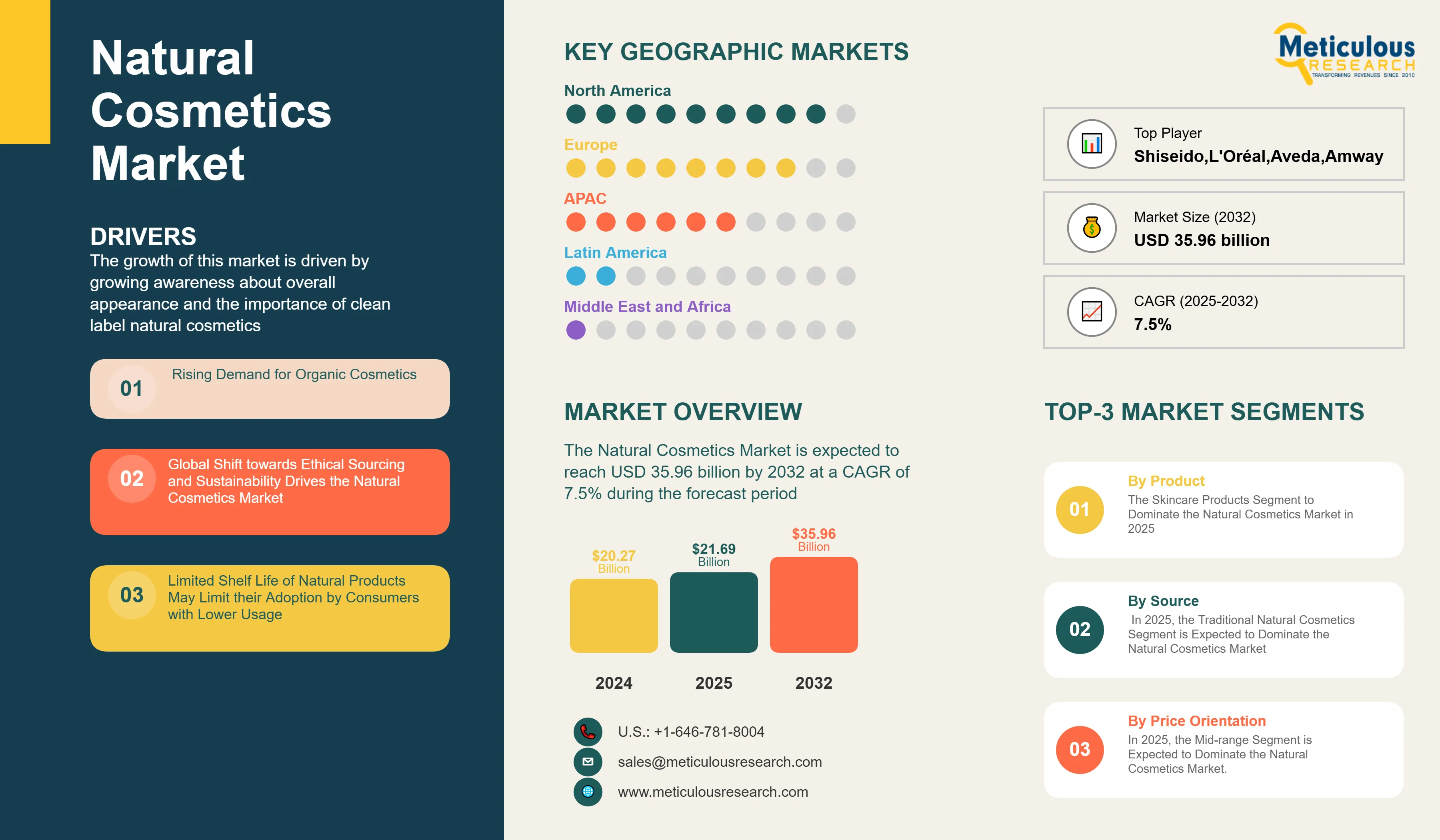
The Natural Cosmetics Market was valued at USD 20.27 billion in 2024. This market is expected to reach USD 35.96 billion by 2032 from an estimated USD 21.69 billion in 2025, at a CAGR of 7.5% during the forecast period of 2025-2032. Natural Cosmetics Market Size & Forecast The growth of this market
- Published
- Mar 2025
- Pages
- 250
- Format
- PDF + Excel
- Report ID
- MROTH - 1041456
- Base year
- 2024
- 2024 · BASELINE
- $20.27B
- 2032
- $35.96B
- CAGR 2025–2032
- 7.5%
2024 baseline · 2025–2032 forecast at 7.5% CAGR · hover a bar for the value
Key highlights
By Product: The Skincare Products Segment to Dominate the Natural Cosmetics Market in 2025.
By Source: In 2025, the Traditional Natural Cosmetics Segment is Expected to Dominate the Natural Cosmetics Market.
By Price Orientation: In 2025, the Mid-range Segment is Expected to Dominate the Natural Cosmetics Market.
By End User: In 2025, the Supermarkets & Hypermarkets Segment is Expected to Account for the Largest Share of the Natural Cosmetics Market.
By Geography: North America Dominates the Natural Cosmetics Market in 2025.
Report summary
| Particulars | Details |
|---|---|
| Number of Pages | 250 |
| Format | |
| Forecast Period | 2025–2032 |
| Base Year | 2024 |
| CAGR (Value) | 7.5% |
| Market Size in 2025 | USD 21.69 Billion |
| Market Size in 2032 | USD 35.96 Billion |
| Segments Covered | By Product · Color Cosmetics · Concealer · Foundation · Blush · Mascara · Eyeshadows · Eyeliner · Lipsticks · Others Color Cosmetic Products · Skincare Products · Lotions & Moisturizers · Cleansers · Creams · Face Oils · Serums · Other Skincare Products · Haircare Products · Shampoo · Conditioners · Hair Oil · Hair Masks · Other Haircare Products · Body Care Products · Shampoo · Conditioners · Hair Oil · Hair Masks · Other Body Care Products · Fragrances · Perfumes · Deodorants · Body Mists · Other Natural Cosmetic Products · (Note1 : Others Color Cosmetic Products include Contour, Highlighter, Primer, Gloss, and Lip Liner) · (Note2 : Other Skincare Products include Scrubs, Masks, Toners, and Exfoliators) · (Note3 : Other Body Care Products include Lip Care Products, Nail Care Products, and Bath Bombs) · (Note4 : Other natural cosmetic products include Men Grooming Products, Nail Care Products and Lip Care Products.) · By Source · Organic Cosmetics · Traditional Natural Cosmetics · By Price Orientation · Economy · Mid-range · Premium · By Distribution Channel · Supermarkets & Hypermarkets · Specialty Stores · Convenience Stores · Online/E-commerce |
| Countries Covered | North America (U.S. and Canada), Europe (Germany, France, U.K., Italy, Spain, Russia, and Rest of Europe), Asia-Pacific (China, Japan, India, South Korea, Indonesia, Thailand, Australia, and Rest of Asia-Pacific), Latin America (Brazil, Mexico, Argentina, and Rest of Latin America) and Middle East & Africa. (Saudi Arabia, UAE, South Africa, and Rest of Middle East & Africa) |
| Key Companies | 100% Pure (U.S.), Amway Corporation (U.S.), Arbonne International LLC (U.S.) Aveda Corporation (U.S.), Avon Products, Inc. (U.K.), Bare Escentuals Beauty Inc. (U.S.), Burt’s Bees (U.S.), Coty Inc. (U.S.), Estée Lauder Companies Inc. (U.S.), Johnson & Johnson (U.S.), L'Oréal SA (France), Procter & Gamble Co. (U.S.), and Shiseido Co., Ltd. (U.S.). |
Report overview
Segments covered: product, source, price orientation. Regions: North America, Europe, Asia-Pacific, Latin America.
The growth of this market is driven by growing awareness about overall appearance and the importance of clean label natural cosmetics, rising demand for organic cosmetics, global shift towards ethical sourcing and sustainability. Furthermore, significant growth from emerging economies, rise in digital marketing strategy & promotions and new personalized product launches are expected to generate growth opportunities for the stakeholders in this market.
Report infographic
Market dynamics
3 factors across 2 forcesGrowing Awareness about Overall Appearance and the Importance of Clean Label Natural Cosmetics
Individuals with clear and healthy skin tend to report higher levels of confidence and self-esteem and therefore with urbanization, growing disposable income, and awareness on availability & accessibility for products, the demand for cosmetic products including natural cosmetics is significantly increasing among consumers from past decade. Consumers are becoming aware of the connection between skin health and overall well-being, contributing to the demand for products that offer hydration and protection to the skin. Further, a shift from simply covering flaws to nourishing and maintaining skin health is increasing the use of natural cosmetics that offer gentle care and safe ingredients. Due to growing awareness about harmful effects of synthetic chemicals in traditional cosmetics, consumers are consistently seeking alternatives that align with the desire for non-toxic and natural ingredients. As natural cosmetics are often free from parabens, sulfates, artificial fragrances, and other chemicals, appeal to consumers who want to enhance their appearance without compromising their skin’s health is rising.
In addition, along with the growing awareness of overall appearance, there is also a rise in ethical beauty choices. Thus, consumers are increasingly considering the safety of the products they use, as well as the ethical consequences, such as the environmental and social impact of their purchases. Natural cosmetics, which are often cruelty-free, free from harmful chemicals, and sustainably sourced, appeal to these ethical considerations. Further, the growing popularity of the “no-makeup” makeup trend has fueled demand for lightweight, natural cosmetics that offer skin-perfecting properties, while allowing the natural features to shine through. Thus, natural cosmetics are sited perfectly to meet the demand for products that not only enhance skin appearance, but also promote long-term skin health, ethical considerations, and environmental sustainability, ultimately driving the growth of the natural cosmetics market.
Rising Demand for Organic Cosmetics
Organic cosmetics are made of at least 95% certified organic ingredients. Various conventional products contain oil that is harmful to the skin such as palm oil, hormonally active substances or even allergenic fragrances, whereas organic cosmetics do not use artificial colors and preservatives, mineral oils or silicones which make it a preferable choice for consumers. The rising demand for organic cosmetics is one of the most significant trends driving the natural beauty market today. Further, various cosmetics providers are focusing on developing innovative organic cosmetics products to combat the growing demand for organic cosmetics. Some of these key developments are as follows:
- In October 2023, Organic Harvest (India) launched makeup line, which includes organic lipsticks, BB cream, matte compact, kohl, and eyeliner.
- In October 2023, Sky Organics, LLC, d/b/a Sky Organics (U.S.) launched organic oils, balms, and body butters.
- In June 2022, Samisha Organic (India) launched a new line of skincare products including organic body lotion, foot cream, hand and nail car cream, and facewash.
In addition, organic cosmetics products often promise higher quality ingredients, with fewer preservatives and additives, which aligns to the changing consumer preferences. Thus, changing consumer preferences, and growing demand for organic cosmetic products is expected to drive the natural cosmetic market.
Table of contents
12 chapters · 150 sections · 250 pages · click to expandSegmental analysis
| Segment | Largest share (2025) | Fastest growth (2025–2032) |
|---|---|---|
| By Product | Skincare Products | — |
| By Price Orientation | Mid-range Price | — |
By Product
- The skincare products segment is estimated to account for the largest share of the natural cosmetics market.
- Factors such as growing focus on skin health, increasing demand for safe skin ingredients, rising demand for clean and green beauty products, growing sensitive skin concerns, and growing social media marketing, are contributing to the largest share of the segment.
- In recent years, consumers’ preferences have shifted from enhancing their appearance to prioritizing skin health.
- This primarily includes concerns about moisturization, anti-aging, protection from UV rays, and repairing skin damage caused by environmental stressors like pollution and harsh weather.
- As natural skin care products are gentle and safer for maintaining skin health without exposing skin to harmful chemicals, the demand for natural skin care products is rising.
By Price Orientation
- The mid-range price segment is estimated to account for the largest share of the natural cosmetics market.
- This is largely because it represents the ideal balance between quality and affordability, and it is thus the most attractive option for a large consumer demographic.
- Consumers who want natural and organic ingredients in their personal and beauty care products tend to desire higher quality than mass-market products but may not necessarily be prepared to pay the high premium costs of luxury brands.
- This renders mid-priced goods the most affordable option for a significant portion of the population, especially middle-class and upper-middle-class individuals.
- Also, as consumers become increasingly aware of clean beauty and sustainability, more mass-market companies are launching natural lines of cosmetics at competitive prices, further growing this category.
- The success of e-commerce and direct-to-consumer (DTC) brands has also fueled the growth of the mid-range category through the ability to provide affordable natural options without the luxury distribution channel costs.
- Growing markets like India, China, and Brazil are also driving the success of the medium-price segment.
- There, growing disposable incomes and a growing focus on health-oriented beauty products are compelling consumers to adopt natural cosmetics that are affordable but still of high quality.
- Furthermore, retail growth through supermarkets, specialty outlets, and the internet has increased the availability of mid-range natural cosmetics than ever before.
- This has boosted their sales volume over premium-priced products.
- Thus, the medium price range segment is still dominating the marketplace, drawing in value-oriented as well as quality-driven buyers across the globe.
Geographic analysis
North America
Largest shareIn 2025, North America is estimated to account for the largest share of the natural cosmetics market. The large share of North America in the natural cosmetics market is primarily attributed to highly conscious consumers in the region, growing trends toward clean beauty—product, high awareness about ingredient transparency and high focus on skin health, and influence of social media and digital marketing. Further, focus on sustainability, premium natural products, and personalized beauty solutions, along with regulatory support and changing lifestyle trends, are supporting the growth of this regional market. North America Dominates the Natural Cosmetics Market in 2025
Asia-Pacific
Fastest growthHowever, the Asia-Pacific region is expected to grow at the highest CAGR during the forecast period. This market's growth is attributed to factors like growing urbanization, rising disposable incomes, increasing emphasis on personal appearance and skin health; and rising awareness and accessibility on cosmetic products including natural, plant-based products and clean label ingredients due to the rising influence of social media, digital platforms, and e-commerce websites. Furthermore, cultural shifts toward wellness, the influence of traditional beauty practices in the region, and increasing environmental awareness are supporting the growth of natural cosmetics market in the region.
Competitive landscape
- April 2023
Almora Botanica UK Ltd. (U.K.) launched seven products to help prevent and repair skin damage. These formulations contain 98.5% to 100% natural ingredients.
- September 2022
Neo Naturals (India) launched beauty care products brand Pearl with 18 chemical-free 100% natural sources organic products beauty, skin and hair care.
- August 2022
OrgaGlo (India) launched vegan skin and hair care products using natural ingredients.
- June 2021
SO’BiO étic a bran of Léa Nature Services (France) launched organic beauty product line in the U.S. by introducing its U.S. Instagram account.
- 100% Pure (U.S.)
- Amway Corporation (U.S.)
- Arbonne International LLC (U.S.) Aveda Corporation (U.S.)
- Avon Products, Inc. (U.K.)
- Bare Escentuals Beauty Inc. (U.S.)
- Burt’s Bees (U.S.)
- Coty Inc. (U.S.)
- Estée Lauder Companies Inc. (U.S.)
- Johnson & Johnson (U.S.)
- L'Oréal SA · France
- Procter & Gamble Co. (U.S.)
- Shiseido Co., Ltd. (U.S.)
Frequently asked questions
The global natural cosmetics market size was valued at $20.27 billion in 2024.
Cite this report
Meticulous Research. (2025). Natural Cosmetics Market - Global Opportunity Analysis and Industry Forecast (2025-2032) (Report No. MROTH - 1041456). Meticulous Market Research Pvt. Ltd. https://www.meticulousresearch.com/product/natural-cosmetics-market-6139