Mining Automation Software Market (2026-2036)
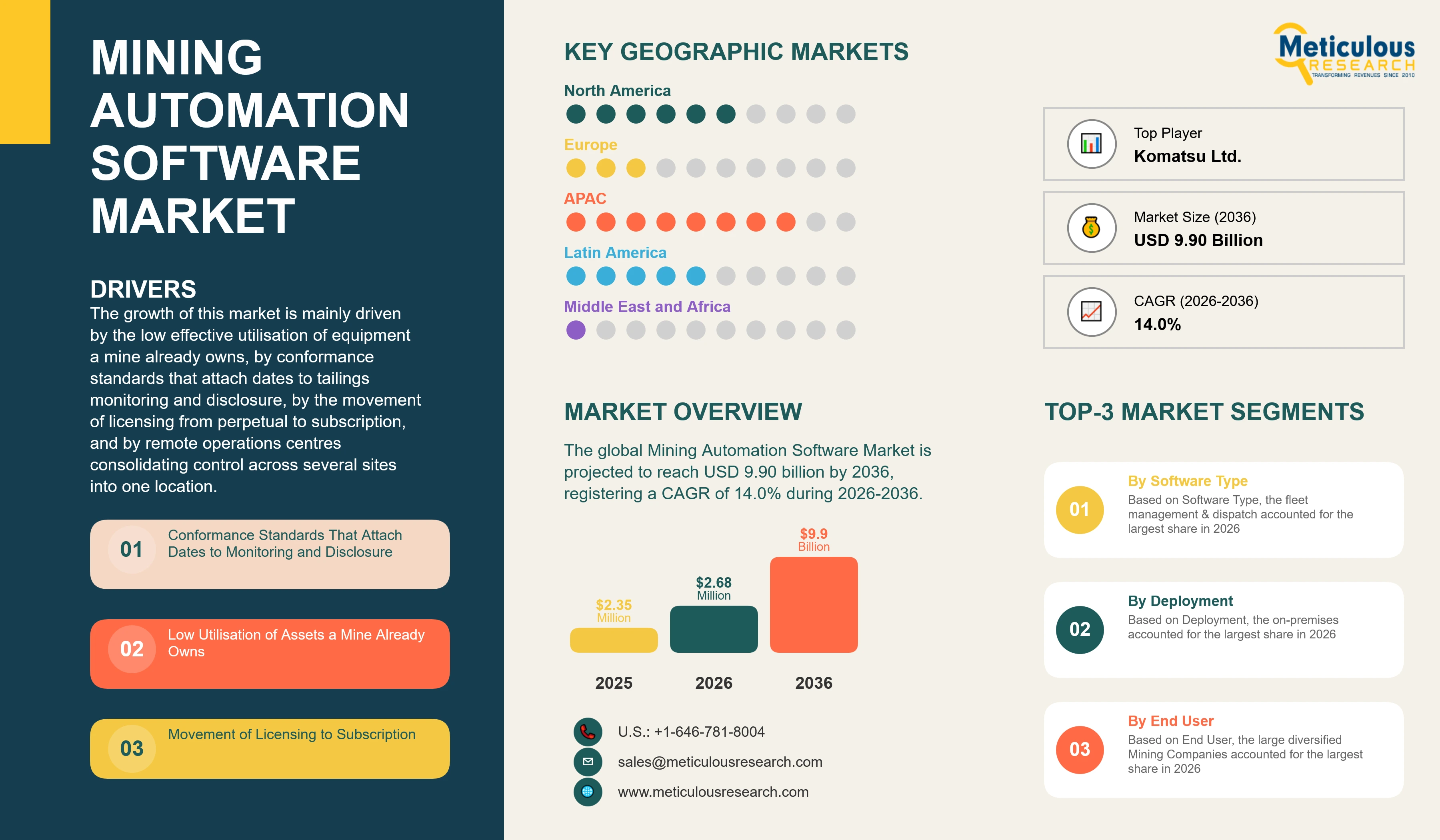
The global Mining Automation Software Market was valued at USD 2.35 billion in 2025. This market is expected to reach USD 9.90 billion by 2036 from an estimated USD 2.68 billion in 2026, registering a CAGR of 14.0% during the forecast period (2026-2036).
- Published
- Nov 2026
- Pages
- 339
- Format
- PDF + Excel
- Report ID
- MRICT - 1042424
- Base year
- 2025
- 2025 · BASELINE
- $2.35B
- 2036
- $9.90B
- CAGR 2026–2036
- 14.0%
2025 baseline · 2026–2036 forecast at 14.0% CAGR · hover a bar for the value
Key highlights
The global Mining Automation Software Market is valued at USD 2.68 billion in 2026 and is projected to reach USD 9.90 billion by 2036, at a CAGR of 14.0%.
Based on software type, the fleet management and dispatch segment is expected to account for the largest share of the market in 2026, while the tailings and environmental monitoring segment is projected to register the highest CAGR during the forecast period.
Based on deployment, the on-premises segment is expected to account for the largest share of the market in 2026, while the cloud segment is projected to register the highest CAGR during the forecast period.
Based on licensing model, the perpetual licence segment is expected to account for the largest share of the market in 2026, while the subscription segment is projected to register the highest CAGR during the forecast period.
Based on mining method, the surface mining segment is expected to account for the largest share of the market in 2026, while the underground mining segment is projected to register the highest CAGR during the forecast period.
Based on commodity, the copper segment is expected to account for the largest share of the market in 2026, while the lithium and battery minerals segment is projected to register the highest CAGR during the forecast period.
Based on end user, the large diversified mining companies segment is expected to account for the largest share of the market in 2026, while the mid-tier and junior mining companies segment is projected to register the highest CAGR during the forecast period.
Based on geography, Asia-Pacific is expected to account for the largest share of the market in 2026, while Latin America is projected to register the highest CAGR during the forecast period.
Report summary
| Particulars | Details |
|---|---|
| Base Year | 2025 |
| Estimated Year | 2026 |
| Forecast Period | 2026-2036 |
| Market Size in 2025 | USD 2.35 billion |
| Market Size in 2026 | USD 2.68 billion |
| Market Size by 2036 | USD 9.90 billion |
| CAGR (2026-2036) | 14.0% |
| Format | PDF, Excel & Cloud Portal · 339 pages |
| Largest Segment by Software Type (2026) | Fleet Management and Dispatch |
| Fastest-growing Segment by Software Type | Tailings and Environmental Monitoring |
| Largest Segment by Deployment (2026) | On-Premises |
| Fastest-growing Segment by Deployment | Cloud |
| Largest Segment by Licensing Model (2026) | Perpetual Licence |
| Fastest-growing Segment by Licensing Model | Subscription |
| Fastest-growing Segment by Mining Method | Underground Mining |
| Largest Segment by Commodity (2026) | Copper |
| Fastest-growing Segment by Commodity | Lithium and Battery Minerals |
| Largest Region (2026) | Asia-Pacific |
| Fastest-growing Region | Latin America |
| Segments Covered | Software Type, Deployment, Licensing Model, Mining Method, Commodity, End User, Geography |
| Company Naming Basis | Registered legal entity, with group capability attributed to its owner |
| Number of Companies Profiled | 20, plus other companies |
Report overview
Segments covered: software type, deployment, licensing model, mining method, commodity, end user.
The mining automation software market covers the software used to plan, dispatch, execute, control and monitor mining operations, including fleet management and dispatch, mine planning and scheduling, production execution and short interval control, autonomous operation control, processing plant optimisation, asset health and predictive maintenance, and tailings and environmental monitoring, licensed or subscribed independently of any machine purchase. The growth of this market is driven by the low utilisation of assets a mine already owns, by conformance standards that attach dates to monitoring and disclosure, by the movement of licensing to subscription, and by remote operations centres consolidating control across sites.
Two different kinds of purchase are counted in this market and they are approved on different grounds. Operational software is bought to raise the output of equipment a mine already owns and competes against capital projects on payback, so it is tested on return. Conformance and disclosure software is bought because a published standard carries a date, and the payback question is not asked.
The Global Industry Standard on Tailings Management was published in August 2020, and members of the International Council on Mining and Metals committed to conformance by August 2023 for facilities classified as extreme or very high consequence and by August 2025 for all other applicable facilities, publishing individual disclosures for each facility. In a report dated 4 November 2025 the International Council on Mining and Metals recorded 836 member facilities, of which 67% were in full conformance and 33% in partial conformance, with more than 80% of extreme and very high consequence facilities fully conformant against 53% to 65% of high, significant and low consequence facilities, and stated that achieving full alignment is taking more time than initially anticipated and remains a work in progress. Both deadlines have therefore passed with about 276 of those 836 facilities still only partially conformant, and the shortfall sits mainly in the more numerous lower consequence facilities, which are the ones least likely to carry existing instrumentation and data systems. Spending in that part of this market continues regardless of commodity prices.
Software in a mining operation decides what each machine does next, records what it did, and reports the result. A dispatch system assigns trucks to loading units and dumps, a planning system sets the sequence in which the ore body is extracted, an execution system compares the shift against the plan while the shift is running, and a monitoring system records the condition of equipment, ground and tailings facilities. Mining has had planning and geological software for decades, and the growth in this market comes from the execution and monitoring layers rather than from the planning layer. Those two layers answer a different question from the plan, namely what is happening now and what condition the operation is in, and they require data the planning layer never needed.
Effective utilisation of mining equipment is low by the standards of other heavy industries, with a haul truck typically productive for a minority of the hours it is available once queueing, waiting on a loading unit, shift change, refuelling and unplanned stoppages are taken out. Software that recovers a few percentage points of that time produces additional tonnes without a machine being bought, which is why operational automation software is assessed against capital projects rather than against other software. A mine comparing a dispatch upgrade with a new truck is comparing two routes to the same tonnes. The software route needs no capital approval, which is why it survives a downturn that stops the fleet addition.
Delivering those percentage points depends on data the software does not own. A dispatch or execution system needs position, payload, engine and cycle data from each machine, and that data is produced by the onboard systems and held in the fleet management system supplied by the equipment manufacturer. What a mine can deploy is therefore bounded by what its equipment supplier exposes rather than by what the software is capable of, and an operation running machines from several manufacturers faces the problem in multiple forms. The constraint is commercial rather than technical, since nothing prevents the data being shared and no supplier gains from sharing it.
This has shaped who supplies the market. The two largest mining equipment manufacturers each own a fleet management platform and sell it as the system of record for the operation, which gives them a position that reflects their installed machine population. Independent software companies compete by integrating across manufacturers, and industrial automation groups come at the operation from the processing plant and the control system rather than from the pit. A mine therefore chooses not only a product but a view of where the operational data will sit. That decision is harder to reverse than the software licence, because moving the system of record means rebuilding every integration that depends on it. Operations therefore live with a platform choice far longer than the licence term suggests. The incumbent position is correspondingly durable once established.
The Global Industry Standard on Tailings Management was published in August 2020, and members of the International Council on Mining and Metals committed to conformance by August 2023 for facilities classified as extreme or very high consequence and by August 2025 for all other applicable facilities, publishing individual disclosures for each facility. In a report dated 4 November 2025 the International Council on Mining and Metals recorded 836 member facilities, of which 67% were in full conformance and 33% in partial conformance, with more than 80% of extreme and very high consequence facilities fully conformant against 53% to 65% of high, significant and low consequence facilities, and stated that achieving full alignment is taking more time than initially anticipated and remains a work in progress. Both deadlines have now passed and about 276 of those 836 facilities remain partially conformant, which represents committed and continuing expenditure on instrumentation, data management and disclosure software at facilities that in most cases had none. The number of facilities rather than their size governs that spending, so it is spread across many small purchases rather than concentrated in a few large ones.
Conformance spending behaves differently from operational spending. A standard with a date removes the payback test, so the purchase proceeds through a commodity price cycle that would postpone a dispatch upgrade, and the buyer is the corporate function rather than the site. The disclosure obligation also means the output is published, which raises the assurance and audit trail requirements on the software well above what an internal production report needs.
Licensing has moved towards subscription across the market, which changes what a vendor earns from an installation and what a buyer commits to. A perpetual licence with annual maintenance put the upgrade decision with the mine, while a subscription places the vendor on a renewal cycle and makes continued use conditional on continued payment. Subscription has also lowered the entry cost enough for mid-tier and single asset operations to deploy systems that previously only large diversified companies could fund.
Remote operations centres consolidate control of several sites into one location, which requires the software at each site to report into a common model and makes consistency across operations more valuable than the best available tool at any one of them. This favours vendors able to supply a suite over vendors with a strong single product, and it is one of the reasons the independent software companies have been acquired by equipment manufacturers and industrial groups rather than growing into platforms themselves. A standardisation decision replaces working products at sites that had no complaint about them. Buyers now choose between suites rather than assembling the best available product for each workflow.
Connectivity is a precondition this market does not supply. An execution system reporting within a shift needs a network that covers the pit or the underground workings continuously, and that network is a separate capital project with its own approval. Growth in the underground segment in particular depends on spending that sits outside this market, and an operation without coverage can buy the software without being able to use it as intended.
Report infographic
Market dynamics
22 factors across 5 forcesLow Utilisation of Assets a Mine Already Owns
Effective utilisation of mining equipment is low by the standards of other heavy industries, with a haul truck productive for a minority of its available hours once queueing, waiting on a loading unit, shift change, refuelling and unplanned stoppages are removed. Software that recovers a few percentage points of that time produces additional tonnes without a machine being bought, so a mine comparing a dispatch upgrade with a new truck is comparing two routes to the same tonnes and the software route requires no capital. This driver strengthens when commodity prices fall and capital is withheld, which makes it countercyclical against equipment demand. The case is also made at site level rather than corporately, because the saving appears in the production numbers the site already reports. No separate measurement system is needed to see whether it worked. That visibility is also why a failed implementation is hard to conceal. Site management therefore carries the outcome personally, which raises the attention a project receives.
Conformance Standards That Attach Dates to Monitoring and Disclosure
The Global Industry Standard on Tailings Management was published in August 2020, and members of the International Council on Mining and Metals committed to conformance by August 2023 for facilities classified as extreme or very high consequence and by August 2025 for all other applicable facilities, publishing individual disclosures for each facility. In a report dated 4 November 2025 the International Council on Mining and Metals recorded 836 member facilities, of which 67% were in full conformance and 33% in partial conformance, with more than 80% of extreme and very high consequence facilities fully conformant against 53% to 65% of high, significant and low consequence facilities, and stated that achieving full alignment is taking more time than initially anticipated and remains a work in progress. About 276 of those 836 facilities remain partially conformant after both deadlines have passed, and the shortfall sits mainly in the more numerous lower consequence facilities that are least likely to carry existing instrumentation. This driver removes the payback test from the purchase, so the spending continues through a price cycle that would postpone operational projects. The buyer is the corporate function rather than the site, and the published disclosure raises the assurance and audit trail requirements well above what an internal production report needs.
Movement of Licensing to Subscription
A perpetual licence with annual maintenance left the upgrade decision with the mine and the revenue flat, while subscription places the vendor on a renewal cycle and ties revenue to continued use. The change has lowered the entry cost enough for mid-tier and single asset operations to deploy systems that previously only large diversified companies could fund, which widens the buyer base rather than increasing spend per site. It also raises the recorded value of this market as licences convert, since a subscription records revenue every year where a perpetual licence recorded it once. Part of the growth recorded in this market therefore reflects the payment model rather than additional deployment, which the forecast separates rather than presenting as new adoption.
Remote Operations Centres Consolidating Control Across Sites
Running several operations from one location requires the software at each site to report into a common model, which makes consistency across sites more valuable than the best available tool at any one of them. An operator standardising on a suite replaces products at sites that were satisfied with what they had, which produces demand that has nothing to do with the performance of the system being replaced. This driver favours vendors able to supply the full workflow and is a principal reason independent software companies have been acquired rather than growing into platforms themselves. It also produces larger orders than a site level purchase, since the decision covers every operation the group runs.
Table of contents
14 chapters · 153 sections · 339 pages · click to expandGeographic analysis
Asia-Pacific
Largest shareIn 2026, Asia-Pacific is expected to account for the largest share of the market. The large share of this region is mainly due to the scale of iron ore and coal operations in Australia, India, China and Indonesia, to the remote operations centres Australian operators run from capital cities, and to the depth of dispatch and execution deployment at Pilbara operations. Australia accounts for most of the regional position, and Chinese and Indonesian coal operations add volume on domestically supplied systems. India contributes through state owned coal operations adopting dispatch systems on large fleets.
Latin America
Fastest growthHowever, Latin America is projected to register the highest CAGR during the forecast period. The rapid growth of this region is attributed to the number of copper operations in Chile and Peru and the declining head grades that make plant control worth more per percentage point, to lithium developments in Chile and Argentina specifying software from the outset, and to tailings conformance work at operations across the region. Chile accounts for the largest part of the regional position. Peru and Brazil follow, with Argentina contributing through lithium developments.
North America
North America holds a position built on Canadian underground operations, where tracking and short interval control are well established, and on copper and gold operations in the United States and Mexico. Operations in the region run mixed equipment fleets more often than the large single-manufacturer fleets of Australia, which makes integration across manufacturers a larger part of regional demand, and several of the independent software vendors serving that need are based here. Canada accounts for a larger share of the regional position than its production would suggest, reflecting the number of underground operations and the corporate functions located there. Mexico adds demand through copper, silver and gold operations run by international groups. Adoption across the region follows the corporate standards of those groups rather than local practice.
Europe
Europe accounts for a smaller position concentrated in Nordic underground operations and in the industrial automation groups supplying processing plant control from the region.
Middle East & Africa
The Middle East & Africa remains an earlier market in which copper, gold and phosphate developments specify software for new operations and in which tailings conformance work is underway, and adoption across both regions depends on implementation support available locally rather than on product capability.
Competitive landscape
The two largest mining equipment manufacturers each own a fleet management platform sold as the system of record for an operation, and their positions in this market reflect their installed machine populations as much as any advantage in software. Industrial automation groups approach the operation from the processing plant and the control system, where they already hold the installed base. Independent software companies compete by integrating across equipment manufacturers and by covering workflows the larger suppliers do not reach. Specialist vendors serve planning, geological modelling and blast design, and several have been acquired by the first three groups.
Control of the equipment data decides much of the competition, because a dispatch or execution system cannot function without position, payload and cycle data that the equipment manufacturer holds, and an independent vendor is selling into an account where that manufacturer already owns the system of record. Breadth of suite decides corporate standardisation decisions, since an operator consolidating several sites into a remote operations centre values consistency across operations above the best tool at any one. Implementation capability decides sales to mid-tier operations, which have no internal systems function and need a product configured rather than engineered.
Consolidation has reduced the number of independent vendors of scale. Equipment manufacturers and industrial groups have acquired mining software companies rather than building equivalent products, because the acquirer already holds the account and a suite is worth more than a single product in a standardisation decision. The vendors that remain independent compete on the one position the acquirers cannot credibly take, which is consolidating data across equipment manufacturers for operations running mixed fleets.
Key players operating in the global Mining Automation Software Market are Caterpillar Inc. (U.S.), Komatsu Ltd. (Japan), Sandvik AB (Sweden), Epiroc AB (Sweden), Hitachi Construction Machinery Co., Ltd. (Japan), Hexagon AB (Sweden), Trimble Inc. (U.S.), ABB Ltd (Switzerland), Siemens AG (Germany), Schneider Electric SE (France), Honeywell International Inc. (U.S.), Rockwell Automation, Inc. (U.S.), Emerson Electric Co. (U.S.), Dassault Systemes SE (France), Constellation Software Inc. (Canada), RPMGlobal Holdings Limited (Australia), Maptek Pty Ltd (Australia), Orica Limited (Australia), Imdex Limited (Australia), and Metso Corporation (Finland).
Companies are identified at registered legal entity level, and capability held within a group is attributed to the entity that owns it. Modular Mining Systems is not listed separately, because it is held within Komatsu Ltd., Wenco International Mining Systems is not listed separately, because it is held within Hitachi Construction Machinery Co., Ltd., Deswik and Newtrax are not listed separately, because both are held within Sandvik AB, Autonomous Solutions Inc. and Mobilaris are not listed separately, because both are held within Epiroc AB, AVEVA is not listed separately, because it is held within Schneider Electric SE, Aspen Technology is not listed separately, because Emerson Electric Co. completed the acquisition of its remaining outstanding shares on 12 March 2025, Datamine is not listed separately, because it is held within Constellation Software Inc., and GEOVIA is not listed separately, because it is held within Dassault Systemes SE. The companies profiled were verified as active in the supply of mining automation software as of October 2026. Mining companies operating these systems rather than supplying them, communication network and connectivity suppliers, enterprise resource planning vendors without a mining automation product, consulting and systems integration firms without proprietary software, and equipment manufacturers whose software is supplied only as part of a machine were excluded.
- Caterpillar Inc. (U.S.)
- Komatsu Ltd. · Japan
- Sandvik AB · Sweden
- Epiroc AB · Sweden
- Hitachi Construction Machinery Co., Ltd. · Japan
- Hexagon AB · Sweden
- Trimble Inc. (U.S.)
- ABB Ltd · Switzerland
- Siemens AG · Germany
- Schneider Electric SE · France
- Honeywell International Inc. (U.S.)
- Rockwell Automation, Inc. (U.S.)
- Emerson Electric Co. (U.S.)
- Dassault Systemes SE · France
- Constellation Software Inc. · Canada
- RPMGlobal Holdings Limited · Australia
- Maptek Pty Ltd · Australia
- Orica Limited · Australia
- Imdex Limited · Australia
- Metso Corporation · Finland
Expert perspectives
This market is usually presented as one category and it contains two purchases that are approved on different grounds. Operational software is bought to raise the output of equipment a mine already owns, competing against capital projects on payback, and it strengthens when prices fall and capital is withheld. Conformance software is bought because a published standard carries a date. The Global Industry Standard on Tailings Management was published in August 2020, and members of the International Council on Mining and Metals committed to conformance by August 2023 for facilities classified as extreme or very high consequence and by August 2025 for all other applicable facilities, publishing individual disclosures for each facility, and In a report dated 4 November 2025 the International Council on Mining and Metals recorded 836 member facilities, of which 67% were in full conformance and 33% in partial conformance, with more than 80% of extreme and very high consequence facilities fully conformant against 53% to 65% of high, significant and low consequence facilities, and stated that achieving full alignment is taking more time than initially anticipated and remains a work in progress, which leaves about 276 of those facilities partially conformant after both deadlines have passed. What limits the operational side is not the software but the data beneath it, since a dispatch or execution system needs position, payload and cycle data held in the fleet management platform supplied by the equipment manufacturer. The binding constraint is therefore shifting from what the software can calculate to what the equipment supplier exposes.
Spending is expected to continue moving from planning to execution and monitoring through 2036, because the planning installed base is largely served while the gap between the plan and the shift is where operations are adding systems. Licensing is expected to continue converting to subscription, which raises recorded market value as the same software is paid for annually rather than once and brings mid-tier operations into the market on lower entry cost. Consolidation is expected to continue, since a suite reporting into a remote operations centre is worth more in a standardisation decision than a strong single product.
For companies planning entry or expansion, tailings and environmental monitoring at high, significant and low consequence facilities is the most dependable opportunity, because conformance there runs at between 53% and 65% against more than 80% at extreme and very high consequence facilities, the facilities are more numerous, and the purchase is not subject to a payback test. Integration across equipment manufacturers is the one position the largest suppliers structurally cannot occupy, and it addresses the majority of operations that run mixed fleets. Buyers should establish what machine data a vendor can obtain from their specific equipment before assessing what the software claims to do.
Attribution limits how far this market can be sold on measured outcome, because a mine that installs a system and records higher tonnes has also changed its pit, its blasting and its maintenance in the same period, so a second purchase requires the first to be shown to have worked and the evidence is rarely clean. Implementation capacity limits delivery, since an execution system changes how a shift is run and operations frequently hold the licences without the change capacity, which falls hardest on the mid-tier buyers growing fastest. Network coverage is a third dependency outside this market, and an operation without it can buy the software and be unable to run it as intended.
Overall, the core of demand through the forecast period will continue to sit in on-premises fleet management and dispatch software licensed perpetually to large diversified mining companies at surface copper and iron ore operations across Asia-Pacific, while the fastest growth will come from tailings and environmental monitoring, cloud deployment, subscription licensing, underground operations, lithium and battery minerals, mid-tier and junior mining companies and Latin American operations.
Customer perspectives
Head of Technology, Diversified Mining Group
This perspective confirms that deployment is bounded by the machine data the equipment manufacturer exposes rather than by software capability. It supports the conclusion that control of equipment data decides competitive position in this market, and that an independent vendor is selling into an account where the manufacturer already holds the system of record.
Group Tailings Manager, Mining Company
This perspective identifies conformance deadlines rather than return as the basis on which tailings monitoring is approved, and the lower consequence facilities as where the work remains. It supports the conclusion that tailings and environmental monitoring is the fastest-growing software type and that spending in it continues through a commodity price cycle.
General Manager, Single Asset Gold Operation
This perspective confirms that subscription licensing has brought mid-tier and single asset operations into the market and that implementation capacity rather than cost is the subsequent constraint. It supports the conclusion that this buyer group grows fastest and that products requiring configuration rather than engineering are what succeed in it.
Frequently asked questions
The market was valued at USD 2.35 billion in 2025 and is estimated at USD 2.68 billion in 2026.
Cite this report
Meticulous Research. (2026). Mining Automation Software Market - Global Opportunity Analysis and Industry Forecasts (2026-2036) (Report No. MRICT - 1042424). Meticulous Market Research Pvt. Ltd. https://www.meticulousresearch.com/product/mining-automation-software-market-7107