
Membrane Filtration Technologies Market (2023-2030)
The Membrane Filtration Technologies Market is projected to reach $22.2 billion by 2030, at a CAGR of 6.9% from 2023 to 2030.
- Published
- Jun 2023
- Pages
- 242
- Format
- PDF + Excel
- Report ID
- MRSE - 104853
- Base year
- 2022
- 2030 · FORECAST
- $22.20B
- 2030
- $22.20B
- CAGR 2023–2030
- 6.9%
2022 baseline · 2023–2030 forecast at 6.9% CAGR · hover a bar for the value
Key highlights
Product launches & enhancements were the most preferred key growth strategies adopted by leading players accounted for a share of 53.8%. The leading players that actively launched products in the market include 3M Company (U.S.), GEA Group Aktiengesellschaft (Germany), Pall Corporation (U.S.), Veolia Water Technologies, Inc. (France), Koch Separation Solutions (U.S.), DuPont de Nemours, Inc. (U.S.), Synder Filtration Inc. (U.S.), Pentair plc (U.S.), Porvair Filtration Group (U.K.), and SPX Flow, Inc. (U.S.).
Partnerships, agreements, and collaborations accounted for a share of 30.8% of the total strategic developments from key players between 2020 and 2023. Some of the major companies that adopted partnerships, collaborations, and agreements as key development strategies were 3M Company (U.S.), Koch Separation Solutions (U.S.), DuPont de Nemours, Inc. (U.S.), and SPX Flow, Inc. (U.S.).
Acquisitions accounted for a share of 15.4% of the total strategic developments by leading market players between 2020 and 2023. The leading players that actively adopted these strategies were DuPont de Nemours, Inc. (U.S.), Pentair plc (U.S.), and Suez SA (France).
Report summary
| Particulars | Details |
|---|---|
| Number of Pages | 238 |
| Format | |
| Forecast Period | 2023-2030 |
| Base Year | 2022 |
| CAGR | 6.9% |
| Estimated Market Size (Value) | $22.2 billion by 2030 |
| Segments Covered | By Type · Reverse Osmosis · Ultrafiltration · Microfiltration · Nanofiltration · Other Technologies · By Construction · Hollow Fiber Membrane · Spiral Wound Membrane · Tubular Membrane · Other Constructions · By Membrane Material · Polymeric · Ceramic · Other Membrane Materials · By Sector · Fully Autonomous · Partially Autonomous · By Application · Municipal · Residential · Industrial · Food & Beverage · Chemicals & Pharmaceuticals · Power Generation · Pulp & Paper · Oil & Gas · Mining · Petrochemical · Electronics & Semiconductors · Other End-use Industries · By Geography · North America · U.S. · Canada · Europe · Germany · U.K. · France · Italy · Spain · Rest of Europe · Asia-Pacific · Japan · China · India · South Korea · Australia & New Zealand · Rest of Asia-Pacific · Latin America · Mexico · Brazil · Rest of Latin America · Middle East & Africa · UAE · Saudi Arabia · Rest of Middle East & Africa |
Report overview
Segments covered: type, construction, membrane material, sector.
The growth of the membrane filtration technologies market is attributed to the growing need for water reclamation and reuse technologies and the high consumption of water in the food & beverage processing industry. However, a lack of awareness of using water treatment techniques may restrain the market's growth.
Furthermore, the growing demand for energy-efficient and advanced water treatment technologies are expected to offer significant growth opportunities for the membrane filtration technologies market. However, retrofitting membrane filtration technologies in existing infrastructure may hinder the growth of this market.
Water is crucial in many stages of food processing, including washing and cleaning, preparation, cooking, and cooling. The food & beverage industry is one of the largest water consumers globally. Food production requires large quantities of water, leading to high levels of wastewater generation. High water consumption in the food & beverage industry has a significant impact on the environment, leading to water scarcity and pollution. Hence, there is increased regulatory pressure on the F&B industry to adopt sustainable water treatment technologies. As a result, there is a growing demand for membrane filtration technologies in the food & beverage processing industry.
To meet stringent regulations and maintain water quality, the food & beverage industry is turning to water and wastewater treatment technologies, including membrane filtration technology. These technologies are used to remove impurities, bacteria, and other contaminants from water, maintain water quality, and meet regulatory requirements. Common water treatment processes used in the food & beverage industry include reverse osmosis, ultrafiltration, microfiltration, and nanofiltration membranes. Thus, the high consumption of water in the food & beverage processing industry drives the growth of this market.
Report infographic
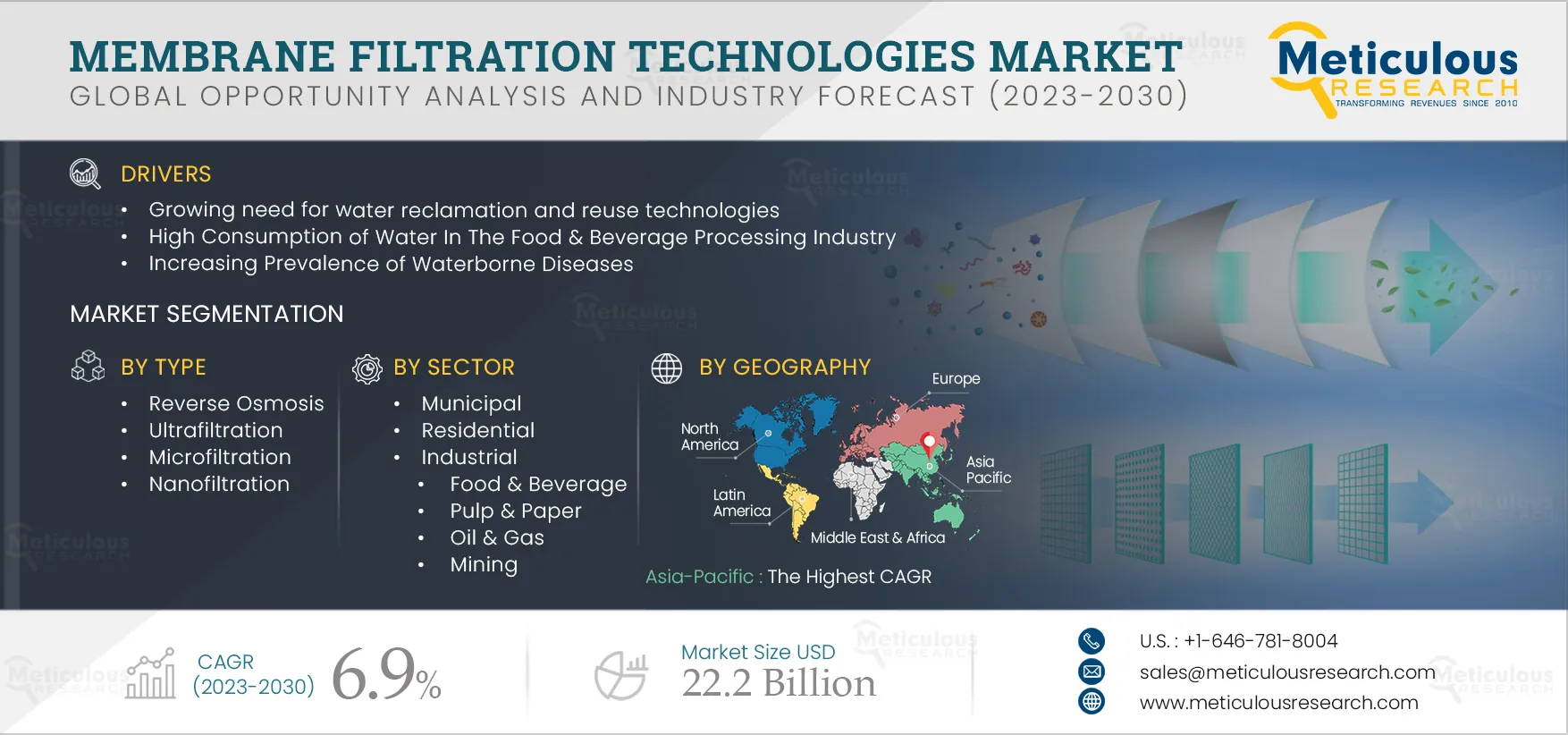
Table of contents
12 chapters · 105 sections · 242 pages · click to expandSegmental analysis
| Segment | Largest share (2023) | Fastest growth (2023–2030) |
|---|---|---|
| By Type | Reverse Osmosis | — |
| By Construction | — | Hollow fiber membrane |
| By Application | — | — |
| Other segments | — | Food & beverage |
By Type
- The reverse osmosis segment accounted for the largest share of 39.4% of the global membrane filtration technologies market.
- The segment’s large market share is attributed to the increasing demand for spiral wound membranes as they are cost-effective solutions available for the filtration process and rising the demand for spiral wound membranes across various sectors such as food & beverage, water & wastewater, residential, municipal, and industrial sectors.
By Construction
- The hollow fiber membrane segment is expected to record the highest CAGR of 9.0% during the forecast period.
- The growing need for hollow fiber filters to remove contaminants such as fungi, viruses, and bacteria support the growth of the hollow fiber membranes market during the forecast period.
By Application
- The industrial segment is further segmented into food & beverage, chemicals & pharmaceuticals, power generation, pulp & paper, oil & gas, mining, petrochemical, electronics & semiconductors, and other end-use industries.
- The industrial segment accounted for a share of 30.5% of the global membrane filtration technologies market.
- The growth of this market is attributed to the increasing prevalence of water-borne diseases, growth in industrial demand, and stringent governmental regulations on treating industrial wastewater.
Other segments
- The Food & Beverage Segment to Register the Highest CAGR of 8.1% During the Forecast Period
- The food & beverage segment is projected to register the highest CAGR of 8.1% during the forecast period.
- The growth of this segment is attributed to the increasing demand for membrane filtration technologies for water treatment in the food & beverage industry.
- Major F&B companies across the globe are seeking solutions to improve water quality and ensure reliable and clean water sources in their operations.
- This is boosting the growth of this segment.
Geographic analysis
Asia-Pacific
Fastest growthAsia-Pacific is slated to register the highest CAGR of 7.7% during the forecast period. The growth of this market is attributed to the rapid growth of industrialization, advances in membrane technology, increased environmental deterioration, and declining availability of clean water. Asia-Pacific to Register the Highest CAGR of 7.7% During the Forecast Period
Competitive landscape
- Pall Corporation
- Veolia Water Technologies, Inc.
- Alfa Laval AB
- Nemours, Inc.
- Synder Filtration Inc.
- ProMinent GmbH
- Pentair plc
- Advantec MFS, Inc.
- Thermax Limited
- SPX Flow, Inc.
Frequently asked questions
The global membrane filtration technologies market is projected to reach $22.2 billion by 2030, at a CAGR of 6.9% during the forecast period.
Cite this report
Meticulous Research. (2023). Membrane Filtration Technologies Market - Global Opportunity Analysis And Industry Forecast (2023-2030) (Report No. MRSE - 104853). Meticulous Market Research Pvt. Ltd. https://www.meticulousresearch.com/product/membrane-filtration-technologies-market-5536