Handheld X-ray Market (2026-2036)
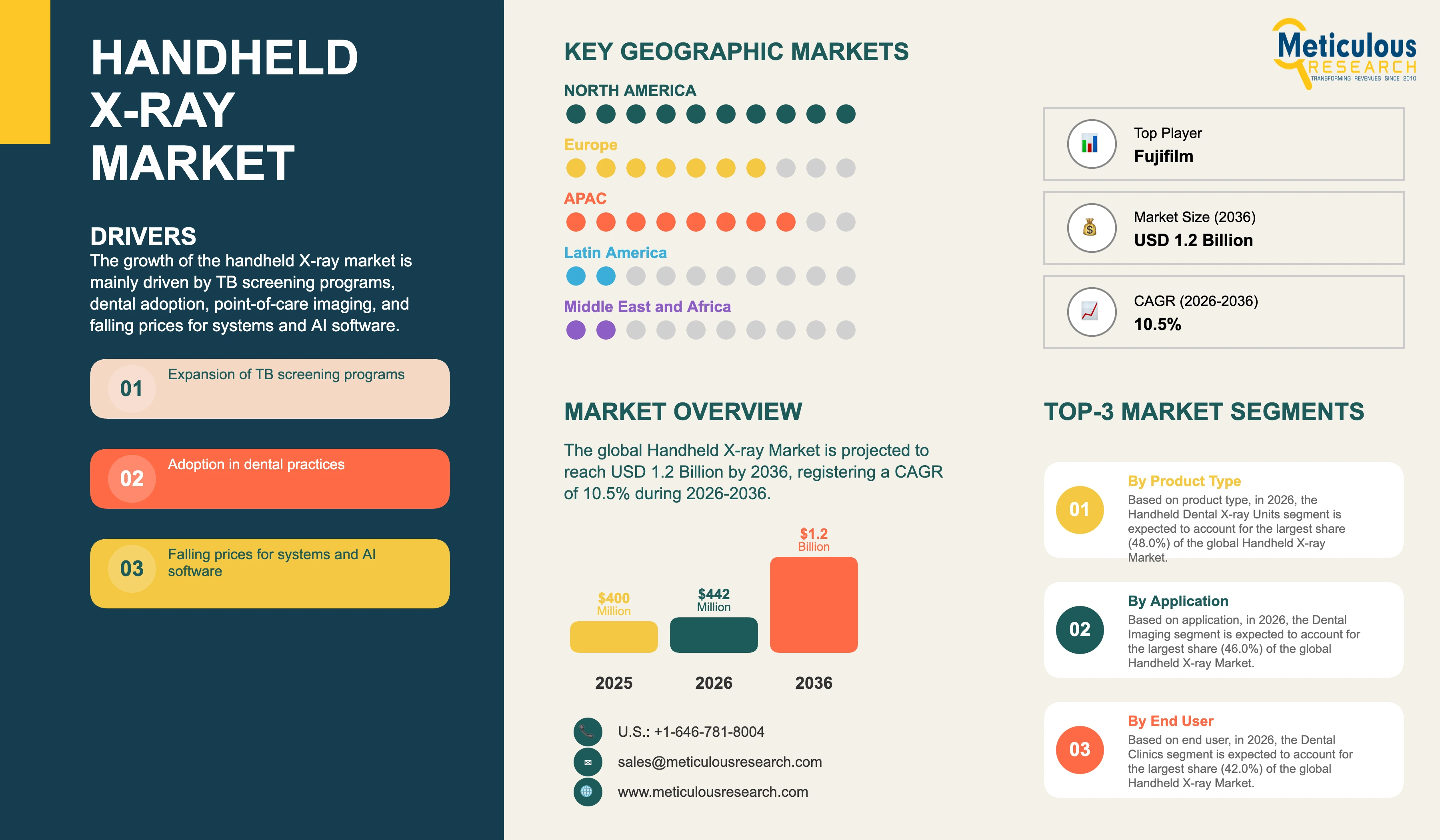
The global handheld X-ray market was valued at USD 400.0 million in 2025. This market is expected to reach USD 1.20 billion by 2036 from an estimated USD 442.0 million in 2026, registering a CAGR of 10.5% during the forecast period (2026-2036).
- Published
- Nov 2026
- Pages
- 243
- Format
- PDF + Excel
- Report ID
- MRHC - 1042632
- Base year
- 2025
- 2025 · BASELINE
- $400.0M
- 2036
- $1.20B
- CAGR 2026–2036
- 10.5%
2025 baseline · 2026–2036 forecast at 10.5% CAGR · hover a bar for the value
Key highlights
On May 20, 2025, Unitaid and the Clinton Health Access Initiative (CHAI) announced an agreement under which Poskom's AirRay 20 ultraportable digital chest X-ray system is available to 138 low- and middle-income countries at a ceiling price of USD 20,000, about 60% less than similar quality ultraportable chest X-ray systems, with all components needed for field implementation, according to CHAI. The system weighs about 5 kg.
In July 2026, Unitaid and CHAI announced agreements with DeepTek and Delft Imaging that cut the annual cost of AI-based computer-aided detection software for tuberculosis screening by up to 65% through an all-inclusive annual fee for unlimited use per connected X-ray device, and CHAI noted that, combined with the 2025 reduction in the price of portable X-ray devices, programs can now deploy a complete AI-powered screening solution at a fraction of the earlier cost.
The World Health Organization recommends computer-aided detection for tuberculosis screening and triage in people aged 15 and older and in 2025 identified six products meeting its performance standards, including Delft Imaging's CAD4TB and DeepTek's Genki, according to CHAI. The CAD pricing agreements remain in effect through December 2029.
Fujifilm's ultraportable, battery-powered Xair X-ray system has been deployed with Qure.ai's AI-enabled chest X-ray solution for tuberculosis case finding in rural communities in Nigeria, according to Imaging Technology News, while the Philippines Food and Drug Administration authorized the use of portable and ultraportable X-ray devices in government-approved TB screening programs in October 2023, according to the Manila Bulletin.
Tuberculosis remains the world's deadliest infectious disease, and chest X-rays are a critical screening tool, according to CHAI, while Kenya's Ministry of Health has reported success with ultraportable digital chest X-ray combined with AI software for community-level screening, which supports the growing use of handheld systems in public health programs. Similar programs are being scaled in other high-burden countries with support from international funders. These programs are also building local capacity for maintenance and training.
By product type, handheld dental x-ray units account for the largest share of 48.0% in 2026, while ultraportable digital radiography systems register the highest CAGR.
By detector technology, digital radiography (flat-panel and CMOS sensors) accounts for the largest share in 2026 and also registers the highest CAGR.
By application, dental imaging accounts for the largest share in 2026, while chest imaging and TB screening registers the highest CAGR.
By end user, dental clinics account for the largest share of 42.0% in 2026, while public health and screening programs register the highest CAGR.
By geography, North America accounts for the largest share of 34.0% in 2026, while Asia-Pacific registers the highest CAGR of 13.4%.
Report summary
| Particulars | Details |
|---|---|
| Base Year | 2025 |
| Estimated Year | 2026 |
| Forecast Period | 2026-2036 |
| Market Size in 2025 | USD 400.0 million |
| Market Size in 2026 | USD 442.0 million |
| Market Size by 2036 | USD 1.20 billion |
| CAGR (2026-2036) | 10.5% |
| Format | PDF, Excel & Cloud Portal · 243 pages |
| Largest Segment by Product Type (2026) | Handheld Dental X-ray Units (48.0%) |
| Largest Segment by End User (2026) | Dental Clinics (42.0%) |
| Largest Region (2026) | North America (34.0%) |
| Fastest-Growing Region | Asia-Pacific (CAGR 13.4%) |
| Companies Profiled | 12 companies and other companies |
| Segments Covered | Product Type, Detector Technology, Application, End User, Geography |
| Countries Covered | U.S., Canada, Rest of North America, Germany, U.K., France, Italy, Spain, Netherlands, Switzerland, Belgium, Sweden, Denmark, Norway, Finland, Austria, Poland, Ireland, Rest of Europe, China, Japan, India, South Korea, Australia, Indonesia, Philippines, Viet Nam, Pakistan, Bangladesh, Thailand, Singapore, Malaysia, Taiwan, New Zealand, Rest of Asia-Pacific, Brazil, Mexico, Argentina, Peru, Colombia, Chile, Rest of Latin America, South Africa, Nigeria, Kenya, Saudi Arabia, U.A.E., Israel, Turkey, Egypt, Rest of Middle East & Africa |
Report overview
Segments covered: product type, application, end user.
The growth of this market is mainly driven by the expansion of community-based tuberculosis screening programs using ultraportable chest X-ray and artificial intelligence-based computer-aided detection, the widespread adoption of handheld X-ray units in dental practices, the growing demand for point-of-care imaging in emergency, military, disaster response, home care, and long-term care settings, the declining prices of ultraportable systems and AI software for public health programs, and advances in battery, generator, and flat-panel detector technology. However, factors such as radiation safety concerns and regulatory restrictions on handheld operation in some countries, the lower power and image quality of some handheld systems compared with fixed and mobile X-ray, limited budgets of public health programs, and the need for trained operators are expected to restrain the growth of this market to some extent.
Handheld X-ray devices are lightweight, battery-powered X-ray systems that can be carried by a single operator and used at the point of care rather than in a fixed radiography room. They include handheld dental X-ray units used for intraoral imaging, ultraportable digital radiography systems that combine a lightweight X-ray generator with a wireless flat-panel detector for chest and general imaging, and handheld units for extremity, orthopedic, veterinary, forensic, and military imaging. These devices allow imaging in clinics, homes, nursing homes, rural communities, field hospitals, and disaster zones where conventional X-ray systems are not available or practical.
This report covers the global handheld X-ray market, including handheld dental X-ray units, ultraportable digital radiography systems, and handheld extremity and other X-ray units. The market is analyzed by product type, application, end user, and geography. Conventional fixed radiography systems, wheeled mobile X-ray systems, dental panoramic and cone-beam CT systems, and standalone AI software sold separately from X-ray hardware are analyzed in separate reports, although AI software bundled with handheld systems is included. The market is measured on a revenue basis at manufacturer selling prices, on a sales basis in each country.
Handheld dental X-ray units are the most established segment of the market. These devices allow dentists to take intraoral radiographs without a wall-mounted X-ray unit in each operatory, which saves space and cost, improves workflow, and allows imaging in multiple rooms, nursing homes, schools, and mobile dental clinics. Handheld dental units are designed with built-in shielding to protect the operator and are widely used in North America, Europe, and Asia-Pacific.
Ultraportable digital radiography systems have become an important tool for tuberculosis screening in low- and middle-income countries. These systems, which typically weigh only a few kilograms and can be carried in a backpack, allow health workers to perform chest X-rays in villages, homes, prisons, mines, and mobile clinics. When combined with AI-based computer-aided detection software, which the World Health Organization recommends for tuberculosis screening and triage, ultraportable X-ray enables same-day screening results without an on-site radiologist. Global health organizations such as Unitaid and CHAI have negotiated lower prices for ultraportable X-ray systems and AI software, which is accelerating adoption.
Handheld dental X-ray units account for the largest share of the market by product type, while ultraportable digital radiography systems are the fastest-growing product type. Dental imaging is the largest application, while chest imaging and TB screening is the fastest-growing application. Dental clinics are the largest end user, while public health and screening programs are the fastest-growing end user. Digital radiography is the largest and fastest-growing detector technology. North America accounts for the largest share of the market, while Asia-Pacific is the fastest-growing region.
Technological advances are improving the performance and usability of handheld X-ray systems. Higher-power battery-operated generators, lightweight carbon-fiber and nanotube-based X-ray sources, wireless flat-panel detectors with high sensitivity, longer battery life, and integrated image processing and AI software are allowing handheld systems to produce diagnostic-quality images for a wider range of applications. Some systems now offer image quality comparable to conventional digital radiography for chest imaging.
The market includes companies focused on dental imaging, such as Envista (KaVo Nomad), Vatech, Genoray, and Digital Doc, companies offering ultraportable digital radiography systems, such as Fujifilm, Poskom, MinXray, Remedi, Micro-X, DRGEM, and Konica Minolta, and companies that combine X-ray hardware with AI software and screening solutions, such as Delft Imaging. Partnerships between hardware manufacturers and AI software companies are common, particularly for tuberculosis screening. Many ultraportable systems are sold as complete kits that include the generator, detector, stand, laptop, software, and carrying case, which simplifies procurement for screening programs and mobile services. Dental units, by contrast, are usually sold as standalone devices that work with existing digital sensors.
Over the forecast period, the handheld X-ray market is expected to grow strongly, supported by tuberculosis screening programs, dental adoption, point-of-care imaging in new settings, falling prices, and technological improvements. The pace of growth will depend on global health funding, regulatory acceptance of handheld operation, radiation safety practices, and the availability of trained operators. Digital detectors are now used with most new handheld systems, which allows images to be stored, shared, and analyzed by AI software, and many manufacturers offer bundles that include the generator, detector, laptop, and software.
North America is expected to account for the largest share of 34.0% of the market in 2026, mainly due to the widespread adoption of handheld dental X-ray units, use in home care, long-term care, military, and veterinary settings, and high healthcare spending.
Asia-Pacific is projected to register the highest CAGR of 13.4% during the forecast period, driven by high tuberculosis burden, expanding screening programs with ultraportable X-ray and AI, the large number of dental practices, and regional manufacturers.
The report profiles 12 companies, including Fujifilm, Poskom, MinXray, Remedi, Micro-X, Envista (KaVo Nomad), Vatech, Genoray, Delft Imaging, Konica Minolta, DRGEM, and Digital Doc.
AI-based computer-aided detection software reads chest X-ray images and flags signs of tuberculosis and other abnormalities, allowing same-day screening results without an on-site radiologist. The WHO recommends this software for tuberculosis screening and triage in people aged 15 and older.
Report infographic
Market dynamics
18 factors across 5 forcesExpansion of community-based tuberculosis screening
Tuberculosis remains the world's deadliest infectious disease, and millions of people with the disease go undiagnosed each year, particularly in low- and middle-income countries. Chest X-ray is a critical screening tool that can identify people who may have tuberculosis, including those without symptoms, so that they can receive a confirmatory test. However, conventional X-ray systems are often unavailable in rural and underserved communities. Ultraportable digital chest X-ray systems allow screening programs to bring X-ray to communities, homes, and mobile clinics.
National tuberculosis programs in countries such as Viet Nam, Kenya, Nigeria, India, the Philippines, and South Africa are expanding active case-finding programs using ultraportable X-ray and AI-based computer-aided detection. Global health funders and organizations, including Unitaid, CHAI, the Global Fund, and the Stop TB Partnership, support these programs, which is driving strong demand for ultraportable systems. Many programs follow a strategy of screening entire communities with chest X-ray and then testing people with abnormal results using molecular tests, which requires large numbers of portable X-ray systems that can be moved between villages and screening sites.
The WHO recommendation of computer-aided detection for tuberculosis screening and triage and the identification of six products meeting its performance standards in 2025 have further increased confidence in AI-supported screening with portable X-ray.
Widespread adoption of handheld x-ray in dental practices
Handheld dental X-ray units have become widely adopted in dental practices because they allow dentists to take intraoral radiographs in any operatory without a wall-mounted X-ray unit, reducing equipment and installation costs and improving workflow. They are also used in mobile dentistry, nursing homes, schools, humanitarian dental care, and forensic dentistry. Built-in shielding protects operators from scatter radiation, and many systems are designed for use with digital intraoral sensors.
The growing number of dental practices, the increasing use of digital radiography in dentistry, and the expansion of mobile and community dental services are expected to continue to drive demand for handheld dental X-ray units over the forecast period. Dental service organizations that operate many practices are also standardizing on handheld units to reduce equipment costs across their networks.
Growing demand for point-of-care imaging
Healthcare systems are increasingly delivering care outside hospitals, including in homes, nursing homes, long-term care facilities, ambulances, emergency settings, and remote communities. Handheld X-ray devices allow imaging in these settings without transporting patients to a hospital or imaging center, which reduces costs, saves time, and improves patient comfort. Point-of-care imaging is particularly valuable for elderly and frail patients, for whom transport can be difficult.
Military, disaster response, and humanitarian organizations also use handheld X-ray devices in field hospitals and emergency situations, where conventional equipment cannot be deployed. The growing frequency of natural disasters and humanitarian crises is supporting demand for portable imaging equipment. Ambulance services and emergency physicians are also evaluating handheld X-ray for use in pre-hospital care and urgent care centers.
Declining prices for ultraportable systems and AI software
Prices of ultraportable digital X-ray systems and AI software have declined significantly, making them more accessible to public health programs and smaller healthcare facilities. In May 2025, Unitaid and CHAI announced an agreement making Poskom's AirRay 20 ultraportable system available to 138 low- and middle-income countries at a ceiling price of USD 20,000, about 60% less than similar systems. In July 2026, Unitaid and CHAI announced agreements that cut the cost of AI-based computer-aided detection software by up to 65%.
Lower prices allow tuberculosis programs to purchase more systems and expand screening coverage within fixed budgets, which is expected to drive strong volume growth in ultraportable systems. Competition between manufacturers is also expected to continue to reduce prices over the forecast period. Lower prices also make ultraportable systems more attractive to private clinics and small hospitals in emerging markets, which broadens the customer base beyond public health programs.
Advances in battery, generator, and detector technology
Advances in battery technology, high-frequency X-ray generators, lightweight X-ray sources, and wireless flat-panel detectors are improving the image quality, power, portability, and battery life of handheld X-ray systems. Modern ultraportable systems can produce chest images with quality suitable for tuberculosis screening and many other clinical applications, while weighing only a few kilograms.
Integration of image processing, wireless connectivity, cloud storage, and AI software further increases the value of handheld systems by enabling immediate image interpretation and remote reading. These advances are expanding the range of applications for handheld X-ray and increasing acceptance among clinicians.
Table of contents
12 chapters · 162 sections · 243 pages · click to expandSegmental analysis
| Segment | Largest share (2026) | Fastest growth (2026–2036) |
|---|---|---|
| By Product Type | Handheld dental X-ray units | Ultraportable digital radiography systems |
| By Detector Technology | Digital radiography (flat-panel and CMOS sensors) | Digital radiography (flat-panel and CMOS sensors) |
| By Application | Dental imaging | Chest imaging and TB screening |
| By End User | Dental clinics | Public health and screening programs |
| Other segments | Digital radiography (flat-panel and CMOS sensors) | — |
By Product Type
- Handheld X-ray Market Analysis by Product Type
- The handheld dental X-ray units segment is expected to account for the largest share of 48.0% of the global handheld X-ray market.
- The large share of this segment is mainly due to the widespread adoption of handheld units in dental practices in North America, Europe, and Asia-Pacific, the large number of dental practices worldwide, the ability of handheld units to replace wall-mounted X-ray units in each operatory, reducing equipment and installation costs, and their use in mobile dentistry, nursing homes, schools, humanitarian dental care, and forensic dentistry.
- Handheld dental units are offered by companies such as Envista (KaVo Nomad), Vatech, Genoray, and Digital Doc.
- Dental schools and public dental programs also use handheld units for training and community outreach, which adds to the segment's demand base.
- Handheld dental units are designed with built-in shielding to protect operators from backscatter radiation and are typically used with digital intraoral sensors or phosphor plates.
- The established market for these devices provides a stable base of replacement and new practice demand.
- However, the ultraportable digital radiography systems segment is projected to register the highest CAGR during the forecast period.
- The rapid growth of this segment is driven by the expansion of community-based tuberculosis screening programs in low- and middle-income countries, the pairing of ultraportable systems with AI-based computer-aided detection software, the lower prices negotiated by Unitaid and CHAI, the growing use of ultraportable systems in home care, long-term care, emergency, military, and disaster response settings, and technological advances that have improved image quality and portability.
- Ultraportable systems are offered by companies such as Fujifilm, Poskom, MinXray, Remedi, Micro-X, DRGEM, and Konica Minolta.
- The handheld extremity and other X-ray units segment accounts for the remaining share of the market and includes handheld systems used for extremity, orthopedic, veterinary, forensic, and security imaging.
- This segment is expected to grow steadily, supported by demand from orthopedic clinics, sports medicine, veterinary practices, and military and forensic applications.
- Product choice in the handheld X-ray market also depends heavily on the setting in which the device will be used.
- Dental practices prefer compact handheld units with built-in shielding, while tuberculosis screening programs and mobile imaging providers require complete ultraportable systems with detectors, stands, laptops, and AI software that can be carried in a backpack and set up quickly in the field.
- Hospitals and mobile imaging providers, by contrast, often prefer slightly larger portable systems with higher power for a wider range of examinations, while military users prioritize ruggedness and battery life.
By Detector Technology
- Handheld X-ray Market Analysis by Detector Technology
- The digital radiography (flat-panel and CMOS sensors) segment is expected to account for the largest share of the global handheld X-ray market.
- The large share of this segment is mainly due to the use of wireless flat-panel detectors in ultraportable chest and general radiography systems, the widespread use of CMOS intraoral sensors with handheld dental units, the immediate image availability that digital detectors provide, and their compatibility with AI-based computer-aided detection software.
- Digital radiography allows images to be reviewed on site, shared remotely, and analyzed by AI within seconds, which is essential for community tuberculosis screening and point-of-care imaging.
- Digital detectors have become lighter, more sensitive, and more durable, which allows ultraportable systems to produce good-quality images at low radiation doses.
- Wireless connectivity and long battery life also make digital detectors practical in field settings, while dental practices have largely moved to digital intraoral sensors that integrate directly with practice management and imaging software.
- This segment is also projected to register the highest CAGR during the forecast period, driven by the expansion of tuberculosis screening programs using ultraportable digital systems, the falling cost of detectors, and the continued shift away from film and phosphor plates in dental and veterinary practices.
- The computed radiography segment includes phosphor plate systems that are still used in some dental and veterinary practices because of their thin, flexible plates, while the film-based imaging segment is declining as practices convert to digital imaging.
By Application
- Handheld X-ray Market Analysis by Application
- The dental imaging segment is expected to account for the largest share of the global handheld X-ray market.
- The large share of this segment is mainly due to the widespread use of handheld X-ray units for intraoral imaging in dental practices, the large number of dental procedures that require radiographs, the use of handheld units in mobile and community dental services, and the established regulatory acceptance of handheld dental X-ray in many countries.
- However, the chest imaging and TB screening segment is projected to register the highest CAGR during the forecast period.
- The rapid growth of this segment is driven by the expansion of active tuberculosis case-finding programs in countries with high tuberculosis burden, the WHO recommendation of computer-aided detection for tuberculosis screening and triage, the lower prices of ultraportable systems and AI software, and the growing use of chest X-ray for broader lung health screening, including the detection of lung nodules, pneumonia, and other abnormalities.
- Tuberculosis remains the world's deadliest infectious disease, which makes chest X-ray screening a high priority for global health programs.
- AI software that can detect multiple lung abnormalities is also expected to support the use of ultraportable chest X-ray for screening silicosis among miners and for broader lung health programs, which would further expand this segment beyond tuberculosis.
- The orthopedic and trauma imaging segment includes the use of handheld systems to image fractures and injuries in emergency, sports medicine, military, and disaster response settings.
- The veterinary imaging segment includes the use of handheld systems in equine, mobile, and small animal veterinary practices, while the other applications segment includes forensic, security, and other imaging applications.
- Forensic applications include disaster victim identification and mortuary imaging, where portable systems are essential, and the growing use of handheld systems in sports medicine and urgent care is expected to support steady growth in the orthopedic and trauma segment.
- The dental clinics segment is expected to account for the largest share of 42.0% of the handheld X-ray market, while the public health and screening programs segment is projected to register the highest CAGR during the forecast period.
By End User
- Handheld X-ray Market Analysis by End User
- The dental clinics segment is expected to account for the largest share of 42.0% of the global handheld X-ray market.
- The large share of this segment is mainly due to the large number of dental practices worldwide, the widespread adoption of handheld dental X-ray units, and the use of handheld units to reduce equipment costs and improve workflow in multi-operatory practices.
- Mobile dental services and community dental programs also use handheld units extensively.
- However, the public health and screening programs segment is projected to register the highest CAGR during the forecast period.
- The rapid growth of this segment is driven by the expansion of community-based tuberculosis screening programs, support from global health funders such as Unitaid, CHAI, and the Global Fund, lower prices for ultraportable systems and AI software, and the growing use of portable X-ray in broader lung health and primary care screening.
- The hospitals and clinics segment accounts for a significant share of the market, supported by the use of handheld systems in emergency departments, intensive care units, and outpatient clinics, while the veterinary clinics segment and the military, home care, and other end users segment account for the remaining share of the market.
- Veterinary clinics, particularly equine and mobile practices, are expected to grow steadily, while home care and long-term care providers represent an emerging customer group as mobile imaging services expand.
Other segments
- The digital radiography (flat-panel and CMOS sensors) segment is expected to account for the largest share of the handheld X-ray market, and it is also projected to register the highest CAGR during the forecast period.
Geographic analysis
North America
Largest shareIn 2026, North America is expected to account for the largest share of 34.0% of the global handheld X-ray market. The large share of this region is mainly due to the widespread adoption of handheld dental X-ray units in U.S. dental practices, the large number of dental practices, the growing use of handheld and ultraportable systems in home care, long-term care, mobile imaging, military, and veterinary settings, high healthcare spending, and the presence of companies such as Envista, MinXray, and Digital Doc. Canada also contributes to the regional market, with handheld systems used in remote and Indigenous communities and in mobile dental services.
Asia-Pacific
Fastest growthAsia-Pacific is projected to register the highest CAGR of 13.4% during the forecast period. The rapid growth of this region is mainly driven by the high tuberculosis burden in countries such as India, Indonesia, the Philippines, Viet Nam, Pakistan, and Bangladesh, the expansion of community-based tuberculosis screening programs using ultraportable X-ray and AI software, the large number of dental practices in China, Japan, South Korea, and India, and the presence of manufacturers such as Fujifilm, Konica Minolta, Poskom, Vatech, Genoray, DRGEM, and Remedi. Viet Nam's national tuberculosis program has used ultraportable chest X-ray as part of its screening strategy, according to CHAI. India, which has the world's largest number of tuberculosis cases, is also scaling up screening with portable X-ray and AI.
Europe
Europe accounts for a significant share of the market, supported by the use of handheld dental X-ray units, mobile imaging services for nursing homes, and veterinary imaging.
Middle East & Africa
The Middle East & Africa accounts for a notable share of the market and is expected to grow strongly, driven by tuberculosis screening programs in countries such as Nigeria, Kenya, and South Africa, supported by global health funding, while Latin America accounts for a smaller share of the market, with demand concentrated in Brazil and Mexico. Peru and other countries with significant tuberculosis burden are also exploring portable screening. Regional differences in tuberculosis burden, dental practice patterns, regulatory acceptance of handheld X-ray, healthcare spending, and global health funding shape the demand for handheld X-ray around the world. Regions with high tuberculosis burden and expanding screening programs are expected to see the fastest growth over the forecast period. Regional manufacturing in South Korea, Japan, and China also supports competitive pricing for ultraportable systems sold in emerging markets. In the Middle East, Saudi Arabia, the U.A.E., Turkey, and Egypt are adopting handheld systems in dental practices and mobile health services, while Israel's medical technology sector supports demand for advanced portable imaging. Local distributors and service partners will be important for growth in these markets.
Latin America
Latin America accounts for a smaller share of the market, but demand is growing in Brazil, Mexico, Peru, Colombia, and Argentina, supported by dental practices, veterinary clinics, and tuberculosis screening in high-burden areas. Peru and Brazil have relatively high tuberculosis rates in some communities, which creates opportunities for portable screening.
Competitive landscape
The global handheld X-ray market is moderately fragmented, with the top five players estimated to account for about 45% of the market in 2025. The market includes dental imaging companies, medical imaging companies offering ultraportable digital radiography systems, specialized portable X-ray manufacturers, and companies that combine X-ray hardware with AI software.
Envista offers the KaVo Nomad handheld dental X-ray units, while Vatech, Genoray, and Digital Doc also offer handheld dental systems. Fujifilm offers the Xair ultraportable X-ray system, which has been deployed with Qure.ai's AI software for tuberculosis screening in Nigeria. Poskom offers the AirRay ultraportable system, which is available at a reduced price to 138 low- and middle-income countries under an agreement with Unitaid and CHAI. MinXray, Remedi, Micro-X, DRGEM, and Konica Minolta offer portable and ultraportable digital radiography systems, while Delft Imaging offers integrated screening solutions that combine X-ray and its CAD4TB AI software.
Companies in this market compete on image quality, weight, power, battery life, radiation safety, ease of use, ruggedness, integration with detectors and AI software, price, regulatory approvals, and service support. Key strategies include developing lighter and more powerful systems, partnering with AI software companies, participating in global health procurement and pricing agreements, expanding service networks in emerging markets, and targeting new applications such as home care, military, and veterinary imaging.
Recent competitive activity has focused on pricing agreements and integrated screening solutions. Unitaid and CHAI reached an agreement with Poskom in May 2025 to reduce the price of its AirRay 20 system, and in July 2026 announced agreements with DeepTek and Delft Imaging to reduce the cost of AI software. These agreements have made complete AI-powered tuberculosis screening solutions more affordable and are expected to increase competition among ultraportable X-ray manufacturers.
We expect competition to intensify in the ultraportable segment as more manufacturers seek to participate in tuberculosis screening programs and as prices decline. Companies that offer integrated, affordable, and well-supported solutions are expected to gain share, while dental handheld manufacturers will compete on image quality, safety, and workflow integration. Partnerships with AI developers such as Qure.ai, DeepTek, and Delft Imaging are expected to remain important for ultraportable manufacturers that want to offer complete screening solutions.
Some of the key players operating in the handheld X-ray market are Fujifilm Holdings Corporation, Poskom Co., Ltd., MinXray, Inc., Remedi Co., Ltd., Micro-X Limited, Envista Holdings Corporation (KaVo Nomad), Vatech Co., Ltd., Genoray Co., Ltd., Delft Imaging Systems B.V., Konica Minolta, Inc., DRGEM Corporation, and Digital Doc LLC, among others.
- —
Unitaid and CHAI reached an agreement with Poskom in May 2025 to make its AirRay 20 system available at a ceiling price of USD 20,000 in 138 countries, and in July 2026 announced agreements with DeepTek and Delft Imaging that cut AI screening software costs by up to 65%.
- Fujifilm Holdings Corporation
- Poskom Co., Ltd.
- MinXray, Inc.
- Remedi Co., Ltd.
- Micro-X Limited
- Envista Holdings Corporation (KaVo Nomad)
- Vatech Co., Ltd.
- Genoray Co., Ltd.
- Delft Imaging Systems B.V.
- Konica Minolta, Inc.
- DRGEM Corporation
- Digital Doc LLC
Expert perspectives
The handheld X-ray market is benefiting from two distinct sources of growth: the established and steady demand for handheld units in dental practices and the rapidly growing demand for ultraportable digital radiography systems in tuberculosis screening and point-of-care imaging. The combination of ultraportable X-ray and AI-based interpretation has created a practical solution for bringing chest imaging to communities without radiologists, and global health organizations are actively reducing prices to accelerate adoption.
Over the forecast period, the market is expected to grow at a CAGR of 10.5%, from USD 442.0 million in 2026 to USD 1.20 billion in 2036. Growth will be supported by tuberculosis screening programs, dental adoption, point-of-care imaging in new settings, falling prices, and technological improvements. The market's growth rate reflects the combination of a mature dental segment and a rapidly growing ultraportable segment.
Among the market segments, handheld dental units are the largest product type, while ultraportable digital radiography systems grow fastest. Dental imaging is the largest application, while chest imaging and TB screening grows fastest, and dental clinics are the largest end user, while public health and screening programs grow fastest. Digital radiography is the largest and fastest-growing detector technology. North America is the largest region, and Asia-Pacific is the fastest-growing region at a CAGR of 13.4%.
In our view, the most important factor for the market over the forecast period will be the scale and sustainability of global health funding for tuberculosis screening. The market-shaping agreements negotiated by Unitaid and CHAI have significantly reduced the cost of complete screening solutions, but the number of systems purchased will depend on donor and government budgets. Any reductions in global health funding could slow the growth of the ultraportable segment. Domestic government funding in countries such as India and Indonesia is also increasingly important and could offset some of this risk.
We also expect the use of ultraportable X-ray to broaden beyond tuberculosis to general lung health screening, home care, long-term care, and emergency imaging, particularly as AI software expands to detect multiple conditions. This diversification could gradually and meaningfully reduce the market's dependence on tuberculosis funding over time. Private sector demand from occupational health, mining, and mobile imaging services is also expected to grow, providing additional diversification.
Overall, we believe the handheld X-ray market will grow strongly over the forecast period, with ultraportable systems, chest imaging and TB screening, public health programs, and Asia-Pacific providing the fastest growth. Companies that combine affordable hardware with AI software, strong service networks, and relationships with global health organizations will be best positioned to benefit. Partnerships with AI software providers and global health organizations will matter greatly.
Customer perspectives
Customers for handheld X-ray devices include dental practices, national tuberculosis programs, non-governmental organizations, hospitals and clinics, mobile imaging providers, home care and long-term care providers, military medical units, and veterinary practices. Purchasing decisions depend mainly on image quality, weight, power, battery life, radiation safety, ease of use, ruggedness, AI software integration, price, regulatory approval, training, and service support. Public health buyers also consider whether systems are prequalified or listed by global procurement agencies, while private buyers focus more on workflow and total cost of ownership. Dental practices focus on image quality, shielding, ergonomics, and compatibility with their existing sensors, while screening programs focus on portability, battery life, durability, and price. Veterinary and home care users value lightweight designs and simple workflows.
This comment explains why chest imaging and TB screening is the fastest-growing application and why public health and screening programs are the fastest-growing end user. Program managers also value devices that are easy to maintain locally.
Dentist - Multi-Operatory Practice, U.S.
A handheld unit lets us take radiographs in every room without installing wall-mounted units, which saves money and keeps patients moving.
This comment explains why handheld dental X-ray units account for 48.0% of the market and why dental clinics account for 42.0% of the market as the largest end user.
This comment explains why ultraportable digital radiography systems are the fastest-growing product type.
“With ultraportable X-ray and AI software, our teams can screen people in their villages and refer those who need testing the same day. Lower prices let us buy more units with the same budget.”
“Bringing X-ray to nursing homes avoids stressful hospital trips for frail residents, and lighter systems make it practical for one technologist to do the job.”
Frequently asked questions
The global handheld X-ray market was valued at USD 400.0 million in 2025, up from USD 360.0 million in 2024, and is estimated at USD 442.0 million in 2026. The market includes handheld dental X-ray units, ultraportable digital radiography systems, and handheld extremity and other X-ray units.
The global handheld X-ray market is expected to reach USD 1.20 billion by 2036, supported by tuberculosis screening programs, dental adoption, point-of-care imaging, falling prices for ultraportable systems and AI software, and technological advances.
The market is expected to register a CAGR of 10.5% from 2026 to 2036.
Ultraportable digital radiography systems combine a lightweight, battery-powered X-ray generator with a wireless flat-panel detector and image processing software. Systems such as Poskom's AirRay 20 weigh about 5 kg and can be carried in a backpack for use in communities, homes, and mobile clinics.
Market growth is mainly driven by the expansion of community-based tuberculosis screening, widespread adoption of handheld X-ray in dental practices, growing demand for point-of-care imaging, declining prices for ultraportable systems and AI software, and advances in battery, generator, and detector technology.
Radiation safety concerns and regulatory restrictions and the lower power and image quality of handheld systems restrain growth, while limited budgets and dependence on global health funding and the need for trained operators and service support are key challenges.
Key growth opportunities include integrated AI-supported screening solutions, home care, long-term care, and mobile imaging services, military, emergency, and disaster response applications, and veterinary imaging.
Handheld dental X-ray units are expected to account for the largest share of 48.0% of the market in 2026, while ultraportable digital radiography systems are projected to register the highest CAGR.
Dental imaging is expected to account for the largest share of the market in 2026, while chest imaging and TB screening is projected to register the highest CAGR.
In 2026, the dental clinics segment is expected to account for the largest share of 42.0% of the handheld X-ray market, while the public health and screening programs segment is projected to register the highest CAGR during the forecast period.
In 2026, the digital radiography (flat-panel and CMOS sensors) segment is expected to account for the largest share of the handheld X-ray market, and it is also projected to register the highest CAGR during the forecast period.
North America is expected to account for the largest share of 34.0% of the market in 2026, mainly due to the widespread adoption of handheld dental X-ray units, use in home care, long-term care, military, and veterinary settings, and high healthcare spending.
Asia-Pacific is projected to register the highest CAGR of 13.4% during the forecast period, driven by high tuberculosis burden, expanding screening programs with ultraportable X-ray and AI, the large number of dental practices, and regional manufacturers.
The report profiles 12 companies, including Fujifilm, Poskom, MinXray, Remedi, Micro-X, Envista (KaVo Nomad), Vatech, Genoray, Delft Imaging, Konica Minolta, DRGEM, and Digital Doc.
Unitaid and CHAI reached an agreement with Poskom in May 2025 to make its AirRay 20 system available at a ceiling price of USD 20,000 in 138 countries, and in July 2026 announced agreements with DeepTek and Delft Imaging that cut AI screening software costs by up to 65%.
AI-based computer-aided detection software reads chest X-ray images and flags signs of tuberculosis and other abnormalities, allowing same-day screening results without an on-site radiologist. The WHO recommends this software for tuberculosis screening and triage in people aged 15 and older.
Cite this report
Meticulous Research. (2026). Handheld X-ray Market - Global Opportunity Analysis and Industry Forecast (2026-2036) (Report No. MRHC - 1042632). Meticulous Market Research Pvt. Ltd. https://www.meticulousresearch.com/product/handheld-x-ray-market-7315