Europe Nannochloropsis Market (2023-2030)
The Europe Nannochloropsis Market is projected to reach $4.79 million by 2030, at a CAGR of 9% from 2023 to 2030. In terms of volume, the europe nannochloropsis market is projected to reach 39.93 tons by 2030, at a CAGR of 9.6% during the forecast period 2023–2030.
- Published
- Apr 2023
- Pages
- 86
- Format
- PDF + Excel
- Report ID
- MRFB - 104805
- Base year
- 2022
- 2030 · FORECAST
- $4.8M
- 2030
- $4.8M
- CAGR 2023–2030
- 9%
2022 baseline · 2023–2030 forecast at 9% CAGR · hover a bar for the value
Key highlights
In 2023, the Frozen Segment is Expected to Account for the Largest Share of this Market
In 2023, the Aquafeed Segment is Expected to Account for the Largest Share of this Market
Spain: The Largest and the Fastest-growing Regional Market
Report summary
| Particulars | Details |
|---|---|
| Base Year | 2022 |
| Estimated Year | 2023 |
| Forecast Period | 2023–2030 |
| Market Size (2030) | USD 4.8 million |
| CAGR (2023–2030) | 9% |
| Format | PDF, Excel & Cloud Portal · 86 pages |
| Segments Covered | By Form: Frozen, Liquid, Powder, Fresh Pastes · By Application: Aquafeed, Extraction Companies, Other Applications |
| Countries Covered | Europe (Spain, Portugal, Germany, Italy, France, U.K., Denmark, Sweden, Rest of Europe) |
| Key Companies | BlueBioTech Group, Reed Mariculture Inc. (U.S.), Necton S.A., Astaxa GmbH, Proviron Industries NV, Allmicroalgae Natural Products S.A., Algatechnologies Ltd. (A Part of Solabia Group), Monzón Biotech S.L, AlgaSpring B.V., Archimede Ricerche Srl |
Report overview
Segments covered: form, application. Regions: Europe.
This report is executed in collaboration with the European Algae Biomass Association (EABA). Combining Meticulous Research®’ market intelligence services with EABA’s broad expertise in the development of research, technology and industrial capacities in the field of algae, the two organizations have leveraged their research capabilities to come up with the most reliable and accurate market assessments in this field.
The growth of this market is driven by the increasing demand for algae protein, the rising need for protein-rich and lipid-rich aquafeed, and the growing demand for omega-3 fatty acids. In addition, the growing demand from the biodiesel industry creates lucrative growth opportunities for Nannochloropsis manufacturers in Europe. However, the complex production process of Nannochloropsis restrains the growth of this market to a certain extent.
Algae have demonstrated the potential to meet the population’s need for a more sustainable food supply, specifically with respect to protein demand. It has become a strategic factor for the global food and beverage industries, aqua-farming, and animal nutrition. Entrepreneurs and investors are increasingly focusing on algae as an alternative protein source to help feed an increasing global population. Several products can be made from algae due to the large variety of species whose composition can be influenced by changing the cultivation conditions. Algae protein is gaining prominence as an alternative plant protein, owing to its balanced proportions of all the amino acids. It is a complete protein with essential amino acids involved in metabolic processes like enzyme production. Algae protein is now competing with other plant proteins, such as soy and wheat protein. As a result, high demand is observed for algae products from the food & feed industry.
Algae protein helps promote weight loss, reduce fatigue & anxiety, treat attention-deficit/hyperactivity disorder (ADHD), and prevent early-onset cardiovascular diseases and other health conditions. The high protein content in algae positively affects the immune system.
Nannochloropsis is rich in protein, lipids, and essential fatty acids. Nannochloropsis proteins are highly demanded in the animal feed and human food sectors. The high protein content in Nannochloropsis makes it an excellent source of nutrition. Nannochloropsis cell mass comprises 50–55% crude protein. The growing demand for algae protein and the high protein content in Nannochloropsis is expected to drive the growth of the Europe Nannochloropsis market.
Moreover, rising sustainability issues, such as the increase in greenhouse gas emissions and loss of biodiversity during animal protein production, have resulted in a shift in consumer preference for plant-based and other alternative sources.
Aquaculture is the fastest-growing food-producing sector in Europe. According to the European Market Observatory for Fisheries and Aquaculture (EUMOFA) report (2021), aquaculture production across the EU grew by 11% between 2010 and 2019, while in terms of value, it grew by 40%. Furthermore, aquafeed production in Europe increased from 17.21 metric tons in 2021 to 17.37 metric tons in 2022 (Source: FAO). An increase in fish production, the growing seafood trade, and the rising fish consumption boost the aquafeed market in Europe.
Nutrition influences the growth, reproduction, and health of fish and their response to physiological and environmental stress and pathogens. Fish utilize protein preferentially over lipids or carbohydrates as an energy source. Dietary protein is the most important factor for the growth of fish. Therefore, it is important from a nutritional and economic standpoint to improve protein utilization for tissue synthesis rather than energy use. Moreover, dietary lipids are a vital source of energy and essential fatty acids necessary for the growth and development of fish.
Nannochloropsis is widely used in aquaculture due to its nutritional value and ability to produce valuable chemical compounds, such as pigments (zeaxanthin, astaxanthin, and canthaxanthin) and polyunsaturated fatty acids (EPA). Nannochloropsis is used in the production of microalgal concentrates for fish hatcheries. Additionally, Nannochloropsis can be used as both a protein and lipid source for aquafeeds due to its high protein and lipid content. Nannochloropsis cell mass comprises 50–55% crude protein, which is ideal for a whole-cell ingredient in aquafeeds. Generally, salmonids require 36–38% digestible protein (dry-matter basis) in their diets, although this reduces to 29% for tilapia, an omnivorous fish. Hence, the growing aquaculture industry and the rising demand for protein-rich and lipid-rich aquafeed are expected to drive the growth of the Europe Nannochloropsis market.
Report infographic
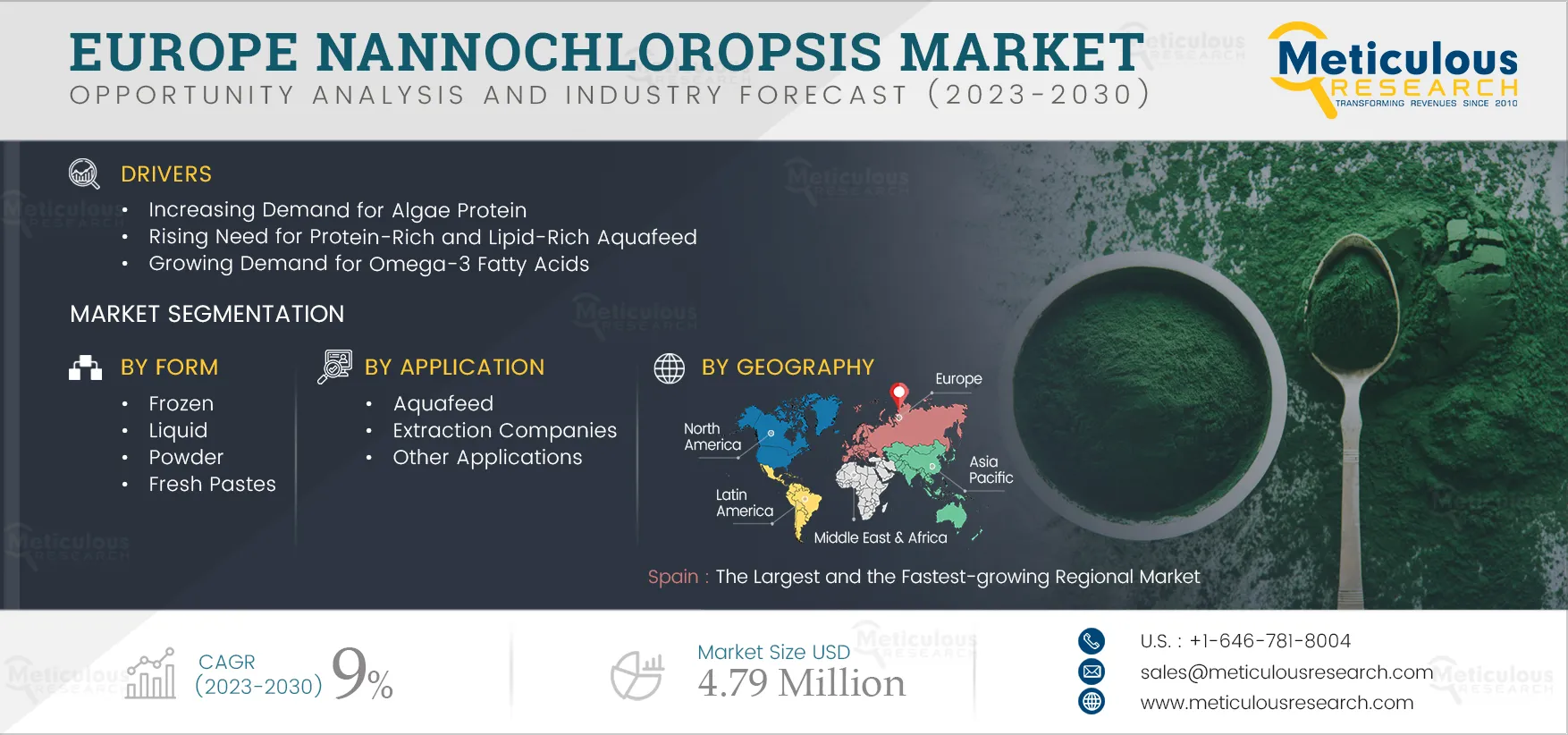
Table of contents
10 chapters · 69 sections · 86 pages · click to expandSegmental analysis
| Segment | Largest share (2023) | Fastest growth (2023–2030) |
|---|---|---|
| By Form | Frozen | — |
| By Application | Aquafeed | — |
By Form
- The frozen segment is expected to account for the largest share of the Europe Nannochloropsis market.
- The large market share of this segment is attributed to its wide range of applications in aquaculture hatcheries to establish the initial step of an artificial food chain, as frozen Nannochloropsis is rich in fatty acids (EPA, ARA).
- Frozen Nannochloropsis biomass application eases management in biomass production of lipid-enriched rotifers.
- It aids the artificial food chain with essential fatty acids, which are crucial for developing and cultivating fish larvae, with a relatively limited effort for algae production on the hatchery site.
- Moreover, this segment is expected to record the highest CAGR during the forecast period as frozen Nannochloropsis biomass promotes easy management in biomass production of lipid-enriched rotifers.
By Application
- The aquafeed segment is expected to account for the largest share of the Europe Nannochloropsis market.
- Nannochloropsis sp. is one of the most extensively used microalgae in aquaculture due to their nutritional value and the ability to produce valuable chemical compounds, such as pigments (zeaxanthin, astaxanthin, and canthaxanthin) and polyunsaturated fatty acids (EPA).
- Nannochloropsis sp. is one of the most extensively used microalgae in aquaculture.
- Besides having EPA as an important ω-3 fatty acid, Nannochloropsis sp. is a rich source of pigments such as β-carotene, violaxanthin, and zeaxanthin.
- Nannochloropsis is used in aquaculture as a valuable feed, providing polyunsaturated fatty acids, essential vitamins, and amino acids.
- This segment is also projected to record the highest CAGR during the forecast period due to the growing aquaculture industry in Europe, the rising aquafeed sector, and the increasing demand for protein-rich aquafeeds.
Geographic analysis
Europe
Fastest growthIn 2023, Spain is expected to account for the largest share of the Europe Nannochloropsis market. The large market share of Spain is attributed to the growing aquaculture industry and the necessity for aquafeed, government support to the fishery sector, and consumer inclination toward a healthier lifestyle. Moreover, demand from the biodiesel industry and the growing vegetarian population are expected to create lucrative growth opportunities for Nannochloropsis manufacturers in this country. Spain: The Largest and the Fastest-growing Regional Market
Competitive landscape
- BlueBioTech Group · Germany
- Reed Mariculture Inc. (U.S.)
- Necton S.A. · Portugal
- Astaxa GmbH · Germany
- Proviron Industries NV · Belgium
- Allmicroalgae Natural Products S.A. · Portugal
- Algatechnologies Ltd. (A Part of Solabia Group) · Israel
- Monzón Biotech S.L · Spain
- AlgaSpring B.V. · Netherlands
- Archimede Ricerche Srl · Italy
Frequently asked questions
The Europe Nannochloropsis market is projected to reach $4.79 million by 2030, at a CAGR of 9% during the forecast period.
Cite this report
Meticulous Research. (2023). Europe Nannochloropsis Market- Regional Opportunity Analysis and Industry Forecast (2023-2030) (Report No. MRFB - 104805). Meticulous Market Research Pvt. Ltd. https://www.meticulousresearch.com/product/europe-nannochloropsis-market-5489