Electric Power Steering Market (2025-2032)
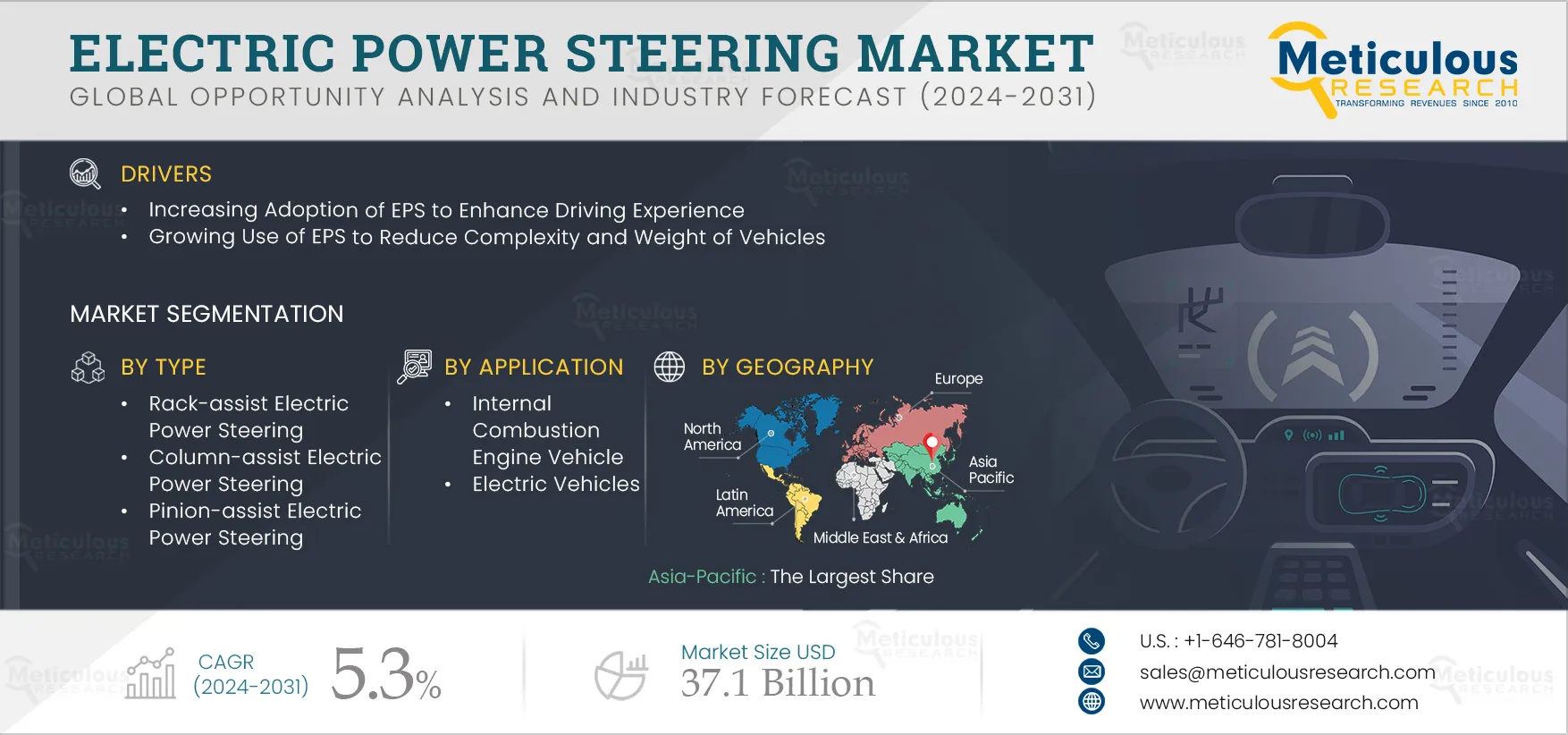
The Electric Power Steering Market is expected to reach $37.1 billion by 2032, at a CAGR of 5.3% from 2025 to 2032.
- Published
- May 2024
- Pages
- 250
- Format
- PDF + Excel
- Report ID
- MR-1185
- Base year
- 2024
- 2032 · FORECAST
- $37.10B
- 2032
- $37.10B
- CAGR 2025–2032
- 5.3%
2024 baseline · 2025–2032 forecast at 5.3% CAGR · hover a bar for the value
Report summary
| Particulars | Details |
|---|---|
| Number of Pages | 250 |
| Format | |
| Forecast Period | 2025–2032 |
| Base Year | 2024 |
| CAGR (Value) | 5.3% |
| Market Size (Value) | USD 37.1 Billion by 2032 |
| Segments Covered | By Type · Rack-assist Electric Power Steering · Column-assist Electric Power Steering · Pinion-assist Electric Power Steering · Single Pinion-assist EPS (SPEPS) · Dual Pinion-assist EPS (SPEPS) · By Application · Internal Combustion Engine Vehicle · Commercial Vehicles · Passenger Vehicles · Industrial Vehicles · Electric Vehicles · Commercial Vehicles · Passenger Vehicles |
| Countries Covered | North America (U.S., Canada), Europe (Germany, U.K., France, Italy, Netherlands, Spain, Sweden, and Rest of Europe), Asia-Pacific (China, India, Japan, South Korea, Singapore, Australia & New Zealand, Indonesia, and Rest of Asia-Pacific), Latin America (Brazil, Mexico, and Rest of Latin America), and the Middle East & Africa (Saudi Arabia, UAE, Israel, and Rest of the Middle East & Africa) |
| Key Companies | JTEKT Corporation (Japan), Robert Bosch GmbH (Germany), ZF Friedrichshafen AG (Germany), Nidec Corporation (Japan), Magna International Inc. (Canada), ContiTech Deutschland GmbH (Germany), HYCET Technology Co., Ltd (China), HL Mando Corporation (South Korea), Mitsubishi Electric Mobility Corporation (Japan), Nexteer Automotive Corporation (U.S.), NSK Ltd. (Japan), thyssenkrupp AG (Germany), Hitachi Astemo Americas, Inc. (A Subsidiary of Hitachi America Ltd) (U.S), and MAHLE GmbH (A Subsidiary of Mahle Stiftung GmbH) (Germany). |
Report overview
Segments covered: type, application. Regions: North America, Europe, Asia-Pacific, Latin America, Middle East & Africa.
The growth of the electric power steering market is driven by the increasing adoption of EPS to enhance driving experience and the growing use of EPS to reduce the complexity and weight of vehicles. Furthermore, the surging use of steer-by-wire technology and the growing adoption of electric vehicles are expected to generate growth opportunities for the players operating in this market.
Report infographic
Market dynamics
3 factors across 2 forcesIncreasing Adoption of EPS to Enhance Driving Experience
Electric power steering (EPS) has become increasingly popular in modern vehicles due to its advantages over traditional hydraulic power steering systems. This technology significantly enhances the driving experience in several ways, such as by improving fuel efficiency, enhanced steering precision and control, and variable steering assistance. Additionally, EPS systems have increasingly been integrated with ADAS, which provides features like lane-keeping assistance, adaptive cruise control, and automatic parking.
Moreover, the adoption of EPS systems reduces the physical efforts required to steer, which is especially beneficial in city driving and parking situations. The increasing adoption of EPS over hydraulic power steering is because EPS systems are generally more lightweight compared to hydraulic systems. This helps to reduce mechanical complexity and leads to lower maintenance requirements. Thus, the increasing adoption of EPS systems to enhance the driving experience helps to increase the demand for EPS during the forecast period.
Growing Use of EPS to Reduce Complexity and Weight of Vehicles
Electric power steering (EPS) reduces complexity and weight in vehicles by simplifying the steering system's design and eliminating the need for certain components used in traditional hydraulic power steering. An EPS system uses an electric motor to provide power steering assistance, which is directly mounted on the steering column or rack. Thus, this integration allows for a more straightforward design compared to the complex arrangement of hydraulic systems, which requires circulation and pressure management.
Moreover, EPS systems use lightweight materials in their construction, helping to reduce the weight of vehicles. Components such as electric motors, sensors, bearings, and electronic control units are designed to be compact and efficient, further minimizing the weight of vehicles. Thus, EPS helps reduce complexity and weight in vehicles by simplifying the steering system's design, eliminating hydraulic components, reducing maintenance requirements, and allowing for more flexible placement of parts.
Table of contents
10 chapters · 108 sections · 250 pages · click to expandSegmental analysis
| Segment | Largest share (2025) | Fastest growth (2025–2032) |
|---|---|---|
| By Type | Rack-assist electric power steering | Column-assist electric power steering |
| By Application | Segment's large market share | Electric vehicles |
By Type
- The electric power steering market is segmented into rack-assist electric power steering, column-assist electric power steering, and pinion-assist electric power steering.
- The rack-assist electric power steering segment is expected to account for the largest share of above 40.0% of the electric power steering market.
- The segment's large market share is attributed to the increasing adoption of rack-assist EPS to enhance steering precision; the increasing need to adjust the level of steering assistance based on vehicle speed and driving condition; and the rack-assist EPS to enhance fuel efficiency, steering response, and maintenance.
- Additionally, with the growing adoption of rack-assist EPS, several providers are increasingly launching (mREPS) systems to efficiently meet OEMs’ wide-ranging requirements for advanced steering systems.
- Additionally, with the growing adoption of rack-assist EPS, several providers are increasingly launching (mREPS) systems to efficiently meet OEMs’ wide-ranging requirements for advanced steering systems.
- For instance, in April 2024, Nexteer Automotive Corporation (U.S.) launched the Modular Rack-Assist Electric Power Steering (mREPS) system and expanded the company’s cost-effective, modular EPS offerings.
- Nexteer’s mREPS provides flexibility to efficiently meet OEMs’ wide-ranging requirements for advanced steering systems of heavier vehicles, EVs, and light commercial vehicles.
- However, the column-assist electric power steering segment is expected to register the highest CAGR during the forecast period.
- This segment's growth is attributed to the increasing adoption of column-assist EPS due to its compact design, the rising use of column-assist EPS to reduce vibration transmitted to the steering wheel, and the integration of column-assist EPS with advanced driver-assistance systems such as lane-keeping assist and adaptive cruise control.
By Application
- The electric power steering market is segmented into internal combustion engine vehicles and electric vehicles.
- The internal combustion engine vehicle segment is expected to account for the larger share of above 68.0% of the electric power steering market.
- The segment's large market share is attributed to the increasing adoption of EPS to enhance the driving experience in ICE vehicles; the rising use of EPS in ICE vehicles due to it being more energy-efficient compared to traditional hydraulic power steering systems; and the rising integration of EPS with various vehicle control systems such as stability control, lane-keeping assist, automatic parking.
- However, the electric vehicles segment is expected to register the highest CAGR during the forecast period.
- This segment's growth is attributed to the increasing adoption of EPS in EVs to improve safety and redundancy, the rising use of EPS in electric vehicles for energy efficiency and to reduce vehicle complexity and weight, and the EPS's ability to provide variable steering assistance, enabling lighter steering at low speed and stronger steering at high speed.
Geographic analysis
Asia-Pacific
Largest shareIn 2025, Asia-Pacific is expected to account for the largest share of above 36.0% of the electric power steering market. Asia-Pacific’s significant market share can be attributed to the growing penetration of EPS systems in major countries such as India, China, and Japan; the increasing production of electric vehicles; the growing use of EPS to reduce the complexity and weight of vehicles; new technological advancements such as steer-by-wire technology in EPS systems; and the increasing need of EPS systems in commercial vehicles due to heavier steering loads. Also, this market is expected to register the highest CAGR of above 7.0% during the forecast period.
Competitive landscape
The report offers a competitive analysis based on an extensive assessment of the leading players’ product portfolios, geographic presence, and key growth strategies adopted in the last 3–4 years. Some of the key players operating in the electric power steering market JTEKT Corporation (Japan), Robert Bosch GmbH (Germany), ZF Friedrichshafen AG (Germany), Nidec Corporation (Japan), Magna International Inc. (Canada), ContiTech Deutschland GmbH (Germany), HYCET Technology Co., Ltd (China), HL Mando Corporation (South Korea), Mitsubishi Electric Mobility Corporation (Japan), Nexteer Automotive Corporation (U.S.), NSK Ltd. (Japan), thyssenkrupp AG (Germany), Hitachi Astemo Americas, Inc. (A Subsidiary of Hitachi America Ltd) (U.S), and MAHLE GmbH (A Subsidiary of Mahle Stiftung GmbH) (Germany).
- June 2024
Nidec Corporation (Japan) launched an electric power steering motor power pack (EPS-PP). Nidec’s newly developed EPS-PP detects and corrects the motor’s and the EPS unit’s friction and torque ripple as they are generated to successfully solve the lingering issue of artificial steering feeling.
- December 2022
China Automotive Systems, Inc. (China) launched a new series of electric power steering systems for BYD Company Limited (China), a Chinese EV producer.
- JTEKT Corporation · Japan
- Robert Bosch GmbH · Germany
- ZF Friedrichshafen AG · Germany
- Nidec Corporation · Japan
- Magna International Inc. · Canada
- ContiTech Deutschland GmbH · Germany
- HYCET Technology Co., Ltd · China
- HL Mando Corporation · South Korea
- Mitsubishi Electric Mobility Corporation · Japan
- Nexteer Automotive Corporation (U.S.)
- NSK Ltd. · Japan
Frequently asked questions
The electric power steering market study focuses on market assessment and opportunity analysis through the sales of electric power steering across different regions and countries across different market segmentations. This study is also focused on competitive analysis for electric power steering based on an extensive assessment of the leading players’ product portfolios, geographic presence, and key growth strategies.
Cite this report
Meticulous Research. (2024). Electric Power Steering Market - Global Opportunity Analysis and Industry Forecast (2025-2032) (Report No. MR-1185). Meticulous Market Research Pvt. Ltd. https://www.meticulousresearch.com/product/electric-power-steering-market-5868