Edible Packaging Market (2025-2032)
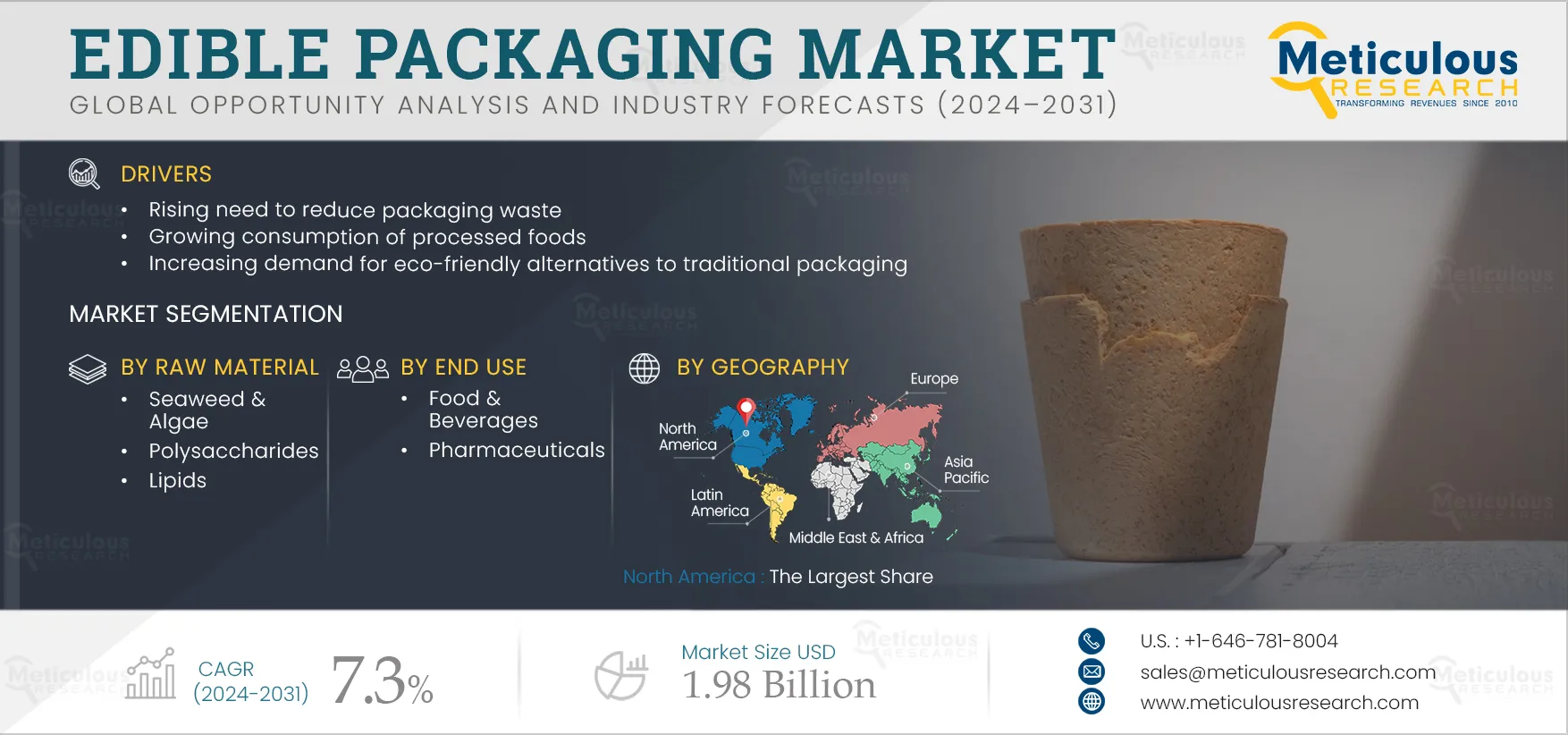
The Edible Packaging Market is projected to reach $1.98 billion by 2032, at a CAGR of 7.3% during the forecast period 2025–2032.
- Published
- Jun 2024
- Pages
- 200
- Format
- PDF + Excel
- Report ID
- MRFB - 1041250
- Base year
- 2024
- 2032 · FORECAST
- $1.98B
- 2032
- $1.98B
- CAGR 2025–2032
- 7.3%
2024 baseline · 2025–2032 forecast at 7.3% CAGR · hover a bar for the value
Key highlights
By Source: The Plant Segment to Dominate the Edible Packaging Market in 2025
By Raw Material: The Seaweed & Algae Segment to Dominate the Edible Packaging Market in 2025
By Packaging Process: The Antimicrobial Segment to Dominate the Edible Packaging Market in 2025
By End Use: The Pharmaceuticals Segment to Witness the Fastest Growth During the Forecast Period
Report summary
| Particulars | Details |
|---|---|
| Number of Pages | ~200 |
| Format | |
| Forecast Period | 2025–2032 |
| Base Year | 2024 |
| CAGR (Value) | 7.3% |
| Market Size (Value) | $1.98 Billion |
| Segments Covered | By Source · Plant · Animal · By Raw Material · Seaweed & Algae · Polysaccharides · Lipids · Other Raw Materials · By Packaging Process · Antimicrobial · Nanotechnology · Electrohydrodynamic · Coatings · Microbial · By End Use · Food & Beverages · Pharmaceuticals |
| Countries Covered | North America (U.S. and Canada), Europe (Germany, U.K., France, Italy, Spain, Poland, Netherlands, Switzerland, Belgium, Sweden, and Rest of Europe), Asia-Pacific (China, Japan, Australia, South Korea, India, Indonesia, Thailand, Malaysia, and Rest of Asia-Pacific), Latin America (Brazil, Mexico, Argentina, and Rest of Latin America), and the Middle East & Africa (UAE, Saudi Arabia, South Africa, and Rest of Middle East & Africa) |
| Key Companies Profiled | Notpla Limited (U.K.), Xampla Limited (U.K.), JRF Technology, LLC (U.S.), MonoSol, LLC (U.S.), Evoware (Indonesia), Nagase America LLC (U.S.), Devro Limited (U.K.), TIPA Corp. Ltd. (Israel), Lactips (France), Mantrose-Haeuser Co., Inc. (U.S.), Do Eat (Belgium), Amtrex Nature Care Pvt. Ltd. (India), Glanbia plc (Ireland), and Pace International, LLC (U.S.) |
Report overview
Segments covered: source, raw material, packaging process, end use. Regions: North America, Europe, Asia-Pacific, Latin America, Middle East & Africa.
The growth of the edible packaging market is primarily driven by the rising need to reduce packaging waste, the growing consumption of processed foods, and the increasing demand for eco-friendly alternatives to traditional packaging materials. However, the high costs of edible packaging materials and stringent regulatory requirements restrain the growth of this market. Moreover, advancements in packaging technologies and innovations & new product development in the edible packaging industry are expected to generate significant growth opportunities for the stakeholders in this market. However, handling, taste, and texture issues are a challenge in the edible packaging market. Additionally, functional edible packaging and sustainable packaging are the latest trends in the edible packaging market.
Report infographic
Market dynamics
5 factors across 3 forcesRising Need to Reduce Packaging Waste
Growing environmental concerns are increasing awareness about the adverse effects of traditional packaging materials, such as plastics. Food packaging waste is a significant environmental issue, contributing to the growing problem of plastic pollution and waste management challenges.
Edible packaging offers a sustainable alternative by providing packaging solutions that are not only biodegradable but also edible, reducing the amount of waste generated from packaging materials. Edible packaging also includes packaging films made of milk proteins, vitamins, proteins, and probiotics, which contain essential nutrients, can provide an oxygen barrier, and prevent the contamination of food.
Furthermore, governments and regulatory bodies are implementing policies and regulations aimed at reducing single-use plastics and promoting the use of eco-friendly packaging materials. In response, companies in the food & beverage industry are exploring edible packaging options as part of their sustainability strategies. Thus, the rising need to reduce packaging waste is increasing the adoption of edible packaging, driving the growth of this market.
Growing Consumption of Processed Foods
Processed foods come in various forms, such as snacks, ready-to-eat meals, and convenience foods, and require efficient & innovative packaging solutions to maintain freshness, extend shelf life, and ensure convenience for consumers. Edible packaging offers a unique solution by not only providing functional packaging but also adding value to the product. Nowadays, consumers are increasingly attracted to the novelty and sustainability aspects of edible packaging, as it aligns with their preference for convenient yet eco-friendly products.
Additionally, rapid urbanization and busy lifestyles have increased consumers’ reliance on processed foods. This trend has created a demand for packaging that not only meets functional requirements but also resonates with modern consumer preferences for sustainability and innovation. Edible packaging addresses these demands by offering a sustainable alternative to traditional packaging materials, making it an attractive option for both consumers and food manufacturers. Thus, the increasing consumption of processed foods, coupled with consumer demand for novelty and sustainability, is driving the adoption of edible packaging.
Table of contents
12 chapters · 128 sections · 200 pages · click to expandSegmental analysis
| Segment | Largest share (2025) | Fastest growth (2025–2032) |
|---|---|---|
| By Source | Plant | Plant |
| By Raw Material | Seaweed & Algae | Polysaccharides |
| By Packaging Process | Antimicrobial | — |
| By End Use | — | End Use: The Pharmaceuticals |
By Source
- The Plant Segment to Dominate the Edible Packaging Market in 2025
- The plant segment is expected to account for the larger share of 67.0% of the edible packaging market.
- The large market share of this segment can be attributed to rising concerns over single-use plastics, the growing adoption of veganism and vegetarianism, and governments’ & regulatory bodies’ implementation of increasingly stringent regulations and policies to reduce plastic pollution and promote sustainable practices.
- Moreover, the plant segment is also expected to record the highest growth rate during the forecast period 2025–2032.
- The growth of this segment is driven by the rising demand for plant-based foods due to their health benefits, such as the reduced risk of chronic diseases, including heart disease, diabetes, and obesity.
- Also, growing concerns over the environmental impacts of animal agriculture, including greenhouse gas emissions, deforestation, and water usage, are encouraging consumers to choose plant-based alternatives.
By Raw Material
- The Seaweed & Algae Segment to Dominate the Edible Packaging Market in 2025
- The seaweed & algae segment is expected to account for the largest share of 44.3% of the edible packaging market.
- The large market share of this segment can be attributed to the advantages of seaweed & algae, including their abundance, renewable nature, and sustainability.
- In addition, seaweed & algae are rich sources of natural polysaccharides, such as carrageenan, agar, and alginate, which possess excellent gelling, film-forming, and barrier properties.
- These properties make them ideal for producing edible packaging materials.
- However, the polysaccharides segment is projected to witness the highest growth rate during the forecast period 2025–2032.
- The growth of this segment is driven by the desirable properties of polysaccharides, such as biodegradability, cost-effectiveness, and non-toxicity.
By Packaging Process
- The Antimicrobial Segment to Dominate the Edible Packaging Market in 2025
- The antimicrobial segment is expected to account for the largest share of the edible packaging market.
- Antimicrobial packaging processes help inhibit the growth of harmful microorganisms, such as bacteria and fungi, thereby extending the shelf life of perishable foods and reducing the risk of foodborne illnesses.
- The increased focus on food safety drives the demand for antimicrobial packaging solutions in the edible packaging market.
By End Use
- The Pharmaceuticals Segment to Witness the Fastest Growth During the Forecast Period
- The food & beverages segment is expected to account for the larger share of 78.1% of the edible packaging market.
- Edible packaging is widely used in the food & beverage industries to package products, including fresh food, functional foods, baby food, dairy products, and bakery & confectionery products.
- The rising demand for processed foods and consumers’ changing lifestyles support the segment's expansion.
- Also, the increasing use of edible packaging to enhance the presentation and visual appeal of food & beverage products supports the growth of this segment.
- Edible packaging can be used for decorative purposes, such as in the form of edible wrappers for chocolates or garnishes for cocktails, to make them visually appealing and unique.
- However, the pharmaceuticals segment is projected to witness the higher growth rate during the forecast period 2025–2032.
- The growth of this segment is driven by the increasing emphasis on patient compliance and convenience.
- Edible packaging offers a user-friendly and easy-to-administer method for delivering medications, especially for individuals who may have difficulty swallowing pills or tablets.
- This innovative approach not only enhances the patient experience but also improves medication adherence, leading to better treatment outcomes.
- In addition, the increasing demand for capsules for packaging pharmaceutical and nutraceutical ingredients is driving the growth of this segment.
Geographic analysis
North America
Largest shareIn 2025, North America is expected to account for the largest share of 42.5% of the edible packaging market, followed by Europe, Asia-Pacific, Latin America, and the Middle East & Africa. The edible packaging market in North America is estimated to reach $513.7 million in 2025. North America’s significant market share can be attributed to the region’s well-established food processing industry, the presence of several key players in the region’s edible packaging sector, increased R&D related to edible packaging, and government funding to develop eco-friendly packaging projects. By Geography: North America to Dominate the Edible Packaging Market in 2025
Asia-Pacific
Fastest growthHowever, Asia-Pacific is slated to register the highest growth rate during the forecast period. The growth of this regional market is driven by consumers’ changing lifestyles, increasing disposable incomes, growing awareness about the benefits of edible packaging, and government efforts to ban single-use plastics in the region.
Competitive landscape
- January 2025
TIPA partnered with cannabis product company Wyld (U.S.) to use TIPA’s 608 home compostable laminate in individual wrapping for edibles, as well as in pouches and bags for outer parcels, in the U.S. and Canada.
- September 2024
Xampla launched a remarkable consumer brand, Morro, to develop bio-based and edible packaging solutions that can compete with plastics. The launch of this brand will enable food brands to make an easy switch from single-use plastics to the company’s breakthrough material.
- September 2021
Pace International introduced PrimaFresh 60 Organic (OR), a premium organic edible plant-based coating brand. The company developed the product specifically to enhance the fresh appeal of stone fruits through better management of dehydration.
- Notpla Limited (U.K.)
- Xampla Limited (U.K.)
- JRF Technology, LLC (U.S.)
- MonoSol, LLC (U.S.)
- Evoware · Indonesia
- Nagase America LLC (U.S.)
- Devro Limited (U.K.)
- TIPA Corp. Ltd. · Israel
- Lactips · France
- Mantrose-Haeuser Co., Inc. (U.S.)
- Do Eat · Belgium
- Amtrex Nature Care Pvt. Ltd. · India
- Glanbia plc · Ireland
- Pace International, LLC (U.S.)
Frequently asked questions
This report provides market sizes and forecasts for the edible packaging market based on source, raw material, packaging process, end use, and geography. It also includes the value analysis of various segments of the edible packaging market at the regional and country levels.
Cite this report
Meticulous Research. (2024). Edible Packaging Market - Global Opportunity Analysis and Industry Forecast (2025-2032) (Report No. MRFB - 1041250). Meticulous Market Research Pvt. Ltd. https://www.meticulousresearch.com/product/edible-packaging-market-5933