Dental 3D Printing Material Market (2024-2031)
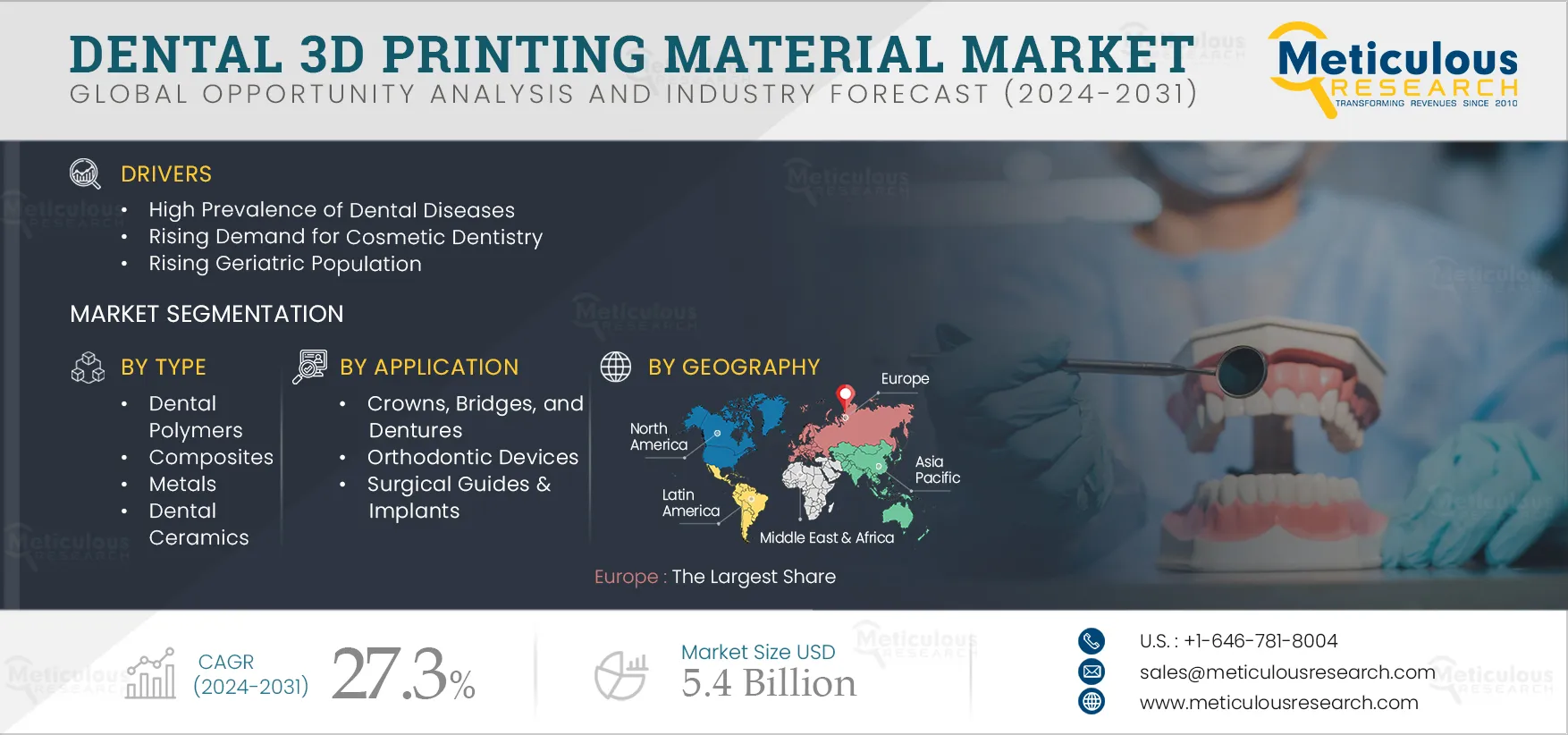
The Dental 3D Printing Material Market was valued at $0.8 billion in 2023. This market is expected to reach $5.4 billion by 2031, from an estimated $1 billion in 2024, at a CAGR of 27.3% during the forecast period 2024-2031. Dental 3D Printing Material Market Size & Forecast Advanced dental 3D printing
- Published
- May 2024
- Pages
- 190
- Format
- PDF + Excel
- Report ID
- MRHC - 104513
- Base year
- 2023
- 2023 · BASELINE
- $800.0M
- 2031
- $5.40B
- CAGR 2024–2031
- 27.3%
2023 baseline · 2024–2031 forecast at 27.3% CAGR · hover a bar for the value
Key highlights
The Dental 3D Printing Material Market was valued at $0.8 billion in 2023.
This market is expected to reach $5.4 billion by 2031, from an estimated $1 billion in 2024, at a CAGR of 27.3% during the forecast period 2024-2031.
The Dental Polymers Segment to Dominate the Dental 3D Printing Market
The crown, bridges, and dentures segment is expected to account for the largest share of 45.8% of the dental 3D printing material market.
In 2024, Europe is expected to account for the largest share of 39.3% of the dental 3D printing material market.
However, the market in Asia-Pacific is projected to register the highest growth rate of 29.5% during the forecast period.
Report summary
| Particulars | Details |
|---|---|
| Number of Pages | 190 |
| Format | |
| Forecast Period | 2024-2031 |
| Base Year | 2023 |
| CAGR | 27.3% |
| Estimated Market Size (Value) | $5.4 billion by 2031 |
| Segments Covered | By Type · Dental Polymers · Resins · Thermoplastics · Other Polymers · Composites · Metals · Dental Ceramics · Zirconia · Alumina · Other Ceramics · (Note1: Other polymers comprise polymer hydrogels, impression material like irreversible hydrocolloids- alginate, polysulfides, and silicone rubbers.) · (Note2: Other ceramics comprise calcium phosphate salts, glass ceramics, oxides of magnesium and titanium, leucite-reinforced glass ceramics, lithium silicate ceramics, and silicates.) · By Application · Crowns, Bridges, and Dentures · Orthodontic Devices · Surgical Guides & Implants · Other Applications · (Note: Other applications comprise dental impression trays, try-ins, metal frameworks, veneers, and temporary restorations.) |
| Countries Covered | North America (U.S. and Canada), Europe (Germany, France, U.K., Italy, Spain, Switzerland, Sweden, Poland, and Rest of Europe), Asia-Pacific (China, Japan, India, Australia, South Korea, and the Rest of Asia-Pacific), Latin America (Brazil, Mexico, Rest of Latin America) and the Middle East & Africa |
| Key Companies | The key players operating in the Dental 3D Printing Material market are 3D Systems Corporation (U.S.), EnvisionTEC (U.S.), DWS S.r.l. (Italy), Keystone Industries (U.S.), VOCO GmbH (U.S.), DMG Chemisch-Pharmazeutische Fabrik GmbH (Germany), Stratasys Ltd. (Israel), Prodoways Tech (France), Formlabs Inc. (U.S.), DENTSPLY SIRONA Inc. (U.S.), 3M Company (U.S.), Den-Mat Holdings, LLC (U.S.), Shandong Huge Dental Material Co., Ltd. (China), Ultradent Products, Inc. (U.S.), and Straumann Holding AG (Switzerland). |
Report overview
Segments covered: type. Regions: North America, Europe, Asia-Pacific.
Advanced dental 3D printing material are non-toxic and biocompatible. Such properties enhance their applications in cosmetic dentistry and other applications. The high prevalence of dental diseases like edentulism, increasing demand for cosmetic dentistry, growth in the geriatric population, and advancements in 3D printing technology propel market growth. In addition, advancements in the resins used for dental 3D printing and increasing awareness and acceptance of computer-aided design/computer-aided manufacturing (CAD/CAM) technologies are expected to create market growth opportunities.
Report infographic
Market dynamics
5 factors across 2 forcesRising Demand for Cosmetic Dentistry
Cosmetic procedures are experiencing a surge in demand due to increasing awareness about oral health and rapid technological advancements. This demand is particularly prominent among two age groups: 24–40 and 57–75. Individuals aged 24–40 predominantly seek dental aesthetics, such as implants and veneers, to achieve a more youthful appearance. Meanwhile, those aged 57–75 often require dentures. The shifting dynamics within the industry are primarily driven by patients' preferences, which have evolved from basic hygiene to enhancing aesthetics. People are increasingly willing to invest in themselves, leading to a growing demand for cosmetic dentistry. Factors contributing to this trend include baby boomers with high disposable incomes, the younger generation seeking ideal appearances for career advancement in industries like business or entertainment, and advancements in technology.
The American Academy of Cosmetic Dentistry states that around 99% of people think a smile is their most important social asset. In 2018, the Harley Street Emporium surveyed more than 1,000 U.K. residents over 18 years of age. The survey concluded that the most desired improvement people want to make is cosmetic dentistry. Furthermore, 43% of the people who participated in the survey wanted to improve their teeth with dental treatments.
The introduction and application of two significant concepts, biomimetics and biocompatibility, have set the stage for the future of the cosmetic dentistry industry. The rise in the disposable income to spend on appearance, social media, celebrity influence, and technological advancements in cosmetic dentistry, such as CAD/CAM systems (Computer-Aided Design and Computer-Aided Manufacturing), are the factors contributing to the increasing demand for cosmetic dentistry.
Advancements in 3D Printing Technology
3D printing technology has accelerated progress in the dental sector, mainly due to advancements in computer-aided design (CAD) and enhanced imaging techniques such as cone beam computed tomography (CBCT) and magnetic resonance imaging (MRI). These techniques allow for planning and printing dental and maxillofacial prostheses to restore and replace lost structures. Previously, dentistry was mainly influenced by subtractive manufacturing, also known as milling. However, it could not reproduce complex models as it did not consider internal structures. Modern CAD software uses intricate algorithmic designs and artificial intelligence to help model any object or tissue to reproduce it as required.
3D-printed products are high-quality and cost-competitive, which drives the adoption of 3D printing technology in the dental sector. Additionally, today’s advanced 3D printing technology can directly print a transparent product, eliminating the grinding and buffing steps required with older 3D-printed dental products. Earlier, dental practices had to contract a third party to fulfill various applications; however, currently, many practices can handle their 3D printing needs in-house or through lower-cost avenues. Such advancements in technology are expected to drive the demand for 3D printing material for dental applications.
High Prevalence of Dental Diseases
Oral diseases are caused by various modifiable risk factors, including sugar consumption, tobacco use, alcohol use, and poor hygiene. The surge in tobacco use and uptake of unhealthy food are expected to increase the incidence of oral diseases in the coming years. According to the WHO, nearly 3.5 billion people worldwide have oral diseases, with caries of permanent teeth (2 billion people) being the most common. Globally, dental caries remains a major public health issue and is the fourth most expensive chronic disease in terms of treatment costs. It causes pain and infection and can eventually result in tooth loss if left untreated, negatively impacting a person’s general well-being and quality of life.
Periodontal disease is prevalent in both developed and developing countries and affects about 20–50% of the global population. The high prevalence of periodontal disease in adolescents, adults, and older individuals makes it a major public health concern. Several risk factors, such as smoking, poor oral hygiene, diabetes, medication, age, hereditary, and stress, are linked to periodontal diseases. Evidence also relates periodontal disease to systemic diseases such as cardiovascular diseases and diabetes, as well as to adverse pregnancy outcomes. Thus, the high prevalence of dental diseases is driving the market.
Rising Geriatric Population
The age structure of the global population is in a state of constant change, driven by increasing life expectancy and decreasing fertility levels. People are living longer, and both the number and the share of older adults in the global population are rising. According to the United Nations, the global aging population is projected to increase from 727 million in 2020 to 1,549 million in 2050. Globally, the share of the elderly population (aged 65 years or over) is expected to increase from 9.3% in 2020 to around 16.0% in 2050. The demographic of older adults (65 years of age and older) is growing, which is expected to boost the demand for dental procedures in the coming years. The rising geriatric population is expected to increase the demand for advanced dental 3D printing material.
Table of contents
10 chapters · 99 sections · 190 pages · click to expandSegmental analysis
| Segment | Largest share (2024) | Fastest growth (2024–2031) |
|---|---|---|
| By Material Type | Dental Polymers | Dental composites |
| By Application | Crown, Bridges, and Dentures | — |
By Material Type
- The Dental Polymers Segment to Dominate the Dental 3D Printing Market
- The dental polymers segment is expected to account for the largest share of 45.4% of the dental 3D printing material market.
- This segment’s large market share can be attributed to advancements in engineering and nanotechnology and the benefits offered by dental polymers, such as adaptability to diverse environments, biocompatibility, stability in oral conditions, and cost-effectiveness.
- However, the dental composites segment is projected to witness the highest growth rate of 28.4% during the forecast period of 2024–2031.
- Similar to polymers, a major advantage of composites is manipulating the manufacturing process to yield the desired material properties.
- Advances in composites include the introduction of fiber-reinforced composites, self-repairing composites, condensable composites/packable composites, organically modified ceramic oligomers, and hybrid ceramics conventional material additives, altering their physical properties.
- Such advances are expected to drive the growth of this segment.
By Application
- The crown, bridges, and dentures segment is expected to account for the largest share of 45.8% of the dental 3D printing material market.
- This segment’s large market share can be attributed to the advantages provided by 3D printing in the fabrication of crowns, bridges, and dentures.
- These benefits include minimal material wastage, superior fitting accuracy, and excellent detail reproducibility.
Geographic analysis
Europe
Largest shareIn 2024, Europe is expected to account for the largest share of 39.3% of the dental 3D printing material market. Europe’s significant market share is attributed to the rising adoption of digital technologies in dental laboratories, rising demand for cosmetic dentistry, growth in the geriatric and edentulous population, rising number of dental implant procedures, and rise in dental tourism. By Geography: In 2024, Europe is Expected to Dominate the Dental 3D Printing Market
Asia-Pacific
Fastest growthHowever, the market in Asia-Pacific is projected to register the highest growth rate of 29.5% during the forecast period. The growth of this regional market can be attributed to favorable government initiatives aimed at enhancing oral health access and awareness, rising disposable incomes, a high prevalence of dental caries and other dental disorders, and an increasing number of edentulous patients among the geriatric population.
Competitive landscape
- February 2024
Stratasys Ltd. (U.S.) partnered with Express Dental Laboratory (U.S) to provide partial and full dentures to more than 55 people in need.
- January 2024
Formlabs (U.S) launched two new 3D printing material and a new accessory. These products aim to increase production with less hassle, low resin costs, and reduced waste.
- November 2023
Axtra3D Inc. (U.S) partnered with 3D Systems Corporation (U.S.) and Oqton (U.S). Through this partnership, Axtra3D integrated its 3D printing systems with Oqton’s automation software and 3D Systems’ NextDent dental material.
- March 2023
3D Systems Corporation (U.S.) launched two dental 3D printing material, NextDent Base and NextDent Cast.
- November 2023
B9Creations, LLC (U.S.) launched new dental 3D printers and material with a range of specialized resins.
- 3D Systems Corporation (U.S.)
- EnvisionTEC (U.S.)
- DWS S.r.l · Italy
- Keystone Industries (U.S.)
- VOCO GmbH (U.S.)
- DMG Chemisch-Pharmazeutische Fabrik GmbH · Germany
- Stratasys Ltd. · Israel
- Prodoways Tech · France
- Formlabs Inc. (U.S.)
- DENTSPLY SIRONA Inc. (U.S.)
- 3M Company (U.S.)
- Den-Mat Holdings, LLC (U.S.)
- Shandong Huge Dental Material Co., Ltd. · China
- Ultradent Products, Inc. (U.S.)
- Straumann Holding AG · Switzerland
Frequently asked questions
The dental 3D printing material market report covers qualitative analysis and market sizing based on type and application. This report involves the analysis of various segments of dental 3D printing materials at the regional and country levels. The report also provides insights on factors impacting market growth, related market analysis, pricing analysis, and Porter’s five forces analysis.
Cite this report
Meticulous Research. (2024). Dental 3D Printing Material Market - Global Opportunity Analysis And Industry Forecast (2024-2031) (Report No. MRHC - 104513). Meticulous Market Research Pvt. Ltd. https://www.meticulousresearch.com/product/dental-3d-printing-material-market-5204