
Biosurfactants Market (2026-2036)
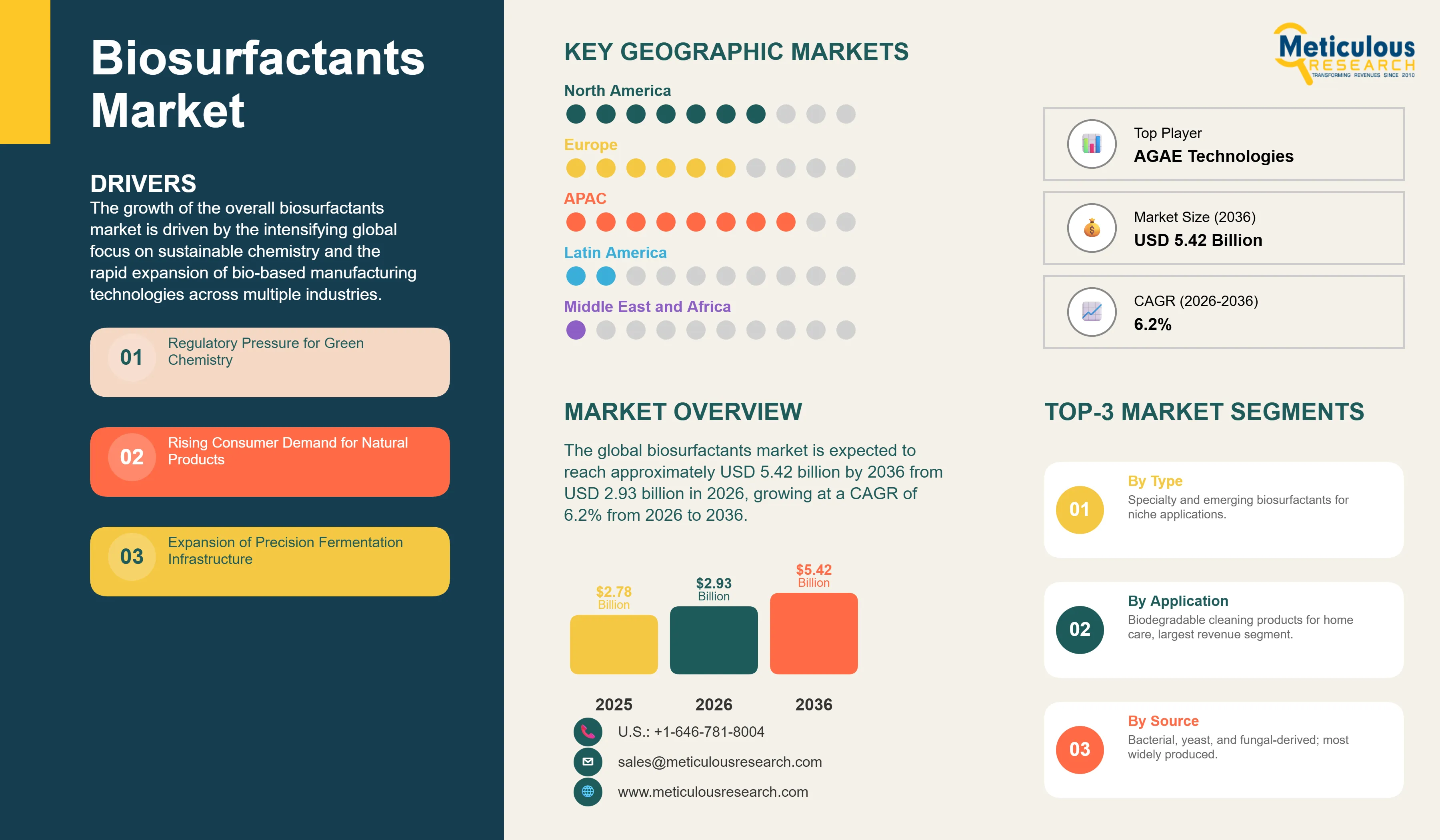
The global biosurfactants market was valued at USD 2.78 billion in 2025. The market is expected to reach approximately USD 5.42 billion by 2036 from USD 2.93 billion in 2026, growing at a CAGR of 6.2% from 2026 to 2036.
- Published
- Feb 2026
- Pages
- 284
- Format
- PDF + Excel
- Report ID
- MR-1722
- Base year
- 2025
- 2025 · BASELINE
- $2.78B
- 2036
- $5.42B
- CAGR 2026–2036
- 6.2%
2025 baseline · 2026–2036 forecast at 6.2% CAGR · hover a bar for the value
Key highlights
In terms of revenue, the global biosurfactants market is projected to reach USD 5.42 billion by 2036.
The market is expected to grow at a CAGR of 6.3% from 2026 to 2036.
Europe dominates the global biosurfactants market with the largest market share in 2026, driven by stringent environmental regulations and the presence of leading chemical innovators in Germany, Belgium, and the United Kingdom.
Asia-Pacific is expected to witness the fastest growth during the forecast period, supported by massive investments in bio-manufacturing infrastructure and the rapid adoption of green chemistry solutions in China, India, and Japan.
By type, the glycolipids segment holds the largest market share in 2026, particularly driven by rhamnolipids and sophorolipids in household and personal care applications.
By application, the household detergents segment holds the largest market share in 2026, due to the rising demand for biodegradable cleaning products and the increasing consumer preference for sustainable home care solutions.
By source, the microbial biosurfactants segment holds the largest share of the overall market in 2026.
Report summary
| Particulars | Details |
|---|---|
| Market Size by 2036 | USD 5.42 Billion |
| Market Size in 2026 | USD 2.93 Billion |
| Market Size in 2025 | USD 2.78 Billion |
| Market Growth Rate (2026-2036) | CAGR of 6.3% |
| Format | PDF, Excel & Cloud Portal · 284 pages |
| Dominating Region | Europe |
| Fastest Growing Region | Asia-Pacific |
| Base Year | 2025 |
| Forecast Period | 2026 to 2036 |
| Segments Covered | Type, Application, Source, and Region |
| Regions Covered | North America, Europe, Asia-Pacific, Latin America, and Middle East & Africa |
Report overview
Segments covered: type, application, source.
The growth of the overall biosurfactants market is driven by the intensifying global focus on sustainable chemistry and the rapid expansion of bio-based manufacturing technologies across multiple industries. As chemical manufacturers and consumer goods companies seek to integrate more environmentally responsible ingredients into product formulations and reduce carbon footprints, biosurfactant infrastructure has become essential for maintaining regulatory compliance and meeting consumer expectations for green products. The rapid expansion of precision fermentation infrastructure and the increasing need for biodegradable alternatives in household and industrial cleaning applications continue to fuel significant growth of this market across all major geographic regions.
Biosurfactants are important compounds that use biological production methods to deliver effective cleaning and better environmental profiles through naturally made molecular structures. These systems include integrated fermentation processes, purification technologies, and formulation capabilities aimed at replacing petrochemical surfactants while improving sustainability throughout the product lifecycle. The market features high-efficiency glycolipid molecules such as rhamnolipids and sophorolipids, along with specific lipopeptide variants that greatly enhance biodegradability and lower aquatic toxicity in effective cleaning and personal care settings. These systems are essential for formulators looking to improve their product sustainability and meet strict safety and regulatory standards.
The market offers a wide range of solutions, from basic single-strain fermentation systems for glycolipid production to complex multi-organism setups and integrated biorefinery ideas. These systems increasingly use advanced components like continuous fermentation reactors and membrane-based purification to ensure cost-effective production while maintaining product purity and consistent quality. The ability to provide stable, high-performance surfactancy with minimal environmental impact has made biosurfactant technology the preferred choice for manufacturers focused on sustainability and regulatory acceptance.
The global chemical and consumer goods sectors are actively working to switch to renewable ingredients, intending to meet bio-based content targets and carbon neutrality goals. This push has led to a rise in the use of precision fermentation solutions, with strain engineering and process optimization helping to stabilize the economics of commercial-scale biosurfactant manufacturing. Meanwhile, the rapid growth in the green cleaning and natural personal care markets is increasing the demand for high-purity, certified sustainable surfactant solutions.
Report infographic
Market dynamics
4 factors across 3 forcesRegulatory Pressure for Green Chemistry and Consumer Demand for Natural Products
A key driver of the biosurfactants market is the rapid movement of the global chemical industry toward sustainable, bio-based ingredient platforms. Global demand for biodegradable formulations, reduced aquatic toxicity, and renewable carbon content has created significant incentives for the adoption of biosurfactant infrastructure. The trend toward "green label" certification and the integration of bio-based surfactants into unified formulation platforms drive manufacturers toward scalable solutions that biosurfactants can uniquely provide. It is estimated that as regulatory frameworks for chemical safety tighten and consumer adoption of eco-labeled products rises through 2036, the need for robust, certified sustainable surfactants increases significantly; therefore, advanced glycolipid molecules and optimized fermentation processes, with their ability to ensure high-performance cleaning with minimal environmental impact, are considered a crucial enabler of modern sustainable chemistry strategies.
Table of contents
10 chapters · 112 sections · 284 pages · click to expandSegmental analysis
| Segment | Largest share (2026) | Fastest growth (2026–2036) |
|---|---|---|
| By Type | Glycolipids | — |
| By Application | Household Detergents | Personal care |
| By Source | Microbial Biosurfactants | — |
By Type
- The glycolipids segment accounts for a significant portion of the overall biosurfactants market in 2026.
- This is mainly attributed to the versatile use of these molecules in supporting high-performance cleaning, excellent foaming characteristics, and superior mildness profiles within modern household and personal care formulations.
- These systems offer the most comprehensive way to ensure regulatory compliance across diverse application requirements.
- The household detergents and personal care sectors alone consume a large share of glycolipid biosurfactants, with major commercial launches in Europe and North America demonstrating the technology's capability to handle demanding performance specifications.
- However, the lipopeptides segment is expected to grow at a rapid CAGR during the forecast period, driven by the growing need for antimicrobial functionality and specialized agricultural applications in crop protection and soil enhancement.
By Application
- The household detergents segment holds the largest share of the overall market in 2026.
- This is primarily due to the massive volume of cleaning product formulations and the rigorous performance standards required for effective soil removal and fabric care.
- Current large-scale consumer goods manufacturers are increasingly specifying bio-based surfactant platforms to ensure compliance with global environmental standards and consumer expectations for sustainable household products.
- The personal care segment is expected to witness the fastest growth during the forecast period.
- The shift toward natural beauty formulations and the complexity of multi-functional cosmetic systems are pushing the requirement for advanced biosurfactant solutions that can handle varied formulation chemistries and deliver gentle cleansing while ensuring absolute safety for skin contact applications.
By Source
- The microbial biosurfactants segment holds the largest share of the global biosurfactants market in 2026.
- This leadership comes from the effective scalability of fermentation-based production, the ability to achieve high product yields, and the established regulatory acceptance of ingredients derived from microbes.
- This makes it the preferred method for producing biosurfactants on a large scale.
- The demand for rhamnolipid and sophorolipid production drives large-scale operations.
- Companies like Evonik Industries and Jeneil Biotech provide advanced fermentation platforms that ensure reliable performance in commercial settings.
- However, the plant-based biosurfactants segment is expected to grow steadily through 2036.
- This growth is driven by an increase in applications for food-grade formulations and a rising consumer preference for plant-based ingredients.
- Manufacturers are under pressure to enhance extraction and purification processes for high-volume applications.
- Plant-based saponins and lecithins offer a natural alternative for food emulsification and pharmaceutical uses.
Geographic analysis
Europe
Largest shareEurope holds the largest share of the global biosurfactants market in 2026. This dominance is mainly due to strict environmental regulations, advanced fermentation infrastructure, and the presence of top chemical innovators, especially in Germany, Belgium, and the United Kingdom. The European Union accounts for a significant portion of global biosurfactant production. Its role as a leading adopter of bio-based chemistry and circular economy principles supports continuous growth. Leading manufacturers like BASF, Evonik Industries, and Solvay, along with a strong green chemistry supply chain, create a solid market for both commodity and specialty biosurfactant solutions.
North America
Asia-Pacific and North America together make up a large share of the global biosurfactants market. The growth in these regions mainly results from the need for sustainable chemical alternatives in consumer goods and industrial cleaning. In North America, leadership in precision fermentation technology and the drive for bio-based chemical innovations encourage the use of high-performance biosurfactant solutions. The United States and Canada are leading the way, focusing on incorporating sustainable surfactant solutions into consumer products and advanced industrial cleaning systems. This ensures strong environmental performance and meets regulatory requirements.
Asia-Pacific
In Asia-Pacific, the demand for advanced biosurfactant systems is largely due to the expansion of large-scale manufacturing capabilities and the growth of bio-manufacturing clusters in China, India, and South Korea.
Competitive landscape
- BASF SE
- Evonik Industries AG
- Solvay S.A.
- Stepan Company
Frequently asked questions
The global biosurfactants market is expected to grow from USD 2.93 billion in 2026 to USD 5.42 billion by 2036.
Cite this report
Meticulous Research. (2026). Biosurfactants Market - Global Opportunity Analysis and Industry Forecast (2026-2036) (Report No. MR-1722). Meticulous Market Research Pvt. Ltd. https://www.meticulousresearch.com/product/biosurfactants-market-6405