Biodiversity and Natural Capital Credit Market (2025-2032)
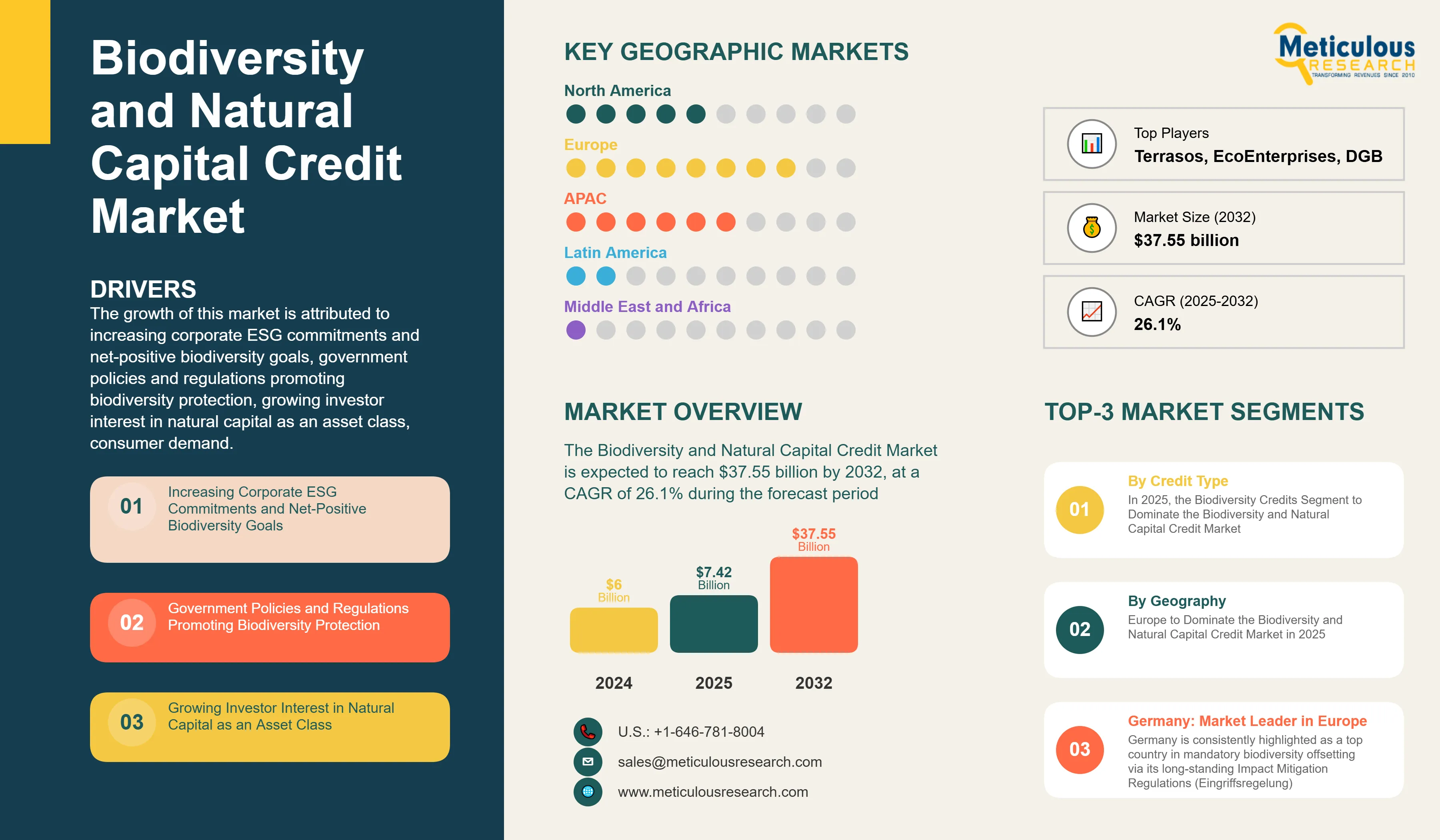
The Biodiversity and Natural Capital Credit Market was valued at $6.0 billion in 2024. This market is expected to reach $37.55 billion by 2032 from an estimated $7.42 billion in 2025, at a CAGR of 26.1% during the forecast period of 2025–2032. Biodiversity and Natural Capital Credit Market Size & Forecast The
- Published
- Apr 2025
- Pages
- 130
- Format
- PDF + Excel
- Report ID
- MR-1471
- Base year
- 2024
- 2024 · BASELINE
- $6.00B
- 2032
- $37.55B
- CAGR 2025–2032
- 26.1%
2024 baseline · 2025–2032 forecast at 26.1% CAGR · hover a bar for the value
Key highlights
The Biodiversity and Natural Capital Credit Market was valued at $6.0 billion in 2024.
This market is expected to reach $37.55 billion by 2032 from an estimated $7.42 billion in 2025, at a CAGR of 26.1% during the forecast period of 2025–2032.
The biodiversity credits segment is expected to account for the largest share of the biodiversity and natural capital credit market.
In 2025, Europe is expected to account for the largest share of the biodiversity and natural capital credit market.
However, the Asia-Pacific region is poised to record the highest CAGR during the forecast period, owing to rapid economic development, urbanization, and the growing recognition of the region's environmental challenges.
Report summary
| Particulars | Details |
|---|---|
| Number of Pages | 130 |
| Format | |
| Forecast Period | 2025–2032 |
| Base Year | 2024 |
| CAGR (Value) | 26.1% |
| Market Size (Value) in 2025 | USD 7.42 Billion |
| Market Size (Value) in 2032 | USD 37.55 Billion |
| Segments Covered | By Credit Type · Biodiversity Credits · Habitat/Ecosystem Conservation Credits · Species conservation Credits · Restoration Credits · Avoided Loss Credits · Natural Capital Credits · Carbon Sequestration · Watershed Services · Soil Quality Improvement · Pollination Services · Hybrid/Bundled Credits · Combined Carbon and Biodiversity Credits · Ecosystem Service Packages · Landscape-level Conservation Credits |
| Countries Covered | North America (U.S., Canada), Europe (Germany, U.K., France, Spain, Netherlands, Rest of Europe), Asia-Pacific (Japan, China, India, South Korea, Indonesia, Australia, Rest of Asia-Pacific), Latin America (Mexico, Brazil, Argentina, Rest of Latin America), and the Middle East & Africa |
| Key Companies | Terrasos SAS (Colombia), BioCarbon Partners LP. (Zambia), Ekos Kāmahi Ltd (New Zealand), Climate Asset Management Limited (U.K.), Biodiversity Solutions Ltd (Uganda), EcoEnterprises Fund (U.S.), Zero Imprint Ltd. (U.K.), New Forests Advisory Pty Limited (Australia), GreenVest (U.S.), Wildlife Works Services (U.S.), Nature Metrics Ltd (U.K.), GreenCollar Group (Australia), Earthbanc (Denmark), DGB GROUP N.V. (Netherlands), The Landbanking Group (Austria), ClimateTrade (Spain), CreditNature Ltd (U.K.), and South Pole (Australia). |
Report overview
Segments covered: type. Regions: North America, Europe, Asia-Pacific, Latin America.
The growth of this market is attributed to increasing corporate ESG commitments and net-positive biodiversity goals, government policies and regulations promoting biodiversity protection, growing investor interest in natural capital as an asset class, consumer demand for environmentally responsible products, and international frameworks such as the Kunming-Montreal Global Biodiversity Framework.
Moreover, integration with carbon markets for bundled credits, technological advancements in biodiversity monitoring and verification, expansion into marine and freshwater ecosystems, development of biodiversity credit registries and exchanges, and growth of biodiversity-linked financial instruments are expected to offer growth opportunities for the players operating in this market.
Furthermore, increasing use of technology (remote sensing, eDNA, AI) for verification, growth of blockchain-based solutions for transparency, rise of jurisdictional and landscape approaches, development of biodiversity credit ratings systems, and integration with climate finance and natural climate solutions are major trends in the global biodiversity and natural capital credit market.
However, Lack of standardized metrics and methodologies for measurement, Limited regulatory frameworks in many regions, High transaction costs and market fragmentation, Challenges in ensuring long-term conservation outcomes, and Verification and additionality concerns are expected to hinder the growth of this market.
Report infographic
Market dynamics
4 factors across 3 forcesIncreasing Corporate ESG Commitments and Net-Positive Biodiversity Goals Driving the Biodiversity and Natural Capital Credit Market
As businesses face mounting pressure from stakeholders—investors, regulators, and consumers—to address climate change and environmental degradation, many companies are making more ambitious ESG commitments. These commitments often involve not just reducing carbon emissions but also enhancing biodiversity and protecting natural ecosystems.
One of the ways companies are working to achieve these goals is by investing in biodiversity and natural capital projects. These projects include initiatives focused on restoring ecosystems, protecting endangered species, and maintaining ecosystem services, such as water purification, pollination, and soil fertility. The biodiversity and natural capital credit market provides a platform for companies to purchase credits that represent measurable environmental benefits generated by these types of projects. This market, which is still evolving, is increasingly seen as a valuable tool for companies to offset their environmental impact and contribute positively to global biodiversity.
As the demand for biodiversity and natural capital credits grows, companies are increasingly integrating these assets into their corporate sustainability strategies. The credits allow businesses to demonstrate their environmental stewardship, meet regulatory requirements, and communicate progress on their ESG commitments. Additionally, with an increasing recognition of the economic value of biodiversity and natural capital, more organizations are adopting net-positive biodiversity goals—aiming not just to minimize their harm to the environment but to actively contribute to its restoration and enhancement.
Finally, the growing integration of biodiversity into corporate strategies and the development of the biodiversity and natural capital credit market signal a positive shift toward a more sustainable, nature-positive global economy. This trend is expected to accelerate as more businesses, investors, and governments align ambitious environmental goals that include the preservation and restoration of natural capital.
International Frameworks such as the Kunming-Montreal Global Biodiversity Framework
International frameworks like the Kunming-Montreal Global Biodiversity Framework play a pivotal role in boosting demand for biodiversity and natural capital credits. Adopted in 2022, this framework sets ambitious targets to halt biodiversity loss and restore ecosystems by 2030. It provides a unified approach for countries to address biodiversity challenges, emphasizing conservation, sustainable resource use, and financial support for nature-positive initiatives.
The framework serves as a catalyst for corporations and investors to accelerate their involvement in biodiversity conservation. It encourages nations and businesses to align their activities with global biodiversity goals, using market-based instruments such as biodiversity credits. These credits represent verified environmental actions like habitat restoration or species protection, which companies can purchase to offset negative impacts or support conservation directly.
As the Kunming-Montreal framework strengthens national and corporate commitments to biodiversity, the demand for biodiversity credits is expected to rise. Companies seeking to comply with international standards or enhance their ESG profiles are increasingly turning to these credits. This surge in demand reflects a broader global shift toward integrating biodiversity considerations into business models and investment strategies. Ultimately, frameworks like Kunming-Montreal drive financial flows into nature-based solutions, catalyzing a more sustainable, nature-positive economy.
While biodiversity credits are gaining traction, they differ from biodiversity offsets, which are compliance-driven and used to compensate for unavoidable environmental damage. Biodiversity credits, on the other hand, are voluntary investments in biodiversity conservation, offering indirect benefits such as supply chain protection and reputational gains. Despite their potential, challenges remain, including the need for standardized metrics and robust governance frameworks to ensure the integrity and effectiveness of biodiversity credits.
Table of contents
9 chapters · 108 sections · 130 pages · click to expandSegmental analysis
| Segment | Largest share (2025) | Fastest growth (2025–2032) |
|---|---|---|
| By Credit Type | Biodiversity Credits | Hybrid/bundled credits |
By Credit Type
- The biodiversity credits segment is expected to account for the largest share of the biodiversity and natural capital credit market.
- The large market share of this segment is attributed to the increasing awareness and demand for ecosystem preservation to mitigate the impacts of climate change and human activities on biodiversity.
- Governments and private sector entities are investing heavily in protecting natural habitats, and regulatory frameworks across various regions are becoming more aligned with biodiversity conservation goals.
- Furthermore, these credits are increasingly being integrated into corporate sustainability strategies as businesses are called to balance economic growth with environmental responsibility.
- The rise of international initiatives like the Convention on Biological Diversity (CBD) has propelled habitat/ecosystem conservation as a critical pillar in the global conservation agenda.
- However, the hybrid/bundled credits segment is projected to register the highest CAGR during the forecast period due to increasing recognition that ecosystem-based solutions can simultaneously address both climate change and biodiversity loss.
- The ability to purchase credits that cover multiple aspects of environmental conservation appeals to a wide range of stakeholders, from corporations seeking more comprehensive sustainability solutions to governmental bodies implementing integrated environmental policies.
- Furthermore, the rise of cross-sector collaboration among environmental organizations, companies, and governments is accelerating the adoption of hybrid credits, making them a key driver in the transition to a more integrated approach to ecosystem service management.
Geographic analysis
Europe
Largest shareIn 2025, Europe is expected to account for the largest share of the biodiversity and natural capital credit market. The market growth in Europe is primarily driven by the robust regulatory frameworks, established environmental policies, and substantial financial investments in sustainability and conservation efforts. The European Union's Green Deal, which includes ambitious goals to reduce carbon emissions and protect biodiversity, has stimulated market growth. Moreover, European countries have pioneered efforts to integrate natural capital into national accounting systems, leading to a high demand for biodiversity credits. Countries like Germany, the Netherlands, and France are at the forefront of using biodiversity and natural capital credits for environmental protection and climate goals. This region also benefits from a growing pool of investors and industries eager to meet sustainability targets through credible environmental credit systems. In 2025, Europe to Dominate the Biodiversity and Natural Capital Credit Market
Asia-Pacific
Fastest growthHowever, the Asia-Pacific region is poised to record the highest CAGR during the forecast period, owing to rapid economic development, urbanization, and the growing recognition of the region's environmental challenges. Countries in this region are facing severe biodiversity loss, deforestation, and degradation of natural resources, which has led to an increasing demand for ecosystem service solutions. Additionally, many governments in this region are actively promoting sustainability and carbon markets. Key factors include rising environmental awareness among consumers, a surge in corporate sustainability commitments, and growing support for green finance initiatives. Countries like China, India, and Australia are playing a crucial role in this growth, with China particularly focusing on scaling up its carbon and biodiversity credit systems to meet its climate and conservation targets.
Competitive landscape
- September 2024
Climate Asset Management raised more than $1 billion to invest in natural capital projects such as regenerative agriculture.
- January 2024
Terra Natural Capital was launched to invest in scaling carbon removal and natural asset projects. It focuses on delivering financing for high-integrity carbon credits, supporting global organizations’ net-zero goals, and fostering ecosystem restoration through nature-based solutions.
- June 2022
Ekos Kāmahi Ltd (New Zealand) launched a new biodiversity market, enabling Sanctuary Mountain Maungatautari to fund conservation by selling biodiversity units to businesses. Profile Group was the first buyer, supporting 83 hectares of conservation. The Ekos program aims to unlock private sector investment for conservation.
- May 2022
ClimateTrade (Spain) and Terrasos SAS (Colombia) collaborated to promote Voluntary Biodiversity Credits (VBCs) from the Bosque de Niebla-El Globo Habitat Bank in Colombia. These VBCs, priced at $30, represent 30 years of conservation or restoration of 10m2 of forest, supporting threatened species and ecosystem services. ClimateTrade's blockchain ensures transparency and traceability in VBC transactions.
- Terrasos SAS · Colombia
- BioCarbon Partners LP · Zambia
- Ekos Kāmahi Ltd · New Zealand
- Climate Asset Management Limited (U.K.)
- Biodiversity Solutions Ltd · Uganda
- EcoEnterprises Fund (U.S.)
- Zero Imprint Ltd. (U.K.)
- New Forests Advisory Pty Limited · Australia
- GreenVest (U.S.)
- Wildlife Works Services (U.S.)
- Nature Metrics Ltd (U.K.)
- GreenCollar Group · Australia
- Earthbanc · Denmark
- DGB GROUP N.V. · Netherlands
- Landbanking Group · Austria
- ClimateTrade · Spain
- CreditNature Ltd (U.K.)
- South Pole · Australia
Frequently asked questions
The global biodiversity and natural capital credit market size was valued at $6.0 billion in 2024.
Cite this report
Meticulous Research. (2025). Biodiversity and Natural Capital Credit Market - Global Opportunity Analysis and Industry Forecast (2025-2032) (Report No. MR-1471). Meticulous Market Research Pvt. Ltd. https://www.meticulousresearch.com/product/biodiversity-and-natural-capital-credit-market-6154