
Asia-Pacific NGS Automation Market (2025-2032)
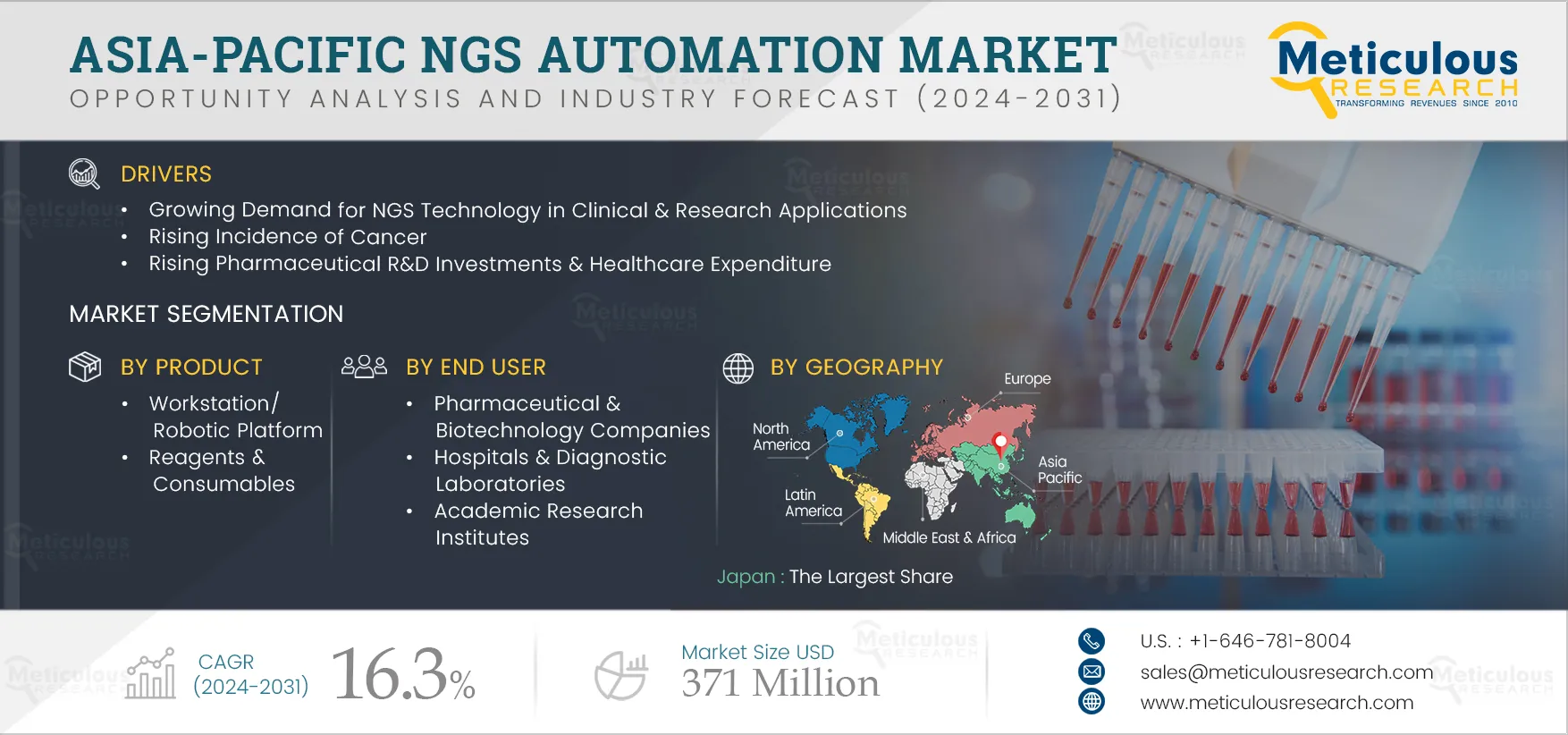
The Asia-Pacific NGS Automation Market was valued at $112.3 million in 2024. This market is expected to reach $371 million by 2032, from an estimated $129 million in 2025, at a CAGR of 16.3% during the forecast period 2025-2032. Asia-Pacific NGS Automation Market Size & Forecast Next-generation Sequencing
- Published
- Feb 2024
- Pages
- 200
- Format
- PDF + Excel
- Report ID
- MRHC - 1041107
- Base year
- 2024
- 2024 · BASELINE
- $112.3M
- 2032
- $371.0M
- CAGR 2025–2032
- 16.3%
2024 baseline · 2025–2032 forecast at 16.3% CAGR · hover a bar for the value
Key highlights
In 2025, the Workstations/Robotic Platforms Segment is Expected to Dominate this Market
The Whole Genome Sequencing Segment is Projected to Register the Highest CAGR During the Forecast Period
In 2025, the Drug Discovery Segment is Expected to Dominate this Market
The Hospitals & Diagnostic Laboratories Segment Is Projected to Register the Highest CAGR During the Forecast Period
Report summary
| Particulars | Details |
|---|---|
| Number of Pages | ~200 |
| Format | |
| Forecast Period | 2025-2032 |
| Base Year | 2024 |
| CAGR | 16.3% |
| Estimated Market Size (Value) | $371 million by 2032 |
| Segments Covered | By Product · Workstations/Robotic Platforms · Reagents & Consumables · By Sequencing Type · Whole Genome Sequencing · Whole Exome Sequencing · Targeted Sequencing · Other Sequencing Types · (Note : Other sequencing types include degradome sequencing, chromatin immunoprecipitation (ChIP) sequencing, and methylation sequencing.) · By Application · Drug Discovery · Clinical Diagnostics · Reproductive Health Diagnostics · Oncology Diagnostics · Infectious Diseases Diagnostics · Other Clinical Diagnostics · Other Applications · (Note 1: Other clinical diagnostics include applications in cardiovascular diseases, detection of genetic aberrations in neurological disorders, rare diseases, metabolic and immune disorders, and foodborne illnesses, among others. · Note 2: Other applications include basic research (genomics, molecular biology, and other life sciences), agriculture & animal research, and forensics & food microbiology.) · By End User · Pharmaceutical & Biotechnology Companies · Hospitals & Diagnostic Laboratories · Academic Research Institutes · Other End Users · (Note : Other end users include forensic laboratories & security agencies, the food industry, and the agriculture industry.) |
| Countries Covered | Japan, China, India, South Korea, Australia, Thailand, Singapore, Indonesia and Rest of Asia-Pacific |
| Key Companies | The key players operating in the Asia-Pacific NGS automation market are Agilent Technologies, Inc. (U.S.), Danaher Corporation (U.S.), Eppendorf AG (Germany), Hamilton Company (U.S.), PerkinElmer, Inc. (U.S.), Tecan Group Ltd. (Switzerland), PrimaDiag SAS (France), BRAND GMBH + CO KG (Germany), Hudson Robotics (U.S.), SPT Labtech (U.K.), Thermo Fisher Scientific, Inc. (U.S.), and F. Hoffmann-La Roche Ltd. (Switzerland). |
Report overview
Segments covered: product, sequencing type, application, end user.
Next-generation Sequencing (NGS) is a genome sequencing technology usually used for research purposes and applied in clinical diagnostics. NGS determines the order of nucleotides in the entire genomes or targeted regions of DNA or RNA. It is used for various clinical applications such as disease diagnosis, prognosis, therapeutic decision, and follow-up of patients. Also, its massive parallel sequencing capacity offers new opportunities for personalized or precision medicine. The automation of library preparation can increase efficiency and generate consistent results. The purpose of bringing automation to NGS is to generate more precise results and increase lab efficiency. NGS automation helps in maintaining turnaround times and expanding sample workload.
The growth of the Asia-Pacific NGS automation market is driven by the growing demand for NGS technology in clinical & research applications, the rising incidence of cancer, and increasing pharmaceutical R&D investments and healthcare expenditures. However, the high costs of automation workstations restrain the market's growth.
The increasing application of NGS in genetic disease testing and government initiatives aimed at boosting the adoption of advanced technologies are expected to create market growth opportunities. However, regulatory & standardization concerns related to diagnostic testing and the need to train personnel on the use of NGS automation software are major challenges for market growth.
Report infographic
Market dynamics
2 factors across 2 forcesRising Incidence of Cancer is Driving the Growth of this Market
Cancer is universally recognized as one of the most complex and costly diseases worldwide. It stands as a prominent cause of death and a significant barrier to improving life expectancy across many nations. The incidence of cancer is on the rise in the Asia-Pacific region. According to Johnson & Johnson (U.S.), Asia-Pacific accounts for approximately 50% of the world’s new cancer cases each year. Mortality due to cancer in the Asia-Pacific is projected to increase by 36% by 2032. Furthermore, the Asia-Pacific region has the highest incidence rates of stomach and liver cancers, with prostate cancer emerging as one of the leading cancers among males in certain Asian countries.
With the rising incidence of cancer, the significance of precision or personalized medicine in oncology has grown substantially, driving the need for researchers to develop effective therapies. Precision medicine plays a crucial role in tailoring treatments for specific tumors, aiding in the determination of more effective tests and treatments. It is often applied to individuals with certain cancers or those at a heightened risk of developing specific cancers. In cancer treatment, precision medicine leverages both the unique genetic makeup of individual patients and genetic information from their tumors to identify and prescribe an appropriate and effective treatment regimen. This trend is expected to drive demand for NGS services, consequently boosting throughput in laboratories.
The increased throughput in labs is expected to boost the demand for automation to increase efficiency and generate consistent and reproducible results. Thus, the rising incidence of cancer and increasing efforts to develop targeted treatment approaches are expected to drive the growth of the NGS automation market during the forecast period.
Table of contents
12 chapters · 89 sections · 200 pages · click to expandSegmental analysis
| Segment | Largest share (2025) | Fastest growth (2025–2032) |
|---|---|---|
| By Product | Workstations/Robotic Platforms | — |
| By Sequencing Type | — | Whole genome sequencing |
| By Application | Drug Discovery | — |
| By End User | — | Hospitals & diagnostic laboratories |
By Product
- The workstations/robotic platforms segment is expected to account for the largest share of the market.
- The large market share of this segment is attributed to factors such as the high demand for NGS automation among pharmaceutical and biotechnology companies for drug discovery purposes, the increasing utilization of robotic platforms for precise transfer of liquid volumes, coupled with their higher price point, and the enhanced workflow facilitated by minimizing manual interaction with reagents and samples, thereby reducing the risk of contamination.
By Sequencing Type
- The whole genome sequencing segment is expected to register the highest CAGR during the forecast period.
- This growth can be attributed to several factors, including the increasing demand for automation in whole genome sequencing to reduce per-sample costs, the expanding applications of whole genome sequencing in identifying inherited disorders and characterizing mutations driving cancer progression, and the tracking of disease outbreaks.
- Additionally, the rise in whole genome sequencing-based research projects further supports market growth.
- For instance, in October 2022, BGI Genomics (China), Ruijin Hospital (China), and Shanghai Jiao Tong University Institute of Translational Medicine (China) utilized the DNBSEQ sequencing platform for analyzing non-human genetic sequences in the whole genome sequencing (WGS) data of 10,585 individuals from the China Metabolic Analysis Program (ChinaMAP), thereby constructing the first blood virological profile of the Chinese population.
By Application
- The drug discovery segment is expected to account for the largest share of the market.
- NGS plays a crucial role in identifying novel drug targets and developing therapeutic techniques that target specific genes and proteins, including targeted therapies, gene therapies, and oligonucleotide therapies.
- The growing demand for targeted and gene therapies contributes to the large market share of this segment.
- Moreover, the gradually increasing number of drug approvals, driven by the need for novel drug therapies, further contributes to the segment’s growth.
- For instance, according to CDSCO, 27 drugs were approved in India in 2024, compared to 25 drugs approved in 2021.
By End User
- The hospitals & diagnostic laboratories segment is expected to register the highest CAGR during the forecast period.
- This growth can be attributed to several factors, including the rising number of hospitalizations for various diseases necessitating diagnosis, the proliferation of hospitals and clinics in the region, and the rising awareness regarding genetic testing, which drives the utilization of diagnostic products.
Geographic analysis
Asia-Pacific
Largest shareIn 2025, Japan is expected to account for the largest share of the Asia-Pacific NGS automation market. Japan’s major market share can be attributed to several factors, including the country’s high geriatric population, the increasing incidence of cancer, and the significant focus on genomic research. The rising cancer incidence drives the demand for NGS automation products in personalized medicine research. Moreover, various institutions such as the National Cancer Center, universities, and hospitals have initiated NGS-based clinical testing for cancer patients in Japan, further driving the adoption of NGS automation products. The report offers a competitive landscape based on an extensive assessment of the offerings, geographic presence, and key strategic developments implemented by top market players over the past few years. The key players operating in the Asia-Pacific NGS automation market are Agilent Technologies, Inc. (U.S.), Danaher Corporation (U.S.), Eppendorf AG (Germany), Hamilton Company (U.S.), PerkinElmer, Inc. (U.S.), Tecan Group Ltd. (Switzerland), PrimaDiag SAS (France), BRAND GMBH + CO KG (Germany), Hudson Robotics (U.S.), SPT Labtech (U.K.), Thermo Fisher Scientific, Inc. (U.S.), and F. Hoffmann-La Roche Ltd. (Switzerland). Japan: Largest Market Asia-Pacific NGS Automation Market: Competitive Analysis
Competitive landscape
- Agilent Technologies, Inc. (U.S.)
- Danaher Corporation (U.S.)
- Eppendorf AG · Germany
- Hamilton Company (U.S.)
- PerkinElmer, Inc. (U.S.)
- Tecan Group Ltd. · Switzerland
- PrimaDiag SAS · France
- BRAND GMBH + CO KG · Germany
- Hudson Robotics (U.S.)
- SPT Labtech (U.K.)
- Thermo Fisher Scientific, Inc. (U.S.)
- F. Hoffmann-La Roche Ltd. · Switzerland
Frequently asked questions
The Asia-Pacific NGS automation market covers the qualitative and quantitative assessment of different products, applications, and end users. This report involves the analysis of various segments of the Asia-Pacific NGS automation market at the regional and country levels.
Cite this report
Meticulous Research. (2024). Asia-Pacific NGS Automation Market - Opportunity Analysis and Industry Forecast (2025-2032) (Report No. MRHC - 1041107). Meticulous Market Research Pvt. Ltd. https://www.meticulousresearch.com/product/asia-pacific-ngs-automation-market-5790