Robotic Lawn Mowers Market (2026-2036)
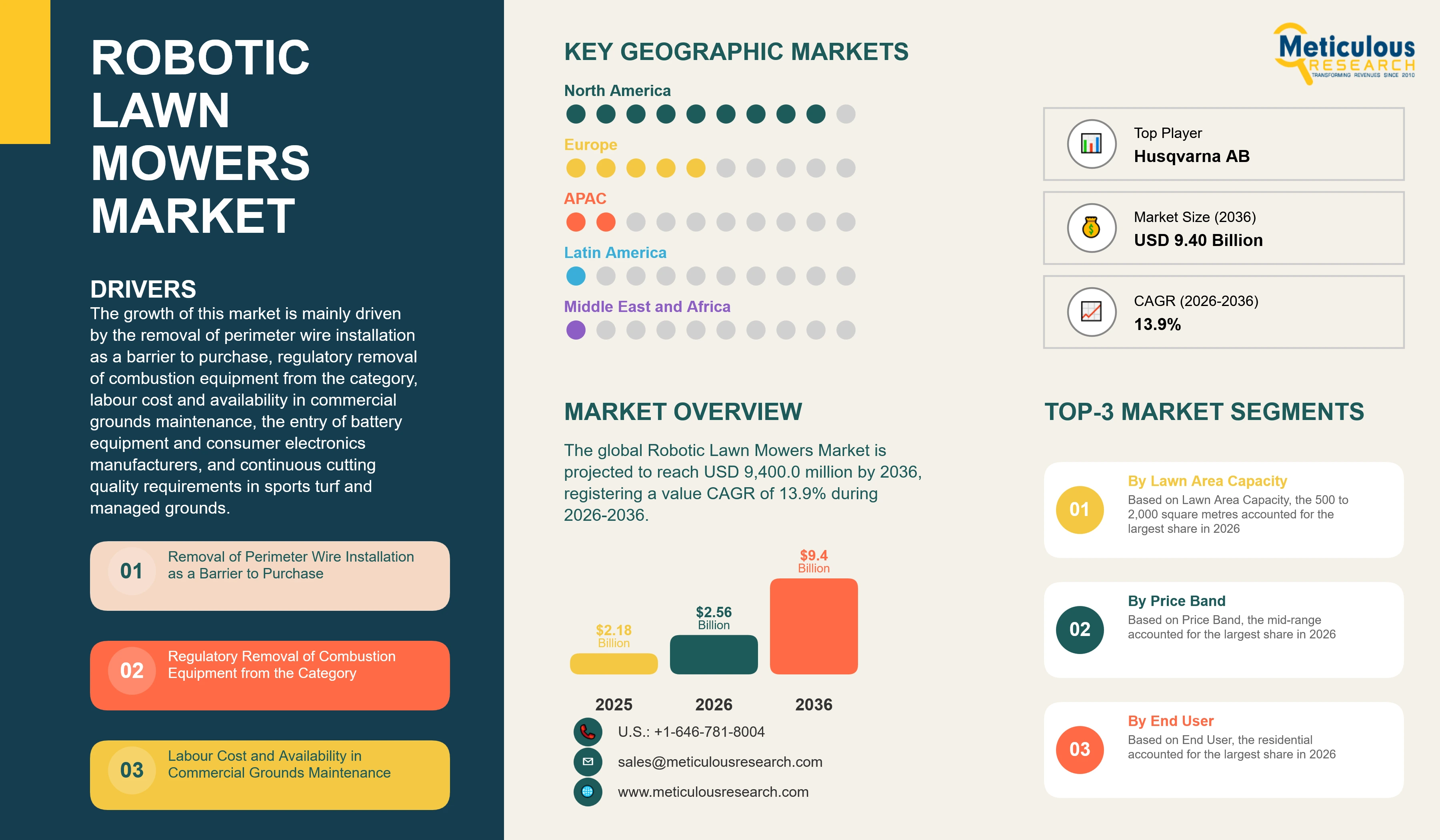
The global Robotic Lawn Mowers Market was valued at USD 2,180.0 million in 2025. This market is expected to reach USD 9,400.0 million by 2036 from an estimated USD 2,560.0 million in 2026, registering a CAGR of 13.9% during the forecast period (2026-2036).
- Published
- Oct 2026
- Pages
- 334
- Format
- PDF + Excel
- Report ID
- MRSE - 1042395
- Base year
- 2025
- 2025 · BASELINE
- $2.18B
- 2036
- $9.40B
- CAGR 2026–2036
- 13.9%
2025 baseline · 2026–2036 forecast at 13.9% CAGR · hover a bar for the value
Key highlights
The global Robotic Lawn Mowers Market is valued at USD 2, 560.0 million in 2026 and is projected to reach USD 9,400.0 million by 2036, at a CAGR of 13.9%.
In volume terms, the market is estimated at 2.58 million units in 2026 and is projected to reach 11.20 million units by 2036, at a CAGR of 15.8%, with the average selling price declining across the forecast period.
Based on navigation technology, the perimeter wire guided segment is expected to account for the largest share of the market in 2026, while the RTK-GNSS segment is projected to register the highest CAGR during the forecast period.
Based on lawn area capacity, the 500 to 2, 000 square metres segment is expected to account for the largest share of the market in 2026, while the above 10,000 square metres segment is projected to register the highest CAGR during the forecast period.
Based on cutting system, the pivoting razor blade segment is expected to account for the largest share of the market in 2026, while the fixed multi-blade disc segment is projected to register the highest CAGR during the forecast period.
Based on price band, the mid-range segment is expected to account for the largest share of the market in 2026, while the professional segment is projected to register the highest CAGR during the forecast period.
Based on end user, the residential segment is expected to account for the largest share of the market in 2026, while the commercial and institutional grounds segment is projected to register the highest CAGR during the forecast period.
Based on distribution channel, the specialist dealers segment is expected to account for the largest share of the market in 2026, while the e-commerce segment is projected to register the highest CAGR during the forecast period.
Based on geography, Europe is expected to account for the largest share of the market in 2026, while North America is projected to register the highest CAGR during the forecast period.
Report summary
| Particulars | Details |
|---|---|
| Base Year | 2025 |
| Estimated Year | 2026 |
| Forecast Period | 2026-2036 |
| Market Size in 2025 (Value) | USD 2,180.0 million |
| Market Size in 2026 (Value) | USD 2,560.0 million |
| Market Size by 2036 (Value) | USD 9,400.0 million |
| CAGR (2026-2036, Value) | 13.9% |
| Format | PDF, Excel & Cloud Portal · 334 pages |
| Market Size in 2025 (Volume) | 2.18 million units |
| Market Size in 2026 (Volume) | 2.58 million units |
| Market Size by 2036 (Volume) | 11.20 million units |
| CAGR (2026-2036, Volume) | 15.8% |
| Implied Average Selling Price (2026) | USD 992 |
| Implied Average Selling Price (2036) | USD 839 |
| Largest Segment by Navigation Technology (2026) | Perimeter Wire Guided |
| Fastest-growing Segment by Navigation Technology | RTK-GNSS |
| Largest Region (2026) | Europe |
| Fastest-growing Region | North America |
| Segments Covered | Navigation Technology, Lawn Area Capacity, Cutting System, Price Band, End User, Distribution Channel, Geography |
| Units Reported | Value (USD million) and Volume (million units) |
| Number of Companies Profiled | 18 |
Report overview
Segments covered: navigation technology, lawn area capacity, cutting system, price band, end user, distribution channel.
In volume terms, the global Robotic Lawn Mowers Market accounted for 2.18 million units in 2025. This market is expected to reach 11.20 million units by 2036 from an estimated 2.58 million units in 2026, registering a CAGR of 15.8% during the same period. The volume growth rate therefore exceeds the value growth rate throughout the forecast period, and the implied average selling price declines from approximately USD 992 in 2026 to approximately USD 839 in 2036.
That divergence between units and revenue is the most important single feature of this market and the reason both measures are reported here. Volume is expanding faster than value because the removal of the perimeter wire has eliminated the installation labour that limited adoption, which opens the entry and mid-range tiers to buyers who would never have commissioned a wired installation, while competitive entry from consumer electronics manufacturers is compressing price in exactly those tiers. A forecast reading value alone will understate the scale of the installed base being created, and a forecast reading units alone will overstate the revenue available to capture.
The second defining feature is that the regulation pushing this category forward is not aimed at robotic mowers at all. It is aimed at the combustion engine, and robotic mowing is the format that benefits most from its removal. Running against that is a constraint the sector has not yet priced, namely a published and freely reproducible animal safety test that any third party can now run on any machine on the market without waiting for a standards body to adopt it.
Robotic mowing has been a commercial product in Europe for more than two decades, which makes it unusual among the robotics categories now attracting attention. It has an installed base, a dealer network, an established service model and a mature European customer who understands what the machine does. What it did not have until recently was a way of being sold without a day of installation labour, and the removal of that single obstacle is responsible for most of what is now happening to the volumes.
The perimeter wire was the defining constraint of the first two decades. A boundary cable had to be laid around the lawn and around every bed, tree and obstacle, which required either a professional installation or a determined owner, and it made the purchase a project rather than a product. It also made the lawn a fixed asset, since changing a flower bed meant moving cable. Satellite positioning using real-time kinematic correction, and increasingly vision, have removed that requirement, allowing a boundary to be defined by walking the machine or by drawing on an application, and changed in minutes afterwards.
The commercial consequence runs in two directions at once, which is why the value and volume lines separate. On one side, removing installation labour removes the largest single barrier to purchase and opens the category to buyers who would not have commissioned a wired installation, which is expanding units sharply in the entry and mid-range tiers. On the other, the installed wire was also a retention mechanism. A customer who had paid to have cable laid for one brand faced a switching cost when replacing the machine, and that cost has now gone. Combined with entry from consumer electronics and battery equipment manufacturers with established supply chains and direct online channels, the result is falling average selling prices in the tiers where the volume growth is concentrated.
The regulatory driver behind the category is often misdescribed, and the precise position is worth stating because the timing matters. California Assembly Bill 1346, signed by Governor Newsom, requires the California Air Resources Board to set emissions requirements for small off-road engines to zero by 2024 or whenever the board determines is feasible, and the category it covers includes lawn mowers and leaf blowers. The measure was accompanied by USD 30 million secured in the state budget to create a statewide incentive programme helping landscaping businesses move to zero-emission equipment. The supporting material states that projected smog-forming pollution from small off-road engines will surpass that from passenger cars, and that a 2018 study by the California Air Resources Board found operators could potentially double their current cancer risk from volatile organic compounds.
Two things follow. First, this is a standards mandate rather than a product ban, and it carries a feasibility qualification, so the transition date is administratively determined rather than fixed. Suppliers planning around a hard cut-off are planning around something the legislation does not say. Second, and more important commercially, the regulation targets the engine rather than the robot. Its effect is to remove combustion equipment from the market and leave buyers choosing among battery alternatives, and robotic mowing is the format that benefits most from that choice in professional and larger residential settings because it also removes the labour hour rather than merely electrifying it. The incentive funding directed at landscaping businesses reinforces the professional end of the market specifically.
The constraint that has not been priced sits on the other side of the ledger, and it arrived from conservation research rather than from a regulator. A standardised safety test assessing the danger robotic lawn mowers present to European hedgehogs was published on 16 January 2024 by Dr Sophie Lund Rasmussen, a research associate at the Wildlife Conservation Research Unit of the University of Oxford, with funding support from the British Hedgehog Preservation Society. The method was developed by observing the behaviour of live hedgehogs and by using crash test dummy hedgehogs, and the team planned to release the dummy design publicly so that it can be reproduced by three-dimensional printing. The observed behaviour is the commercially significant part of the finding. Hedgehogs responded in three ways, by running away, by standing rigidly while partly curled up, or by sniffing the mower, with younger animals behaving more boldly than adults, and animals tested a second time tended to act more shyly, which the researcher suggested indicates learning from a first encounter. No standards body has adopted the test. The authors stated an aim of seeing it integrated into official testing protocols for the European market and of establishing a certification scheme allowing consumers to choose models assessed as hedgehog-friendly.
The absence of standards adoption is usually read as meaning there is no obligation yet. That reading misunderstands the mechanism. A published, standardised test whose physical dummy is to be freely reproducible by three-dimensional printing can be run by any consumer organisation, retailer, broadcaster or conservation body on any machine available for purchase, and the results published, without any standards body being involved at all. The exposure is reputational and it is available immediately, which is a materially different risk profile from waiting for a regulation to be drafted.
The engineering implication is specific rather than general. A hedgehog that stands rigidly while partly curled up, or that approaches to sniff the machine, presents an obstacle that is low, static, soft and small. Detection systems developed to avoid garden furniture, toys and tree trunks are tuned for objects that are either tall enough to interrupt a sensor plane or hard enough to trigger a collision bumper, and a small motionless animal satisfies neither condition. The observation that younger animals behave more boldly than adults compounds the problem, since the animals least likely to retreat are also the smallest. Suppliers whose obstacle detection relies on bump contact and height are therefore exposed in a way that suppliers using vision or vertical sensing are not, and the distinction maps closely onto the navigation transition already under way.
That convergence is the strategic heart of this market. The move from perimeter wire to satellite and vision guidance is being made for a commercial reason, namely the removal of installation cost, but it also installs the sensing hardware needed to address animal safety and to support the mapping and multi-zone behaviour that professional customers require. A supplier making the navigation transition acquires a defence against the safety exposure as a side effect, while a supplier remaining on wire and bump detection faces rising installation disadvantage and rising safety exposure simultaneously. The two pressures are not independent, and they fall on the same group of companies.
Volume and value therefore need reading together across the price bands. The entry tier is where units grow fastest and where price falls hardest, which makes it a share battle with thin margin and heavy reputational risk from any published safety result. The professional tier, serving commercial grounds, sports turf and municipal green space, is where revenue per unit rises, where regulatory incentives are directed, where multi-zone mapping and fleet management are genuinely valued, and where a dealer and service relationship still functions as a barrier to entry. The sensible reading of this market is that the units are being won at the bottom and the profit at the top.
Report infographic
Market dynamics
22 factors across 5 forcesRemoval of Perimeter Wire Installation as a Barrier to Purchase
The elimination of boundary cable is a major factor driving the Robotic Lawn Mowers Market in volume terms, because installation labour rather than machine price was the binding constraint on adoption for two decades. Laying cable around a lawn and every bed, tree and obstacle turned a purchase into a project requiring either professional installation or a committed owner, and it fixed the garden layout. Satellite positioning with real-time kinematic correction and vision-based boundary definition allow a perimeter to be set by walking the machine or drawing in an application and altered in minutes, which converts a project into a product and explains why unit growth exceeds revenue growth. The driver is strongest in the entry and mid-range tiers, where the installation cost represented a larger proportion of total outlay than in the premium classes and therefore deterred proportionally more buyers.
Regulatory Removal of Combustion Equipment From the Category
Emissions regulation is driving the category by removing the alternative rather than by promoting the robot. California Assembly Bill 1346, signed by Governor Newsom, requires the California Air Resources Board to set emissions requirements for small off-road engines to zero by 2024 or whenever the board determines is feasible, and the category it covers includes lawn mowers and leaf blowers. The measure was accompanied by USD 30 million secured in the state budget to create a statewide incentive programme helping landscaping businesses move to zero-emission equipment. The supporting material states that projected smog-forming pollution from small off-road engines will surpass that from passenger cars, and that a 2018 study by the California Air Resources Board found operators could potentially double their current cancer risk from volatile organic compounds. Because the measure targets the engine, its effect is to leave buyers choosing among battery alternatives, and robotic mowing is the format that benefits most in professional and larger residential settings since it removes the labour hour rather than merely electrifying the machine. The incentive funding directed at landscaping businesses weights the driver towards the professional tier specifically. The driver also operates ahead of the regulation itself in jurisdictions watching California, because equipment manufacturers rationalise portfolios across markets rather than maintaining separate combustion lines for states that have not yet legislated.
Labour Cost and Availability in Commercial Grounds Maintenance
Labour economics are driving adoption at the professional end, because grounds maintenance is a recurring, schedule-driven task performed on sites where the work is substantially identical each week. A robotic fleet converts a weekly labour commitment into a capital and energy commitment with supervision rather than operation, which suits commercial grounds, sports turf, municipal green space and institutional campuses. The driver is reinforced by the quality argument, since continuous low-height cutting produces a different turf result from weekly cutting and is valued in sports turf applications where appearance and sward density are contractual. The driver is reinforced by scheduling freedom, since autonomous operation can run outside the hours when a site is occupied, which removes the conflict between maintenance access and site use that constrains manual grounds work.
Entry of Battery Equipment and Consumer Electronics Manufacturers
Competitive entry is driving volume by widening distribution and lowering price. Manufacturers from cordless power tools, portable power and consumer robotics have entered with established battery platforms, existing contract manufacturing relationships and direct online channels, which has expanded availability beyond the specialist dealer network that historically defined the category. The driver accelerates unit growth and depresses average selling price simultaneously, which is the proximate cause of the divergence between the volume and value forecasts in this report. The driver also changes the purchase itself, because a buyer already holding a battery platform evaluates an additional tool against a marginal rather than a full cost, which lowers the effective price of entry into the category.
Table of contents
14 chapters · 140 sections · 334 pages · click to expandGeographic analysis
Europe
Largest shareIn 2026, Europe is expected to account for the largest share of the market in both value and volume. The large share of this region is mainly due to more than two decades of commercial availability, an established specialist dealer and service network, garden sizes and layouts well matched to the machines, high electricity and labour cost relative to equipment cost, and a replacement cycle now running on a substantial installed base. European demand also carries the strongest consumer sensitivity to garden wildlife, which makes animal safety a purchasing consideration here before it becomes one elsewhere.
North America
Fastest growthHowever, North America is projected to register the highest CAGR during the forecast period. The rapid growth of this region is attributed to the removal of perimeter wire installation, which was a greater obstacle in a market accustomed to ride-on and walk-behind equipment and larger lot sizes, and to emissions regulation that removes combustion equipment from the category. California Assembly Bill 1346 requires the California Air Resources Board to set emissions requirements for small off-road engines to zero by 2024 or whenever the board determines is feasible, accompanied by USD 30 million in the state budget for a statewide incentive programme assisting landscaping businesses, which weights regional growth towards the professional tier.
Asia-Pacific
Asia-Pacific occupies a position defined by manufacture rather than by consumption. Several of the entrants that have expanded unit volume and compressed price in the entry and mid-range tiers are headquartered in the region and supply Europe and North America through direct online channels, which means regional output substantially exceeds regional installation. Domestic demand is concentrated in Japan, South Korea, Australia and New Zealand, where garden formats and labour costs resemble the established markets, while elsewhere in the region private lawn area is limited and the addressable base sits in commercial grounds, resorts and sports facilities rather than in households.
Latin America
Latin America and the Middle East & Africa remain small and concentrated in specific applications rather than in general residential demand. Golf courses, resorts, sports facilities and master-planned developments in the Gulf states and in Brazil, Mexico and South Africa provide the addressable base, where managed turf area is large, maintenance is contracted and appearance is commercially significant. Water availability constrains irrigated lawn area across much of both regions, which caps the residential opportunity independently of purchasing power, and suppliers should treat these as professional turf markets rather than as consumer ones throughout the forecast period.
Competitive landscape
The competitive landscape of the Robotic Lawn Mowers Market contains three groups whose positions are being redrawn by the navigation transition. Established outdoor power equipment manufacturers hold the European installed base, the specialist dealer and service network, and the professional and sports turf relationships, and they carry the largest exposure to the loss of the installation-based retention effect. Battery equipment and cordless tool manufacturers are extending existing battery platforms and retail distribution into the category, competing on price and channel breadth. Consumer robotics and portable power entrants have arrived with wire-free navigation, direct online sales and aggressive pricing, and have driven most of the unit growth and most of the price compression in the entry and mid-range tiers.
Competitive advantage is separating by tier. In the volume tiers it rests on cost, channel and the ability to sustain thin margin, and it is vulnerable to any published safety result because those buyers purchase on reputation and review rather than on a service relationship. In the professional tier it rests on multi-zone mapping, fleet supervision, documented service, theft protection and dealer presence, which are harder to replicate and are valued by buyers evaluating against a labour line. The emerging third axis is verifiable animal safety performance, where no supplier currently holds a certification because none yet exists, and where the first credible claim will be difficult for competitors to match quickly.
Key players operating in the global Robotic Lawn Mowers Market are Husqvarna AB (Sweden), STIGA Group (Italy), Andreas Stihl AG & Co. KG (Germany), Robert Bosch GmbH (Germany), AL-KO Gerate GmbH (Germany), Positec Tool Corporation (China), Globe Group (China), Deere & Company (U.S.), The Toro Company (U.S.), Techtronic Industries Company Limited (Hong Kong), Mammotion Technology (China), Segway Technology Co., Ltd. (China), EcoFlow (China), Sunseeker Robotics (China), Yarbo Inc. (U.S.), Zucchetti Centro Sistemi S.p.A. (Italy), Yamabiko Corporation (Japan), and Dreame Technology (China).
The companies profiled in this report were selected on the basis of verified activity as of October 2026 in the design, manufacture or branded supply of robotic lawn mowers for residential, commercial, sports turf or municipal use. Manufacturers of walk-behind and ride-on mowers without a robotic product line, manufacturers of other garden power equipment without a robotic mower, autonomous agricultural and vineyard machinery suppliers, golf course utility vehicle manufacturers, component and module suppliers including motor, blade, battery and positioning module manufacturers, and distributors and private-label resellers without product development were excluded, as were companies whose relevant operations could not be verified as active at the time of writing.
- Husqvarna AB · Sweden
- STIGA Group · Italy
- Andreas Stihl AG & Co. KG · Germany
- Robert Bosch GmbH · Germany
- AL-KO Gerate GmbH · Germany
- Positec Tool Corporation · China
- Globe Group · China
- Deere & Company (U.S.)
- Toro Company (U.S.)
- Techtronic Industries Company Limited · Hong Kong
- Mammotion Technology · China
- Segway Technology Co., Ltd. · China
- EcoFlow · China
- Sunseeker Robotics · China
- Yarbo Inc. (U.S.)
- Zucchetti Centro Sistemi S.p.A · Italy
- Yamabiko Corporation · Japan
- Dreame Technology · China
Expert perspectives
This market is normally presented as a straightforward consumer robotics growth story, and the single figure that most needs explaining is why units are growing faster than revenue. The answer is that the perimeter wire was doing two jobs. It was the obstacle to purchase, because laying cable around a lawn and every obstacle turned a product into a project, and it was the retention mechanism, because a customer who had paid for an installation faced a switching cost at replacement. Satellite and vision guidance removed both at once. Volume therefore expands as the barrier falls while price erodes as the lock-in disappears and entrants with direct online channels add capacity in exactly the tiers where the new volume sits. The binding constraint is therefore shifting from installation cost to margin defence without an installed asset.
Three structural features are expected to shape competitive positions through 2036. First, the navigation transition and the animal safety response will continue converging, because the sensing hardware adopted to remove installation cost is also what detects a low, static, soft obstacle, so suppliers moving to satellite and vision guidance acquire a safety defence as a side effect while those on wire and bump detection face both disadvantages together. Second, the market will continue separating into a volume tier won on cost and channel and a profit tier won on mapping, fleet supervision, service and dealer presence. Third, suppliers facing price erosion in mowing will continue extending the chassis, site map and scheduling platform into snow clearance, leaf collection and treatment distribution, converting a periodic hardware sale into a year-round attachment and software relationship.
For companies planning entry or expansion, the useful observation is that the published animal safety test is an opportunity before it becomes a liability. The method was developed from live hedgehog observation and crash test dummy hedgehogs, the dummy is intended for free reproduction by three-dimensional printing, and the authors stated an aim of a certification scheme letting consumers choose models assessed as hedgehog-friendly. No supplier holds such a certification because none exists. A manufacturer that commissions a credible independent assessment now holds a verifiable differentiator in the largest regional market, where consumer sensitivity to garden wildlife is highest, and converts an exposure into a claim. The second observation is that the professional tier is where the value is, because incentive funding is directed there, buyers evaluate against a labour line, and the dealer and service barrier that the consumer tiers have lost still functions.
Two cautions belong in any assessment of this market. The first concerns the emissions regulation most often cited for it. California Assembly Bill 1346 requires the California Air Resources Board to set emissions requirements for small off-road engines to zero by 2024 or whenever the board determines is feasible, which is a standards mandate with a feasibility qualification rather than a dated product ban, so a plan built on a hard cut-off is built on something the legislation does not say. The second concerns the safety exposure. The absence of standards adoption is widely read as meaning there is no obligation yet, but a standardised test with a freely reproducible dummy can be run by any consumer organisation, retailer, broadcaster or conservation body on any machine on sale and the result published without a standards body being involved, so the risk is immediate and reputational rather than deferred and procedural.
Overall, the core of demand through the forecast period will continue to sit in mid-range machines for 500 to 2,000 square metre residential lawns sold through specialist dealers across Europe, while the fastest growth will come from RTK-GNSS navigation, large-area and professional machines, fixed multi-blade cutting systems, commercial and institutional grounds, e-commerce distribution and North American adoption, with unit volumes rising faster than revenue throughout, so that a market commonly measured in growth rates is better understood as one in which the units are won at the bottom and the profit is earned at the top.
Customer perspectives
Grounds Manager, University Estate
This perspective confirms that professional buyers evaluate against a labour schedule and require multi-zone mapping and documented operation rather than cutting performance alone. It supports the conclusion that the professional tier retains a defensible value position while the consumer tiers compete on price, and that transition incentive funding is a material factor in the purchase.
Category Buyer, European Home Improvement Retailer
This perspective confirms both the volume expansion and the price compression that follow the removal of installation, and identifies the reputational exposure from an independently reproducible safety test. It supports the conclusion that the exposure is immediate rather than contingent on regulatory adoption and that suppliers lacking assessment data carry it indirectly through their retail channel.
Head of Product, Outdoor Power Equipment Manufacturer
This perspective confirms that the navigation transition removed an incumbent retention mechanism and that established suppliers are responding by repositioning upwards rather than defending volume share. It supports the conclusion that retention must now be found in service, dealer relationship, fleet software or certification rather than in the physical installation.
Frequently asked questions
The market was valued at USD 2,180.0 million in 2025 and is estimated at USD 2,560.0 million in 2026.
Cite this report
Meticulous Research. (2026). Robotic Lawn Mowers Market - Global Opportunity Analysis and Industry Forecasts (2026-2036) (Report No. MRSE - 1042395). Meticulous Market Research Pvt. Ltd. https://www.meticulousresearch.com/product/robotic-lawn-mowers-market-7078