Antifreeze Protein Market (2025-2032)
The Antifreeze Protein Market is Projected to Reach $85.8 Million by 2032, at a CAGR of 33.4% from 2025 to 2032.
- Published
- Feb 2025
- Pages
- 200
- Format
- PDF + Excel
- Report ID
- MRFB - 104751
- Base year
- 2024
- 2032 · FORECAST
- $85.8M
- 2032
- $85.8M
- CAGR 2025–2032
- 33.4%
2024 baseline · 2025–2032 forecast at 33.4% CAGR · hover a bar for the value
Report summary
| Particulars | Details |
|---|---|
| Base Year | 2024 |
| Estimated Year | 2025 |
| Forecast Period | 2025–2032 |
| Market Size (2032) | USD 85.8 million |
| CAGR (2025–2032) | 33.4% |
| Format | PDF, Excel & Cloud Portal · 200 pages |
| Segments Covered | By Type: Type I, Type III, Antifreeze Glycoprotein, Other Antifreeze Protein Types · By Form: Solid, Liquid · By Source: Fish, Insects, Plants, Microorganisms · By Application: Medical, Cosmetics, Food & Beverages, Other Applications |
| Countries Covered | North America (Canada), Europe (Germany, France, U.K, Italy, Spain, Russia, Rest of Europe), Asia-Pacific (Japan, China, India, Australia, Rest of Asia-Pacific) |
| Key Companies | F Protein Inc., AquaBounty Technologies, Inc., Sirona Biochem Corp, Nichirei Corporation, ProtoKinetix, Inc., Unilever PLC, Rishon Biochem Co., Ltd |
Report overview
Segments covered: type, form, source, application. Regions: North America, Europe, Asia-Pacific.
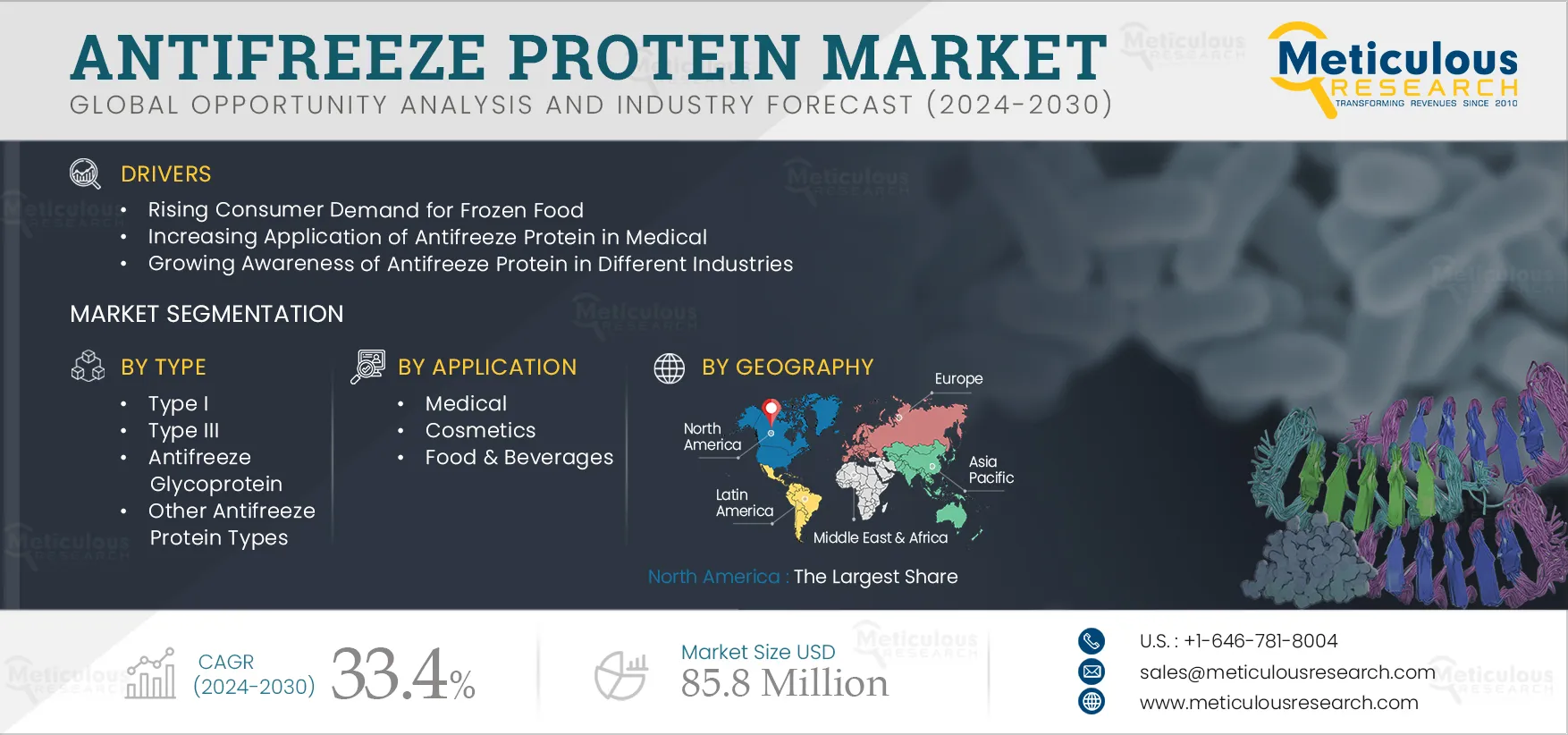
The antifreeze protein market is driven by factors such as the rising consumer demand for frozen food, increasing application of antifreeze protein in the medical industry, and growing adoption of antifreeze protein in different industries. However, high R&D expenditure and production costs are expected to hinder this market's growth to a certain extent.
Report infographic
Market dynamics
1 factors across 1 forceRising Consumer Demand for Frozen Food Products
The changing food consumption pattern has increased the demand for convenience food. Consumers prefer convenience food products, such as RTE and RTC food, due to their ease of preparation and consumption. The demand for ready-to-eat food products is increasing rapidly due to the drastic shift in dietary habits. Additionally, increasing urbanization is likely to boost the growth of this trend.
More than half of the world's population lives in urban areas. According to the United Nations World Urbanization Report, the urban population of the world has grown rapidly from 439,498,772 in 2015 to 471,031,528 in 2019, which indicates that almost 55% of the world’s population lives in urban areas. This proportion is expected to increase to 68% by 2050. As a result, urban consumers are gaining exposure to a wider choice and better food availability than those living in rural areas. Also, this urbanization trend is expected to contribute significantly toward improved living standards and rising incomes, which influences the affordability of frozen food products to a greater extent.
Furthermore, with the rising demand for frozen food, there will be higher adoption of antifreeze protein in the frozen food industry. Antifreeze proteins can modify ice growth, stabilizing ice crystals over a defined temperature range, inhibiting recrystallization, and reducing cellular damage. This safeguards the quality of frozen foods without structural and organoleptic alterations. Antifreeze protein is vital in ice cream, chilled fish and meat, frozen dough, desserts, and other frozen food products.
Hence, the rising demand for frozen food products drives the growth of the antifreeze protein market.
Table of contents
12 chapters · 86 sections · 200 pages · click to expandSegmental analysis
| Segment | Largest share (2025) | Fastest growth (2025–2032) |
|---|---|---|
| By Type | Type I | — |
| By Form | Large market share of this | — |
| By Source | — | Insect |
| By Application | Medical | — |
By Type
- The antifreeze protein market is segmented into Type I, Type III, antifreeze glycoprotein, and other antifreeze protein types.
- The type I segment is expected to account for the largest share of the antifreeze protein market.
- The large market share of this segment is attributed to the increasing availability of fish protein, ease of use in different applications, and successful R&D practices.
By Form
- The antifreeze protein market is segmented into solid and liquid.
- The solid form is expected to account for the larger share of the antifreeze protein market.
- The large market share of this segment is attributed to its easy storage, increased application in frozen food, and easy availability of antifreeze protein in solid form.
By Source
- The antifreeze protein market is segmented into fish, insects, plants, and microorganisms.
- The insect segment is projected to register the highest CAGR during the forecast period.
- The fast growth of this segment is mainly attributed to the growing demand for environment-friendly protein-rich food and the rising investments in edible insect farming.
By Application
- The antifreeze protein market is segmented into medical, cosmetics, food & beverages, and other applications.
- The medical segment is expected to account for the largest share of the antifreeze protein market.
- The large market share of this segment is mainly attributed to the rising R&D from biotechnology and medical companies, increased application of antifreeze protein in cryopreservation and organ transplantation treatment, and functional properties of antifreeze protein suitable for medical treatments.
Geographic analysis
North America
Largest shareThe antifreeze protein market is segmented into five major regions: North America, Europe, Asia-Pacific, Latin America, and the Middle East & Africa. In 2025, North America is expected to account for the largest share of the antifreeze protein market. The large share of this regional market is attributed to the presence of key players and research institutes, well-established end-use industries, such as medical, food and beverages, and cosmetics, increasing demand for frozen food, and technological advancements. North America: The Dominating Regional Market
Competitive landscape
- F Protein Inc.
- AquaBounty Technologies, Inc.
- Sirona Biochem Corp
- Nichirei Corporation
- ProtoKinetix, Inc.
- Unilever PLC
- Rishon Biochem Co., Ltd
Frequently asked questions
The antifreeze protein market is expected to reach $85.8 Million by 2032, with a CAGR of 33.4% from 2025 to 2032.
Cite this report
Meticulous Research. (2025). Antifreeze Protein Market - Global Opportunity Analysis And Industry Forecast (2025-2032) (Report No. MRFB - 104751). Meticulous Market Research Pvt. Ltd. https://www.meticulousresearch.com/product/antifreeze-protein-market-5435