
Industrial Heat-as-a-Service Market (2026-2036)
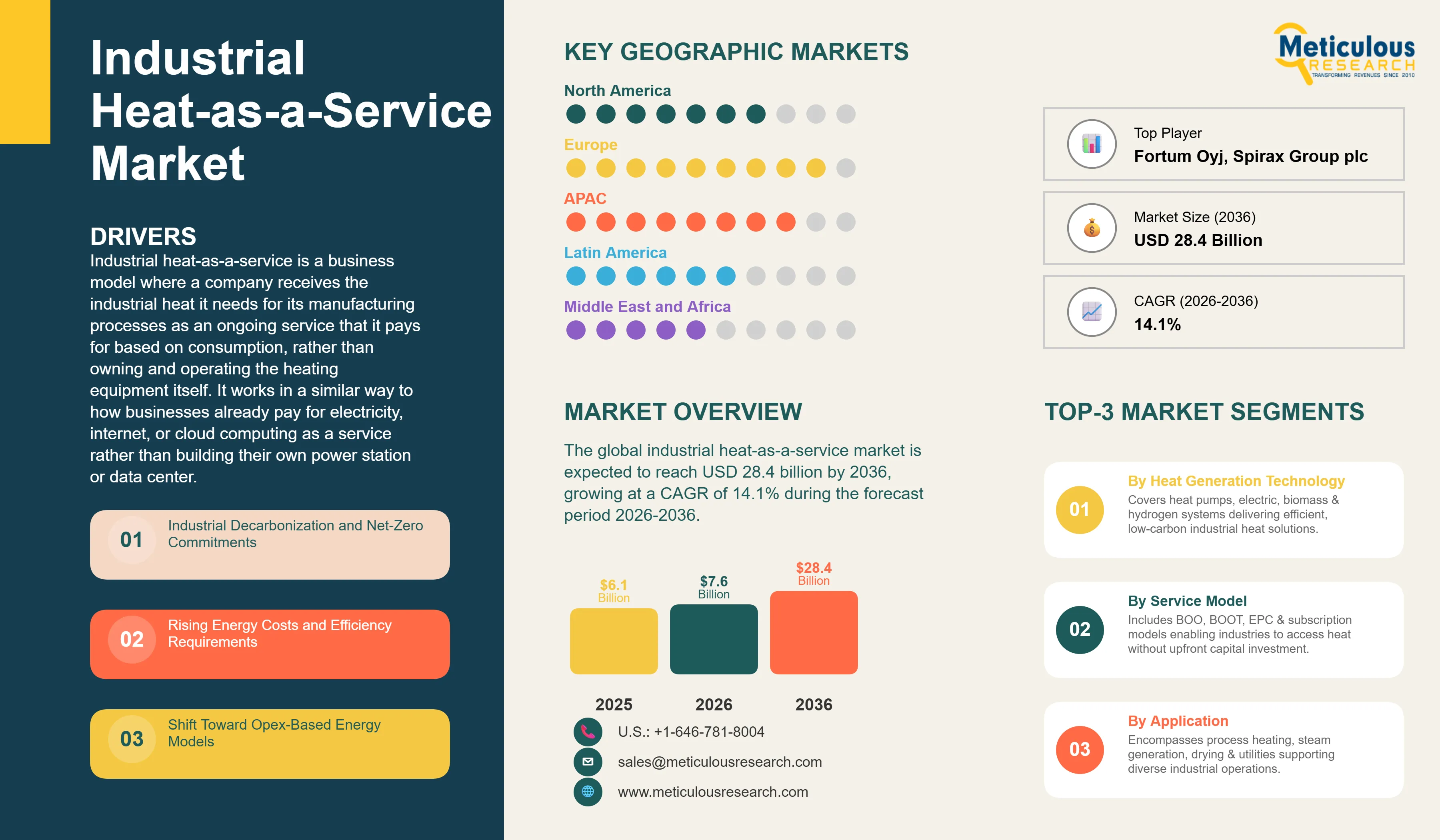
The global industrial heat-as-a-service market was valued at USD 6.1 billion in 2025. This market is expected to reach USD 28.4 billion by 2036 from an estimated USD 7.6 billion in 2026, growing at a CAGR of 14.1% during the forecast period 2026-2036.
- Published
- Apr 2026
- Pages
- 282
- Format
- PDF + Excel
- Report ID
- MR-1933
- Base year
- 2025
- 2025 · BASELINE
- $6.10B
- 2036
- $28.40B
- CAGR 2026–2036
- 14.1%
2025 baseline · 2026–2036 forecast at 14.1% CAGR · hover a bar for the value
Key highlights
The global industrial heat-as-a-service market is projected to reach USD 28.4 billion by 2036.
The market is expected to grow at a CAGR of 14.1% during the forecast period 2026-2036.
The global industrial heat-as-a-service market was valued at USD 6.1 billion in 2025 and is estimated to reach USD 7.6 billion in 2026.
Europe is expected to dominate the global industrial heat services market with the largest market share in 2026, while Asia-Pacific is projected to register the highest CAGR during the forecast period.
By heat generation technology, the industrial heat pumps segment is expected to hold the largest share of the market in 2026, while the hydrogen-based heating systems segment is projected to register the highest CAGR during the forecast period.
By service model, the build-own-operate segment is expected to hold the largest share in 2026, while the subscription-based models segment is projected to register the highest CAGR during the forecast period.
By application, the process heating segment is expected to hold the largest share in 2026, while the steam generation segment is projected to register the highest CAGR during the forecast period.
By end-use industry, the chemicals and petrochemicals segment is expected to hold the largest share in 2026, while the pharmaceuticals segment is projected to register the highest CAGR during the forecast period.
By temperature range, the medium temperature segment is expected to hold the largest share in 2026, while the high temperature segment is projected to register the highest CAGR during the forecast period.
By fuel type, the electricity segment is expected to hold the largest share in 2026, while the hydrogen segment is projected to register the highest CAGR during the forecast period.
Report summary
| Particulars | Details |
|---|---|
| Market Size by 2036 | USD 28.4 Billion |
| Market Size in 2026 | USD 7.6 Billion |
| Market Size in 2025 | USD 6.1 Billion |
| Revenue Growth Rate (2026-2036) | CAGR of 14.1% |
| Format | PDF, Excel & Cloud Portal · 282 pages |
| Dominating Heat Generation Technology | Industrial Heat Pumps |
| Fastest Growing Heat Generation Technology | Hydrogen-Based Heating Systems |
| Dominating Service Model | Build-Own-Operate (BOO) |
| Fastest Growing Service Model | Subscription-Based Models |
| Dominating Application | Process Heating |
| Fastest Growing Application | Steam Generation |
| Dominating End-Use Industry | Chemicals & Petrochemicals |
| Fastest Growing End-Use Industry | Pharmaceuticals |
| Dominating Temperature Range | Medium Temperature (100-400°C) |
| Fastest Growing Temperature Range | High Temperature (>400°C) |
| Dominating Fuel Type | Electricity |
| Fastest Growing Fuel Type | Hydrogen |
| Dominating Geography | Europe |
| Fastest Growing Geography | Asia-Pacific |
| Base Year | 2025 |
| Forecast Period | 2026 to 2036 |
Report overview
Segments covered: heat generation technology, service model, application end-use industry.
Industrial heat-as-a-service is a business model where a company receives the industrial heat it needs for its manufacturing processes as an ongoing service that it pays for based on consumption, rather than owning and operating the heating equipment itself. It works in a similar way to how businesses already pay for electricity, internet, or cloud computing as a service rather than building their own power station or data center. An energy service company builds, owns, and operates the heat generation system, which might use industrial heat pumps, electric boilers, biomass burners, or hydrogen combustion equipment, and then sells the heat output to the industrial customer at a contracted price per unit of heat delivered. The industrial company benefits from getting the heat it needs without having to invest capital in heating equipment, manage its operation, or deal with its eventual replacement, while also gaining access to cleaner heat sources that might be too expensive or technically complex to install and operate independently.
The market is growing because industrial heat demand represents approximately 20% of total global energy consumption and is one of the most challenging sectors to decarbonize, creating very large commercial opportunities for service providers that can deliver clean industrial heat at competitive prices. Factory processes including cooking, drying, sterilizing, distilling, forming metals, and producing chemicals all require heat at temperatures ranging from below 100 degrees Celsius up to over 1,000 degrees Celsius, and the vast majority of this heat is currently produced by burning natural gas, coal, or oil. Industrial companies facing growing carbon pricing costs, net-zero commitments, and energy price volatility are looking for ways to both decarbonize their heat supply and convert the significant capital cost of heating infrastructure into a more predictable operating expense, both of which the heat-as-a-service model addresses directly.
Two significant opportunities are shaping the market's development. The availability of low-carbon heat technologies, particularly industrial heat pumps that can deliver heat below 200 degrees Celsius at efficiencies three to five times higher than direct electric heating, is creating a compelling clean heat option for a large share of industrial heat demand and making the economics of heat-as-a-service agreements more attractive to both providers and customers. In addition, the integration of digital monitoring and smart energy management with heat-as-a-service contracts is enabling providers to continuously optimize heat delivery efficiency, detect equipment problems before they cause service interruptions, and demonstrate verified performance against contractual obligations in ways that were previously very difficult, building the trust and transparency required for long-term service agreements.
Market dynamics
7 factors across 3 forcesIndustrial Decarbonization and Net-Zero Commitments
The primary driver of the industrial heat-as-a-service market is the growing pressure on industrial companies to reduce carbon dioxide emissions from their manufacturing operations, with heat generation representing one of the largest and most technically challenging sources of industrial carbon emissions to address. Large industrial companies including major chemical producers, food and beverage companies, pharmaceutical manufacturers, and paper mills have made public net-zero emission commitments that require them to fundamentally change how they generate the heat their processes depend on, transitioning away from natural gas and coal boilers toward low-carbon heat sources. The heat-as-a-service model is commercially attractive for these decarbonization programs because it allows an industrial company to replace fossil fuel heating with low-carbon heat supply without having to bear the full capital cost of the new heat generation infrastructure itself, converting a large capital investment into a manageable operating expense while the ESCO bears the investment risk, technology risk, and performance responsibility. Carbon pricing systems in the EU, UK, Canada, and other jurisdictions are making the financial case for switching to clean heat-as-a-service progressively stronger as the effective cost of carbon-intensive heat supply increases each year.
Shift Toward Opex-Based Energy Models
A broader trend across corporate capital management is the preference for converting capital-intensive asset ownership into operating expenditure through service models, which is driving adoption of heat-as-a-service in the same way that it has driven cloud computing, equipment leasing, and facilities management outsourcing across other sectors. A manufacturing company whose core expertise is making food, chemicals, textiles, or pharmaceuticals typically has no strategic advantage in owning and operating boilers, heat pumps, or steam generation equipment. Converting industrial heat from a capital-intensive asset the company owns to a service it buys allows the company to free up balance sheet capital for investment in its core manufacturing and product development activities, reduce the operational complexity of managing energy infrastructure, and transfer the risk of energy infrastructure investment, technology obsolescence, and maintenance reliability to a service provider with genuine expertise in energy systems operation. Chief financial officers and boards at industrial companies increasingly recognize the balance sheet and risk management advantages of service models for non-core infrastructure, creating a financial management driver for heat-as-a-service adoption that operates alongside the sustainability and energy cost drivers.
Table of contents
14 chapters · 181 sections · 282 pages · click to expandSegmental analysis
| Segment | Largest share (2026) | Fastest growth (2026–2036) |
|---|---|---|
| By Heat Generation Technology | Industrial Heat Pumps | Hydrogen-based heating systems |
| By Service Model | Build-Own-Operate | Subscription-based models |
| By Application | Process Heating | Steam generation |
| By End-Use Industry | Chemicals and Petrochemicals | Pharmaceuticals |
By Heat Generation Technology
- Industrial Heat Pumps to Dominate
- The industrial heat pumps segment is expected to account for the largest share of the global industrial heat-as-a-service market.
- Industrial heat pumps have become the preferred heat generation technology for the growing number of heat-as-a-service projects targeting the large low and medium temperature industrial heat market, because their energy efficiency of 300 to 500% compared with direct electric heating makes them the most cost-competitive clean heat option for process temperatures below approximately 180 degrees Celsius.
- The combination of declining heat pump equipment costs, rising natural gas prices and carbon costs in Europe, and growing availability of renewable electricity is progressively making industrial heat pump-based service offerings financially competitive with conventional gas boiler heat supply across a widening range of industrial applications.
- However, the hydrogen-based heating systems segment is projected to register the highest CAGR during the forecast period.
- Green hydrogen produced by electrolysis of water using renewable electricity can be burned in specially designed hydrogen burners or fuel cells to deliver clean high-temperature heat above 400 degrees Celsius that heat pumps cannot economically produce, covering the high-temperature industrial heat demand that accounts for a significant share of total industrial heat consumption in sectors including steel, cement, glass, and ceramics.
- As green hydrogen production costs fall with electrolyzer scale-up and the hydrogen supply chain develops across Europe and Asia-Pacific, hydrogen-based heat-as-a-service contracts for high-temperature industrial applications are expected to grow from their currently very early commercial stage to a meaningful market segment through the forecast period.
By Service Model
- Build-Own-Operate to Hold the Largest Share
- The build-own-operate segment is expected to account for the largest share of the global industrial heat-as-a-service market.
- The BOO model, where the ESCO builds, owns, and permanently operates heat generation infrastructure at or near the industrial customer's site and sells heat output under a long-term supply agreement, is the most commercially established and most widely adopted service model in the market.
- BOO agreements provide the revenue certainty over long contract periods of 10 to 20 years that heat infrastructure investment requires for financial viability, and the permanent ownership by the ESCO aligns incentives for optimizing long-term equipment performance and efficiency.
- However, the subscription-based models segment is projected to register the highest CAGR during the forecast period.
- Simpler subscription or pay-per-heat-unit pricing models with shorter commitment periods and more standardized contract terms are attracting smaller industrial customers and those who prefer flexibility over the lowest possible heat price, expanding the addressable market for heat-as-a-service beyond the large enterprises that traditional BOO contracts are designed for.
By Application
- Process Heating to Hold the Largest Share
- The process heating segment is expected to account for the largest share of the global industrial heat-as-a-service market.
- Direct process heating, which includes heating raw materials, reaction vessels, and product streams to the temperatures required for chemical reactions, food processing, material forming, and other manufacturing operations, represents the majority of total industrial heat demand and the largest total addressable market for heat-as-a-service offerings across all temperature ranges.
- The three-tier breakdown of process heating into low, medium, and high temperature applications reflects the very different technologies and economics applicable to each temperature range, from heat pumps at lower temperatures to biomass and hydrogen at higher temperatures.
- However, the steam generation segment is projected to register the highest CAGR during the forecast period.
- Steam is used very extensively across industrial manufacturing for heating, sterilization, driving turbines for combined heat and power, and numerous specific process applications in food, pharmaceutical, chemical, and paper manufacturing.
- Steam generation as a service, where an ESCO installs and operates a steam generation system, including the boiler, pipework, and controls, and sells steam output by the tonne rather than fuel to the industrial customer, is one of the most commercially well-established heat-as-a-service applications and is growing rapidly as industrial customers seek to decarbonize their steam supply by switching from gas boilers to electric or biomass steam generation under service contracts.
By End-Use Industry
- Chemicals and Petrochemicals to Hold the Largest Share
- The chemicals and petrochemicals segment is expected to account for the largest share of the overall market.
- The chemicals and petrochemicals industry is the world's largest consumer of industrial heat, requiring heat across a very wide range of temperatures for distillation, reaction, drying, and material processing, and it is also one of the sectors facing the strongest regulatory pressure to decarbonize under European and international climate frameworks.
- The very large heat consumption per facility and the sophisticated energy procurement capabilities of major chemical companies make this sector the highest-revenue end-use industry in the market.
- However, the pharmaceuticals segment is projected to register the highest CAGR during the forecast period.
- Pharmaceutical manufacturing facilities have very stringent process requirements including precise temperature control, validated clean steam quality, and documented energy management that make heat-as-a-service offerings with strong digital monitoring and verification capabilities particularly well-suited to their needs.
- The rapid expansion of biopharmaceutical manufacturing capacity globally and the high value of pharmaceutical production that justifies premium pricing for reliable, high-quality heat supply create conditions for strong growth in pharmaceutical heat-as-a-service adoption.
Geographic analysis
Europe
Largest shareIn 2026, Europe is expected to account for the largest share of the overall market. Europe leads the market because it has the most developed regulatory framework for industrial decarbonization, the most advanced energy service company ecosystem, the highest carbon pricing levels that make clean heat economically competitive with fossil fuel heat, and the strongest government support programs for industrial heat electrification and heat pump deployment. Germany, the Netherlands, Denmark, Sweden, and the UK are the most active markets for industrial heat-as-a-service, driven by their strong industrial base, high energy costs, ambitious national climate targets, and well-developed ESCO industries. ENGIE operates large industrial heat networks and supply contracts across France, Belgium, and Germany. Veolia provides industrial utility services including heat supply to major manufacturing companies across Europe. Danish companies including Danfoss and Alfa Laval have built strong positions in industrial heat pump supply that supports local deployment programs. The Netherlands' industrial energy transition programs specifically targeting chemical cluster decarbonization in the Rotterdam and Chemelot industrial parks are among the most ambitious industrial heat decarbonization programs in the world and are generating significant heat-as-a-service market activity. Sweden's long experience with district heating and combined heat and power provides commercial and regulatory precedents that are informing the development of industrial heat-as-a-service commercial structures.
Asia-Pacific
Fastest growthHowever, the Asia-Pacific industrial heat-as-a-service market is expected to grow at the fastest CAGR during the forecast period. China's industrial sector is the world's largest consumer of industrial heat by total volume, and China's dual carbon goals of peak emissions by 2030 and carbon neutrality by 2060 are creating growing policy and regulatory pressure on energy-intensive industries to reduce fossil fuel heat consumption. Chinese energy companies and local government energy service platforms are developing heat-as-a-service offerings for industrial parks and manufacturing clusters, and several pilot programs for electric and biomass industrial heat service contracts have been established in leading industrial regions. India's very large and energy-intensive textile, chemical, and food processing industries represent a substantial long-term addressable market for clean heat services as the country develops its industrial energy transition policy framework. Japan's sophisticated industrial energy management culture, well-developed ESCO industry through companies including Mitsubishi Heavy Industries and Osaka Gas, and strong government programs for industrial decarbonization make it one of the most technically advanced Asia-Pacific markets for industrial heat-as-a-service. South Korea and Australia are also growing markets with active industrial decarbonization programs.
North America
North America is a growing and commercially important market for industrial heat-as-a-service, primarily driven by the U.S. where the Inflation Reduction Act's industrial decarbonization incentives including investment tax credits for heat pumps, clean hydrogen production credits, and industrial efficiency grants are improving the economics of clean heat-as-a-service investments substantially. Honeywell, Siemens Energy, Schneider Electric, and Johnson Controls are all active in the U.S. industrial energy services market and are expanding their heat-as-a-service capabilities. Canada's industrial decarbonization programs and carbon pricing system create similar policy drivers for clean industrial heat adoption.
Latin America
Latin America and the Middle East and Africa represent earlier-stage markets where the heat-as-a-service model is less established but where growing energy costs, sustainability commitments from large industrial corporations, and the economic advantage of service models in capital-constrained environments are creating growing commercial interest.
Competitive landscape
- ENGIE · France
- Veolia Environment S.A. · France
- Siemens Energy AG · Germany
- Fortum Oyj · Finland
- EDF Energy (UK)
- Orsted A/S · Denmark
- Enel X · Italy
- Johnson Controls International plc · Ireland
- Schneider Electric SE · France
- Honeywell International Inc. (U.S.)
- Spirax Group plc (UK)
- Thermax Limited · India
- Alfa Laval AB · Sweden
- Danfoss A/S · Denmark
- Mitsubishi Heavy Industries Ltd. · Japan
Frequently asked questions
The global industrial heat-as-a-service market is expected to reach USD 28.4 billion by 2036 from an estimated USD 7.6 billion in 2026, at a CAGR of 14.1% during the forecast period 2026-2036.
Cite this report
Meticulous Research. (2026). Industrial Heat-as-a-Service Market - Global Opportunity Analysis And Industry Forecasts (2026-2036) (Report No. MR-1933). Meticulous Market Research Pvt. Ltd. https://www.meticulousresearch.com/reports/industrial-heat-as-a-service-market-6616