South East Asia Air Conditioners Market (2025-2032)
is projected to reach $8.66 billion by 2032, at a CAGR of 7.2% during the forecast period 2025–2032.
- Published
- Jan 2025
- Pages
- 200
- Format
- PDF + Excel
- Report ID
- MR-928
- Base year
- 2024
- 2032 · FORECAST
- $8.66B
- 2032
- $8.66B
- CAGR 2025–2032
- 7.2%
2024 baseline · 2025–2032 forecast at 7.2% CAGR · hover a bar for the value
Key highlights
The Split ACs Segment to Dominate the South East Asia Air Conditioners Market in 2025
The Inverter ACs Segment to Account for the Largest Market Share in 2025
The Residential End Users Segment to Dominate the South East Asia Air Conditioners Market in 2025
Report summary
| Particulars | Details |
|---|---|
| Base Year | 2024 |
| Estimated Year | 2025 |
| Forecast Period | 2025–2032 |
| Market Size (2032) | USD 8.66 billion |
| CAGR (2025–2032) | 7.2% |
| Format | PDF, Excel & Cloud Portal · 200 pages |
| Segments Covered | By Type: Split ACs, Window ACs, Centralized/Ducted ACs, VRF (Variable Refrigerant Flow) Systems, Portable ACs · By Tonnage: Up to 2 Tons, 2 Tons to 5 Tons, 5 Tons to 10 Tons, More than 10 Tons · By Technology: Inverter ACs, Non-inverter ACs · By Rating: 1 Star ACs, 2 Star ACs, 3 Star ACs, 4 Star ACs, 5 Star ACs · By End User: Residential, Commercial, Industrial |
| Countries Covered | Asia-Pacific (Indonesia, Thailand, Malaysia, Philippines, Vietnam, Rest of South East Asia) |
| Key Companies | Daikin Industries, Ltd., Mitsubishi Electric Corporation, Hitachi-Johnson Controls Air Conditioning, Carrier Global Corporation (U.S.), Whirlpool Corporation (U.S.), Haier Smart Home Co. Ltd., LG Electronics, Voltas Limited, Panasonic Corporation, Robert Bosch GmbH, Samsung Electronics Co., Ltd., Fujitsu Limited, Blue Star Ltd, Toshiba Corporation, Gree Electric Appliances Inc., Midea Group Co. Ltd |
Report overview
Segments covered: type, tonnage, technology, rating, end user. Regions: Asia-Pacific.
The growth of the South East Asia air conditioners market is driven by soaring temperatures & humidity levels, consumers’ growing inclination toward convenience & comfort, and the rising demand for energy-efficient air conditioners. However, the high costs of air conditioners restrain the growth of the South East Asia air conditioners market.
The rising adoption of air conditioners with inverter & air purification technologies and technological advancements in HVAC systems are creating growth opportunities for the players operating in this market. However, air conditioners have high energy consumption, which limits their adoption. This is a major challenge for market growth. Additionally, connected air conditioners and solar photovoltaic (PV) & solar thermal-assisted air conditioning systems are prominent trends in this market.
Air conditioners provide comfort and convenience and reduce fatigue by offering users control over ambient temperature and humidity. Air conditioners also help improve indoor air quality and enable users to sleep better, resulting in overall well-being. They reduce exhaustion in work settings, thereby increasing productivity. Leading market players are focused on developing new and improved products to enhance consumer experience. For instance, in April 2022, Mitsubishi Electric Corporation (Japan) developed airflow-control technology for visualizing & analyzing airflow from air-conditioning systems & temperature distribution to offer products that optimize room-wide comfort.
Also, in February 2020, Samsung Electronics Co., Ltd. (South Korea) launched a convertible inverter AC with high durability, energy efficiency, and affordability. Air conditioner manufacturers have also developed smart IoT solutions that allow users to remotely manage their air conditioners’ on & off schedules, adjust temperatures on a single platform, and save electricity without compromising comfort. The development of such products by Asian companies is expected to contribute to the growth of the South East Asia air conditioners market.
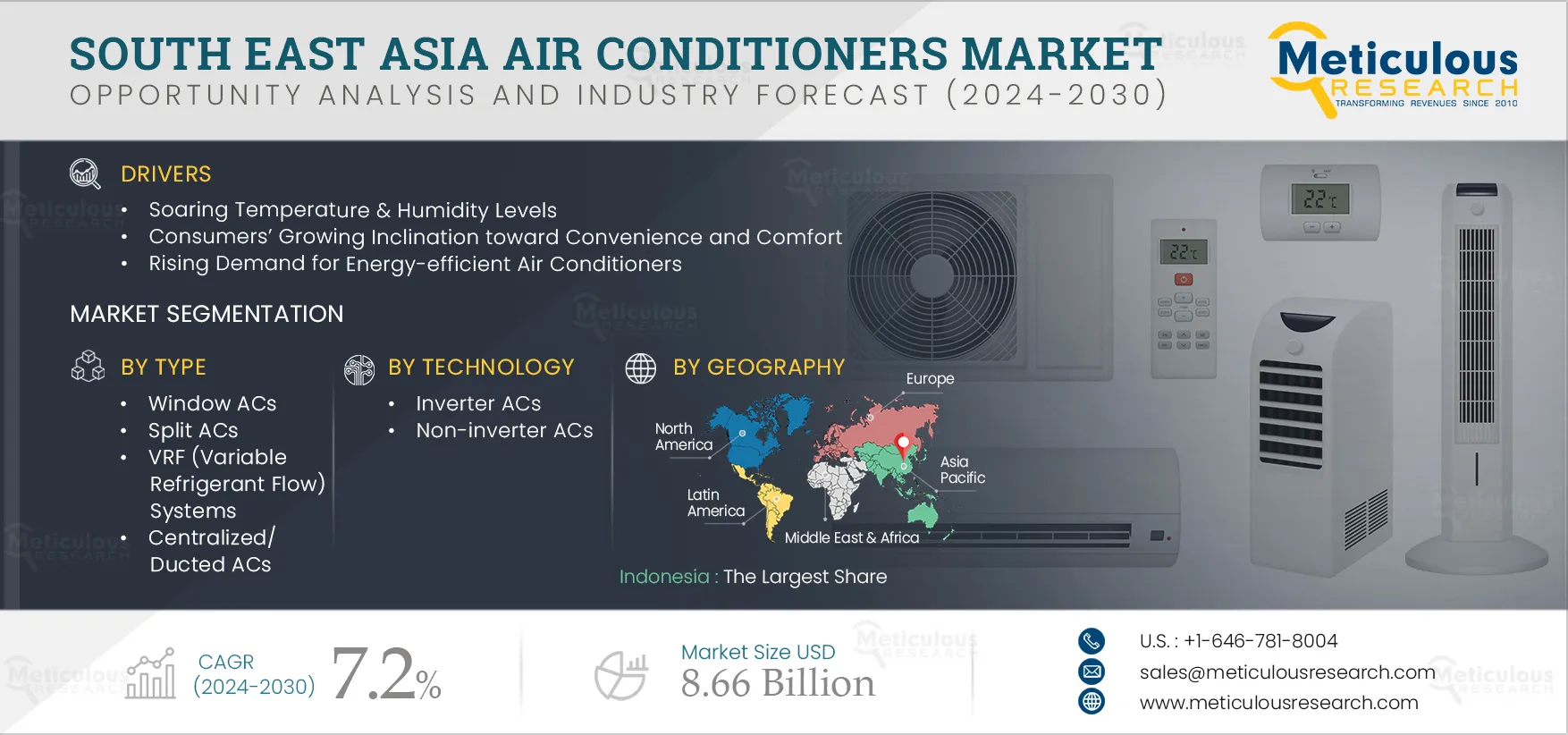
Table of contents
13 chapters · 90 sections · 200 pages · click to expandSegmental analysis
| Segment | Largest share (2025) | Fastest growth (2025–2032) |
|---|---|---|
| By Type | Split ACs | — |
| By Technology | Inverter ACs | — |
| By End User | Residential End Users | Residential end users |
By Type
- The Split ACs Segment to Dominate the South East Asia Air Conditioners Market in 2025
- The split ACs segment is expected to account for the largest share of the South East Asia air conditioners market.
- Split AC systems are more energy efficient, use less energy, and keep indoor environments clean.
- The large market share of this segment is attributed to the increasing demand for energy-saving and low-noise air conditioners.
- Furthermore, several companies are focused on providing quality air conditioners and launching a wide range of ACs in the market.
- For instance, in March 2022, Blue Star Ltd (India) launched its range of affordable split ACs with high quality, reliability, and durability.
- Such developments are driving the sales of split air conditioners in the market.
By Technology
- The Inverter ACs Segment to Account for the Largest Market Share in 2025
- The inverter ACs segment is expected to account for the larger share of the South East Asia air conditioners market.
- The large market share of this segment is attributed to advancements in inverter technology and AC manufacturers’ strong focus on product development and enhancement of inverter-powered ACs.
- For instance, in March 2022, Voltas Limited.
- (India) launched its PureAir Inverter ACs powered by HEPA filters and PM1.0 sensors to strengthen its portfolio of cooling products and home appliances.
- Similarly, in February 2022, LG Electronics India Pvt.
- Ltd. (India) launched its AI dual inverter air conditioners to offer customers superior cooling, maximum energy efficiency, and convenience.
By End User
- The residential end users segment is expected to account for the largest share of the South East Asia air conditioners market.
- The large market share of this segment is mainly attributed to the growing acceptance of smart home technologies, construction companies’ increased focus on offering air-conditioned apartments, and the rising need to improve indoor air quality.
- Moreover, the residential end users segment is also projected to register the highest CAGR during the forecast period.
- Indonesia is expected to account for the largest share of the South East Asia air conditioners market.
- The growing demand for air conditioners among the country’s middle-income population, independent households, the public and hospitality sectors, and the increasing production of air conditioners in Indonesia contribute to the country’s large market share.
- Moreover, Indonesia is also projected to register the highest CAGR during the forecast period.
Competitive landscape
- Daikin Industries, Ltd. · Japan
- Mitsubishi Electric Corporation · Japan
- Hitachi-Johnson Controls Air Conditioning · Japan
- Carrier Global Corporation (U.S.)
- Whirlpool Corporation (U.S.)
- Haier Smart Home Co. Ltd. · China
- LG Electronics · South Korea
- Voltas Limited · India
- Panasonic Corporation · Japan
- Robert Bosch GmbH · Germany
- Samsung Electronics Co., Ltd. · South Korea
- Fujitsu Limited · Japan
- Blue Star Ltd · India
- Toshiba Corporation · Japan
- Gree Electric Appliances Inc. · China
- Midea Group Co. Ltd · China
Frequently asked questions
The South East Asia air conditioners market is projected to reach $8.66 billion by 2032, at a CAGR of 7.2% during the forecast period.
Cite this report
Meticulous Research. (2025). South East Asia Air Conditioners Market - Opportunity Analysis and Industry Forecast (2025-2032) (Report No. MR-928). Meticulous Market Research Pvt. Ltd. https://www.meticulousresearch.com/product/south-east-asia-air-conditioners-market-5611