
Perovskite Solar Cells Market (2026-2036)
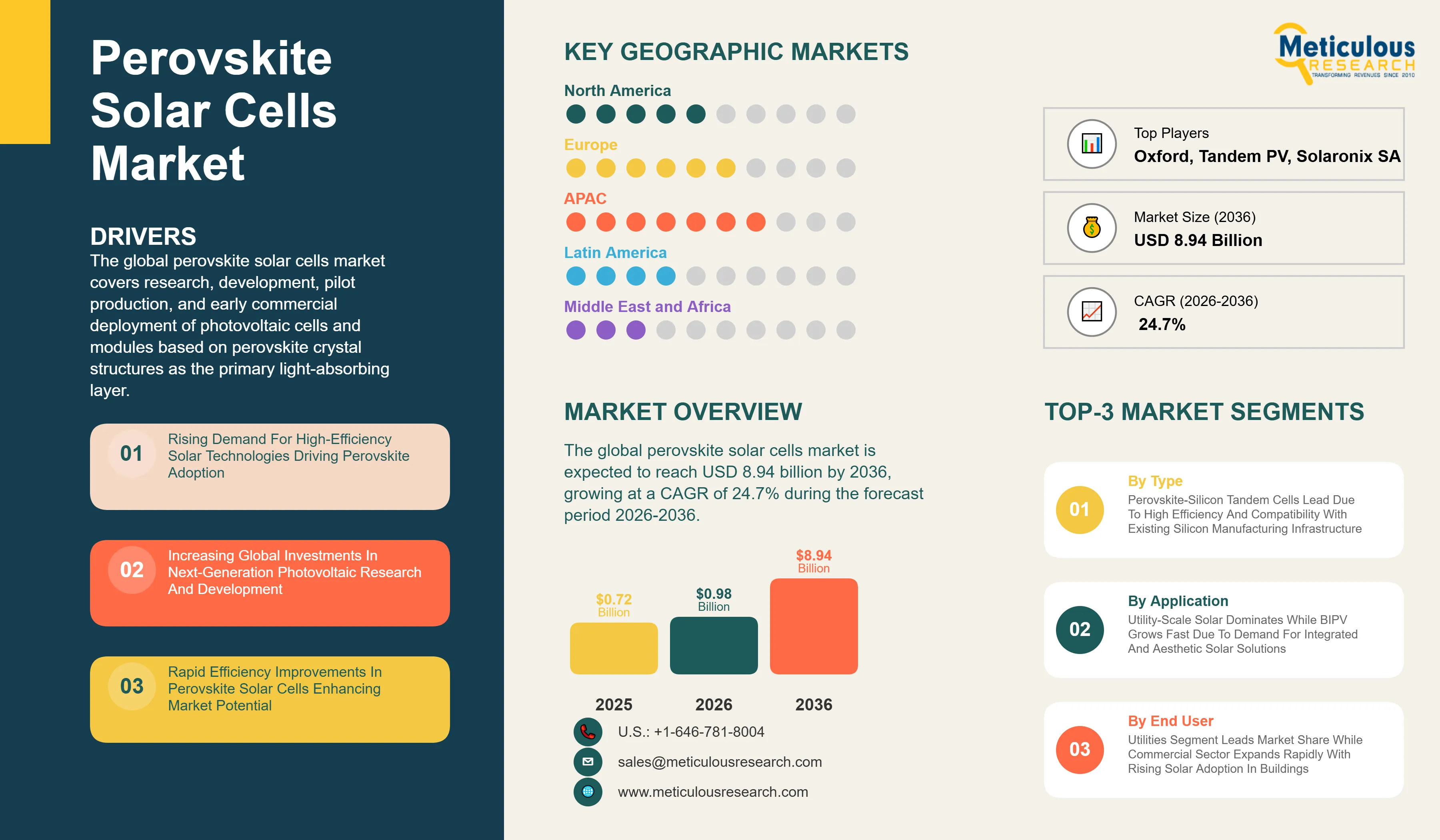
The global perovskite solar cells market was valued at USD 0.72 billion in 2025. This market is expected to reach USD 8.94 billion by 2036 from an estimated USD 0.98 billion in 2026, growing at a CAGR of 24.7% during the forecast period 2026-2036.
- Published
- Apr 2026
- Pages
- 298
- Format
- PDF + Excel
- Report ID
- MR-1877
- Base year
- 2025
- 2025 · BASELINE
- $720.0M
- 2036
- $8.94B
- CAGR 2026–2036
- 24.7%
2025 baseline · 2026–2036 forecast at 24.7% CAGR · hover a bar for the value
Key highlights
The global perovskite solar cells market is projected to reach USD 8.94 billion by 2036.
The market is expected to grow at a CAGR of 24.7% during the forecast period 2026-2036.
The global perovskite solar cells market was valued at USD 0.72 billion in 2025 and is estimated to reach USD 0.98 billion in 2026.
Asia-Pacific is expected to dominate the global perovskite solar cells market with the largest market share in 2026, driven by the strong research and pilot manufacturing base in China, Japan, South Korea, and Taiwan, the leading presence of solar PV manufacturers including GCL Technology and Panasonic, and significant government-backed investment in next-generation photovoltaic technology development.
Europe is projected to witness the fastest growth during the forecast period, driven by the European Union's Green Deal and Solar Energy Strategy funding programs supporting perovskite photovoltaic commercialization, the strong academic and startup ecosystem concentrated in the U.K., Germany, Sweden, and the Netherlands, and the aggressive climate targets accelerating next-generation solar technology deployment across the region.
By cell architecture, the perovskite-silicon tandem solar cells segment is expected to hold the largest share of the market in 2026, driven by the segment's demonstrated power conversion efficiencies exceeding 33%, the strong commercial momentum from Oxford PV and Tandem PV in scaling tandem modules toward initial production, and the direct compatibility of tandem technology with existing silicon solar manufacturing infrastructure.
By cell architecture, the all-perovskite tandem solar cells segment is projected to register the highest CAGR during the forecast period, driven by the theoretical efficiency ceiling of over 43% for all-perovskite multijunction architectures and increasing research investment directed at resolving the stability and bandgap tuning challenges required for commercial deployment of this architecture.
By material composition, the lead-based perovskites segment is expected to hold the largest share of the market in 2026, as lead halide perovskite formulations currently deliver the highest certified power conversion efficiencies and represent the most commercially advanced material platform in both research and pilot production environments.
By material composition, the lead-free perovskites segment is projected to register the highest CAGR, driven by intensifying regulatory pressure on lead usage in electronic devices across the EU and other major markets, and accelerating research progress in tin-based and bismuth-based perovskite compositions that are progressively narrowing the efficiency gap with lead-based alternatives.
By manufacturing method, the printed and roll-to-roll cells segment is projected to register the highest CAGR, driven by the potential to achieve very low production costs through continuous high-throughput manufacturing and the progress of companies including Saule Technologies and Heliatek in advancing inkjet-printed and roll-to-roll perovskite manufacturing toward commercial viability.
By application, the utility-scale solar power segment is expected to hold the largest share in 2026, while the building-integrated photovoltaics (BIPV) segment is projected to register the highest CAGR, driven by the growing demand for aesthetically integrated solar solutions in commercial and residential construction and the particular suitability of flexible and semi-transparent perovskite cells for BIPV applications.
By end user, the utilities segment is expected to hold the largest share in 2026, while the commercial segment is projected to register the highest CAGR during the forecast period.
Report summary
| Particulars | Details |
|---|---|
| Market Size by 2036 | USD 8.94 Billion |
| Market Size in 2026 | USD 0.98 Billion |
| Market Size in 2025 | USD 0.72 Billion |
| Revenue Growth Rate (2026-2036) | CAGR of 24.7% |
| Format | PDF, Excel & Cloud Portal · 298 pages |
| Dominating Cell Architecture | Perovskite-Silicon Tandem Solar Cells |
| Fastest Growing Cell Architecture | All-Perovskite Tandem Solar Cells |
| Dominating Material Composition | Lead-Based Perovskites |
| Fastest Growing Material Composition | Lead-Free Perovskites |
| Dominating Manufacturing Method | Solution-Processed Cells |
| Fastest Growing Manufacturing Method | Printed and Roll-to-Roll Cells |
| Dominating Application | Utility-Scale Solar Power |
| Fastest Growing Application | Building-Integrated Photovoltaics (BIPV) |
| Dominating End User | Utilities |
| Fastest Growing End User | Commercial |
| Dominating Geography | Asia-Pacific |
| Fastest Growing Geography | Europe |
| Base Year | 2025 |
| Forecast Period | 2026 to 2036 |
Report overview
Segments covered: cell architecture, material composition, manufacturing method, application, end user.
The global perovskite solar cells market covers research, development, pilot production, and early commercial deployment of photovoltaic cells and modules based on perovskite crystal structures as the primary light-absorbing layer. This includes single-junction perovskite cells, perovskite-silicon tandem cells, all-perovskite tandem cells, and flexible thin-film perovskite configurations, spanning solution-processed, vapor-deposited, and printed manufacturing methods across utility-scale, building-integrated, portable, and specialty application segments.
The growth of the global perovskite solar cells market is primarily driven by the rapid improvement in certified power conversion efficiencies, which have advanced from below 4% in 2009 to certified records exceeding 26% for single-junction and 33% for tandem configurations, approaching and in some configurations surpassing the practical efficiency limits of conventional silicon PV. The potential for significantly lower manufacturing costs through solution-processed and printed deposition methods, combined with the demonstrated tunability of the perovskite bandgap across the visible and near-infrared spectrum enabling tailored absorption profiles, is attracting substantial investment from both established PV manufacturers and venture-backed startups pursuing commercialization of this technology.
However, the market faces key constraints. Long-term operational stability under real-world conditions of moisture, heat, and UV exposure remains the primary technical barrier to commercial deployment, with most perovskite formulations demonstrating operational lifetimes substantially shorter than the 25-year warranty standards of commercial silicon modules. The environmental and regulatory challenges associated with the lead content in high-performance perovskite formulations are adding complexity to regulatory approval and end-of-life disposal frameworks in key markets.
Despite these challenges, several opportunities are accelerating market development. The rapid commercial momentum of perovskite-silicon tandem cells, which are approaching pilot production at Oxford PV, Tandem PV, and several Chinese manufacturers, represents the nearest-term commercialization pathway. Advancements in encapsulation technologies are progressively extending perovskite module operational lifetimes, while the expansion of BIPV demand is creating near-term application pull for the aesthetic and form-factor flexibility that perovskite cells uniquely enable.
Report infographic
Market dynamics
9 factors across 4 forcesRising Demand for High-Efficiency Solar Technologies
The primary driver of the global perovskite solar cells market is the sustained global push for photovoltaic technologies that can surpass the efficiency limits of conventional crystalline silicon solar cells, which are approaching their practical conversion ceiling of 26-29% for single-junction configurations. Perovskite solar cells have demonstrated the fastest efficiency improvement trajectory of any photovoltaic technology in research history, advancing from 3.8% in 2009 to certified efficiencies exceeding 26% for single-junction and 33% for tandem configurations within 15 years. This performance trajectory is attracting substantial capital from both established PV manufacturers seeking technology differentiation and policy-driven investment programs targeting next-generation clean energy technologies.
Increasing Investments in Next-Generation Photovoltaics
Global investment in next-generation photovoltaic technologies has accelerated substantially, with perovskite solar cells attracting the largest share of research and early-stage commercial funding among emerging PV technologies. The U.S. Department of Energy's Solar Energy Technologies Office, the European Commission's Horizon programs, and equivalent national funding bodies in China, Japan, South Korea, and Australia have collectively committed hundreds of millions of dollars to perovskite photovoltaic research and early commercialization programs. Venture capital investment in perovskite solar cell startups has grown significantly, with companies including Oxford PV, Swift Solar, Tandem PV, and Saule Technologies collectively raising substantial funding to advance their respective technology and manufacturing programs toward commercial scale.
Table of contents
13 chapters · 161 sections · 298 pages · click to expandSegmental analysis
| Segment | Largest share (2026) | Fastest growth (2026–2036) |
|---|---|---|
| By Cell Architecture | Perovskite-Silicon Tandem | All-perovskite tandem solar cells |
| By Material Composition | Lead-Based Perovskites | Lead-free perovskites |
| By Manufacturing Method | Solution-Processed Cells | Printed and roll-to-roll cells |
| By Application | Utility-Scale Solar Power | BIPV |
| By End User | Utilities | Commercial end user |
By Cell Architecture
- The Perovskite-Silicon Tandem Segment to Dominate
- The perovskite-silicon tandem solar cells segment is expected to account for the largest share of the global perovskite solar cells market.
- The large share of this segment is attributed to the demonstrated performance advantage of tandem architectures over single-junction silicon, the strongest commercial development activity among all perovskite cell architectures, and the direct compatibility of perovskite top cells with the silicon manufacturing infrastructure that major PV manufacturers have already established.
- However, the all-perovskite tandem solar cells segment is poised to register the highest CAGR during the forecast period.
- The high growth of this segment is attributed to the theoretical efficiency ceiling exceeding 43% for optimally designed all-perovskite multijunction configurations, the growing research investment directed at this architecture by leading academic groups and startups including Swift Solar, and the potential for fully solution-processed all-perovskite tandem manufacturing at costs below silicon-based alternatives once stability and efficiency targets are achieved.
By Material Composition
- Lead-Based Perovskites to Hold the Largest Share
- The lead-based perovskites segment is expected to account for the largest share of the global perovskite solar cells market.
- This dominance reflects the current efficiency leadership of lead halide perovskite formulations, which hold all major certified efficiency records for single-junction and tandem perovskite cells, and the concentration of commercial development activity at companies including Oxford PV, Saule Technologies, and GCL Technology around lead-based formulations that have demonstrated the strongest performance and manufacturing compatibility to date.
- However, the lead-free perovskites segment is projected to register the highest CAGR during the forecast period.
- This growth is driven by the anticipated tightening of EU RoHS regulations affecting lead content in photovoltaic applications, the accelerating research progress in tin-based and bismuth-based perovskite compositions narrowing the efficiency gap with lead-based alternatives, and the strategic positioning investments being made by companies seeking regulatory preemptive advantage in markets where lead restrictions are expected to affect commercial approval timelines.
By Manufacturing Method
- Solution-Processed Cells to Hold the Largest Share
- The solution-processed cells segment is expected to account for the largest share of the global perovskite solar cells market.
- This is driven by the broad research and pilot production base built on solution-processed perovskite deposition techniques, the lower capital equipment requirements compared with vapor deposition, and the demonstrated ability of solution-processed approaches to achieve high efficiencies at research and pilot production scales across a wide range of perovskite formulations.
- However, the printed and roll-to-roll cells segment is projected to register the highest CAGR during the forecast period.
- This growth is driven by the potential of continuous roll-to-roll and inkjet printing manufacturing to achieve very low production costs through high-throughput processing of flexible substrates, the progress of companies including Saule Technologies and Heliatek in advancing inkjet-printed perovskite manufacturing toward commercial viability, and the alignment of printed flexible perovskite cells with the rapidly growing BIPV and portable power application segments.
By Application
- Utility-Scale Solar Power to Hold the Largest Share
- The utility-scale solar power segment is expected to account for the largest share of the global perovskite solar cells market.
- This is driven by the initial commercial deployment focus of leading perovskite-silicon tandem manufacturers including Oxford PV and GCL Technology on high-efficiency utility-scale module formats, where the efficiency premium of tandem cells justifies the price premium over standard silicon modules for developers seeking maximum energy yield per unit area.
- However, the BIPV segment is projected to register the highest CAGR during the forecast period.
- This growth is driven by the rapidly expanding global BIPV market propelled by net-zero building standards, the unique form-factor and transparency advantages of perovskite cells for architectural integration, and the early commercial BIPV deployments by companies including Saule Technologies demonstrating commercially viable perovskite BIPV installations on commercial building facades.
By End User
- Utilities to Hold the Largest Share
- The utilities segment is expected to account for the largest share of the global perovskite solar cells market.
- This dominance is attributed to the focus of initial commercial perovskite module deployments on large-scale solar power projects where high-efficiency tandem modules are being evaluated as premium alternatives to standard silicon modules for maximizing energy density in land-constrained project sites.
- However, the commercial end user segment is projected to register the highest CAGR during the forecast period.
- This growth is driven by the growing adoption of perovskite-based BIPV products in commercial building construction and retrofit programs, the expansion of commercial rooftop and facade solar installations targeting net-zero building certification, and the suitability of perovskite module form factors for commercial building integration applications that are driving strong demand growth in this end user category.
Geographic analysis
Asia-Pacific
Largest shareIn 2026, Asia-Pacific is expected to account for the largest share of the global perovskite solar cells market. The largest share of this region is mainly due to the leading position of Chinese research institutions and manufacturers including GCL Technology in advancing perovskite cell technology toward pilot and commercial production, the strong research programs in Japan at Panasonic, Toshiba, and Sharp, the active perovskite research ecosystem in South Korea, and Taiwan's established solar cell manufacturing infrastructure that provides a manufacturing platform for perovskite cell integration. China's national solar technology development programs have specifically identified perovskite photovoltaics as a strategic next-generation technology with significant public research funding commitments, creating a concentrated development ecosystem that is accelerating the region's commercial readiness. However, the European perovskite solar cells market is expected to grow at the fastest CAGR during the forecast period.
Europe
Europe's rapid growth is driven by Oxford PV's commercial manufacturing facility in Germany representing the world's most advanced perovskite-silicon tandem production program, the strong academic and startup ecosystem at institutions including the University of Oxford, Helmholtz-Zentrum Berlin, and IMEC in Belgium that is translating research advances into commercial ventures, the European Commission's substantial Horizon program funding for perovskite photovoltaic commercialization, and the EU's ambitious solar energy deployment targets that are creating strong demand pull for high-efficiency photovoltaic technologies.
North America
North America is establishing a growing position in the perovskite solar cells market, with companies including Swift Solar, Tandem PV, and Hunt Perovskite Technologies advancing perovskite cell commercialization programs supported by U.S. Department of Energy funding and the Inflation Reduction Act incentives for domestic solar manufacturing. The U.S. market's large solar installation base and strong research university ecosystem provide a favorable environment for perovskite solar cell market development through the forecast period.
Competitive landscape
- Oxford PV Ltd. (U.K.)
- Saule Technologies · Poland
- Microquanta Semiconductor · China
- Swift Solar (U.S.)
- Tandem PV (U.S.)
- Heliatek GmbH · Germany
- Hunt Perovskite Technologies (U.S.)
- Greatcell Energy · Australia
- GCL Technology Holdings · China
- Panasonic Corporation · Japan
- Toshiba Corporation · Japan
- Sharp Corporation · Japan
- EneCoat Technologies · Japan
- Solaronix SA · Switzerland
- Dyesol Limited · Australia
Frequently asked questions
The global perovskite solar cells market is expected to reach USD 8.94 billion by 2036 from an estimated USD 0.98 billion in 2026, at a CAGR of 24.7% during the forecast period 2026-2036.
Cite this report
Meticulous Research. (2026). Perovskite Solar Cells Market - Global Opportunity Analysis and Industry Forecast (2026-2036) (Report No. MR-1877). Meticulous Market Research Pvt. Ltd. https://www.meticulousresearch.com/product/perovskite-solar-cells-market-6560