NFC in Healthcare Market (2026-2036)
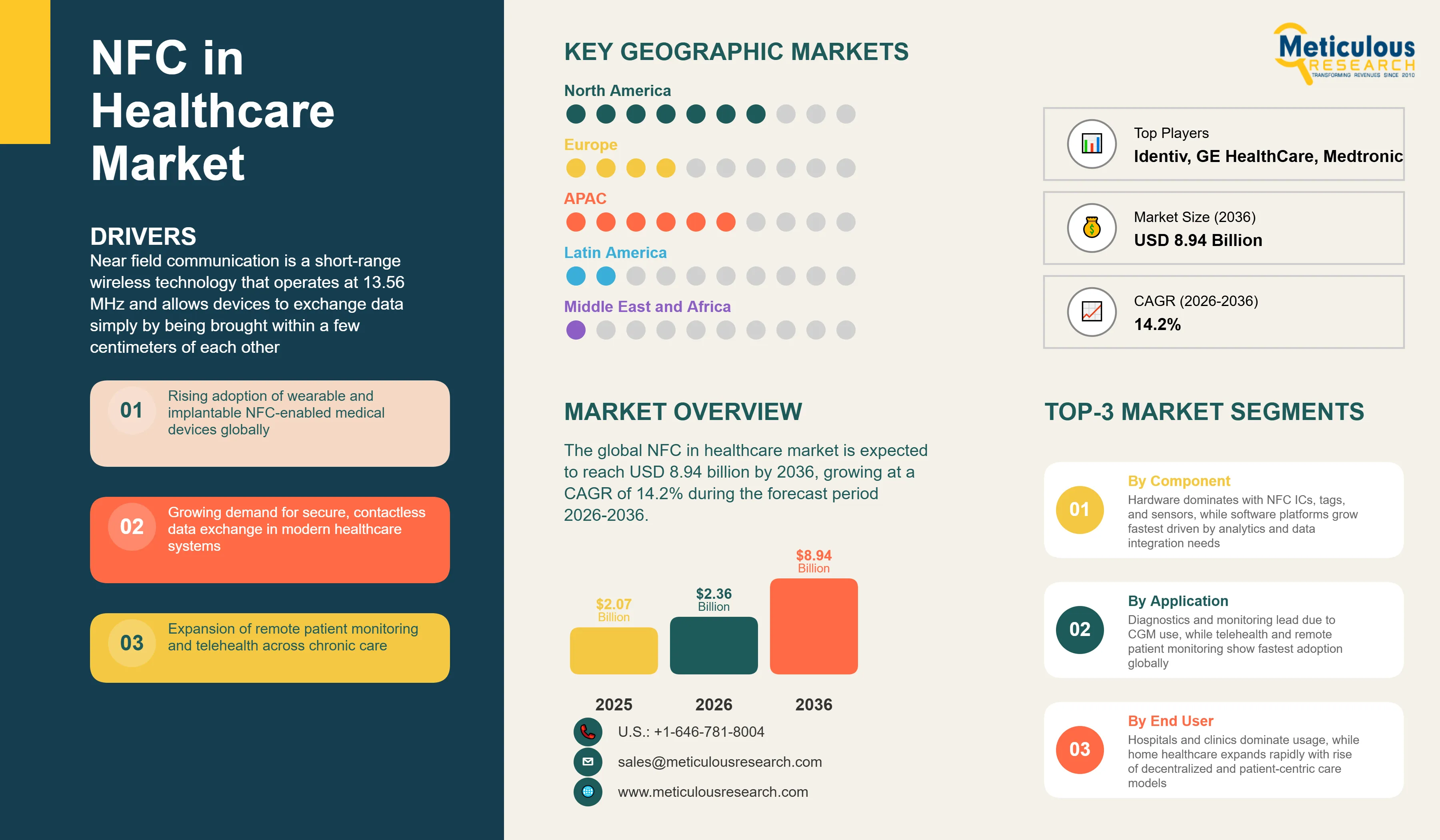
The global NFC in healthcare market was valued at USD 2.07 billion in 2025. This market is expected to reach USD 8.94 billion by 2036 from an estimated USD 2.36 billion in 2026, growing at a CAGR of 14.2% during the forecast period 2026-2036.
- Published
- May 2026
- Pages
- 310
- Format
- PDF + Excel
- Report ID
- MRHC - 1041961
- Base year
- 2025
- 2025 · BASELINE
- $2.07B
- 2036
- $8.94B
- CAGR 2026–2036
- 14.2%
2025 baseline · 2026–2036 forecast at 14.2% CAGR · hover a bar for the value
Key highlights
The global NFC in healthcare market is projected to reach USD 8.94 billion by 2036.
The market is expected to grow at a CAGR of 14.2% during the forecast period 2026-2036.
The global NFC in healthcare market was valued at USD 2.07 billion in 2025 and is estimated to reach USD 2.36 billion in 2026.
North America is expected to dominate the global NFC in healthcare market with the largest market share in 2026, while Asia-Pacific is projected to register the highest CAGR during the forecast period.
By component, the hardware segment is expected to hold the largest share of the market in 2026, while the software (data analytics platforms) segment is projected to register the highest CAGR during the forecast period.
By device type, the wearable devices segment is expected to hold the largest share in 2026, while the implantable devices segment is projected to register the highest CAGR during the forecast period.
By sensor type, the biosensors segment is expected to hold the largest share in 2026, while the chemical sensors (glucose monitoring) segment is projected to register the highest CAGR during the forecast period.
By application, the diagnostics and monitoring segment is expected to hold the largest share in 2026, while the remote patient monitoring and telehealth segment is projected to register the highest CAGR during the forecast period.
By end user, the hospitals and clinics segment is expected to hold the largest share in 2026, while the home healthcare segment is projected to register the highest CAGR during the forecast period.
By deployment mode, the cloud-based systems segment is expected to hold the largest share in 2026 and is also projected to register the highest CAGR during the forecast period.
Report summary
| Particulars | Details |
|---|---|
| Market Size by 2036 | USD 8.94 Billion |
| Market Size in 2026 | USD 2.36 Billion |
| Market Size in 2025 | USD 2.07 Billion |
| Revenue Growth Rate (2026-2036) | CAGR of 14.2% |
| Format | PDF, Excel & Cloud Portal · 310 pages |
| Dominating Component | Hardware (NFC ICs and Chipsets) |
| Fastest Growing Component | Software (Data Analytics Platforms) |
| Dominating Device Type | Wearable Devices |
| Fastest Growing Device Type | Implantable Devices |
| Dominating Sensor Type | Biosensors |
| Fastest Growing Sensor Type | Chemical Sensors (Glucose Monitoring) |
| Dominating Application | Diagnostics & Monitoring |
| Fastest Growing Application | Remote Patient Monitoring & Telehealth |
| Dominating End User | Hospitals and Clinics |
| Fastest Growing End User | Home Healthcare |
| Dominating Deployment Mode | Cloud-Based Systems |
| Fastest Growing Deployment Mode | Cloud-Based Systems |
| Dominating Geography | North America |
| Fastest Growing Geography | Asia-Pacific |
| Base Year | 2025 |
| Forecast Period | 2026 to 2036 |
Report overview
Segments covered: component, sensor type, application, end user.
Near field communication technology, which enables two-way wireless data exchange over distances of a few centimeters, is transforming how patient data is collected, how medical devices communicate, and how medications are tracked in healthcare settings where contactless, secure, and battery-independent data transmission has compelling operational and clinical advantages.
Near field communication is a short-range wireless technology that operates at 13.56 MHz and allows devices to exchange data simply by being brought within a few centimeters of each other. In healthcare, NFC enables a wide range of applications, from a nurse tapping a smartphone against a patient wristband to retrieve medical records, to a continuous glucose monitor patch transmitting blood sugar readings to a smartphone without needing a battery in the patch itself. Passive NFC tags can be powered entirely by the electromagnetic field from a reader device, making them suitable for small disposable medical sensors, smart medication packaging, and patient identification bands that require no onboard power. Active NFC systems in medical devices enable two-way communication with smartphones and hospital IT systems, creating a seamless data bridge between the patient and the electronic health record.
The market is growing because healthcare is experiencing a broad shift toward digitization, decentralization, and continuous monitoring that NFC's specific properties are well-suited to enable. The COVID-19 pandemic demonstrated the value of contactless interaction in clinical settings, and the operational advantages of NFC over alternatives including Bluetooth in terms of zero pairing requirement, instant data transfer, and passive operation have sustained clinical adoption well beyond the pandemic period. According to the International Diabetes Federation's Diabetes Atlas 2025, approximately 11.1% of adults worldwide are living with diabetes, and the continuous glucose monitoring market serving this population is one of the most commercially active adoption channels for NFC-enabled medical sensors.
Two growth opportunities are defining the technology's next phase. Abbott's FreeStyle Libre continuous glucose monitoring system, which uses NFC to transmit glucose readings from a wearable sensor to a smartphone or dedicated reader, reported global FreeStyle Libre sales of approximately USD 1.8 billion in Q4 2024 according to Abbott's 2025 financial results, making it the world's largest single NFC-enabled healthcare product and a powerful proof-of-concept for the commercial potential of NFC in continuous health monitoring. The second opportunity is NFC-enabled implantable biosensors, where research programs at multiple academic and commercial organizations are developing subcutaneous sensors for continuous biomarker monitoring that communicate data wirelessly through the skin to an external reader, removing the need for any transcutaneous connections or battery replacement.
Report infographic
Market dynamics
7 factors across 3 forcesGrowth of Wearable and Implantable Medical Devices
The wearable medical device market is one of the most rapidly growing segments of the broader medical technology industry, and NFC is increasingly the preferred wireless connectivity protocol for wearable health sensors because of its battery-independent passive operation and its zero-pairing instant data transfer characteristics. Abbott's FreeStyle Libre, reporting approximately USD 1.8 billion in Q 4 2024 revenues per its 2025 Annual Report, is the commercial anchor of the NFC wearable medical device market and the proof point that NFC-connected biosensors can achieve mass-market consumer adoption at the billion-dollar scale.
Expansion of Remote Patient Monitoring & Telehealth
The telehealth and remote patient monitoring market expanded substantially during the COVID-19 pandemic and has retained a substantially larger patient and provider base than existed before 2020. According to the American Hospital Association's 2025 data, telehealth utilization in the U.S. remained at levels many times higher than pre-pandemic baselines, with chronic disease management and post-acute care representing the highest-volume telehealth use cases. NFC-enabled devices are well-positioned for remote monitoring because they combine continuous sensor operation in the patient's home with a simple smartphone tap to upload accumulated data to the clinical team's patient monitoring platform, requiring no technical expertise from the patient and generating structured data that integrates directly with electronic health record systems. The International Diabetes Federation's 2025 Diabetes Atlas projecting over 600 million diabetes patients globally by 2045 indicates the long-term scale of the chronic disease monitoring market that NFC-enabled remote monitoring is increasingly serving.
Table of contents
14 chapters · 186 sections · 310 pages · click to expandSegmental analysis
| Segment | Largest share (2026) | Fastest growth (2026–2036) |
|---|---|---|
| By Component | Hardware | Software |
| By Device Type | Wearable Devices | Implantable devices |
| By Application | Diagnostics and Monitoring | Remote patient monitoring and telehealth |
By Component
- Hardware to Hold the Largest Share
- The hardware segment is expected to account for the largest share of the global NFC in healthcare market.
- NFC semiconductor ICs, tags, and sensor-integrated modules are the physical enablers of every NFC healthcare application and represent the largest procurement category by value, anchored by the large volumes of NFC chipsets consumed by the continuous glucose monitoring and wearable biosensor markets.
- NXP Semiconductors and STMicroelectronics are the world's leading NFC IC suppliers and serve both consumer NFC and healthcare-specific NFC applications.
- However, the software segment, particularly data analytics platforms, is projected to register the highest CAGR during the forecast period.
- As NFC-enabled health sensor deployments scale up and generate large volumes of continuous physiological data, the value of analytics platforms that can process, visualize, and generate clinical insights from this data is growing rapidly.
- Healthcare providers and digital health companies are increasingly adopting subscription analytics platforms that convert raw NFC sensor data into actionable clinical guidance, creating a high-margin recurring revenue software stream that is growing faster than the underlying hardware market.
By Device Type
- Wearable Devices to Hold the Largest Share
- The wearable devices segment is expected to account for the largest share of the global NFC in healthcare market.
- The continuous glucose monitoring market anchored by Abbott's FreeStyle Libre, which uses NFC-enabled skin-worn sensor patches, drives the majority of NFC wearable medical device revenue and provides the commercial scale reference for this segment.
- The broader wearable biosensor market is rapidly adding additional parameters to NFC-connected wearable platforms, expanding the total addressable market beyond glucose monitoring.
- However, the implantable devices segment is projected to register the highest CAGR during the forecast period.
- NFC-enabled implantable biosensors that can transmit data from beneath the skin to an external reader without transcutaneous connections represent a significant clinical improvement over current implantable sensor approaches and are attracting growing research and commercial investment.
- Medtronic's work on NFC-enabled implantable cardiac monitors and several academic and startup programs developing NFC-powered subcutaneous biosensors represent the leading edge of this segment's commercial development.
By Application
- Diagnostics and Monitoring to Hold the Largest Share
- The diagnostics and monitoring segment is expected to account for the largest share of the global NFC in healthcare market.
- Continuous glucose monitoring and other NFC-enabled biosensor applications for chronic disease monitoring generate the highest total NFC healthcare revenue, driven by the very large and growing diabetes patient population and the premium pricing of CGM systems relative to traditional monitoring approaches.
- The point-of-care diagnostics subcategory is also growing rapidly as NFC-connected test cartridges reduce the infrastructure requirements for bedside and home-based testing.
- However, the remote patient monitoring and telehealth segment is projected to register the highest CAGR during the forecast period.
- The sustained high levels of telehealth utilization, combined with the growing clinical evidence that continuous remote monitoring improves outcomes in chronic disease management, is driving healthcare providers and payers to invest in NFC-enabled RPM programs.
- The International Diabetes Federation's 2025 Diabetes Atlas projecting global diabetes prevalence reaching over 853 million by 2050 represents the long-term patient population growth that will sustain remote monitoring demand.
Geographic analysis
North America
Largest shareIn 2026, North America is expected to account for the largest share of the global NFC in healthcare market. The United States has the world's most advanced digital health ecosystem, the highest per-capita healthcare spending, and the largest domestic commercial deployment of NFC-enabled continuous glucose monitors anchored by Abbott's FreeStyle Libre and Dexcom's competing CGM systems. The U.S. FDA's digital health policy framework, which has developed specific regulatory pathways for software as a medical device and NFC-enabled diagnostics, provides regulatory clarity that enables faster product commercialization than most other markets. The U.S. Centers for Medicare and Medicaid Services has expanded reimbursement coverage for CGM devices in recent years, according to the American Diabetes Association's 2025 Standards of Medical Care, making continuous NFC-enabled glucose monitoring financially accessible to a broader population of Medicare beneficiaries. The very large U.S. diabetes population, the American Hospital Association's data showing sustained high telehealth adoption, and the presence of leading NFC semiconductor companies including NXP, Texas Instruments, and Analog Devices collectively make North America the dominant regional market.
Asia-Pacific
Fastest growthHowever, the Asia-Pacific NFC in healthcare market is expected to grow at the fastest CAGR during the forecast period. The region contains the two largest national diabetes populations globally: the International Diabetes Federation's 2025 Atlas identifies China at approximately 148 million and India at approximately 90 million adult patients, creating enormous demand for affordable continuous monitoring solutions. China's digital health transformation, accelerated by government investment in healthcare digitalization and the very high smartphone penetration that provides the NFC reader infrastructure for patient-facing applications, is creating rapid adoption of digital health technologies including NFC-enabled wearables. Japan's aging population, with over 29% of residents aged 65 and above according to Japan's Statistics Bureau 2025 data, creates growing demand for remote monitoring solutions that NFC-enabled wearables are well-positioned to serve. South Korea's advanced digital health infrastructure, high NFC-capable smartphone penetration, and sophisticated health technology industry including Samsung's semiconductor and healthcare businesses, and Singapore's position as Asia's most advanced digital health hub, add to the region's growth momentum.
Competitive landscape
- NXP Semiconductors N.V. · Netherlands
- STMicroelectronics N.V. · Switzerland/France
- Infineon Technologies AG · Germany
- Analog Devices Inc. (U.S.)
- Texas Instruments Incorporated (U.S.)
- Medtronic plc · Ireland
- Abbott Laboratories (U.S.)
- Philips Healthcare · Netherlands
- GE HealthCare (U.S.)
- Siemens Healthineers AG · Germany
- Sony Semiconductor Solutions Corporation · Japan
- Identiv Inc. (U.S.)
- HID Global Corporation (U.S.)
- Silicon Craft Technology PLC · Thailand
- Zebra Technologies Corporation (U.S.)
Frequently asked questions
The global NFC in healthcare market is expected to reach USD 8.94 billion by 2036 from an estimated USD 2.36 billion in 2026, at a CAGR of 14.2% during the forecast period 2026-2036.
Cite this report
Meticulous Research. (2026). NFC in Healthcare Market - Global Opportunity Analysis and Industry Forecast (2026-2036) (Report No. MRHC - 1041961). Meticulous Market Research Pvt. Ltd. https://www.meticulousresearch.com/product/nfc-in-healthcare-market-6644