Multilayer Ceramic Capacitor (MLCC) Market (2026-2036)
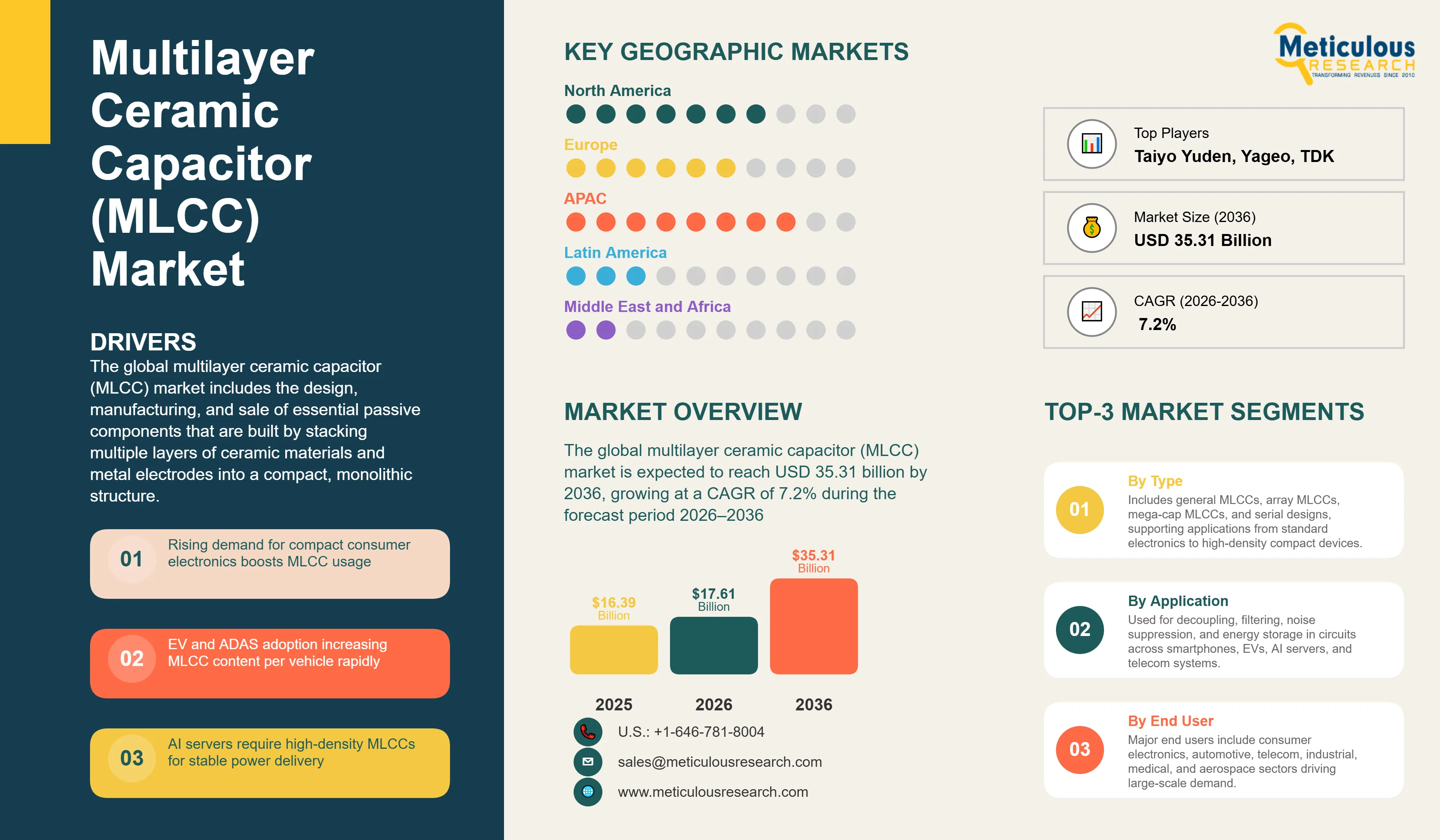
The global multilayer ceramic capacitor (MLCC) market was valued at USD 16.39 billion in 2025. This market is expected to reach USD 35.31 billion by 2036 from an estimated USD 17.61 billion in 2026, growing at a CAGR of 7.2% during the forecast period 2026–2036
- Published
- Apr 2026
- Pages
- 275
- Format
- PDF + Excel
- Report ID
- MR-1865
- Base year
- 2025
- 2025 · BASELINE
- $16.39B
- 2036
- $35.31B
- CAGR 2026–2036
- 7.2%
2025 baseline · 2026–2036 forecast at 7.2% CAGR · hover a bar for the value
Key highlights
The global MLCC market is projected to reach USD 35.31 billion by 2036.
The market is expected to grow at a CAGR of 7.2% during the forecast period 2026–2036.
The global MLCC market was valued at USD 16.39 billion in 2025 and is estimated to reach USD 17.61 billion in 2026.
AI servers require up to 8 times more MLCCs per unit compared to conventional servers, with each GPU board requiring approximately 3,000 MLCCs, creating a rapidly growing demand vector for ultra-low-ESL 0402-size high-capacitance MLCCs.
Leading manufacturers are pushing the boundaries of MLCC miniaturization to meet the performance requirements of next-generation applications. Murata Manufacturing initiated the world’s first mass production of 47 µF MLCCs in the 0402 form factor for AI servers and data centers in July 2025. Similarly, KYOCERA AVX announced the development of 47 µF MLCCs in the same compact size in March 2025, with mass production scheduled for December 2025.
Asia Pacific is expected to dominate the global MLCC market during the forecast period, driven by Japan's mastery of precision ceramics, South Korea's high-mix automotive MLCC production, and China's vast consumer electronics export engine.
North America is expected to witness the fastest regional growth during the forecast period, driven by CHIPS and Science Act incentives attracting semiconductor and passive-component supply chain investment, hyperscaler AI server MLCC procurement (Microsoft and Amazon doubled server-grade MLCC orders in 2025), and EV manufacturing expansion.
By end-use, consumer electronics is expected to hold the largest market share in 2026, while automotive is projected to register the highest CAGR during the forecast period, driven by EV powertrain content expansion.
By voltage range, low-voltage (<500 V) MLCCs are expected to hold the largest share in 2026, while mid-voltage (500–1,000 V) MLCCs are projected to register the fastest growth driven by 800 V EV battery platform adoption.
Report summary
| Particulars | Details |
|---|---|
| Market Size by 2036 | USD 35.31 Billion |
| Market Size in 2026 | USD 17.61 Billion |
| Market Size in 2025 | USD 16.39 Billion |
| Revenue Growth Rate (2026–2036) | CAGR of 7.2% |
| Format | PDF, Excel & Cloud Portal · 275 pages |
| Dominating Type | General Capacitors (Class II) |
| Fastest Growing Type | Array MLCCs |
| Dominating Dielectric | Class I (C0G/NP0, X7R) |
| Fastest Growing Dielectric | Class I (High-Frequency, High-Stability) |
| Dominating Voltage Range | Low Voltage (< 500 V) |
| Fastest Growing Voltage Range | Mid Voltage (500 V–1,000 V) |
| Dominating Case Size | 0201 |
| Fastest Growing Case Size | 0402 |
| Dominating End-Use | Consumer Electronics |
| Fastest Growing End-Use | Automotive |
| Dominating Geography | Asia Pacific |
| Fastest Growing Geography | North America |
| Base Year | 2025 |
| Forecast Period | 2026 to 2036 |
Report overview
Segments covered: type, dielectric type, voltage range, case size, end-use industry.
The global multilayer ceramic capacitor (MLCC) market includes the design, manufacturing, and sale of essential passive components that are built by stacking multiple layers of ceramic materials and metal electrodes into a compact, monolithic structure. Produced through processes such as casting, electrode printing, lamination, and high-temperature sintering, MLCCs play a critical role in modern electronic circuits by enabling functions such as decoupling, filtering, energy storage, signal coupling, and noise suppression
MLCCs are the most widely used discrete electronic components in the world, with annual production reaching trillions of units. They are found across virtually every electronic application, from smartphones, laptops, and wearables to electric vehicles, telecom infrastructure, industrial systems, and aerospace technologies. Their widespread use, essential functionality, and massive production volumes have earned them the nickname the “rice of the electronics industry,” highlighting their indispensable role in the global electronics ecosystem
The growth of the multilayer ceramic capacitor (MLCC) market is primarily driven by the increasing demand for consumer electronics, including 5G smartphones, laptops, wearables, and tablets, which require a higher number of MLCCs per device as designs become more compact and feature-rich. In parallel, the rapid electrification of the automotive sector is significantly increasing MLCC content per vehicle
Electric vehicles (EVs), particularly those based on 800 V architectures, require thousands of additional MLCCs across powertrain systems, advanced driver-assistance systems (ADAS), and infotainment units, positioning automotive as one of the fastest-growing end-use segments
Furthermore, the increasing deployment of 5G infrastructure, reaching over 2 billion global connections, has increased MLCC demand per base station due to the need for stable high-frequency signal management and noise suppression. These factors collectively are driving demand across high-volume and high-reliability MLCC applications Despite strong demand, the market remains influenced by cyclical inventory corrections, particularly in the consumer electronics segment, which historically experiences demand volatility. In addition, intense price competition from Chinese manufacturers in commoditized MLCC segments is exerting pressure on margins. Fluctuations in the prices of key raw materials, including nickel, palladium, and barium titanate, further contribute to cost instability and impact overall profitability
The emergence of AI servers and data centers as a high-growth MLCC demand segment offers a significant opportunity. AI-optimized servers require substantially higher MLCC content compared to traditional servers, driven by increased power density and signal integrity requirements. Additionally, the transition toward high-voltage EV architectures (1,000 V+) is creating strong demand for specialized high-voltage MLCCs, where supply remains relatively constrained
Moreover, the ongoing diversification of global electronics supply chains is driving new manufacturing investments across regions such as India, the Philippines, and Southeast Asia, supporting capacity expansion and reducing dependency on concentrated production hubs
A key trend shaping the market is the continuous miniaturization of MLCC form factors while maintaining or increasing capacitance levels. Leading manufacturers such as KYOCERA AVX and Murata Manufacturing are advancing high-capacitance MLCCs in ultra-compact sizes, such as 0402 form factors, to support next-generation applications, including AI servers and compact consumer devices. This trend reflects ongoing innovation aimed at enabling higher component density without compromising performance
Report infographic
Market dynamics
2 factors across 1 forceAI Server Infrastructure Creating Structural New High-Value MLCC Demand Category
The rapid expansion of AI training and inference infrastructure is emerging as a new, high-value demand segment for multilayer ceramic capacitors (MLCCs). This growth is being driven by advanced computing platforms built around accelerators from companies such as NVIDIA, AMD, and Google, which are significantly increasing component density and performance requirements at the server board level.
AI GPU server boards typically incorporate around 3,000 MLCCs per unit, substantially higher than conventional server designs, due to the need for stable power delivery under high-current and high-frequency operating conditions. These systems rely on compact 0402 case-size MLCCs with ultra-low equivalent series inductance (ESL) and high capacitance (e.g., 47 µF+) to support voltage regulation and maintain signal integrity. As a result, MLCC content per AI server can be several times higher than that of traditional server architectures.
As hyperscale cloud providers continue to scale AI infrastructure deployments, demand for high-capacitance 0402 MLCCs is increasing rapidly, leading to supply tightness in premium-grade specifications. In response, leading manufacturers such as Murata Manufacturing are driving product innovation, including the commercialization of high-capacitance MLCCs specifically optimized for AI servers and data center environments. This shift highlights the growing role of AI infrastructure as a key driver of value creation and product differentiation in the MLCC market
Miniaturization Frontier and Geo-Diversification of MLCC Supply Chains
The continued miniaturization of MLCC form factors is playing a central role in enabling higher component density across smartphones, wearables, and increasingly, AI server boards. Ultra-compact case sizes such as 0201 (0.6 mm × 0.3 mm) have become the dominant format by unit volume, while 0402 (1.0 mm × 0.5 mm) is witnessing the fastest growth, driven by rising performance requirements in advanced electronics. This shift toward smaller form factors is also raising the technological entry barrier, concentrating production among manufacturers with capabilities in advanced material engineering, precision layer deposition, and high-end cleanroom manufacturing.
Leading players such as Murata Manufacturing continue to push the limits of miniaturization, with ultra-small MLCC designs demonstrating high capacitance within extremely compact footprints. These developments highlight the industry’s focus on balancing size reduction with performance enhancement to meet the evolving demands of high-density electronic systems.
In parallel, the global MLCC supply chain is undergoing structural realignment, driven by the need to reduce geographic concentration and improve supply resilience. With a significant share of global MLCC production historically concentrated in China, manufacturers are increasingly diversifying capacity across alternative regions. Key investments include new and expanded production facilities in India and Southeast Asia, aimed at supporting both consumer electronics and automotive-grade MLCC demand while aligning with evolving supply chain strategies.
Major manufacturers, such as Murata Manufacturing, Samsung Electro-Mechanics, and Taiyo Yuden, are actively expanding manufacturing footprints in regions such as India and the Philippines. These investments are expected to enhance regional production capacity, improve supply chain resilience, and support the growing demand for high-reliability MLCCs, especially in automotive and industrial applications
Table of contents
13 chapters · 138 sections · 275 pages · click to expandSegmental analysis
| Segment | Largest share (2026) | Fastest growth (2026–2036) |
|---|---|---|
| Other segments | China | — |
| By Type | General Capacitors | Array MLCC |
| By Dielectric Type | Class I | — |
| By Voltage Range | Low-Voltage MLCCs | Mid-voltage segment (500–1,000 V) |
| By End-Use | Consumer Electronics | Automotive |
Other segments
- Automotive MLCC Emergence as the Highest-Value, Fastest-Growing Application Segment
- The electrification of the global automotive fleet is reshaping the MLCC market by driving demand for high-voltage, high-reliability capacitors that differ significantly from those used in consumer electronics.
- Automotive applications require stringent performance standards and long-term durability, concentrating production among manufacturers capable of meeting AEC-Q200 qualification requirements.
- A key driver is the transition from 400 V to 800 V battery architectures, adopted in vehicles such as those from BYD, Hyundai Motor Company (IONIQ series), Porsche, and Lucid Motors.
- This shift significantly increases MLCC content, adding around 2,000–4,000 mid-voltage capacitors per vehicle across critical systems such as inverters, onboard chargers, and DC-DC converters.
- China remains the largest production hub for electric vehicles, with output exceeding 17 million units annually, making it the single largest market for automotive MLCC demand.
- Beyond electrification, the growing integration of advanced driver-assistance systems (ADAS), radar, and LiDAR technologies is further expanding MLCC usage.
- These applications require highly stable Class I capacitors, such as C0G/NP0 types, for precise timing and high-frequency signal filtering, where performance stability is critical and cannot be compromised by capacitance variation
By Type
- The General Capacitors Segment to Dominate the Global MLCC Market
- The general capacitors segment is expected to account for the largest share of the market, driven by the widespread use of standard MLCCs across high-volume applications such as consumer electronics, industrial equipment, and telecommunications infrastructure.
- General-purpose MLCCs, particularly those based on widely adopted dielectric formulations such as X5R and X7R, serve as the fundamental components for decoupling and bypass functions in most electronic circuits.
- Their dominance reflects the scale of global electronics production, where standardized specifications, cost efficiency, and well-established supply chains support large-volume deployment across multiple end-use industries.
- However, the array MLCC segment is projected to register the highest CAGR during the forecast period.
- This growth is driven by the increasing adoption of integrated capacitor arrays, which combine multiple MLCCs within a single compact package.
- These configurations are gaining traction in space-constrained applications such as ultra-thin 5G smartphones, wearable devices, and high-density AI server boards, where reducing component count and optimizing PCB space are critical design priorities
By Dielectric Type
- Class I to Hold the Largest Share by Revenue
- Class I MLCCs are expected to account for the largest share of the market by revenue, driven by their superior performance characteristics, including high temperature stability, low dielectric loss, and precise capacitance control.
- The higher revenue contribution of Class I capacitors reflects their use in mission-critical applications where performance stability is essential.
- These include automotive systems compliant with AEC-Q200 standards, RF front-end modules and timing circuits in 5G devices, as well as precision industrial and medical equipment.
- The production of Class I MLCCs requires advanced material formulations, tighter manufacturing tolerances, and longer qualification cycles, which create higher entry barriers and support premium pricing.
- In addition, Class I MLCCs are expected to register strong growth during the forecast period, driven by increasing adoption in high-frequency and high-reliability applications such as carrier aggregation in 5G networks, advanced driver-assistance systems (ADAS), and AI server architectures.
- However, Class II MLCCs continue to dominate in terms of unit volume due to their ability to deliver higher capacitance in smaller form factors, making them well-suited for bulk decoupling applications in consumer electronics and other high-volume segments
By Voltage Range
- Low-Voltage MLCCs to Hold the Largest Share
- The low-voltage segment is expected to account for the largest share of the market, driven by the high-volume demand from consumer electronics and standard telecommunications applications.
- Devices such as smartphones, laptops, wearables, and IoT products operate on low-voltage supply rails, typically in the range of a few volts to tens of volts, and collectively represent the largest source of MLCC consumption by unit volume.
- The widespread use of low-voltage MLCCs in these applications, combined with established manufacturing scale and cost efficiency, underpins the segment’s dominant market position.
- However, the mid-voltage segment (500–1,000 V) is projected to grow at the fastest CAGR from 2026 to 2036.
- This growth is primarily driven by the transition toward higher-voltage architectures in electric vehicles, particularly 800 V platforms, which require MLCCs with higher voltage ratings and safety margins for use in inverters, onboard chargers, and DC-DC converters.
- Leading manufacturers such as Samsung Electro-Mechanics and TDK Corporation are expanding their portfolios of high-voltage MLCCs to address these emerging requirements.
- The increasing demand for such components, combined with relatively limited supply capacity, is contributing to extended lead times and highlighting the growing importance of mid-voltage MLCCs in automotive and power electronics applications
By End-Use
- Consumer Electronics to Hold the Largest Share
- The consumer electronics segment is expected to account for the largest share of the market, driven by the massive production volumes of devices such as smartphones, laptops, tablets, wearables, smart home products, and gaming systems.
- Smartphones alone hold a significant share of MLCC consumption, with each 5G device incorporating a higher number of capacitors compared to previous generations due to increased functionality and component density.
- The continued expansion of global electronics manufacturing, particularly in emerging production hubs, is further supporting sustained demand in this segment.
- However, the automotive segment is projected to register the highest CAGR during the forecast period.
- This growth is primarily driven by the rapid increase in MLCC content per vehicle, supported by the transition toward electric vehicles, the integration of advanced driver-assistance systems (ADAS), and the growing adoption of connected and infotainment technologies.
- Modern electric vehicles require significantly higher MLCC counts compared to conventional internal combustion engine (ICE) vehicles, with demand spanning powertrain systems, onboard electronics, and communication modules.
- As a result, the automotive sector is expected to emerge as a key value driver for the MLCC market over the forecast period, contributing disproportionately to revenue growth despite lower unit volumes relative to consumer electronics
Geographic analysis
Asia-Pacific
Largest shareIn 2026, Asia Pacific is expected to account for the largest share of the global MLCC market, supported by its strong manufacturing base and deep-rooted electronics ecosystem. The region’s leadership is mainly due to the advanced manufacturing capabilities in Japan, where companies such as Murata Manufacturing, TDK Corporation, and Taiyo Yuden dominate high-specification MLCC production. South Korea, led by Samsung Electro-Mechanics, plays a critical role in high-reliability and automotive-grade MLCC manufacturing, while China remains the largest hub for volume production, driven by its extensive consumer electronics supply chain. In addition, Taiwan-based players such as Yageo Corporation contribute significantly to mid-tier MLCC supply. Despite this concentration, geopolitical considerations and supply chain resilience strategies are encouraging OEMs to diversify sourcing across Japan, South Korea, and emerging manufacturing hubs in India and Southeast Asia.
North America
Fastest growthHowever, North America is expected to register the fastest growth during the forecast period. This growth is driven by increasing domestic investment in semiconductor and electronics supply chains, supported by policy initiatives such as the CHIPS and Science Act, as well as strong demand from hyperscale data center operators, including Microsoft, Amazon, Google, and Meta Platforms. The rapid expansion of AI server infrastructure and electric vehicle manufacturing across the region is further driving demand for high-performance MLCCs.
Europe
Europe is also expected to witness strong growth, driven by its leadership in electric vehicle adoption and stringent regulatory frameworks promoting automotive safety and electrification. Countries such as Germany and the Netherlands are key contributors, with increasing MLCC demand driven by automotive electronics and advanced driver-assistance systems (ADAS)
Competitive landscape
- Murata Manufacturing Co., Ltd. · Japan
- Samsung Electro-Mechanics Co., Ltd. · South Korea
- Taiyo Yuden Co., Ltd. · Japan
- TDK Corporation · Japan
- Yageo Corporation · Taiwan
- KYOCERA Corporation / KYOCERA AVX (Japan/U.S.)
- Walsin Technology Corporation · Taiwan
- Vishay Intertechnology, Inc. (U.S.)
- Nippon Chemi-Con Corporation · Japan
- Samwha Capacitor Group · South Korea
- Guangdong Fenghua Advanced Technology Co., Ltd. · China
- Chaozhou Three-Circle Group Co., Ltd. · China
- Holy Stone Enterprise Co., Ltd. · Taiwan
- Johanson Dielectrics, Inc. (U.S.)
- Viking Tech Corporation · Taiwan
Frequently asked questions
The global MLCC market is expected to reach USD 35.31 billion by 2036 from an estimated USD 17.61 billion in 2026, at a CAGR of 7.2% during the forecast period 2026–2036.
Cite this report
Meticulous Research. (2026). Multilayer Ceramic Capacitor (MLCC) Market - Global Opportunity Analysis and Industry Forecast (2026-2036) (Report No. MR-1865). Meticulous Market Research Pvt. Ltd. https://www.meticulousresearch.com/product/multilayer-ceramic-capacitor-mlcc-market-6548