Industrial Metaverse Market (2025-2032)
The Industrial Metaverse Market was valued at $135.1 billion in 2024. This market is projected to reach $600.6 billion by 2032 from an estimated $162.8 billion in 2025, at a CAGR of 20.5% during the forecast period 2025-2032. Industrial Metaverse Market Size & Forecast The growth of the industrial
- Published
- Sep 2024
- Pages
- 300
- Format
- PDF + Excel
- Report ID
- MR-1318
- Base year
- 2024
- 2024 · BASELINE
- $135.1B
- 2032
- $600.6B
- CAGR 2025–2032
- 20.5%
2024 baseline · 2025–2032 forecast at 20.5% CAGR · hover a bar for the value
Key highlights
By Technology: The Cloud Computing Segment to Dominate the Industrial Metaverse Market in 2025
By Application: The Prototyping, Testing, and Simulation Segment to Dominate the Industrial Metaverse Market in 2025
By End-use Industry: The Industrial Goods & Manufacturing Segment to Dominate the Industrial Metaverse Market in 2025
Report summary
| Particulars | Details |
|---|---|
| Number of Pages | 300 |
| Format | |
| Forecast Period | 2025–2032 |
| Base Year | 2024 |
| CAGR (Value) | 20.5% |
| Market Size (Value) | $600.6 Billion by 2032 |
| Segments Covered | By Technology · AR/VR · Digital Twin · Autonomous Robots · Cloud Computing · AI/ML · 5G/6G · Blockchain · IoT · Location Services · Edge Computing · Exoskeleton · Quantum Computing · By Application · Prototyping, Testing, and Simulation · Predictive Maintenance · Training · Facility Optimization · Research & Development · Workplace Safety · Warehousing & Logistics · Customer Interactions · Other Applications · By End-use Industry · Automotive · Industrial Goods & Manufacturing · Power & Utilities · Transportation · Supply Chain & Logistics · Other End-use Industries |
| Countries Covered | Europe (France, Germany, U.K., Italy, Spain, and Rest of Europe), Asia-Pacific (China, India, Japan, South Korea, Taiwan, and Rest of Asia-Pacific), North America (U.S. and Canada), Latin America, and the Middle East & Africa |
| Key Companies Profiled | ABB Ltd. (Switzerland), Siemens AG (Germany), IBM Corporation (U.S.), Robert Bosch GmbH (Germany), Oracle Corporation (U.S.), Microsoft Corporation (U.S.), Nvidia Corporation (U.S.), Cisco Systems, Inc. (U.S.), Dassault Systèmes SE (France), Altair Engineering Inc. (U.S.), PTC Inc. (U.S.), Intel Corporation (U.S.), Penguin Solutions (U.S.), SAP SE (Germany), and Arm Limited (U.K.) |
Report overview
Segments covered: technology, application, end-use industry. Regions: Europe, Asia-Pacific, North America.
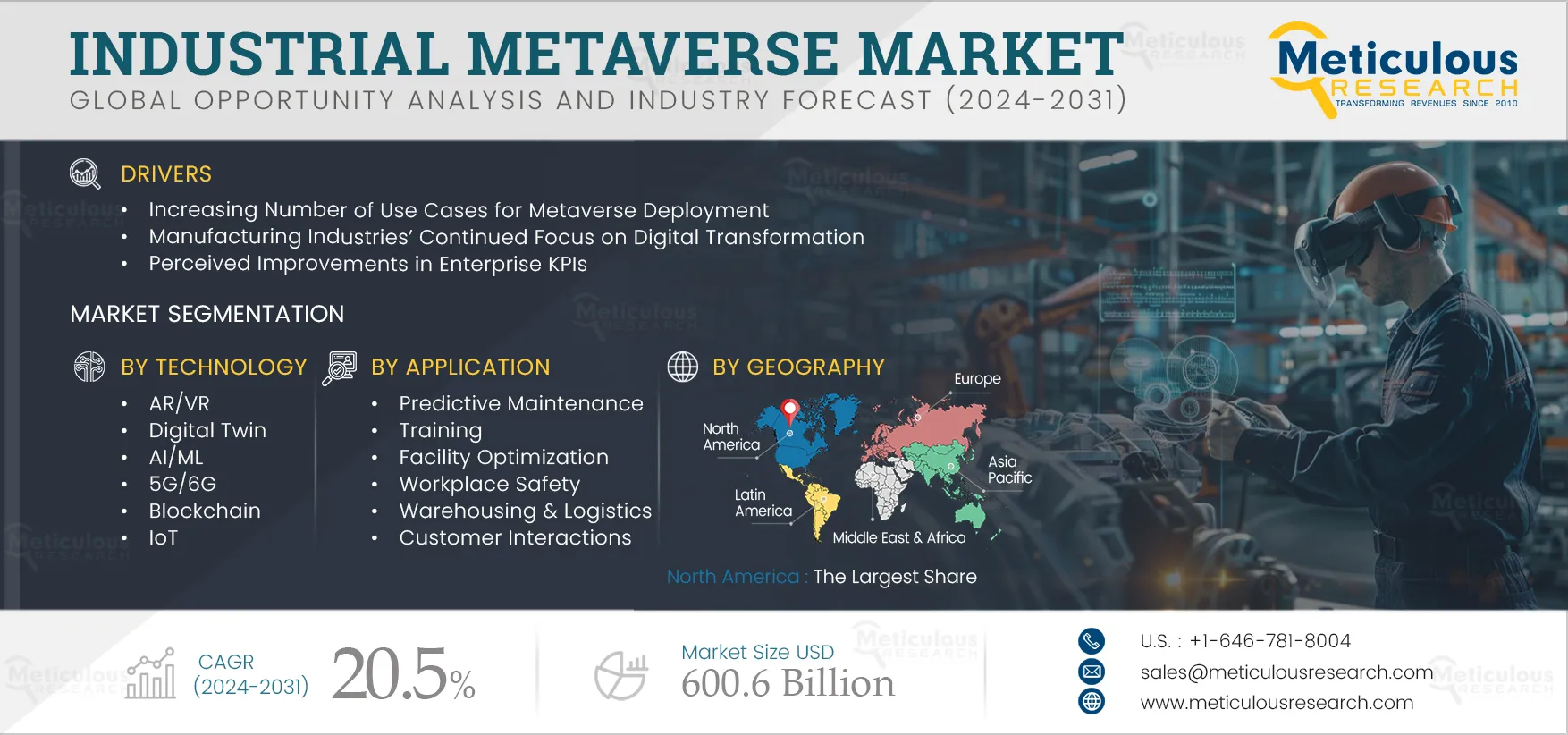
The growth of the industrial metaverse market is attributed to the increasing use cases for metaverse deployment, manufacturing industries’ growing focus on digital transformation, and improvements in enterprise KPIs. Furthermore, organizations’ growing need to reduce operational expenditure and enable collaborative and immersive product design & development is expected to generate growth opportunities for the players operating in this market.
Report infographic
Market dynamics
4 factors across 3 forcesManufacturing Industries’ Growing Focus on Digital Transformation
Manufacturing industries are adopting new-age technologies to drive innovation, enhance efficiency, and stay competitive in the dynamic market landscape. Industrial metaverse adoption is the latest frontier in the digital evolution of manufacturing industries.
Stakeholders in the manufacturing sector are closely monitoring the emergence of technologies such as avatars, digital twins, smart devices, and wearables. These technologies have the potential to increase production efficiency while optimizing costs and reducing risks through predictive & prescriptive analytics. Advanced technologies such as digital twins, robotics, Augmented Reality (AR), Virtual Reality (VR), and Mixed Reality (MR) hold immense potential for the manufacturing sector as they can bridge the gap between the physical & virtual worlds and promote collaboration among geographically dispersed teams in real time.
For instance, Boeing pioneered the use of the industrial metaverse to revolutionize its next-generation airplanes. By integrating design, production, and airline service operations within the metaverse, Boeing aimed to address approximately 70% of the quality issues stemming from design problems. This innovative use of the metaverse to simulate every possible scenario before production is a testament to the transformative power of digital transformation among manufacturing industries.
Improvements in Enterprise KPIs
The industrial metaverse enhances the visualization of intricate manufacturing processes & equipment while also enabling the training of employees in a safe & controlled environment. Metaverse technology is revolutionizing how individuals and organizations interact across production, procurement, sales, consumption, education, and collaboration environments. This shift has brought substantial benefits to the manufacturing sector by enabling effective monitoring and enhancing Key Performance Indicators (KPIs). By leveraging the industrial metaverse, manufacturers can optimize production, lower costs, and boost overall efficiency.
Some of the key improvements brought by the industrial metaverse in manufacturing KPIs are as follows:
- Planning & Optimization: By simulating the production process in a virtual environment, manufacturers can refine their workflows, optimize processes, and identify bottlenecks & inefficiencies, enabling them to make adjustments before implementing changes in the real world. As a result, production becomes more efficient, resource utilization improves, and downtime is minimized.
- Training & Safety: Manufacturers can provide employees with immersive training for the operation & maintenance of equipment and machinery, all while avoiding real-world risks, ensuring safety & compliance, and reducing workplace accidents.
- Predictive Maintenance: The industrial metaverse can monitor equipment performance in real time and predict maintenance needs, thereby minimizing downtime, enhancing productivity, and prolonging the lifespan of machinery.
Such benefits of the industrial metaverse in improving manufacturing KPIs are anticipated to support the growth of the industrial metaverse market during the forecast period.
Table of contents
11 chapters · 106 sections · 300 pages · click to expandSegmental analysis
| Segment | Largest share (2025) | Fastest growth (2025–2032) |
|---|---|---|
| By Technology | Cloud Computing | Quantum computing |
| By Application | Prototyping, Testing, and Simulation | — |
| By End-use Industry | Industrial Goods & Manufacturing | Power & utilities |
By Technology
- The Cloud Computing Segment to Dominate the Industrial Metaverse Market in 2025
- The cloud computing segment is expected to account for the largest share of over 18.0% of the industrial metaverse market.
- The segment’s large market share is attributed to the ability of cloud computing to provide on-demand delivery of IT resources over the Internet with pay-as-you-go pricing instead of needing to buy, own, and maintain physical servers, the high operational efficiencies while hosting the industrial metaverse using cloud computing, and the use of cloud computing to reduce outages by bringing resources closer to users and safeguarding personal information.
- However, the quantum computing segment is projected to register the highest CAGR of 22.4% during the forecast period 2025–2032.
- The growth of this segment is driven by quantum computing's ability to revolutionize the industrial metaverse, ensure highly accurate and efficient simulation and modeling of complex systems, and excel in solving optimization problems in manufacturing and supply chain management.
- Moreover, quantum computing can accelerate ML & AI algorithms, enabling more sophisticated data analysis, pattern recognition, and predictive modeling within the industrial metaverse.
By Application
- The Prototyping, Testing, and Simulation Segment to Dominate the Industrial Metaverse Market in 2025
- The prototyping, testing, and simulation segment is expected to account for the largest share of 33.2% of the industrial metaverse market.
- The segment’s large share is attributed to the benefits of the industrial metaverse in prototyping, testing, and simulation applications, such as accelerated product development cycles, reduced chances of costly errors, an agile approach toward product development, and real-time collaborations between geographically dispersed teams in real time.
By End-use Industry
- The industrial goods & manufacturing segment is expected to account for the largest share of over 28% of the industrial metaverse market.
- The segment’s large market share is attributed to the complex product development processes, reliance on simulation and testing, and the need for continuous innovation in the industrial goods & manufacturing sectors.
- However, the power & utilities segment is expected to register the highest CAGR of 30.0% during the forecast period 2025–2032.
- The metaverse enhances energy infrastructure planning for power & utility companies, optimizing systems ranging from power plants to distribution networks and reducing energy waste.
- Digital twins enable remote monitoring and predictive maintenance, boosting operational efficiency and minimizing on-site visits.
- Spatial computing supports virtual training environments, mitigating the risks of on-site training for nuclear power plants.
- Blockchain technology is instrumental in tracking green energy sources from origin to consumption, simplifying the assessment of sustainability progress.
Geographic analysis
North America
Largest shareIn 2025, North America is expected to account for the largest share of over 36% of the industrial metaverse market, followed by Europe, Asia-Pacific, Latin America, and the Middle East & Africa. North America’s large market share is attributed to the high number of industrial metaverse use cases in the region. Large MNCs such as Tesla, Ford, and Dow Chemicals have implemented various IoT, AI/ML, and AR/VR-based solutions for improving plant efficiency, identifying opportunities for improvement, and enabling predictive maintenance and quality control. Ford Motors, in association with Bosch, developed a virtual VR-based automotive service training solution for its all-electric Mustang Mach-E SUV. The solution enabled Ford technicians to diagnose, learn about, and operate the vehicle’s components remotely in an immersive simulated world using a VR headset.
Asia-Pacific
Fastest growthHowever, Asia-Pacific is slated to register the highest CAGR of 25.6% during the forecast period. The growth of this regional market is driven by Asia-Pacific’s high ranking in most active industrial and enterprise metaverse applications. Also, organizations in Asia-Pacific are increasingly integrating the industrial metaverse into their processes and manufacturing facilities, enabling them to better optimize processes and improve efficiencies.
Competitive landscape
- January 2025
Siemens AG partnered with Sony Corporation to introduce a new solution that combines the Siemens Xcelerator portfolio of industry software with Sony’s new spatial content creation system, featuring the XR head-mounted display with high-quality 4K OLED microdisplays and controllers for intuitive interaction with 3D objects, enabling designers and engineers to create & explore design concepts in an immersive workspace, to kickstart content creation for the industrial metaverse.
- March 2024
NVIDIA partnered with Microsoft Corporation to offer NVIDIA Omniverse™ Cloud, a platform-as-a-service solution that enables companies to unify digitalization across their core product & business processes, connect 3D design tools to accelerate vehicle development, build digital twins of automotive factories, and run closed-loop simulations to test vehicle performance.
- ABB Ltd. · Switzerland
- Siemens AG · Germany
- IBM Corporation (U.S.)
- Robert Bosch GmbH · Germany
- Oracle Corporation (U.S.)
- Microsoft Corporation (U.S.)
- Nvidia Corporation (U.S.)
- Cisco Systems, Inc. (U.S.)
- Dassault Systèmes SE · France
- Altair Engineering Inc. (U.S.)
- PTC Inc. (U.S.)
- Intel Corporation (U.S.)
- Penguin Solutions (U.S.)
- SAP SE · Germany
- Arm Limited (U.K.)
Frequently asked questions
The industrial metaverse market study focuses on opportunity assessment and industry forecasts based on the sales of industrial metaverse solutions across various segments, regions, and countries. The report also includes a competitive analysis based on leading market players’ product portfolios, geographic presence, and key growth strategies adopted over the past 3–4 years.
Cite this report
Meticulous Research. (2024). Industrial Metaverse Market - Global Opportunity Analysis and Industry Forecast (2025-2032) (Report No. MR-1318). Meticulous Market Research Pvt. Ltd. https://www.meticulousresearch.com/product/industrial-metaverse-market-6001