
Industrial Compressors Market (2026-2036)
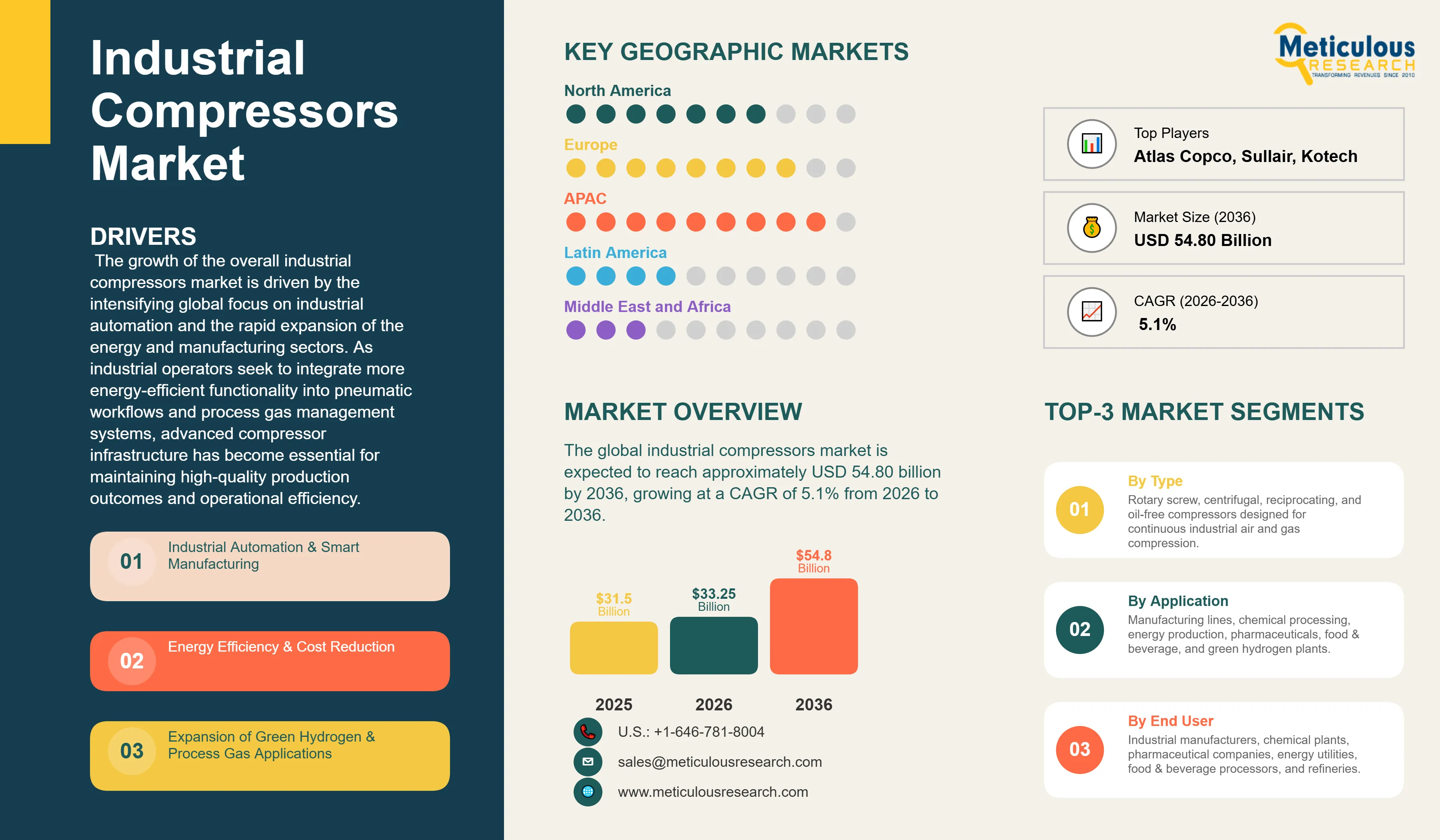
The global industrial compressors market was valued at USD 31.50 billion in 2025. The market is expected to reach approximately USD 54.80 billion by 2036 from USD 33.25 billion in 2026, growing at a CAGR of 5.1% from 2026 to 2036.
- Published
- Feb 2026
- Pages
- 258
- Format
- PDF + Excel
- Report ID
- MR-1735
- Base year
- 2025
- 2025 · BASELINE
- $31.50B
- 2036
- $54.80B
- CAGR 2026–2036
- 5.1%
2025 baseline · 2026–2036 forecast at 5.1% CAGR · hover a bar for the value
Key highlights
In terms of revenue, the global industrial compressors market is projected to reach USD 54.80 billion by 2036.
The market is expected to grow at a CAGR of 5.1% from 2026 to 2036.
Asia-Pacific dominates the global industrial compressors market with the largest market share in 2026, driven by massive industrialization and the presence of leading manufacturing hubs in China, India, and Vietnam.
North America and Europe are expected to witness steady growth during the forecast period, supported by the replacement of aging infrastructure with energy-efficient smart compressors and the rapid adoption of sustainable manufacturing practices.
By technology, the rotary segment holds the largest market share in 2026, particularly in supporting continuous industrial processes and high-demand manufacturing lines.
By lubrication, the oil-flooded segment holds the largest market share in 2026, due to its rugged reliability and cost-effectiveness in heavy-duty industrial applications.
By end-use industry, the manufacturing segment holds the largest share of the overall market in 2026.
Report summary
| Particulars | Details |
|---|---|
| Market Size by 2036 | USD 54.80 Billion |
| Market Size in 2026 | USD 33.25 Billion |
| Market Size in 2025 | USD 31.50 Billion |
| Market Growth Rate (2026-2036) | CAGR of 5.1% |
| Format | PDF, Excel & Cloud Portal · 258 pages |
| Dominating Region | Asia-Pacific |
| Fastest Growing Region | Asia-Pacific |
| Base Year | 2025 |
| Forecast Period | 2026 to 2036 |
| Segments Covered | Product, Technology, Lubrication, Power Rating, End-use Industry, and Region |
| Regions Covered | North America, Europe, Asia-Pacific, Latin America, and Middle East & Africa |
Report overview
Segments covered: product, technology, lubrication, power rating, pressure rating, end-use industry.
The growth of the overall industrial compressors market is driven by the intensifying global focus on industrial automation and the rapid expansion of the energy and manufacturing sectors. As industrial operators seek to integrate more energy-efficient functionality into pneumatic workflows and process gas management systems, advanced compressor infrastructure has become essential for maintaining high-quality production outcomes and operational efficiency. The rapid expansion of green hydrogen infrastructure and the increasing need for high-purity oil-free air in the pharmaceutical and food sectors continue to fuel significant growth of this market across all major geographic regions.
Industrial compressors are critical engineering environments that leverage advanced compression technologies to provide optimized pneumatic processes and improved energy efficiency through a connected industrial infrastructure. These systems include integrated hardware, control software, and maintenance services designed to automate air delivery and enhance decision-making across the production continuum. The market is defined by high-efficiency technologies such as variable speed drives (VSD) and IoT-enabled predictive maintenance, which significantly enhance operational precision and resource utilization in high-pressure industrial environments. These systems are indispensable for facility administrators seeking to optimize their internal operations and meet aggressive energy savings and productivity targets.
The market includes a diverse range of solutions, ranging from small reciprocating units for basic workshop tools to massive centrifugal stages and high-pressure screw compressors. These systems are increasingly integrated with advanced components such as cloud-based monitoring platforms and 5G-enabled connectivity to provide services such as real-time air quality tracking and predictive maintenance of mechanical components. The ability to provide stable, high-precision compressed air while minimizing energy consumption has made industrial compressor technology the choice for enterprises where production accuracy and operational reliability are paramount.
The global industrial sector is pushing hard to modernize facility capabilities, aiming to meet carbon-neutral production targets and Industry 4.0 goals. This drive has increased the adoption of high-efficiency connectivity solutions, with advanced smart controllers helping to stabilize air pressure for ultra-high-precision manufacturing. At the same time, the rapid growth in the semiconductor and biotech markets is increasing the need for high-reliability, oil-free digital solutions.
Report infographic
Market dynamics
4 factors across 3 forcesIndustrial Automation and the Rise of Energy-Efficient Manufacturing
A key driver of the industrial compressors market is the rapid movement of the global manufacturing industry toward automated, energy-efficient production models. Global demand for seamless pneumatic power, real-time pressure monitoring, and data-driven maintenance has created significant incentives for the adoption of smart compressor infrastructure. The trend toward “smart factories” and the integration of industrial devices into unified digital platforms drive operators toward scalable solutions that industrial compressors can uniquely provide. It is estimated that as factory adoption of IoT-enabled sensors rises and diagnostic tools become more decentralized through 2036, the need for robust, connected infrastructure increases significantly; therefore, AI-driven software and high-efficiency controllers, with their ability to ensure high-density power processing, are considered a crucial enabler of modern industrial delivery strategies.
Table of contents
13 chapters · 107 sections · 258 pages · click to expandSegmental analysis
| Segment | Largest share (2026) | Fastest growth (2026–2036) |
|---|---|---|
| By Technology | Rotary | — |
| By End-use Industry | Manufacturing | Healthcare and food & beverages |
| By Lubrication | Oil-flooded Technology | — |
By Technology
- The rotary segment accounts for a significant portion of the overall industrial compressors market in 2026.
- This is mainly attributed to the versatile use of this technology in supporting continuous manufacturing, automated assembly lines, and complex pneumatic systems within modern industrial environments.
- These systems offer the most comprehensive way to ensure stable air delivery across diverse industrial applications.
- The manufacturing and automotive sectors alone consume a large share of rotary compressors, with major projects in China and Germany demonstrating the technology’s capability to handle high-density power requirements.
- However, the centrifugal segment is expected to grow at a rapid CAGR during the forecast period, driven by the growing need for massive air volumes, high-purity oil-free requirements, and technical support in complex chemical and power plant digital transformations.
By End-use Industry
- The manufacturing segment holds the largest share of the overall market in 2026.
- This is primarily due to the massive volume of connected pneumatic tools and the rigorous production standards required for high-volume assembly.
- Current large-scale industrial zones are increasingly specifying high-density digital platforms to ensure compliance with global manufacturing standards and operator expectations for efficient production services.
- The healthcare and food & beverages segment is expected to witness the fastest growth during the forecast period.
- The shift toward AI-enhanced hygiene control and the complexity of multi-modal production suites are pushing the requirement for advanced oil-free systems that can handle varied purity standards and high-resolution air quality monitoring while ensuring absolute reliability for safety-critical industrial decisions.
By Lubrication
- The oil-flooded segment commands the largest share of the global industrial compressors market in 2026.
- This dominance stems from its superior ability to provide rugged, high-torque compression for heavy-duty industrial tasks, making it the technology of choice for high-performance industrial plants.
- Large-scale operations in construction, mining, and general manufacturing drive demand, with advanced units from providers like Ingersoll Rand and Sullair enabling reliable performance in complex industrial environments.
- However, the oil-free segment is poised for steady growth through 2036, fueled by expanding applications in pharmaceutical and semiconductor manufacturing.
- Manufacturers face mounting pressure to optimize costs for high-purity, hygiene-sensitive applications, where oil-free technology provides a reliable alternative for safety-critical facility connectivity.
Geographic analysis
Asia-Pacific
Largest shareAsia-Pacific holds the largest share of the global industrial compressors market in 2026. The largest share of this region is primarily attributed to the massive industrial infrastructure and the presence of the world’s leading manufacturing hubs, particularly in China. China alone accounts for a significant portion of global industrial investment, with its position as a leading producer of automobiles and electronics driving sustained growth. The presence of leading manufacturers like Atlas Copco (regional plants) and a well-developed industrial supply chain provides a robust market for both standard and high-density compressor solutions.
North America
North America and Europe together account for a substantial share of the global industrial compressors market. The growth of these markets is mainly driven by the need for technological modernization in the aerospace and pharmaceutical sectors. The demand for advanced smart systems in North America is mainly due to its large-scale energy infrastructure projects and the presence of innovators in the U.S.
Europe
In Europe, the leadership in precision engineering and the push for energy efficiency innovation are driving the adoption of high-reliability smart solutions. Countries like Germany, France, and the UK are at the forefront, with significant focus on integrating smart digital solutions into industrial workflows and advanced production systems to ensure the highest levels of performance and reliability.
Competitive landscape
- Atlas Copco AB
- Ingersoll Rand Inc.
- Kaeser Kompressoren SE
- Sullair, LLC · Hitachi Group
Frequently asked questions
The global industrial compressors market is expected to grow from USD 33.25 billion in 2026 to USD 54.80 billion by 2036.
Cite this report
Meticulous Research. (2026). Industrial Compressors Market - Global Opportunity Analysis and Industry Forecast (2026-2036) (Report No. MR-1735). Meticulous Market Research Pvt. Ltd. https://www.meticulousresearch.com/product/industrial-compressors-market-6418