
Flexible Electronics Market (2025-2032)
The Flexible Electronics Market is projected to reach $66.9 billion by 2032, at a CAGR of 3.9% from 2025–2032.
- Published
- Jan 2025
- Pages
- 300
- Format
- PDF + Excel
- Report ID
- MR-1279
- Base year
- 2024
- 2032 · FORECAST
- $66.90B
- 2032
- $66.90B
- CAGR 2025–2032
- 3.9%
2024 baseline · 2025–2032 forecast at 3.9% CAGR · hover a bar for the value
Key highlights
By Type: In 2025, the Single-sided Flexible Electronics Segment to Dominate the Flexible Electronics Market
By Component: In 2025, the Surface Mount Devices Segment to Dominate the Flexible Electronics Market
By Technology: In 2025, the Printing Technology Segment to Dominate the Flexible Electronics Market
By Application: In 2025, the Consumer Electronics Segment to Dominate the Flexible Electronics Market
Report summary
| Particulars | Details |
|---|---|
| Number of Pages | 300 |
| Format | |
| Forecast Period | 2025–2032 |
| Base Year | 2024 |
| CAGR (Value) | 9.2% |
| Market Size (Value) | USD 66.9 Billion by 2032 |
| Segments Covered | By Type · Single-sided Flexible Electronics · Double-sided Flexible Electronics · Multi-layer Flexible Electronics · Rigid-flex Flexible Electronics · By Component · Surface Mount Devices · Flexible Integrated Circuits · Flexible Displays · Flexible Sensors · Flexible Batteries · Microcontrollers and Microprocessors · Other Components · By Technology · Printing Technology · Inkjet Printing · Screen Printing · Flexographic Printing · Physical Vapor Deposition · Chemical Vapor Deposition · Atomic Layer Deposition · Other Technologies · By Application · Consumer Electronics · Televisions · Wearable Devices · Smartphones · Other Consumer Electronics · Automotive · Healthcare · Aerospace & Defense · Energy & Power · Robotics · Other Applications |
| Countries Covered | North America (U.S., Canada), Europe (Germany, U.K., France, Italy, Netherlands, Spain, Sweden, and Rest of Europe), Asia-Pacific (China, India, Japan, South Korea, Singapore, Australia & New Zealand, Indonesia, and Rest of Asia-Pacific), Latin America (Brazil, Mexico, and Rest of Latin America), and the Middle East & Africa (Saudi Arabia, UAE, Israel, and Rest of the Middle East & Africa) |
| Key Companies | Samsung Electronics Co., Ltd. (South Korea), LG Electronics, Inc. (A Subsidiary of LG Corporation) (South Korea), Panasonic Corporation of North America (A Division of Panasonic Holdings Corporation) (U.S.), 3M Company (U.S.), Konica Minolta, Inc. (Japan), CCL Industries Inc. (Canada), AUO Corporation (Taiwan), Flexpoint Sensor Systems, Inc. (U.S.), Truly International Holdings Limited (Hong Kong), Multi-Fineline Electronix, Inc. (U.S.), FlexEnable Technology Limited (U.K.), E Ink Holdings Inc. (Taiwan), Pragmatic Semiconductor Limited (U.K.), Enfucell (Finland), and Kateeva, Inc. (U.S.).. |
Report overview
Segments covered: type, component, technology, application. Regions: North America, Europe, Asia-Pacific, Latin America, Middle East & Africa.
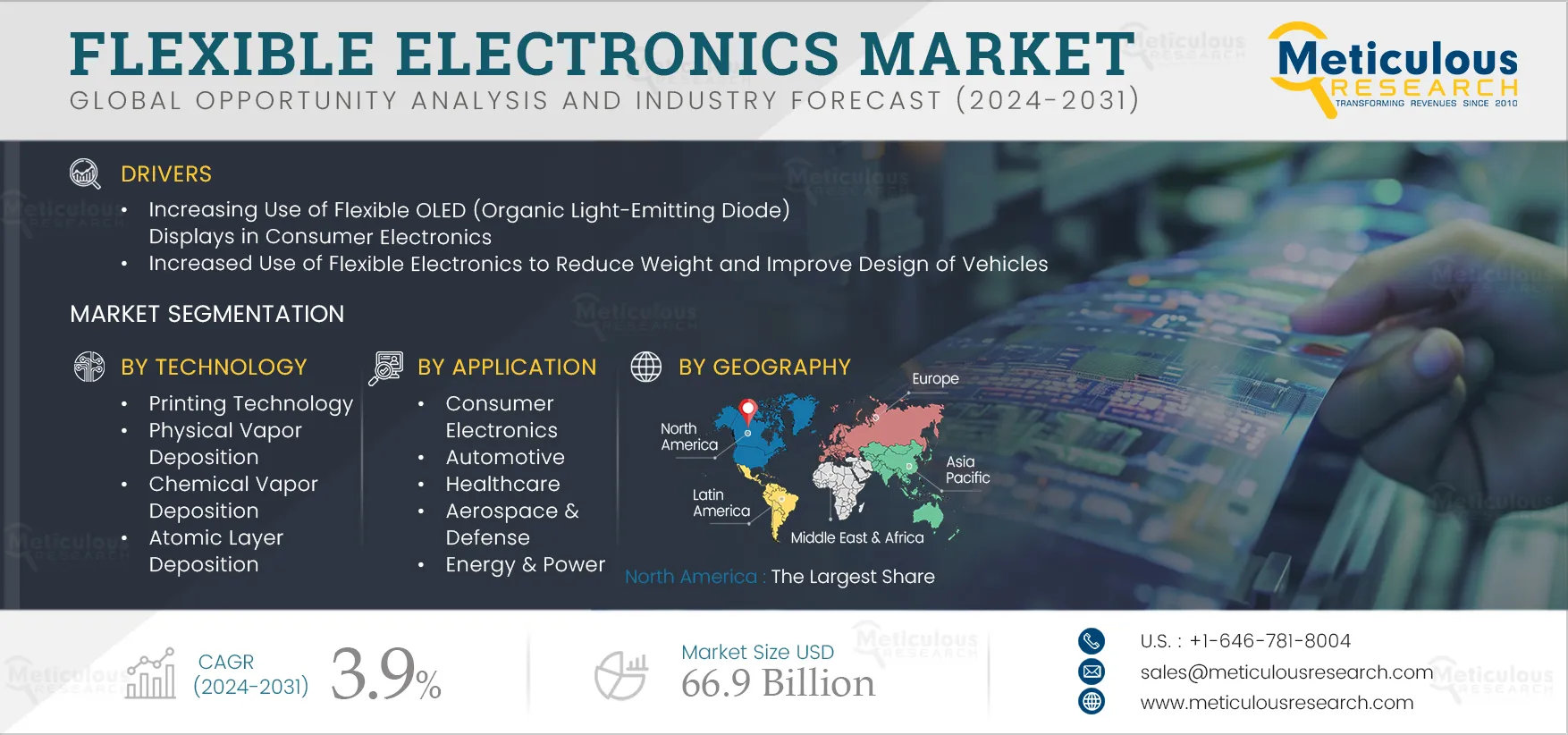
The growth of the flexible electronics market is driven by the increasing use of flexible OLED (organic light-emitting diode) displays in consumer electronics and the growing use of flexible electronics to lower the weight and improve the design of vehicles. Furthermore, the surging adoption of flexible devices in the healthcare sector is expected to generate growth opportunities for the players operating in this market.
Report infographic
Market dynamics
3 factors across 2 forcesIncreasing Use of Flexible OLED (Organic Light-Emitting Diode) Displays in Consumer Electronics
OLED (Organic Light Emitting Diode) is a flat light-emitting device made by stacking organic thin films between two conducting components. The OLED displays are energy-efficient, sunlight-readable, and have high contrast due to the light on the screen coming from each pixel rather than a backlight. Flexible OLED displays have gained popularity in recent years in a variety of consumer gadgets, including smartphones, tablets, wearables, and televisions, because of their improved image clarity, contrast, and brightness. OLED is becoming more popular in consumer devices due to its ability to consume less power and last longer across a wider temperature range.
OLED displays are rapidly being used in consumer devices to provide safe, secure, and high refresh rate displays which minimise eye damage. As a result, as the benefits of flexible OLED displays become more widely recognized, multiple businesses are launching flexible OLED panels. For example, in May 2024, LG Electronics, Inc. (South Korea) introduced the LG OLED Flex (LX3) in India, featuring the world's first bending OLED screen. The LG OLED Flex is a 42-inch 4K bendable OLED TV featuring a flexible screen design that can be used as either a flat screen or a curved screen. Such innovations help to boost demand for flexible OLED displays in consumer electronics during the forecast period.
Increased Use of Flexible Electronics to Reduce Weight and Improve the Design of Vehicles
Flexible electronics are widely used in the automotive sector to reduce weight and improve vehicle design. Flexible electronics are lighter weight than standard electronics. Flexible electrical devices are fitted onto curved surfaces, corners, and regions with limited space within the vehicle construction, thereby reducing weight and improving overall vehicle performance. Additionally, the increasing usage of flexible displays in vehicle interiors enables customizable interfaces for entertainment, navigation, and vehicle diagnostics. Thus, these displays can be curved or wrap-around, offering occupants with a more immersive experience while optimizing dashboard space.
Furthermore, the rising usage of flexible electronics in automobiles contributes to improved dependability and longevity of vehicle electronics, lowering maintenance costs across the vehicle's life cycle. Several firms are rapidly introducing flexible electronics for vehicles. For example, in June 2024, LG Electronics, Inc. (South Korea) introduced Nexlide-M, a flexible stereoscopic automobile lighting system. It is used in a variety of automotive lighting schemes, including daytime running lights (DRL) and rear combination lamps (RCLs, which include tail lights, brake lights, and turn signals). During the forecast period, such expanding innovations contribute to a growth in the application of flexible electronics for vehicle weight reduction and design improvements.
Table of contents
12 chapters · 128 sections · 300 pages · click to expandSegmental analysis
| Segment | Largest share (2025) | Fastest growth (2025–2032) |
|---|---|---|
| By Type | Single-sided Flexible Electronics | Double-sided flexible electronics |
| By Component | Surface Mount Devices | Flexible displays |
| By Technology | Printing Technology | — |
| By Application | Consumer Electronics | On the other hand, the automotive |
By Type
- The single-sided flexible electronics segment is expected to account for the largest share of 38% of the global flexible electronics market.
- This segment's large market share is attributed to the growing adoption of single-sided flexible electronics due to lower production cost and simpler manufacturing process; the rising use of single-sided flexible electronics for a more robust operating temperature range; the single-sided flexible electronics have better environmental durability in terms of cracking & corrosion.
- Additionally, the increasing use of single-sided flexible electronics due to its versatility and high-performance in applications such as consumer electronics and medical equipment.
- However, the double-sided flexible electronics segment is expected to register the highest CAGR during the forecast period.
- This segment’s growth is attributed to the rising adoption of double-sided flexible electronics to increase flexibility for arranging components and routing traces and the growing need to achieve complex circuit designs with two layers in electronic devices.
- Furthermore, the increasing use in various applications such as flexible displays, medical devices, automotive electronics, and IoT sensors to integrate diverse components and functionalities.
By Component
- The surface mount devices segment is expected to account for the largest share of 43% of the global flexible electronics market.
- This segment's large market share is attributed to the increasing adoption of surface mount devices for more compact and lightweight flexible electronic devices with increased functionality and the increasing use of surface mounting devices for more flexible and creative PCB layout designs on flexible substrates.
- Additionally, the SMDs are soldered directly onto the flexible substrate, which provides mechanical strength and durability.
- However, the flexible displays segment is expected to register the highest CAGR during the forecast period.
- This segment's growth is attributed to the growing adoption of flexible displays due to their ability to bend, roll, or fold without losing functionality; their flexible displays are lighter and thinner than conventional displays, reducing device weight and allowing slim designs; and the increasing use of flexible displays for high resolution and superior color reproduction of image quality.
By Technology
- The printing technology segment is expected to account for the largest share of 34% of the global flexible electronics market.
- This segment's large market share is attributed to the growing adoption of printing technology due to its cost-effectiveness and scalability in manufacturing electronic devices, as well as the increasing use of printing technology for readily depositing conductive traces and components onto flexible substrates.
- In addition, the rising use of printing techniques to integrate multiple components, such as conductive traces, semiconductors, and sensors, in a single production step.
- Moreover, this segment is also expected to register the highest CAGR during the forecast period.
By Application
- The consumer electronics segment is expected to account for the largest share of 67% of the global flexible electronics market.
- This segment's large market share is attributed to the growing adoption of flexible electronics due to their durability & resistance to reduce damage from drops or bending, the increasing use of flexible OLED displays in smartphones and laptops, and the increasing adoption of flexible e-paper displays in e-readers and digital signage due to their low power consumption.
- On the other hand, the automotive segment is expected to register the highest CAGR during the forecast period.
- The growth of this segment is attributed to the growing adoption of flexible OLED and AMOLED displays into the dashboard to provide clear and customizable information to the driver and the increasing use of flexible sensors to integrate into seats, steering wheels, and dashboard surfaces to monitor driver biometrics and to improve safety by detecting driver tiredness or distraction.
- Moreover, the automotive has been benefiting from flexible electronics by increasing the available styles for dash panels, infotainment, and other automotive electronics.
Geographic analysis
North America
Largest shareIn 2025, North America is expected to account for the largest share of 39% of the global flexible electronics market. North America’s significant market share can be attributed to the presence of a prominent marketspace for smartphones and smart wearable technology, the growing research and development activities in the region for innovation in flexible electronics, and the increasing demand for flexible electronics devices in the healthcare sector. In 2025, North America Region to Dominate the Flexible Electronics Market
Asia-Pacific
Fastest growthHowever, Asia-Pacific is expected to register the highest CAGR of above 10.5% during the forecast period. The growth of this market is attributed to the growing adoption of flexible electronics in the automotive sector, the increasing innovation in the printing technology for manufacturing flexible electronics in the region, and the rising manufacturing of flexible memory chips and storage components in smart cards, RFID tags, and wearable devices.
Competitive landscape
- April 2025
ENNOVI Holdings Pte. Ltd. (Singapore), a mobility electrification solutions partner, introduced a flexible circuit fabrication technology for low voltage connectivity in EV battery cell contacting systems. ENNOVI's flexible die-cut circuit (FDC) technology provides a more cost-effective and sustainable solution by reducing manufacturing procedures and accelerating continuous reel-to-reel production.
- November 2022
Voltera Inc. (U.S.) launched NOVA, a platform for printing flexible hybrid electronics. NOVA uses direct-write extrusion technology to print on soft, stretchable, and conformable surfaces.
- Samsung Electronics Co., Ltd. · South Korea
- 3M Company (U.S.)
- Konica Minolta, Inc. · Japan
- CCL Industries Inc. · Canada
- AUO Corporation · Taiwan
- Flexpoint Sensor Systems, Inc. (U.S.)
- Truly International Holdings Limited · Hong Kong
- Multi-Fineline Electronix, Inc. (U.S.)
- FlexEnable Technology Limited (U.K.)
- E Ink Holdings Inc. · Taiwan
- Pragmatic Semiconductor Limited (U.K.)
- Enfucell · Finland
- Kateeva, Inc. (U.S.)
Frequently asked questions
The flexible electronics market study focuses on the market assessment and opportunity analysis through the sales of flexible electronics across different regions and countries across different market segmentations; this study is also focused on competitive analysis for flexible electronics based on an extensive assessment of the leading players’ product portfolios, geographic presence, and key growth strategies.
Cite this report
Meticulous Research. (2025). Flexible Electronics Market - Global Opportunity Analysis and Industry Forecast (2025-2032) (Report No. MR-1279). Meticulous Market Research Pvt. Ltd. https://www.meticulousresearch.com/product/flexible-electronics-market-5962