Europe Digital Identity Wallets Market (2026-2036)
Europe Digital Identity Wallets Market Size The Europe digital identity wallets market was valued at USD 1.34 billion in 2025. This market is expected to reach USD 12.39 billion by 2036 from an estimated USD 1.92 billion in 2026, registering a CAGR of 20.5% during the forecast period (2026-2036). The
- Published
- Nov 2026
- Pages
- 255
- Format
- PDF + Excel
- Report ID
- MRICT - 1042490
- Base year
- 2025
- 2025 · BASELINE
- $1.34B
- 2036
- $12.39B
- CAGR 2026–2036
- 20.5%
2025 baseline · 2026–2036 forecast at 20.5% CAGR · hover a bar for the value
Key highlights
Regulation (EU) 2024/1183, which amends the eIDAS Regulation and establishes the European Digital Identity Framework, entered into force on May 20, 2024, and requires all EU Member States to make at least one European Digital Identity Wallet available by December 24, 2026, with regulated relying parties required to accept the wallets by December 2027.
France Identité is already live in production, Italy's IT-Wallet moved into full operation in 2026 with implementing decrees published in the Official Gazette, and Poland's mObywatel app has nearly 10 million users, making these countries among the most advanced in Europe.
Germany plans to launch its state-provided version of the EU Digital Identity Wallet on January 2, 2027, building for about 80 million potential users at the high level of assurance, after opening a sandbox in January 2026, with private wallet providers expected to follow later.
In an assessment of the 27 EU Member States in early 2026, the trust service provider Namirial judged three countries almost certain, five very likely, eight likely, seven possible, and four unlikely to meet the December 2026 wallet deadline, showing that the rollout will be staggered across Europe.
The EU Anti-Money Laundering Regulation's key obligations apply from July 10, 2027, and banks and other obliged entities are expected to use EUDI Wallets for customer due diligence and onboarding, which is a major driver of demand from financial services.
Large-scale pilot projects funded by the European Commission, such as POTENTIAL, the EU Digital Identity Wallet Consortium, NOBID, and DC4EU, tested use cases including government services, bank account opening, mobile driving licenses, payments, education credentials, and travel, and the Commission published a reference wallet implementation to support Member States.
Iceland, Liechtenstein, and Norway, as EEA countries, have an additional year to provide wallets, and candidate countries in the Western Balkans are preparing compatible wallets.
By offering, wallet platforms and applications account for the largest share of 30.0% in 2026, while credential issuance and verification solutions register the highest CAGR.
By wallet provider, government-provided wallets account for the largest share in 2026, while private-sector wallets register the higher CAGR.
By use case, identification and access to public services account for the largest share in 2026, while age verification registers the highest CAGR.
By end user, government and the public sector account for the largest share of 46.0% in 2026, while banking, financial services, and insurance register the highest CAGR.
By country, Germany accounts for the largest share of 19.0% in 2026 and registers the highest CAGR of 23.4%.
Report summary
| Particulars | Details |
|---|---|
| Forecast Period | 2026-2036 |
| Base Year | 2025 |
| Estimated Year | 2026 |
| CAGR (Value) | 20.5% |
| Format | PDF, Excel & Cloud Portal · 255 pages |
| Market Size (Value) in 2025 | USD 1.34 billion |
| Market Size (Value) in 2026 | USD 1.92 billion |
| Market Size (Value) by 2036 | USD 12.39 billion |
| Segments Covered | Offering, Wallet Provider, Use Case, End User, and Country |
| Countries Covered | Germany, France, Italy, U.K., Spain, Nordic Countries, Netherlands, Poland, and Rest of Europe |
| Key Companies | Thales, IDEMIA, IN Groupe, Giesecke+Devrient, Netcompany, Scytáles, Signicat, Namirial, InfoCert, Intesi Group, Procivis, Lissi, Bundesdruckerei, and Sopra Steria |
| Largest Segment by Offering (2026) | Wallet Platforms and Applications (30.0%) |
| Largest Segment by End User (2026) | Government and Public Sector (46.0%) |
| Largest Country (2026) | Germany (19.0%) |
| Fastest-Growing Country | Germany (CAGR 23.4%) |
Report overview
Segments covered: offering, wallet provider, use case, end user.
A digital identity wallet is a secure application, usually on a smartphone, that allows people to store, manage, and share their identity data and other digital credentials, such as identity documents, driving licenses, diplomas, professional qualifications, health documents, and payment credentials. Users can prove who they are online and in person, share only the information needed for a transaction, such as proof that they are over 18, and sign documents with qualified electronic signatures. The European Digital Identity Wallet, or EUDI Wallet, defined by the European Digital Identity Regulation, is the main framework for digital identity wallets in Europe.
This market covers the revenue generated from digital identity wallet solutions and services in Europe, measured in value. It includes wallet platforms and applications, credential issuance and verification solutions used by issuers and relying parties, trust services related to wallets, such as qualified electronic signatures, qualified electronic attestations of attributes, and certificates, integration and implementation services, and managed and support services, provided to governments, banks, telecom operators, healthcare providers, travel and mobility companies, retailers, and other organizations. It is segmented by offering, wallet provider, use case, end user, and country. Revenue from general identity verification services that do not involve digital identity wallets, physical identity documents, and payment processing is not included.
The European Digital Identity Regulation, adopted in 2024 as Regulation (EU) 2024/1183, aims to give every EU citizen and resident access to a secure, free digital identity wallet that is recognized across the EU. Member States must provide at least one wallet by December 2026, either developed by the government or by private companies under government mandate or recognition. The wallets must meet common technical standards defined in implementing acts and an Architecture and Reference Framework, be certified for security, and support the person identification data issued by Member States, as well as other attestations issued by public and private bodies.
The regulation also creates obligations for relying parties, as public sector bodies must accept the wallets for services that require electronic identification, and private organizations that are legally required to use strong user authentication, such as banks, telecom operators, healthcare providers, transport, energy, education, and very large online platforms, must accept the wallets when users choose to use them, from December 2027. This creates demand for verification solutions and integration services across many sectors.
The market includes several types of companies, as identity and security companies, such as Thales, IDEMIA, IN Groupe, and Giesecke+Devrient, provide wallet platforms, secure elements, and identity infrastructure to governments. IT services companies, such as Netcompany and Sopra Steria, develop and integrate wallets for governments and the European Commission. Trust service providers, such as Namirial, InfoCert, Intesi Group, and Signicat, provide qualified signatures, attestations, and identity services, and specialist companies, such as Scytáles, Procivis, and Lissi, provide wallet and credential software. State printing and identity agencies, such as Bundesdruckerei in Germany, also play a key role.
Several countries in Europe already had widely used national digital identity systems before the EUDI Wallet, such as BankID in the Nordic countries, SPID and CIE in Italy, itsme in Belgium, DigiD in the Netherlands, and mObywatel in Poland, and many are evolving these systems into EUDI-compliant wallets. In the Nordic countries, bank-issued BankID schemes are used by most adults for both banking and public services, which shows how a trusted digital identity can become part of everyday life when it is widely accepted. These existing systems give some countries a strong base of users and relying parties, while others are starting with less experience.
Over the forecast period, the market is expected to grow rapidly, as Member States launch wallets, relying parties integrate them, and use cases expand from public services to banking, travel, healthcare, education, age verification, and payments. The early years will be shaped by uneven readiness and low initial adoption, but growth is expected to accelerate as private-sector acceptance becomes mandatory and wallets become part of everyday life.
What comes next: Digital Identity Wallets and the Future of Online Trust, a Meticulous Next™ foresight brief.
Report infographic
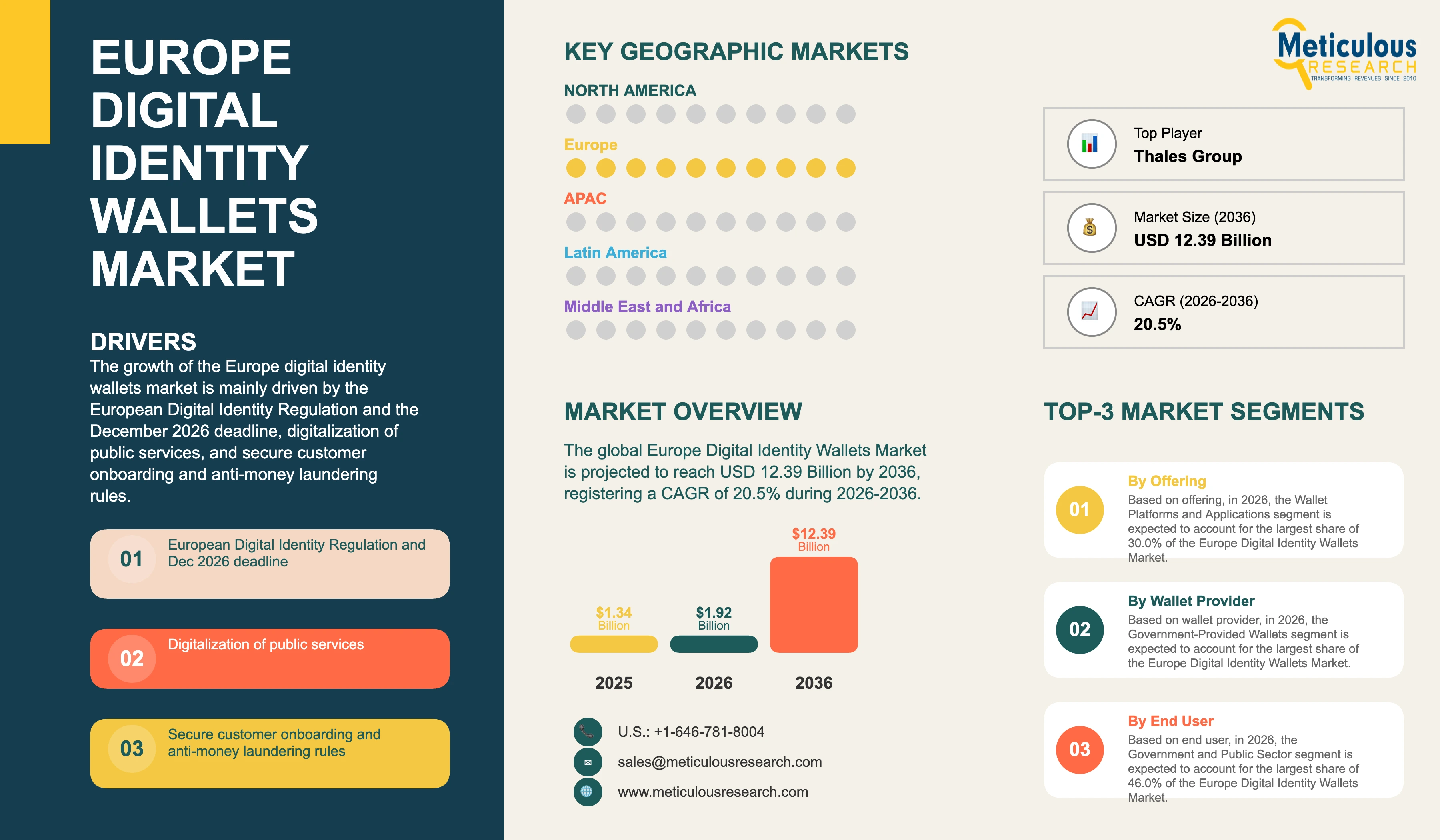
Market dynamics
17 factors across 5 forcesEuropean Digital Identity Regulation and the December 2026 deadline
The European Digital Identity Regulation is the main driver of the market, because it requires all 27 EU Member States to provide at least one European Digital Identity Wallet to citizens and residents by December 24, 2026, and it sets a common framework for security, certification, and interoperability. Member States are procuring wallet platforms, issuance and verification infrastructure, trust services, and integration services from technology providers, and many are running large projects to build, test, and launch their wallets.
The regulation also requires public and private relying parties in regulated sectors to accept the wallets, which creates a second wave of demand for verification solutions and integration services from banks, telecom operators, healthcare providers, transport companies, and online platforms. Wallet platforms and applications account for the largest share of the market by offering, reflecting the large investment by governments in building and launching wallets.
Beyond the wallet itself, the regulation introduces new trust services, such as qualified electronic attestations of attributes and electronic ledgers, requires Member States to provide free qualified electronic signatures for non-professional use through the wallets, and establishes rules for registering relying parties so that users can see who is asking for their data. Each of these elements requires investment in software, infrastructure, and services by governments, trust service providers, and relying parties.
Digitalization of public services
European governments are digitalizing public services, such as tax filing, social benefits, vehicle registration, health services, and residence permits, and they need secure ways for citizens to prove their identity and share documents online. Digital identity wallets allow citizens to access these services from their phones, share verified information, and sign documents electronically, which reduces paperwork and costs for governments.
The EU's Digital Decade targets include providing all key public services online and giving all citizens access to a digital identity by 2030, which supports investment in wallets and related infrastructure. Government and the public sector account for the largest share of the market by end user.
Wallets also support the EU's Once-Only Technical System, which allows citizens and businesses to share official documents and evidence between public administrations across borders, and they make it easier for people who live, work, or study in another Member State to access public services there. Cross-border use is expected to grow as wallets become available in all Member States.
Secure customer onboarding and anti-money laundering rules
Banks, payment providers, insurers, and other financial institutions must verify the identity of their customers under anti-money laundering rules, and digital identity wallets offer a secure and convenient way to onboard customers remotely and authenticate them for high-risk transactions. The EU Anti-Money Laundering Regulation, whose key obligations apply from July 10, 2027, recognizes digital identity wallets as a means of customer due diligence, and financial institutions are preparing to accept them.
Wallets can reduce onboarding costs, fraud, and drop-off rates compared with manual document checks and video identification, and they can support strong customer authentication for payments. Banking, financial services, and insurance form the fastest-growing end user in this market.
Banks also see wallets as a way to reduce their reliance on video identification and document scanning, which are costly and vulnerable to fraud using deepfakes and forged documents. Some banks and banking groups have participated in large-scale pilots to test account opening and payment authentication with EUDI Wallets, and banking associations are preparing common approaches to wallet acceptance across their members.
Demand for privacy-preserving age verification and selective disclosure
Regulations such as the EU Digital Services Act and national online safety laws require online platforms to protect minors, including by verifying users' ages for certain content and services. Digital identity wallets allow users to prove that they are over a certain age without revealing other personal information, which meets both regulatory requirements and privacy expectations. The European Commission has developed an age verification solution based on the EUDI Wallet framework and tested it with several Member States.
Selective disclosure, which allows users to share only the information needed for a transaction, is a key feature of the EUDI Wallet and supports privacy-friendly use cases in retail, alcohol and tobacco sales, entertainment, and online services. Age verification is the fastest-growing use case in this market.
Age verification requirements are expanding across Europe, with several countries introducing or proposing rules for social media, adult content, gambling, and online sales of age-restricted products, which creates demand for reliable and privacy-preserving age checks that can be provided through wallets.
Table of contents
12 chapters · 110 sections · 255 pages · click to expandGeographic analysis
Europe
Largest shareThe Europe digital identity wallets market was valued at USD 1.34 billion in 2025. This market is expected to reach USD 12.39 billion by 2036 from an estimated USD 1.92 billion in 2026, registering a CAGR of 20.5% during the forecast period (2026-2036). The growth of this market is mainly driven by the European Digital Identity Regulation, known as eIDAS 2.0, which requires every EU Member State to provide at least one European Digital Identity Wallet to citizens and residents by December 2026 and requires regulated private-sector organizations to accept these wallets from December 2027, the digitalization of public services, the need for secure and convenient customer onboarding and authentication in banking and other regulated sectors, new EU anti-money laundering rules, demand for privacy-preserving age verification online, and the adoption of mobile driving licenses and other digital credentials. However, factors such as uneven readiness among Member States, the complexity of technical standards and certification, low user awareness and adoption in the early years, concerns about privacy, security, and surveillance, and the cost of integration for relying parties are expected to restrain the growth of this market to some extent. In 2026, the wallet platforms and applications segment is expected to account for the largest share of 30.0% of the market. The large share of this segment is mainly due to the large investment by Member States in developing, certifying, and launching their national EUDI Wallets ahead of the December 2026 deadline, including wallet applications, back-end platforms, secure element and cryptographic components, and user onboarding systems. Wallet platforms are procured by governments from identity and security companies, IT services companies, and specialist wallet providers, and they must meet strict security and certification requirements, including the high level of assurance for person identification data. Many countries are building on existing national identity apps, while others are developing new wallets, sometimes using the Commission's open-source reference implementation. As wallets are launched, spending on platforms is expected to shift from development to operation, updates, and new features, such as additional credential types and cross-border functions. Wallet platforms and applications are expected to remain a large segment over the forecast period, although their share is expected to decline as relying party spending grows. Spending on wallet platforms also includes the onboarding of users, which requires linking the wallet to a high-assurance identity, such as an electronic identity card, a passport with a chip, or an existing national eID, and the issuance of person identification data. Countries with widely used electronic identity cards, such as Germany, Italy, and Spain, can use them for wallet onboarding, while others must develop alternative processes. However, the credential issuance and verification solutions segment is projected to register the highest CAGR during the forecast period. The rapid growth of this segment is driven by the obligation for relying parties to accept wallets and by the growing number of issuers of attestations. Trust services, integration and implementation services, and managed and support services make up the rest of the market. Credential issuance and verification solutions include software used by governments and other issuers to issue person identification data, driving licenses, and attestations to wallets, and software used by relying parties to request and verify credentials from wallets. Trust services include qualified electronic signatures, qualified electronic seals, qualified attestations of attributes, and certificates that support wallet trust, and they are provided by qualified trust service providers, such as Namirial, InfoCert, and Intesi Group. Integration and implementation services help governments and relying parties deploy wallets and verification, while managed and support services cover the operation, monitoring, and support of wallets and related infrastructure. In 2026, the government-provided wallets segment is expected to account for the largest share of the market, as most Member States are providing their own wallets for the December 2026 deadline and are paying for their development, certification, and operation. However, the private-sector wallets segment is projected to register the higher CAGR during the forecast period, driven by countries opening their markets to private wallet providers and by banks, telecom operators, and technology companies offering wallets. Government-provided wallets are developed by public agencies, often with private technology partners, and they are the main way Member States are meeting the December 2026 deadline. Private-sector wallets, provided by companies under government mandate or recognition, are expected in several countries, such as Germany, where the government plans to open the market to private providers after launching its state wallet, and in countries where private identity schemes, such as BankID and itsme, are widely used. In 2026, the identification and access to public services segment is expected to account for the largest share of the market, as governments launch wallets primarily for access to public services. However, the age verification segment is projected to register the highest CAGR during the forecast period, driven by online safety regulations and privacy-preserving age proofs. Financial services onboarding and authentication, mobile driving licenses and travel credentials, education and professional credentials, health credentials, and other use cases make up the rest of the market. Identification and access to public services is the main initial use case for most government wallets at launch, covering online access to tax, social security, health, and other public services. Mobile driving licenses and travel credentials, education and professional credentials, and health credentials are expected to grow as issuers add these credentials to wallets, while age verification is expected to grow rapidly with online safety rules and the Commission's age verification solution. In 2026, the government and public sector segment is expected to account for the largest share of 46.0% of the market. Government spending includes wallet development and operation, issuance infrastructure for identity documents and other credentials, integration of wallets into public service portals, and trust infrastructure, such as trust lists and registration of relying parties. Public sector bodies must also accept wallets for their own services, which requires integration across national, regional, and local governments. Government and the public sector are expected to remain the largest end user over the forecast period. However, the banking, financial services, and insurance segment is projected to register the highest CAGR during the forecast period. Telecommunications, healthcare, travel and mobility, retail and e-commerce, and other end users make up the rest of the market. Banking, financial services, and insurance are expected to be the largest private-sector users of wallets, because they must verify customer identity under anti-money laundering rules and must accept wallets for strong authentication from 2027. Telecom operators use wallets for customer identification when selling SIM cards and contracts, where identity checks are required by law in many countries, healthcare providers for patient identification and prescriptions, travel and mobility companies for check-in, car rental, and ticketing, and retailers and e-commerce companies for age verification and customer accounts. In 2026, Germany is expected to account for the largest share of 19.0% of the Europe digital identity wallets market and is also projected to register the highest CAGR of 23.4% during the forecast period. The large share and rapid growth of this country are mainly due to its large population, the scale of its state wallet program, which is designed for about 80 million potential users at the high level of assurance, its large banking and insurance sector, and plans to open the market to private wallet providers after the state wallet launch on January 2, 2027. Germany's wallet program is led by the federal government, with strong involvement of the Federal Ministry of the Interior, with the Federal Agency for Disruptive Innovation (SPRIND) running a development competition and Bundesdruckerei playing a key role in identity infrastructure. A sandbox for relying parties opened in January 2026, and initial use cases are expected to include identification, age verification, qualified electronic signatures, and bank account opening. Germany has also published an architecture concept that allows several wallets to operate, which is expected to support private-sector wallets. Germany is expected to remain the largest market throughout the forecast period. France and Italy hold significant shares, supported by France Identité, which is live, and Italy's IT-Wallet, which built on the SPID and CIE identity systems. Poland's mObywatel has nearly 10 million users, the Nordic countries have strong BankID systems, and the U.K. is developing its own digital identity framework. France has invested heavily in France Identité, which uses the electronic national identity card and is live in production, and it plans to extend the app into a full EUDI Wallet. Italy's IT-Wallet builds on the widely used SPID and CIE digital identity systems, which have tens of millions of users, and it moved into full operation in 2026, making Italy one of the most advanced countries in Europe. Spain, the Netherlands, Belgium, Austria, and the Nordic countries are also developing wallets, often building on existing national identity systems, while Poland's mObywatel has become one of the most widely used government apps in Europe. The U.K., which is outside the EU framework, is developing a digital identity and attributes trust framework and government digital identity services, and the rest of Europe includes Belgium, Austria, Portugal, the Baltic states, and other countries with active wallet programs. Europe Digital Identity Wallets Market Size Europe Digital Identity Wallets Market Analysis by Offering Geographic Analysis
Competitive landscape
The Europe digital identity wallets market includes identity and security companies, IT services companies, trust service providers, specialist wallet and credential software providers, and state identity agencies. Leading companies include Thales, IDEMIA, IN Groupe, Giesecke+Devrient, Netcompany, Scytáles, Signicat, Namirial, InfoCert, Intesi Group, Procivis, Lissi, Bundesdruckerei, and Sopra Steria.
Wallet and identity companies compete mainly on security and certification, compliance with the EUDI framework and its evolving standards, experience with government identity projects, scalability, user experience, interoperability, and the ability to support both issuance and verification.
Identity and security companies, such as Thales, IDEMIA, IN Groupe, and Giesecke+Devrient, have long experience with national identity documents and secure elements and are major suppliers of wallet platforms and identity infrastructure to governments. Netcompany, together with Scytáles, developed the EUDI Wallet reference implementation for the European Commission and works on national wallet projects. Trust service providers, such as Namirial, InfoCert, Intesi Group, and Signicat, provide qualified signatures, attestations, and identity verification services, while Procivis and Lissi provide wallet and credential software for governments, banks, and other businesses. Bundesdruckerei is a key part of Germany's identity infrastructure, and Sopra Steria provides IT services for government identity projects.
The top five players are estimated to account for 33.0% of the Europe digital identity wallets market in 2025, reflecting the importance of large government contracts, which favor established identity and IT services companies, and the presence of many specialist and regional providers in individual countries.
Players use several strategies to grow in this market, including winning national and regional government wallet contracts, participating in large-scale pilots, obtaining certifications, launching wallet-agnostic verification platforms, partnering with banks and telecom operators, and contributing to open-source reference implementations.
Over time, competition is expected to shift from government wallet contracts to relying party verification and private-sector wallets as the market matures, which will bring identity verification companies, banks, telecom operators, and global technology companies into the market and increase competition. Providers that can offer certified, interoperable solutions across several Member States are expected to gain share, and partnerships and acquisitions are likely over the next few years as companies seek to combine wallet, trust service, and verification capabilities.
Some of the key players operating in the Europe digital identity wallets market are Thales Group, IDEMIA Secure Transactions, IN Groupe, Giesecke+Devrient GmbH, Netcompany A/S, Scytáles AB, Signicat AS, Namirial S.p.A., InfoCert S.p.A. (Tinexta Group), Intesi Group S.p.A., Procivis AG, Lissi GmbH, Bundesdruckerei GmbH, and Sopra Steria Group.
- —
Italy's IT-Wallet entered full operation in 2026, Germany opened a wallet sandbox in January 2026 and set a launch date of January 2, 2027, and France Identité and Poland's mObywatel continued to grow.
- Thales
- IDEMIA
- IN Groupe
- Giesecke+Devrient
Expert perspectives
The European Digital Identity Regulation is creating one of the most ambitious digital identity programs in the world, and the market for digital identity wallets in Europe is set for strong growth as wallets launch and relying parties integrate them.
Over the forecast period, the market is expected to grow at about 20.5% per year from a relatively small base, supported by government wallet programs, mandatory acceptance by regulated sectors, anti-money laundering rules, age verification, and new use cases. The early years will be shaped by uneven readiness, but growth is expected to accelerate from 2027 as private-sector acceptance begins.
Wallet platforms and applications are the largest offering, while issuance and verification solutions grow fastest. Government wallets are the largest provider type, while private-sector wallets grow faster. Government is the largest end user, while banking and financial services grow fastest.
Germany is the largest market and the fastest-growing country at a CAGR of 23.4%. The main swing factors are Member State readiness, user adoption, relying party integration, certification, and security.
For providers, the key priorities are certification, interoperability, wallet-agnostic verification, and partnerships with relying parties. For relying parties, the priority is preparing to accept wallets by December 2027, testing integrations in national sandboxes, and designing customer journeys that make wallet use simple.
The most important period for the market will be 2027 to 2029, when relying parties in regulated sectors must accept wallets and when countries that launch late catch up. During this period, the number of wallet users and the number of services that accept wallets will determine whether the EUDI Wallet becomes a widely used tool or remains limited to public services. Banks, telecom operators, and online platforms will play a key role in driving everyday use, because they interact with customers far more often than most public services.
Risks include delays in Member State launches, low user adoption, security incidents, and the complexity of integration for relying parties, while upside could come from rapid adoption in banking, age verification, and travel, and from strong private-sector wallets and attestations. Countries with existing digital identity systems are expected to see faster adoption than those starting from scratch, and the experience of early countries such as Italy, France, and Poland will provide lessons for the rest of Europe on onboarding, services, and user communication.
Overall, digital identity wallets are expected to become a core part of Europe's digital infrastructure over the forecast period, used by citizens, businesses, and governments for identification, signing, and sharing verified data online and in person.
Customer perspectives
This explains why banking and financial services are the fastest-growing end user and Germany the fastest-growing country.
This explains why government accounts for 46.0% of the market and wallet platforms for 30.0%.
This is why age verification is the fastest-growing use case.
Telecom and other regulated sectors will add to demand for verification solutions from 2027.
Education credentials are one of the growing use cases for credential issuance and verification solutions across Europe.
“We expect to accept EUDI Wallets from 2027 for account opening and strong authentication, and we are already testing in the national sandbox. It should cut onboarding costs and fraud compared with video identification and document scanning.”
“Our priority is launching a certified wallet with useful public services on day one, so that citizens have a reason to download it, and then adding driving licenses, health documents, and other credentials over time.”
“Wallet-based age verification lets us meet our legal obligations without collecting more personal data than necessary, which our users and regulators both prefer to uploading identity documents.”
“We plan to accept wallets for SIM registration and contract signing. It will speed up onboarding in stores and online and reduce identity fraud.”
“Issuing digital diplomas to students' wallets will let employers and other universities verify qualifications instantly. It will reduce fraud and the work of handling verification requests.”
Frequently asked questions
The market was valued at USD 1.34 billion in 2025 and USD 0.98 billion in 2024, and is estimated at USD 1.92 billion in 2026.
The market is expected to reach USD 12.39 billion by 2036, supported by government wallet programs, mandatory relying party acceptance, anti-money laundering rules, and new use cases.
The market is expected to register a CAGR of 20.5% from 2026 to 2036.
The European Digital Identity Wallet is a secure digital wallet that EU Member States must provide to citizens and residents under the European Digital Identity Regulation, allowing them to store and share identity data and other credentials and sign documents electronically.
Member States must make at least one EUDI Wallet available by December 24, 2026, and regulated private-sector relying parties must accept the wallets from December 2027.
Growth is driven by the European Digital Identity Regulation and the December 2026 deadline, digitalization of public services, secure customer onboarding and anti-money laundering rules, and demand for privacy-preserving age verification.
Uneven readiness among Member States and the complexity of standards, certification, and integration restrain growth, while user adoption and trust and security, fraud, and liability remain key challenges.
Key opportunities include relying party verification and integration, private-sector wallets and attestations, mobile driving licenses, travel, and payments, and education, professional, and health credentials.
Wallet platforms and applications are expected to account for the largest share of 30.0% of the market in 2026, while credential issuance and verification solutions are projected to register the highest CAGR.
Government and the public sector are expected to account for the largest share of 46.0% of the market in 2026, while banking, financial services, and insurance are projected to register the highest CAGR.
Germany is expected to account for the largest share of 19.0% of the market in 2026 and to register the highest CAGR of 23.4%.
The report profiles 14 companies, including Thales, IDEMIA, IN Groupe, Giesecke+Devrient, Netcompany, and Signicat. The top five players account for an estimated 33.0% of the market in 2025.
Public sector bodies must accept the wallet for services that require electronic identification, and private organizations required to use strong user authentication, such as banks, telecom operators, and healthcare providers, as well as very large online platforms, must accept it from December 2027.
Trust service providers issue qualified electronic signatures, seals, certificates, and qualified electronic attestations of attributes that support the security and legal validity of wallet transactions.
Selective disclosure allows a wallet user to share only the specific information needed for a transaction, such as proof of being over 18, without revealing other personal data such as name or date of birth.
No, use of the EUDI Wallet is voluntary for citizens and residents, and people who do not use it must still be able to access services by other means.
France, Italy, and Poland are among the most advanced, with France Identité live, Italy's IT-Wallet in full operation, and Poland's mObywatel used by nearly 10 million people.
Italy's IT-Wallet entered full operation in 2026, Germany opened a wallet sandbox in January 2026 and set a launch date of January 2, 2027, and France Identité and Poland's mObywatel continued to grow.
Cite this report
Meticulous Research. (2026). Europe Digital Identity Wallets Market - Global Opportunity Analysis and Industry Forecast (2026-2036) (Report No. MRICT - 1042490). Meticulous Market Research Pvt. Ltd. https://www.meticulousresearch.com/product/europe-digital-identity-wallets-market-7173