Emergency Stop Devices Market (2026-2036)
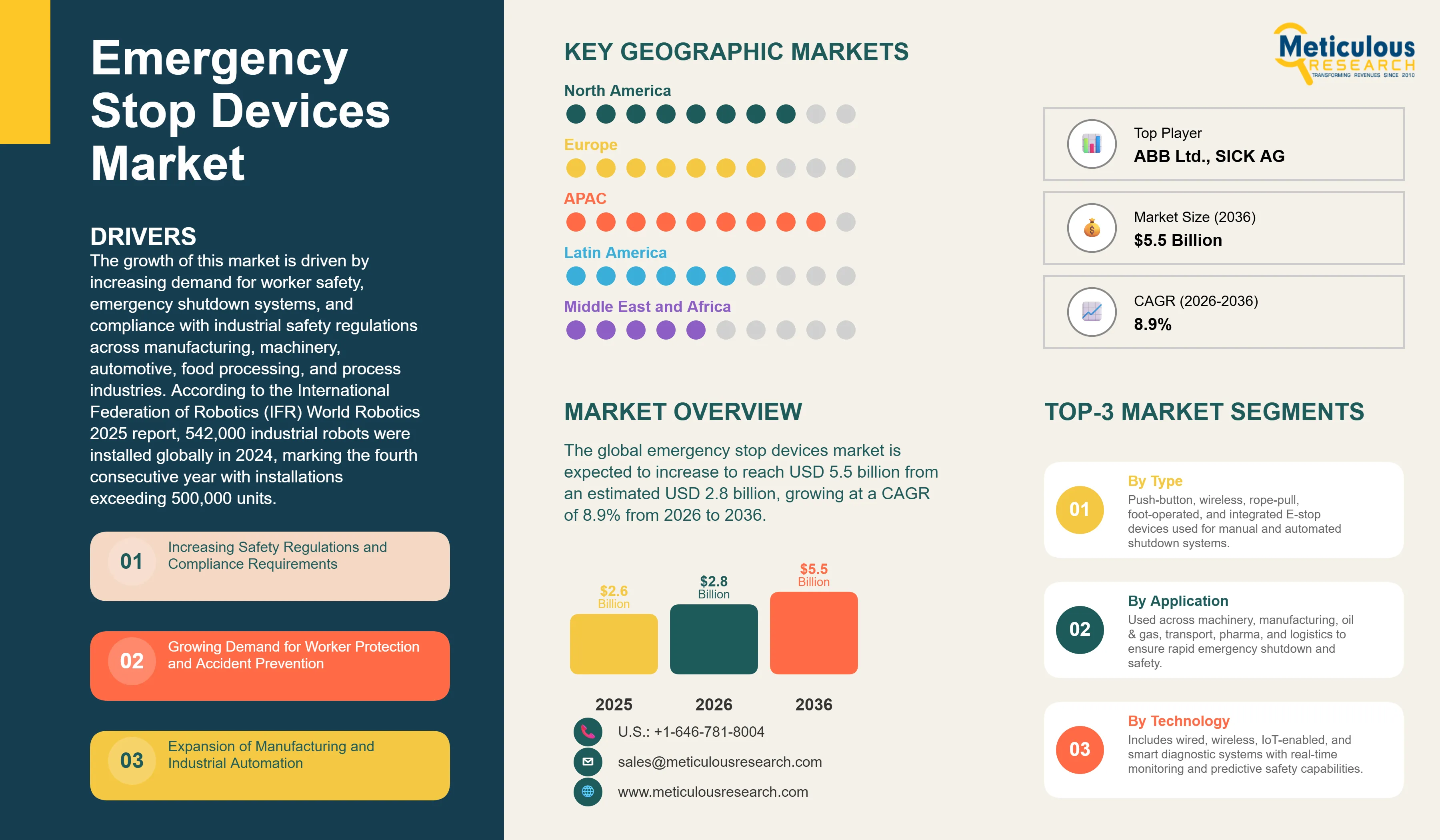
The global emergency stop devices market size was valued at USD 2.6 billion in 2025.This market is expected to increase to reach USD 5.5 billion from an estimated USD 2.8 billion, growing at a CAGR of 8.9% from 2026 to 2036.
- Published
- May 2026
- Pages
- 285
- Format
- PDF + Excel
- Report ID
- MR-1996
- Base year
- 2025
- 2025 · BASELINE
- $2.60B
- 2036
- $5.50B
- CAGR 2026–2036
- 8.9%
2025 baseline · 2026–2036 forecast at 8.9% CAGR · hover a bar for the value
Key highlights
In terms of revenue, the global emergency stop devices market is valued at USD 2.8 billion in 2026 and is projected to reach USD 5.5 billion by 2036.
The market is expected to grow at a CAGR of 8.9% from 2026 to 2036.
Asia-Pacific dominates the global emergency stop devices market with the largest market share in 2026.
North America is expected to witness steady growth during the forecast period, driven by stringent safety regulations and manufacturing automation.
By type, the push-button emergency stops segment holds the largest market share in 2026.
By type, the wireless emergency stops segment is expected to witness the fastest CAGR during the forecast period.
By application, the machinery and equipment segment contributes the highest market share in 2026.
By application, the transportation and logistics segment is expected to witness the fastest CAGR during the forecast period.
Report summary
| Particulars | Details |
|---|---|
| Market Size by 2036 | USD 5.5 Billion |
| Market Size in 2025 | USD 2.5 Billion |
| Market Size in 2026 | USD 2.8 Billion |
| Market Growth Rate (CAGR) 2026 to 2036 | 8.9% |
| Format | PDF, Excel & Cloud Portal · 285 pages |
| Dominating Region | Asia-Pacific |
| Fastest Growing Region | Asia-Pacific |
| Base Year | 2025 |
| Forecast Period | 2026 to 2036 |
| Segments Covered | Type, Technology, Application, and Region |
| Regions Covered | North America, Europe, Asia-Pacific, Latin America, and Middle East & Africa |
Report overview
Segments covered: type, application.
The growth of this market is driven by increasing demand for worker safety, emergency shutdown systems, and compliance with industrial safety regulations across manufacturing, machinery, automotive, food processing, and process industries. According to the International Federation of Robotics (IFR) World Robotics 2025 report, 542,000 industrial robots were installed globally in 2024, marking the fourth consecutive year with installations exceeding 500,000 units. The continued expansion of industrial automation is increasing demand for machine safety components, including emergency stop devices, to protect workers and ensure safe operation of automated systems. In addition, stricter workplace safety requirements and growing adoption of Industry 4.0 technologies are strengthening investments in advanced safety systems
Increasing integration of smart manufacturing, automated machinery, and predictive maintenance systems is further accelerating adoption of sophisticated emergency stop devices with improved reliability, diagnostics, and connectivity capabilities. Growing investments in industrial modernization and workplace safety compliance are creating opportunities for manufacturers offering high-performance emergency stop solutions designed for seamless integration with automated and digitally connected industrial environments.
The emergency stop devices market encompasses the design, manufacturing, installation, and maintenance of emergency shutdown systems designed to enable rapid and safe equipment shutdown in emergency situations. These systems are engineered to provide immediate emergency response capabilities with high reliability and compliance with safety standards. Emergency stop devices are fundamental components in manufacturing, machinery, transportation, and specialized industrial applications where rapid emergency shutdown is essential.
The market includes various emergency stop device types designed for specific safety requirements and applications. Push-button emergency stops provide manual emergency shutdown. Wireless emergency stops enable remote emergency shutdown. Rope-pull emergency stops provide distributed emergency shutdown capability. Foot-operated emergency stops provide hands-free emergency shutdown. Combination emergency stops provide multiple shutdown methods. Safety-rated emergency stops provide certified emergency shutdown. Integrated emergency stops combine shutdown with other safety functions. Modular emergency stops enable flexible configuration.
The market is primarily driven by increasing safety regulations, growing demand for worker protection, technological advancements that enhance emergency response capabilities and reliability, and the shift toward Industry 4.0 integration. These systems find applications in manufacturing facilities, machinery operations, transportation systems, and specialized industrial applications where rapid emergency shutdown is essential.
Report infographic
Market dynamics
14 factors across 5 forcesIncreasing Safety Regulations and Compliance Requirements
A key factor driving the growth of the emergency stop devices market is the increasing implementation of stringent workplace safety regulations and compliance requirements globally. Governments and regulatory agencies are strengthening safety standards to reduce workplace injuries and improve machine safety across manufacturing and industrial environments. According to the International Labour Organization (ILO), approximately 2.93 million workers die annually due to work-related accidents and diseases, while hundreds of millions experience non-fatal occupational injuries, highlighting the growing importance of preventive safety systems. Rising regulatory scrutiny is increasing demand for emergency stop devices designed to ensure rapid shutdown capabilities and compliance with industrial safety standards.
The need to comply with safety regulations and protect workers is driving adoption of emergency stop devices. The trend toward comprehensive safety management is driving demand for advanced emergency stop systems. The development of new safety regulations and standards is driving demand for emergency stop device equipment. The expansion of manufacturing operations globally is creating demand for emergency stop devices that meet regulatory requirements. The trend toward nearshoring and facility expansion is driving demand for safety solutions.
Growing Demand for Worker Protection and Accident Prevention
The growing demand for worker protection and accident prevention is a major driver of the emergency stop devices market. Manufacturing and industrial facilities are under increasing pressure to improve workplace safety, reduce operational risks, and prevent machinery-related accidents. According to the International Labour Organization (ILO), approximately 395 million workers experienced non-fatal work-related injuries globally in the latest assessment, reinforcing the need for advanced safety systems across industrial environments. Emergency stop devices enable rapid equipment shutdown during hazardous situations, reducing accident severity and improving worker protection.
The development of emergency stop devices that enable rapid emergency response is enabling manufacturers to improve safety performance. The growing focus on worker safety and accident prevention is driving investment in advanced emergency stop systems. The trend toward comprehensive safety management is driving demand for advanced emergency stop devices. The expansion of manufacturing operations globally is creating demand for emergency stop devices that improve worker protection. The trend toward nearshoring and facility expansion is driving demand for comprehensive safety solutions.
Expansion of Manufacturing and Industrial Automation
The expansion of manufacturing and industrial automation globally is driving significant growth in the emergency stop devices market. Manufacturing facilities are increasingly automating operations and installing sophisticated machinery requiring emergency stop systems. Industrial automation requires reliable emergency stop devices for worker protection. The expansion of manufacturing automation in emerging markets is creating substantial demand for emergency stop device equipment. The trend toward Industry 4.0 and smart manufacturing is creating demand for advanced emergency stop systems.
The development of new manufacturing facilities and the modernization of existing plants drive demand for emergency stop device equipment. The expansion of manufacturing operations in emerging markets is creating significant demand for emergency stop devices. The trend toward advanced manufacturing is creating demand for sophisticated emergency stop systems. The expansion of manufacturing operations globally is creating significant demand for emergency stop devices. The trend toward nearshoring and facility expansion is driving demand for safety solutions.
Table of contents
11 chapters · 130 sections · 285 pages · click to expandSegmental analysis
| Segment | Largest share (2026) | Fastest growth (2026–2036) |
|---|---|---|
| By Type | Push-button emergency stops | Wireless emergency stops |
| By Application | Machinery and equipment | Transportation and logistics |
By Type
- The push-button emergency stops segment is expected to command the largest share of the overall emergency stop devices market in 2026.
- Push-button emergency stops lead the market because they offer excellent performance for manual emergency shutdown, have proven and reliable designs, provide cost-effective solutions for many applications, and have well-established service networks.
- These systems provide manual emergency shutdown capability.
- This proven technology makes push-button emergency stops ideal for manufacturing, machinery, and general industrial applications where manual emergency shutdown is critical.
- However, wireless emergency stops are expected to witness the fastest CAGR during the forecast period.
- Wireless emergency stops are gaining rapid adoption due to their ability to enable remote emergency shutdown, their reduced installation complexity, and their improved flexibility compared to traditional wired systems.
- These systems enable wireless emergency shutdown from multiple locations.
- Wireless emergency stops are particularly valuable for applications requiring remote emergency control or distributed emergency shutdown capability.
- The manufacturing industry relies heavily on wireless emergency stops for flexible emergency control.
- The trend toward remote operations and reducing on-site personnel is driving adoption of wireless emergency stop technology.
- Advances in wireless emergency stop design have improved reliability and reduced latency concerns, making them increasingly attractive for broader applications.
- The ability to enable remote emergency shutdown makes wireless emergency stops increasingly valuable in diverse applications.
- The growing demand for flexible emergency stop systems is driving adoption of wireless emergency stop technology.
By Application
- The machinery and equipment segment holds the largest share of the emergency stop devices market in 2026.
- This dominance reflects the critical importance of emergency stops in machinery operations.
- Manufacturing facilities use emergency stops extensively for equipment protection and worker safety.
- The machinery industry requires sophisticated emergency stop systems for safe and efficient operations.
- The expansion of machinery operations globally is creating significant demand for emergency stop device equipment.
- The trend toward automation and Industry 4.0 is driving demand for advanced emergency stop systems with monitoring capabilities.
- The development of new machinery and the modernization of existing equipment drive demand for advanced emergency stop systems.
- The trend toward collaborative robots is driving demand for advanced emergency stop systems.
- The expansion of machinery operations in emerging markets is creating significant demand for emergency stops.
- The trend toward sustainable manufacturing practices drives investment in advanced safety technology.
- Machinery and equipment require reliable emergency stop systems for safe and efficient operations.
- The need to meet safety standards and regulatory requirements drives investment in advanced emergency stop systems.
- The trend toward worker protection drives investment in advanced safety technology.
- The expansion of machinery operations in emerging markets is creating significant demand for emergency stops.
- However, the transportation and logistics segment is expected to witness the fastest CAGR during the forecast period.
- The transportation and logistics segment's growth is driven by expanding transportation systems, development of new logistics applications, and increasing demand for comprehensive safety control.
- Transportation systems require emergency stops for vehicle and system safety.
- Logistics applications require emergency stops for equipment protection.
- The trend toward transportation safety and hazard management is creating demand for specialized emergency stops for safety control.
- The development of new transportation and logistics applications creates demand for advanced emergency stop systems.
- The expansion of transportation and logistics capacity globally is creating significant demand for emergency stops.
- The growing demand for comprehensive safety protection drives demand for advanced emergency stop systems.
- The trend toward autonomous vehicles and advanced logistics requires advanced emergency stop systems.
Geographic analysis
Asia-Pacific
Largest shareAsia-Pacific is expected to hold the largest share of the global emergency stop devices market in 2026. This dominance comes from rapid industrialization, significant manufacturing expansion, and growing safety awareness across the region. China is the world's largest manufacturing hub, creating enormous demand for emergency stop device systems. The expansion of manufacturing operations in China to serve the growing domestic market and export markets drives significant equipment demand. India's industrial sector is expanding rapidly, creating demand for emergency stop device equipment. Vietnam, Indonesia, Thailand, and other Southeast Asian countries are experiencing rapid industrial growth driven by foreign direct investment and rising consumer demand. The growing manufacturing operations across Asia-Pacific are creating substantial demand for emergency stop device equipment. Government initiatives promoting manufacturing development and safety are attracting investment and facility development. Infrastructure improvements including reliable power supply, transportation networks, and industrial parks are making these regions increasingly attractive for industrial operations. The region benefits from lower labor costs and growing industrial capacity, which makes it attractive for manufacturing operations. The presence of major multinational manufacturing and machinery companies establishing or expanding operations in the region is driving demand for modern emergency stop device equipment that meets global standards. The trend toward automation in manufacturing is creating demand for intelligent emergency stop systems with advanced capabilities.
North America
North America is expected to hold a significant share of the global emergency stop devices market in 2026. This comes from substantial manufacturing operations, well-developed industrial base, and stringent safety regulations. The United States has major manufacturing operations requiring advanced emergency stop systems. Canada's manufacturing and machinery sectors, while smaller than the United States, include significant operations requiring emergency stop device equipment. Mexico is experiencing manufacturing growth and represents an emerging market for emergency stop device equipment. The region has a well-developed market with established emergency stop device manufacturers, integrators, and service providers. Manufacturing and machinery companies in North America are early adopters of advanced technologies including AI-enabled safety systems. The region's focus on worker safety and stringent safety standards drives investment in advanced emergency stop systems. Stringent regulatory requirements and safety standards create demand for equipment that ensures compliance and safety. The presence of major manufacturing and machinery companies with global operations drives demand for consistent, high-quality equipment across facilities. The trend toward nearshoring and manufacturing facility expansion in North America is supporting equipment demand. Investment in manufacturing and machinery facility upgrades and modernization to improve safety continues to support market growth. The region's mature market is characterized by replacement demand for aging equipment and adoption of advanced technologies to improve safety and efficiency.
Europe
Europe represents a significant market for emergency stop devices of global market share in 2026. The region has a well-established manufacturing industry with significant production operations. Germany is a major manufacturing hub with strong engineering capabilities and a large industrial base. The region's stringent regulatory standards including safety and environmental regulations drive manufacturers to invest in advanced equipment. The manufacturing and machinery industries in Europe are well-developed with major emergency stop requirements. The European market is characterized by a focus on quality, reliability, and advanced manufacturing. Manufacturers are increasingly adopting advanced emergency stop systems to improve safety and compliance. The manufacturing industry in Europe is well-developed with significant operations requiring advanced emergency stop systems. The region's focus on worker safety and stringent occupational safety standards drive investment in advanced emergency stop systems. The machinery industry in Europe requires sophisticated emergency stop systems. The region benefits from a well-developed infrastructure including emergency stop device manufacturers, integrators, and technical expertise. The presence of major multinational corporations with European manufacturing and machinery operations drives demand for high-performance equipment. Investment in manufacturing and machinery facility upgrades to improve safety and competitiveness continues to support market growth. The trend toward automation and Industry 4.0 integration is driving adoption of advanced emergency stop systems with monitoring capabilities.
Competitive landscape
- Schneider Electric SE
- Siemens AG
- ABB Ltd.
- Eaton Corporation plc
- Rockwell Automation
- Omron Corporation
- Phoenix Contact GmbH & Co. KG
- Honeywell International Inc.
- Emerson Electric Co.
- Beckhoff Automation GmbH & Co. KG
- Pepperl+Fuchs SE
- SICK AG
- IDEC Corporation
- Pilz GmbH & Co. KG
- Banner Engineering Corp.
- Bosch Rexroth AG
- Mitsubishi Electric Corporation
- KEYENCE Corporation
- Euchner GmbH + Co. KG
- B&R Industrial Automation (an ABB company)
Frequently asked questions
The global emergency stop devices market is expected to grow from USD 2.8 billion in 2026 to USD 5.5 billion by 2036.
Cite this report
Meticulous Research. (2026). Emergency Stop Devices Market - Global Opportunity Analysis and Industry Forecast (2026-2036) (Report No. MR-1996). Meticulous Market Research Pvt. Ltd. https://www.meticulousresearch.com/product/emergency-stop-devices-market-6679