DNA Data Storage Market (2026-2036)
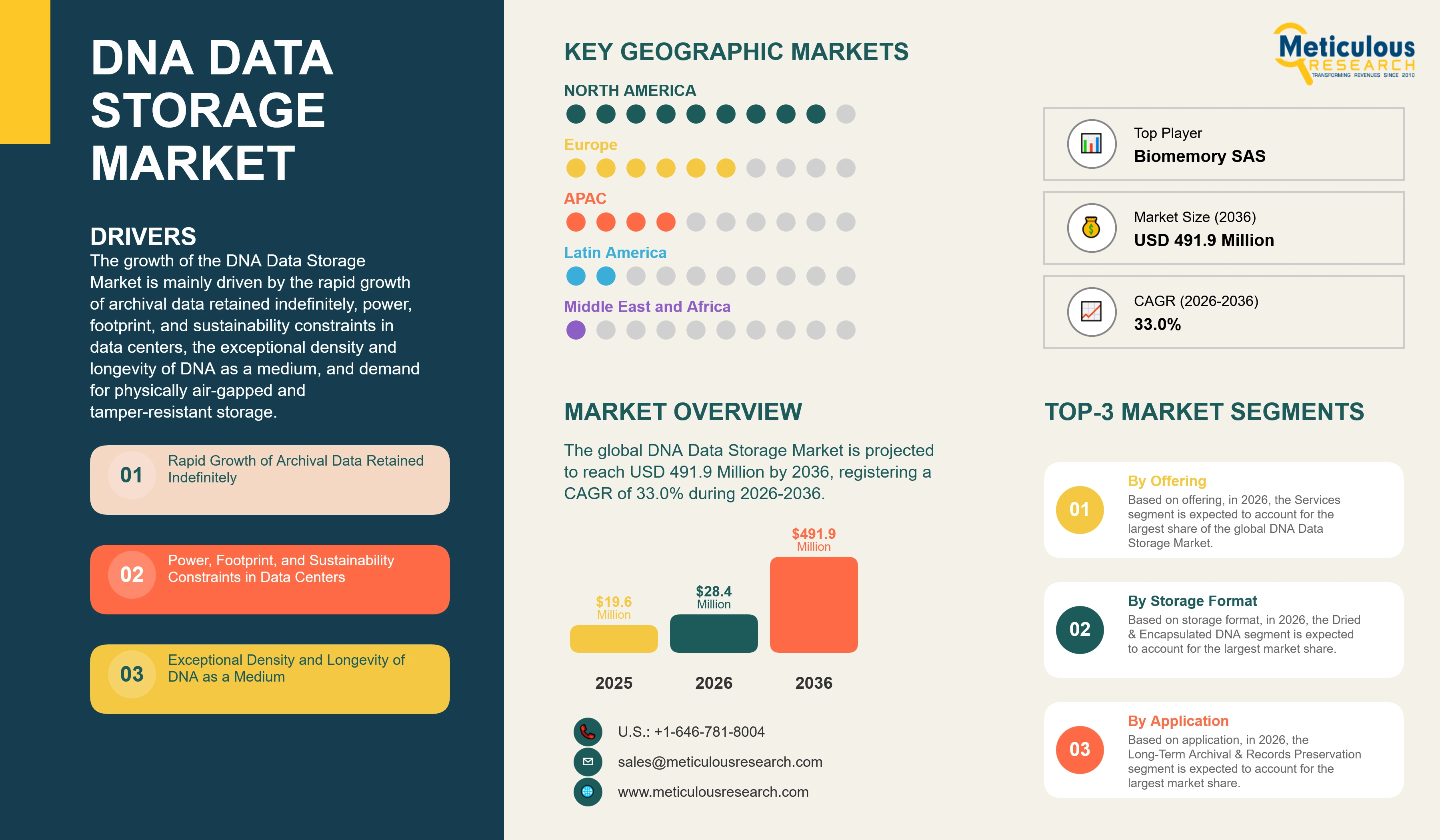
The global DNA Data Storage Market was valued at USD 19.6 million in 2025. This market is expected to reach USD 491.9 million by 2036 from an estimated USD 28.4 million in 2026, registering a CAGR of 33.0% during the forecast period (2026-2036).
- Published
- Oct 2026
- Pages
- 299
- Format
- PDF + Excel
- Report ID
- MRSE - 1042365
- Base year
- 2025
- 2025 · BASELINE
- $19.6M
- 2036
- $491.9M
- CAGR 2026–2036
- 33.0%
2025 baseline · 2026–2036 forecast at 33.0% CAGR · hover a bar for the value
Key highlights
The global DNA Data Storage Market is projected to reach USD 491.9 million by 2036 from a small base, driven by archival data growth, the limits of conventional cold storage, DNA density and longevity, and demand for air-gapped preservation.
The first commercial services have reached the market. In October 2026, Biomemory launched DNA Shield, a synthetic DNA repository service that holds critical digital assets offline and air-gapped without power, with subscriptions starting at EUR 10,000 per month, a claimed retention period of approximately 150 years, and limited pilots running from October 15, 2026 to mid-2027 ahead of general availability.
Consolidation is concentrating capability in the sector. In March 2026, Biomemory, a DNA data storage company founded in Paris in 2021, acquired the assets of Catalog Technologies of Boston, combining enzymatic DNA block assembly, high-speed writing, and high-throughput reading, and stated its intention to launch its first commercial product in the second half of 2026 as an alternative to conventional storage media, with mass deployment in data center environments as its longer-term objective.
North America is expected to account for the largest market share in 2026, supported by hyperscale data center operators, research funding, and the concentration of DNA writing and sequencing capability, while Europe is expected to hold a substantial position and Asia-Pacific is projected to register the fastest growth during the forecast period.
By application, Long-Term Archival & Records Preservation is expected to account for the largest market share in 2026, whereas Secure & Air-Gapped Data Vaulting is projected to witness the fastest growth through 2036, as organizations seek repositories for cryptographic and high-value assets that are unreachable over a network.
Report summary
| Particulars | Details |
|---|---|
| Forecast Period | 2026-2036 |
| Base Year | 2025 |
| Estimated Year | 2026 |
| CAGR (Value) | 33.0% |
| Format | PDF, Excel & Cloud Portal · 299 pages |
| Market Size (Value) in 2026 | USD 28.4 Million |
| Market Size (Value) in 2036 | USD 491.9 Million |
| Segments Covered | By Offering: Writing Systems & Consumables, Storage Media & Preservation Formats, Reading Systems & Consumables, Software (Encoding & Error-Correction Software, Indexing, Random-Access & File System Software), Services (Managed Storage & Vaulting Services, Professional & Integration Services). By Writing Technology: Chemical Synthesis-Based Writing, Enzymatic Writing. By Storage Format: Dried & Encapsulated DNA, Cartridge & Device-Integrated Formats, Liquid & Other Formats. By Application: Long-Term Archival & Records Preservation, Secure & Air-Gapped Data Vaulting, Cultural Heritage & Scientific Data Preservation, Research & Proof-of-Concept Applications. By End User: Data Center & Cloud Service Providers, Government & Defence Organizations, Archives, Libraries & Cultural Institutions, Banking, Financial Services & Insurance, Media & Entertainment, Healthcare & Life Sciences, Other End Users. |
| Countries Covered | North America: U.S., Canada. Europe: France, Germany, U.K., Switzerland, Netherlands, Rest of Europe. Asia-Pacific: China, Japan, Singapore, South Korea, Australia, Rest of Asia-Pacific. Latin America: Brazil, Mexico, Rest of Latin America. Middle East & Africa: UAE, Saudi Arabia, Rest of Middle East & Africa. |
| Key Companies | Biomemory SAS, Twist Bioscience Corporation, Illumina, Inc., Oxford Nanopore Technologies plc, DNA Script SAS, Ansa Biotechnologies, Inc., Molecular Assemblies, Inc., Western Digital Corporation, Seagate Technology Holdings plc, Micron Technology, Inc., and Microsoft Corporation. |
Report overview
Segments covered: offering, writing technology, storage format, application, end user.
The growth of this market is mainly driven by the rapid accumulation of archival data that is retained indefinitely but accessed rarely, the power, footprint, and media migration costs of conventional archival storage at exabyte scale, the exceptional density and longevity of DNA as a storage medium, and demand for physically air-gapped storage that cannot be reached over a network. In addition, the declining cost of high-throughput DNA writing, the maturation of enzymatic writing methods designed for data rather than biology, the falling cost and rising throughput of reading, the formation of industry alliances working toward interoperability, and early commercial launches that move the technology from laboratory demonstration toward paid service are further supporting the growth of this market.
The DNA Data Storage Market, also referred to as the molecular data storage market, synthetic DNA storage market, or DNA-based archival storage market, comprises the technologies, media, systems, software, and services used to encode digital information into synthetic DNA sequences, store that DNA, and read it back as data. The market includes DNA writing systems and the reagents and consumables they consume; the physical storage media and preservation formats in which encoded DNA is held, including dried, encapsulated, and cartridge formats; reading systems, which are sequencing platforms configured for data recovery; encoding, error-correction, indexing, random-access, and file-system software; and the managed services through which organizations store data in DNA without operating the technology themselves. The market ecosystem extends from DNA writing and sequencing technology providers, specialist DNA storage companies, storage hardware and semiconductor companies, and standards alliances to hyperscale and enterprise data center operators, national archives, libraries, museums, government and defence organizations, media companies, financial institutions, and research institutions.
DNA is attractive as a storage medium for reasons that are physical rather than commercial. Information encoded in DNA occupies a volume orders of magnitude smaller than the equivalent data on tape or disk, and DNA held in suitable conditions remains readable for decades to centuries without power. These properties address the structural difficulty of archival storage, which is that conventional media must be migrated to new generations every several years, and that migrating exabyte-scale archives consumes capital, labour, and energy indefinitely. A medium that requires no power and no migration changes the economics of very long retention.
The pressure on archival storage is real and growing. According to the LTO Program, total shipped LTO tape capacity increased 57% year over year in the first quarter of 2026, following 160.3 exabytes shipped in 2025 and a record 176.5 exabytes in 2024, with demand attributed to rising capacity requirements, data center power constraints, the need for physically air-gapped cyber resilience, and the retention of artificial intelligence (AI) training datasets. Tape remains the dominant cold storage medium and is growing rather than declining, which demonstrates both the scale of archival demand and the fact that DNA is not displacing tape at present. DNA storage is instead positioned, initially, for retention periods and use cases that tape serves poorly, including multi-decade preservation without migration and storage that is physically unreachable over a network.
The market has begun to move from demonstration to commerce. In March 2026, Biomemory, a DNA data storage company founded in Paris in 2021, acquired the assets of Catalog Technologies of Boston, combining enzymatic DNA block assembly, high-speed writing, and high-throughput reading, and stated its intention to launch its first commercial product in the second half of 2026 as an alternative to conventional storage media, with mass deployment in data center environments as its longer-term objective. In October 2026, Biomemory launched DNA Shield, a synthetic DNA repository service that holds critical digital assets offline and air-gapped without power, with subscriptions starting at EUR 10,000 per month, a claimed retention period of approximately 150 years, and limited pilots running from October 15, 2026 to mid-2027 ahead of general availability. The pricing and scope of this first service are instructive: it is priced for high-value assets rather than bulk capacity, and it is sold as a vaulting service rather than as media or hardware, which reflects the stage the technology has reached.
Cost remains the central constraint. Biomemory introduced its first DNA storage cards in December 2023 at a price of USD 1,000 for up to one kilobyte of data, and raised a USD 18 million Series A round in December 2024 to complete its first-generation storage appliance and accelerate commercialization, indicating both the early stage of the technology and the investment required to industrialize it. Writing DNA at the cost per terabyte required for bulk archival storage requires reductions of several orders of magnitude from current levels, which is why early commercial activity concentrates on small volumes of high-value data where the value of density, longevity, and air-gapping outweighs the cost per byte.
Progress depends on the underlying DNA writing and reading industries, which are developing for reasons unrelated to data storage. In its fiscal third quarter of 2026, ended June 30, 2026, Twist Bioscience Corporation reported record revenue of USD 118.4 million, up 23% year over year, with DNA Synthesis and Protein Solutions revenue of USD 56.6 million, up 39%, reflecting the scale and continuing cost reduction of the high-throughput DNA writing platforms on which DNA data storage depends. High-throughput platforms built for life science research provide the writing capacity that DNA storage requires, and sequencing platforms provide the reading capacity, so DNA storage benefits from cost reduction driven by a far larger market. Enzymatic writing methods, which operate in aqueous conditions and are designed for throughput rather than for producing biologically functional sequences, are of particular interest for data applications.
Software is a larger part of the problem than the physical medium suggests. Encoding schemes must tolerate the error characteristics of writing and reading, which differ from those of electronic media, and must support indexing and random access so that a file can be retrieved without reading an entire archive. Error correction, file systems, and retrieval software therefore determine much of the practical usability of a DNA archive, and the DNA Data Storage Alliance has worked on interoperability so that DNA written by one system can be read by another.
The market includes specialist DNA storage companies such as Biomemory, which acquired the assets of Catalog Technologies, together with DNA writing and sequencing technology providers including Twist Bioscience, Illumina, Oxford Nanopore Technologies, and enzymatic writing companies such as DNA Script and Ansa Biotechnologies, and storage and semiconductor companies including Western Digital, Seagate Technology, and Micron Technology that participate through the DNA Data Storage Alliance and research collaboration. Participants compete and collaborate on write cost and throughput, read cost and speed, error rate, random-access capability, media stability, interoperability, and the credibility of long-term service commitments.
At the same time, the market faces substantial challenges, including a write cost far above that of conventional media, write and read latency measured in hours rather than milliseconds, the absence of mature standards and of a second source for most components, the difficulty of persuading organizations to commit records to a technology with no long operational history, the risk that a provider will not exist for the retention period it promises, and the continuing improvement of tape, which raises the bar DNA must clear. As a result, participants that combine order-of-magnitude write cost reduction, demonstrated retrieval reliability, standards-based interoperability, and credible custodial arrangements are expected to capture the largest share of growth over the forecast period.
Report infographic
Market dynamics
15 factors across 5 forcesRapid Growth of Archival Data Retained Indefinitely
The rapid growth of archival data retained indefinitely is a major factor driving the DNA Data Storage Market. Organizations retain regulated records, scientific data, media libraries, surveillance footage, and AI training datasets for periods measured in decades, and much of this data is written once and read rarely, which is precisely the profile for which a dense, power-free medium is suited. According to the LTO Program, total shipped LTO tape capacity increased 57% year over year in the first quarter of 2026, following 160.3 exabytes shipped in 2025 and a record 176.5 exabytes in 2024, with demand attributed to rising capacity requirements, data center power constraints, the need for physically air-gapped cyber resilience, and the retention of artificial intelligence (AI) training datasets.
The economics of indefinite retention are the underlying driver. Conventional media must be replaced every several years and archives migrated to each new generation, which means the cost of holding data never ends and grows with the size of the archive. A medium requiring neither power nor migration converts a recurring cost into a one-time cost, which is the proposition DNA storage advances.
Power, Footprint, and Sustainability Constraints in Data Centers
Power, footprint, and sustainability constraints in data centers are significantly driving interest in the market. Data center capacity is increasingly limited by available power rather than by floor space or capital, and archival tiers compete for that power with compute. DNA held in dried or encapsulated form draws no power at all and occupies a volume that is negligible by comparison with any electronic medium, which makes it attractive to operators facing power and footprint limits and to organizations with emissions commitments.
Exceptional Density and Longevity of DNA as a Medium
The exceptional density and longevity of DNA as a medium is an important driver of demand. DNA is a far denser information carrier than magnetic or solid-state media, and DNA held under suitable conditions remains readable for very long periods without intervention. In October 2026, Biomemory launched DNA Shield, a synthetic DNA repository service that holds critical digital assets offline and air-gapped without power, with subscriptions starting at EUR 10,000 per month, a claimed retention period of approximately 150 years, and limited pilots running from October 15, 2026 to mid-2027 ahead of general availability. These properties address requirements that conventional media cannot meet at any price, which is why national archives, libraries, museums, and research institutions have been among the earliest to evaluate the technology.
Longevity also removes the format obsolescence problem that affects every electronic medium. A tape written today requires a compatible drive to be read in thirty years, whereas DNA requires only the ability to sequence DNA, a capability that the life sciences industry will retain regardless of what happens in storage. This decoupling of the medium from any particular device generation is a significant part of the long-term case for DNA.
Demand for Physically Air-Gapped and Tamper-Resistant Storage
Demand for physically air-gapped and tamper-resistant storage supports market growth. Organizations holding cryptographic keys, biometric records, intellectual property, and regulated records increasingly want a copy that no network, cloud, or administrator can reach, and the LTO Program cites physically air-gapped cyber resilience among the drivers of tape demand. In October 2026, Biomemory launched DNA Shield, a synthetic DNA repository service that holds critical digital assets offline and air-gapped without power, with subscriptions starting at EUR 10,000 per month, a claimed retention period of approximately 150 years, and limited pilots running from October 15, 2026 to mid-2027 ahead of general availability. DNA extends this proposition further, because the medium is inert, requires specialized equipment to read, and can be held in custody arrangements independent of any IT system.
Table of contents
13 chapters · 144 sections · 299 pages · click to expandSegmental analysis
| Segment | Largest share (2026) | Fastest growth (2026–2036) |
|---|---|---|
| By Offering | Services | Services |
| By Writing Technology | Chemical Synthesis-Based Writing | Enzymatic Writing |
| By Storage Format | Dried & Encapsulated DNA | Cartridge & Device-Integrated Formats |
| By Application | Long-Term Archival & Records Preservation | Secure & Air-Gapped Data Vaulting |
| By End User | Government & Defence Organizations | Data Center & Cloud Service Providers |
By Offering
- DNA Data Storage Market Analysis by Offering
- Software is further segmented into Encoding & Error-Correction Software and Indexing, Random-Access & File System Software, while Services are further segmented into Managed Storage & Vaulting Services and Professional & Integration Services.
- The Services segment is expected to account for the largest share of the global DNA Data Storage Market and is also projected to register the highest CAGR during the forecast period.
- This is mainly due to the stage the technology has reached, in which organizations buy an outcome rather than operate the technology themselves, the launch of subscription vaulting services priced for high-value assets, and the absence of any practical means for a customer to acquire and run DNA writing and reading capability in its own facility at present.
- The Writing Systems & Consumables segment is expected to account for a significant share, reflecting the capital and consumable intensity of writing, while the Software segment is expected to grow strongly as encoding, error-correction, and random-access capability becomes a principal determinant of whether a DNA archive is usable in practice.
By Writing Technology
- DNA Data Storage Market Analysis by Writing Technology
- The Chemical Synthesis-Based Writing segment is expected to account for the largest share of the market.
- The large share of this segment is mainly due to the maturity and installed capacity of high-throughput chemical writing platforms developed for life science applications, which provide the only presently available means of writing DNA at meaningful scale, and the cost reductions already achieved on those platforms.
- In its fiscal third quarter of 2026, ended June 30, 2026, Twist Bioscience Corporation reported record revenue of USD 118.4 million, up 23% year over year, with DNA Synthesis and Protein Solutions revenue of USD 56.6 million, up 39%, reflecting the scale and continuing cost reduction of the high-throughput DNA writing platforms on which DNA data storage depends.
- However, the Enzymatic Writing segment is projected to register the highest CAGR during the forecast period.
- The rapid growth of this segment is attributed to the suitability of enzymatic methods for the throughput, cost, and parallelization that data storage requires, their operation in aqueous conditions without organic solvents, and their adoption by DNA storage specialists, including the enzymatic block assembly capability that Biomemory combined with high-speed writing and high-throughput reading in 2026.
By Storage Format
- DNA Data Storage Market Analysis by Storage Format
- The Dried & Encapsulated DNA segment is expected to account for the largest share of the market.
- The large share of this segment is mainly due to the stability that drying and encapsulation confer, which is the basis of the multi-decade and century-scale retention claims made for the medium, the negligible volume and absence of any power requirement, and the suitability of the format for custody arrangements held separately from any IT system.
- However, the Cartridge & Device-Integrated Formats segment is projected to register the highest CAGR during the forecast period.
- The rapid growth of this segment is attributed to the intention of providers to move toward deployment in data center environments, which requires DNA to be packaged in formats that handling systems can manage and index automatically rather than in laboratory containers, and to the involvement of storage hardware companies in defining such formats.
By Application
- DNA Data Storage Market Analysis by Application
- The Long-Term Archival & Records Preservation segment is expected to account for the largest share of the market.
- The large share of this segment is mainly due to the alignment between the strengths of the medium and the requirements of write-once, read-rarely retention over decades, the cost of migrating conventional archives indefinitely, and the breadth of organizations holding regulated and institutional records that must survive far longer than any electronic medium generation.
- However, the Secure & Air-Gapped Data Vaulting segment is projected to register the highest CAGR during the forecast period.
- The rapid growth of this segment is attributed to the value organizations place on a copy that cannot be reached over a network, the suitability of high-value, low-volume assets such as cryptographic keys and intellectual property to current write costs, and the launch of commercial vaulting services addressing precisely this requirement.
By End User
- DNA Data Storage Market Analysis by End User
- Other End Users include energy, engineering, and industrial organizations with long-lived asset records.
- The Government & Defence Organizations segment is expected to account for the largest share of the market.
- The large share of this segment is mainly due to statutory retention obligations measured in decades, requirements for storage that is physically unreachable over a network, access to preservation funding outside commercial IT budgets, and a tolerance for early-stage technology in support of sovereign and security objectives.
- However, the Data Center & Cloud Service Providers segment is projected to register the highest CAGR during the forecast period.
- The rapid growth of this segment is attributed to the power and footprint constraints these operators face at exabyte scale, their interest in a medium that eliminates migration, their participation in standards and research collaboration, and the intention of providers to move toward deployment in data center environments.
Geographic analysis
North America
Largest shareIn 2026, North America is expected to account for the largest share of the global DNA Data Storage Market. The large share of this region is mainly attributed to the concentration of hyperscale data center operators facing power and footprint constraints, substantial research funding for molecular storage, the presence of the DNA writing and sequencing companies on which the field depends, including Twist Bioscience, Illumina, and Ansa Biotechnologies, the participation of storage and semiconductor companies including Western Digital, Seagate Technology, and Micron Technology, and the establishment by Biomemory of a Boston base for research, production, and customer support following its acquisition of the Catalog Technologies assets.
Europe
Europe is expected to account for a substantial share of the market, supported by the position of Biomemory as one of the few companies to have brought a commercial DNA storage service to market, European research programs in molecular storage, the presence of enzymatic writing companies including DNA Script, national archive and cultural heritage institutions with century-scale preservation requirements, and regulatory and sustainability expectations that favour storage with no power draw. In October 2026, Biomemory launched DNA Shield, a synthetic DNA repository service that holds critical digital assets offline and air-gapped without power, with subscriptions starting at EUR 10,000 per month, a claimed retention period of approximately 150 years, and limited pilots running from October 15, 2026 to mid-2027 ahead of general availability.
Asia-Pacific
Fastest growthAsia-Pacific is projected to register the highest CAGR during the forecast period. The growth of this region is driven by rapid data center construction in China, Japan, Singapore, and South Korea, government research programs in molecular and biological computing, substantial national sequencing and synthesis capacity, and interest in sovereign long-term storage that does not depend on foreign cloud infrastructure.
Latin America
Latin America and the Middle East & Africa are expected to account for very small shares of the market throughout the forecast period.
Middle East & Africa
In the Middle East, sovereign data initiatives and national archive programs in Gulf countries are expected to generate early evaluation activity, while in Latin America adoption is expected to follow the availability of commercial services rather than to originate locally.
Competitive landscape
The global DNA Data Storage Market is early-stage and concentrated, with a small number of specialist companies pursuing end-to-end systems, DNA writing and sequencing technology providers supplying the capability on which those systems depend, storage and semiconductor companies participating through standards alliances and research collaboration, and academic and corporate research groups contributing encoding and retrieval methods. Participants compete and collaborate on write cost and throughput, read cost and speed, error rate, random-access capability, media stability, interoperability, and the credibility of long-term service commitments.
Activity is concentrated on reducing write cost, assembling working end-to-end systems, establishing interoperability, and converting demonstrations into priced services. Recent examples include the acquisition by Biomemory of the Catalog Technologies assets in March 2026, which brought enzymatic block assembly, high-speed writing, and high-throughput reading together, and the launch of the DNA Shield vaulting service in October 2026 with published subscription pricing and a pilot programme running to mid-2027.
The report provides a comprehensive competitive assessment of the leading companies operating in the global DNA Data Storage Market. The key players profiled in the report include Biomemory SAS (France), Twist Bioscience Corporation (U.S.), Illumina, Inc. (U.S.), Oxford Nanopore Technologies plc (U.K.), DNA Script SAS (France), Ansa Biotechnologies, Inc. (U.S.), Molecular Assemblies, Inc. (U.S.), Western Digital Corporation (U.S.), Seagate Technology Holdings plc (U.S.), Micron Technology, Inc. (U.S.), and Microsoft Corporation (U.S.).
- Biomemory SAS
- Twist Bioscience Corporation
- Illumina, Inc.
- Oxford Nanopore Technologies plc
- DNA Script SAS
- Ansa Biotechnologies, Inc.
- Molecular Assemblies, Inc.
- Western Digital Corporation
- Seagate Technology Holdings plc
- Micron Technology, Inc.
- Microsoft Corporation
Expert perspectives
The DNA Data Storage Market is at the point where a laboratory curiosity becomes a product with a price. With a subscription vaulting service launched in October 2026 at EUR 10,000 per month, the Catalog Technologies assets consolidated into Biomemory, and tape capacity shipments up 57% in the first quarter of 2026, the picture is clear: archival demand is enormous, DNA offers properties no electronic medium can match, and the cost of writing remains orders of magnitude too high for bulk use. The binding constraint is not demand or physics but write cost, and the shape of this market for the next decade follows directly from how quickly that cost falls.
Three structural changes are expected to shape the market through 2036. First, commercial activity is expected to concentrate on high-value, low-volume vaulting, where the value of density, longevity, and air-gapping exceeds the cost per byte, rather than on bulk archival capacity. Second, enzymatic writing is expected to determine the timing of broader adoption, because it is the route by which write cost can fall far enough. Third, standards, interoperability, and custodial arrangements are expected to matter as much as technology, because the customers best suited to DNA are precisely those who cannot rely on an early-stage provider surviving their retention period.
For companies planning entry or expansion, the most defensible positions over the forecast period are likely to be found in secure vaulting services for high-value assets, enzymatic writing platforms targeting order-of-magnitude cost reduction, encoding and random-access software, preservation programs with archives and cultural institutions, and custodial and escrow frameworks that survive provider failure. For the storage and semiconductor companies participating through alliances, the principal value lies in shaping formats and interoperability ahead of any transition to data center deployment.
Overall, the market is expected to grow rapidly from a very small base, remaining a specialty market throughout the forecast period rather than displacing conventional cold storage, with services, chemical writing, dried and encapsulated formats, long-term archival applications, government and defence organizations, and North America providing the core of activity, and enzymatic writing, cartridge formats, secure air-gapped vaulting, data center and cloud providers, and Asia-Pacific providing the fastest growth.
Customer perspectives
Insights gathered during primary interviews with data center infrastructure leaders, national archive directors, and enterprise information security officers operating in this market highlight where evaluation priorities lie. The following perspectives reflect recurring themes raised across these discussions.
“This reflects power and migration cost as the underlying motivation.”
“This indicates provider longevity and interoperability as decisive concerns.”
“This points to air-gapped vaulting as the most immediately viable application.”
Frequently asked questions
The global DNA Data Storage Market is estimated at USD 28.4 million in 2026.
Cite this report
Meticulous Research. (2026). DNA Data Storage Market- Global Opportunity Analysis And Industry Forecasts (2026-2036) (Report No. MRSE - 1042365). Meticulous Market Research Pvt. Ltd. https://www.meticulousresearch.com/product/dna-data-storage-market-7048