
Digital Product Passport Market (2025-2035)
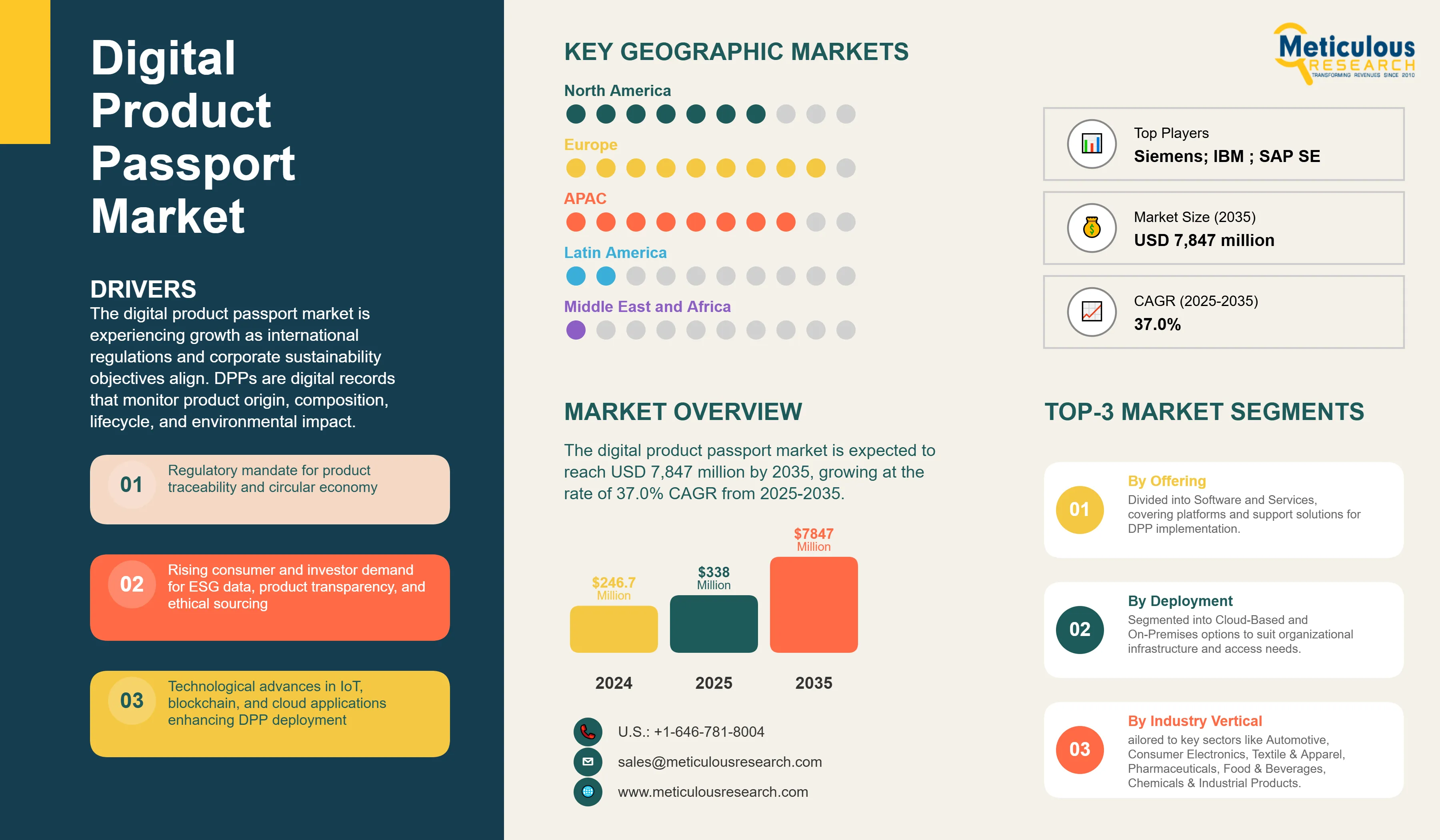
The digital product passport market size was valued at USD 238 million in 2024. This market is estimated to be USD 338 million in 2025 and is expected to reach USD 7,847 million by 2035, growing at the rate of 37.0% CAGR from 2025-2035.
- Published
- Aug 2025
- Pages
- 200
- Format
- PDF + Excel
- Report ID
- MRICT - 1041557
- Base year
- 2024
- 2024 · BASELINE
- $238.0M
- 2035
- $7.85B
- CAGR 2025–2035
- 37.0%
2024 baseline · 2025–2035 forecast at 37.0% CAGR · hover a bar for the value
Key highlights
The digital product passport market size was valued at USD 238 million in 2024.
This market is estimated to be USD 338 million in 2025 and is expected to reach USD 7, 847 million by 2035, growing at the rate of 37.0% CAGR from 2025-2035.
Electronics Sector Leads Digital Product Passport Adoption Due to Complex Supply Chains and Stringent Compliance Needs
Europe is at the forefront of Digital Product Passport adoption and is estimated to command the largest share of 40% of the global DPP market, driven largely by the EU’s Circular Economy Action Plan and the Ecodesign for Sustainable Products Regulation (ESPR).
The Asia Pacific market is anticipated to surge exponentially with more than 40% CAGR by 2035. The Asia-Pacific region is becoming a pivotal area for DPP adoption, propelled by manufacturing exports and regulatory harmonisation.
The United States held over 85% revenue share in the North America regional market in 2025. The United States is promoting the adoption of digital product passports via federal initiatives and corporate ESG strategies.
Report summary
| Particulars | Details |
|---|---|
| Market size (2025) | USD 338 million |
| Revenue forecast in 2035 | USD 7,847 million |
| CAGR (2025-2035) | 37% |
| Format | PDF, Excel & Cloud Portal · 200 pages |
| Base Year | 2024 |
| Forecast period | 2025 – 2035 |
| Report coverage | Market size and forecast, competitive landscape and benchmarking, country/regional level analysis, key trends, growth drivers and restraints |
| Segments covered | Component (Software, Services), Deployment Mode (Cloud-based, On-premises), Organization Size, End-use Industry (Consumer Electronics, Textile & Apparel, Automotive), Geography |
| Regional scope | North America, Europe, Asia-Pacific, Latin America, and Middle East & Africa |
| Key companies profiled | Siemens AG; IBM Corporation; SAP SE; Oracle Corporation; Microsoft Corporation; Everledger; Provenance; VeChain; OPTEL Group; Honeywell International Inc.; Avery Dennison Corporation; Kezzler AS; Circularise; DNV; iPoint-systems gmbh; 3E Company; Billon Group; LyondellBasell Industries; EON; Det Norske Veritas (DNV) |
| Customization | Comprehensive report customization with purchase. Addition or modification to country, regional & segment scope available |
| Pricing Details | Access customized purchase options to meet your specific research requirements. Explore flexible pricing models |
Report overview
Segments covered: organization size.
The digital product passport market is experiencing growth as international regulations and corporate sustainability objectives align. DPPs are digital records that monitor product origin, composition, lifecycle, and environmental impact. The European Union’s Ecodesign for Sustainable Products Regulation (ESPR) requires Digital Product Passports (DPPs) for textiles, electronics, and batteries commencing in 2026, prompting early adoption across sectors. In 2024, more than 150 companies participated in the EU’s CIRPASS consortium to test DPP frameworks for electronics and apparel. Companies such as H&M and Decathlon are currently experimenting with Digital Product Passports (DPPs) to achieve circular economy objectives. The World Economic Forum indicates that 54% of global supply chain executives are allocating resources towards traceability tools to achieve ESG objectives. As digital infrastructure evolves and blockchain, RFID, and cloud platforms integrate, Digital Product Passports (DPPs) are increasingly vital for product transparency, regulatory adherence, and consumer interaction.
Report infographic
Key Factors Impacting Global Digital Product Passport Market (2025–2035)
Base CAGR: 37%
|
Category |
Key Factor |
Short-Term Impact (2025–2028) |
Long-Term Impact (2029–2035) |
Estimated CAGR Impact |
|
Drivers |
1. Government Regulations Like EU ESPR Accelerate Adoption of Digital Product Passports Across Multiple Industries |
Regulatory mandates drive initial adoption |
Widespread compliance and integration across industries |
▲ +10.5% |
|
2. ESG Commitments Drive Demand for Traceable Product Data to Support Transparency, Circularity, and Reporting |
Increased corporate sustainability reporting |
Embedded traceability in global supply chains |
▲ +9.2% |
|
|
3. Growing Consumer Preference for Verified Sustainability Credentials Boosts Digital Product Passport Implementation in Retail |
Rising consumer-driven transparency demands |
Digital product passports become retail standard |
▲ +8.7% |
|
|
4. Blockchain and Cloud Platforms Enable Scalable, Secure Digital Product Passport Systems for Complex Supply Chains |
Adoption of secure DPP platforms by early adopters |
Mature, interoperable blockchain-cloud ecosystems |
▲ +8.0% |
|
|
Restraints |
1. Fragmented Data Formats and Lack of Industry Standards Hinder Cross-Sector Digital Product Passport Interoperability |
Integration complexity slows rollout |
Industry-wide standards and data harmonization emerge |
▼ −3.5% |
|
2. Expensive Integration and Training Costs Limit Digital Product Passport Adoption Among Small and Mid-Sized Enterprises |
High upfront costs deter smaller companies |
Scaled solutions and training reduce barriers |
▼ −2.8% |
|
|
Opportunities |
1. Integration of AI, machine learning, and digital twins for advanced product lifecycle insights |
Pilot projects enhance product intelligence |
Fully AI-enabled lifecycle optimization and predictive insights |
▲ +9.0% |
|
2. Collaboration with policymakers for harmonized DPP frameworks and scalable technology |
Early policy partnerships and framework development |
Global harmonization drives mass adoption |
▲ +8.5% |
|
|
Trends |
1. Shift from centralized to blockchain-enabled DPP systems for immutable records |
Increasing blockchain pilot deployments |
Blockchain becomes default for secure, immutable DPPs |
▲ +7.8% |
|
2. Growth of cloud-native and API-driven DPP integration across supply chains |
Cloud-based, modular DPP platforms gain traction |
Enterprise-grade API ecosystems standardize DPP usage |
▲ +7.4% |
|
|
Challenges |
1. Data collection and validation from multi-tiered supply chains |
Complex multi-tier data delays and validation issues |
Streamlined and automated data validation systems |
▼ −3.2% |
|
2. Ensuring universal access and usability of DPP technologies (e.g., QR, NFC) |
Limited technology adoption in emerging regions |
Ubiquitous accessibility and multi-format support |
▼ −2.9% |
Market dynamics
5 factors across 2 forcesGovernment Regulations Like EU ESPR Accelerate Adoption of Digital Product Passports Across Multiple Industries
Government regulations are a principal catalyst for DPP adoption across various industries. The EU's ESPR requires DPPs for essential product categories commencing in 2026, with pilot programs currently in progress. In 2024, the European Commission introduced a Digital Product Passport (DPP) prototype for batteries in accordance with the Battery Regulation, mandating the collection of lifecycle data and carbon footprint monitoring. The regulation affects more than 800 million battery units each year, compelling manufacturers to digitise product information. Comparable initiatives are arising in Canada and Japan, where traceability is associated with import compliance and recycling incentives.
ESG Commitments Drive Demand for Traceable Product Data to Support Transparency, Circularity, and Reporting
Corporate ESG commitments are increasing the demand for digital product passports to monitor environmental impact. In 2024, Unilever declared that 80% of its product lines would incorporate DPPs by 2026 to enhance transparency and circularity. The company employs QR codes and blockchain technology to disseminate product lifecycle information to consumers. A McKinsey survey revealed that 63% of global executives deem traceability crucial for attaining sustainability objectives. DPPs are increasingly pivotal to ESG reporting, consumer confidence, and brand distinction.
Growing Consumer Preference for Verified Sustainability Credentials Boosts Digital Product Passport Implementation in Retail
Consumers are progressively seeking transparency at the product level, particularly in the sectors of fashion, electronics, and food. In 2024, a survey conducted by IBM revealed that 71% of global consumers are prepared to pay a premium for products possessing verified sustainability credentials. Retailers are integrating Digital Product Passports (DPPs) into product labels and mobile applications. H&M initiated a pilot program utilising Digital Product Passports (DPPs) to convey garment origin, material composition, and care instructions, thereby enhancing customer engagement and minimising returns. This trend is proliferating across e-commerce platforms and physical retail establishments.
Table of contents
13 chapters · 142 sections · 200 pages · click to expandSegmental analysis
| Segment | Largest share (2025) | Fastest growth (2025–2035) |
|---|---|---|
| By End User | Electronics Sector | — |
By End User
- Electronics Sector Leads Digital Product Passport Adoption Due to Complex Supply Chains and Stringent Compliance Needs
- The electronics sector is estimated to command the largest share of 25% of the global digital product passports market.
- This is majorly owing to the result of regulatory pressure and intricate supply chains.
- The EU's Battery Regulation required DPPs for all rechargeable batteries, affecting smartphones, electric vehicles, and consumer electronics.
- DPPs are being tested by companies such as Apple and Samsung to monitor the carbon footprint and the sourcing of materials.
- Blockchain and RFID technologies are employed to guarantee traceability among suppliers.
- The sector is experiencing integration with electronic waste recycling programs and circular economy initiatives.
- Fashion Industry Embraces Digital Product Passports for Circularity, Consumer Engagement, and Transparency Enhancement
- The fashion industry is swiftly embracing digital product passports to enhance circularity and transparency, is expected to with the highest 45% CAGR.
- H&M initiated a pilot program utilising Digital Product Passports (DPPs) to convey garment origin, material composition, and care instructions to consumers.
- Decathlon and Zalando are conducting trials of DPPs to comply with EU sustainability regulations.
- QR codes and mobile applications are utilised to provide product-specific information at the point of sale.
- The sector is experiencing heightened consumer engagement, diminished returns, and enhanced brand trust.
- DPPs are additionally facilitating resale, recycling, and rental paradigms in fashion retail.
Geographic analysis
Europe
Largest shareEurope is at the forefront of Digital Product Passport adoption and is estimated to command the largest share of 40% of the global DPP market, driven largely by the EU’s Circular Economy Action Plan and the Ecodesign for Sustainable Products Regulation (ESPR). In 2024, the European Commission mandated DPP integration for textiles, batteries, and select electronics to improve traceability, recycling, and reuse rates. Countries like Germany and France are pioneering sector-specific DPP pilots—Germany in automotive supply chains to track component origins and France in luxury goods to combat counterfeiting. The Netherlands is expanding blockchain-enabled DPPs in the agri-food sector to strengthen provenance claims. Switzerland’s watchmaking industry has embraced DPPs to certify material sourcing and craftsmanship quality. Europe’s well-established cloud infrastructure, high blockchain adoption rates, and mature compliance culture enable rapid scaling, while upcoming EU-wide digital product data repositories will streamline cross-border data sharing for manufacturers and recyclers. Germany is expected to grow at 42% CAGR during the forecast timeframe. Germany is leading Europe in the adoption of DPP thanks to industrial digitisation and regulatory leadership. For DPPs in the electronics and automotive industries, the German Environment Agency introduced a national framework in 2024. DPPs are being piloted by Siemens and Bosch to monitor component origin, emissions, and recycling potential. The country also leads standardisation efforts within the EU's CIRPASS consortium. Germany's strong manufacturing base and ESG commitments position it as a strategic hub for DPP innovation and deployment. Europe Leads Global Digital Product Passport Deployment Underpinned by Strong Regulatory Mandates and Circular Economy Goals Germany Drives EU DPP Standardization and Innovation, Leveraging Robust Manufacturing and Regulatory Frameworks
Asia-Pacific
The Asia Pacific market is anticipated to surge exponentially with more than 40% CAGR by 2035. The Asia-Pacific region is becoming a pivotal area for DPP adoption, propelled by manufacturing exports and regulatory harmonisation. In 2024, China's Ministry of Industry and Information Technology initiated a pilot program for DPPs in the electronics and textiles sectors to comply with EU import standards. The Ministry of Economy, Trade and Industry (METI) of Japan is financing blockchain-based traceability systems for the automotive and battery industries. The Bureau of Indian Standards in India is investigating DPPs for compliance with electronics and food safety regulations. Due to increasing consumer awareness and export-oriented industries, DPPs are becoming crucial for market access and brand credibility. Regional governments are additionally endorsing digital infrastructure and data interoperability initiatives. China dominated the Asia-Pacific region with 30% revenue share in 2025. China is increasing the use of digital product passports to enhance domestic traceability and comply with international regulations. In 2024, the Ministry of Industry and Information Technology launched a pilot program for electronics and textiles to comply with EU DPP regulations. Big companies like Haier and Lenovo are testing blockchain-based DPPs to keep track of where materials come from and how much carbon they emit. The initiative is in alignment with China's dual circulation strategy and green manufacturing objectives. Asia-Pacific Ramps Up DPP Adoption Through Manufacturing Compliance, Export Alignment, and Government Digital Support China Expands Digital Product Passports Using National Compliance Programs and Growing Enterprise Digitization
North America
The United States held over 85% revenue share in the North America regional market in 2025. The United States is promoting the adoption of digital product passports via federal initiatives and corporate ESG strategies. In 2024, the Department of Energy initiated a USD 50 million pilot program to monitor the lifecycle data of solar panels and batteries utilising Digital Product Passports (DPPs). Walmart and Target are piloting Digital Product Passports to enhance product traceability and achieve climate objectives. The SEC's proposed climate disclosure regulations are encouraging companies to digitise ESG data at the product level. The U.S. market benefits from strong cloud infrastructure and regulatory momentum. U.S. Leads in DPP Adoption with Federal Funding, Corporate ESG Strategies, and Strong Cloud and Blockchain Ecosystem
Competitive landscape
The competitive environment encompasses technology companies, sustainability platforms, and industry coalitions. IBM, SAP, and Circularise are at the forefront of blockchain-based Digital Product Passport solutions for traceability and compliance. Circularise has collaborated with Porsche and BASF to initiate a pilot program for Digital Product Passports (DPPs) in automotive plastics. SAP introduced its Green Token platform to facilitate ESG data sharing throughout supply chains. Startups such as Aectual and Everledger are gaining prominence in the fashion and jewellery industries. Vendors are concentrating on interoperability, secure data transmission, and integration with ERP and PLM systems.
- 2024
Circularise expanded its digital product passport pilot with Porsche and BASF to encompass additional automotive components. The blockchain-based system monitors material provenance, carbon emissions, and recyclability. Preliminary findings indicate a 22% enhancement in traceability throughout supply chains. The project advances EU circular economy objectives and establishes a benchmark for automotive compliance.
- 2024
SAP's Green Token platform achieved significant enterprise adoption, facilitating secure ESG data exchange among suppliers. The platform employs tokenised digital passports to monitor product provenance, emissions, and ethical sourcing. Organisations utilising Green Token experienced a 30% decrease in audit preparation duration. The solution is being implemented in the mining, chemical, and consumer goods industries.
- Siemens AG
- IBM Corporation
- SAP SE
- Oracle Corporation
- Microsoft Corporation
- Everledger
- Provenance
- VeChain
- OPTEL Group
- Honeywell International Inc.
- Avery Dennison Corporation
- Kezzler AS
- Circularise
- DNV
- iPoint-systems gmbh
- 3E Company
- Billon Group
- LyondellBasell Industries
- EON
- Det Norske Veritas (DNV)
Frequently asked questions
The Digital Product Passport Market size is estimated to be USD 338 million in 2025 and grow at a CAGR of 37% to reach USD 7,847 million by 2035.
Cite this report
Meticulous Research. (2025). Digital Product Passport Market - Global Opportunity Analysis and Industry Forecast (2025–2035) (Report No. MRICT - 1041557). Meticulous Market Research Pvt. Ltd. https://www.meticulousresearch.com/product/digital-product-passport-market-6240