Cybersecurity Market for 3D Printing Machines (2026-2036)
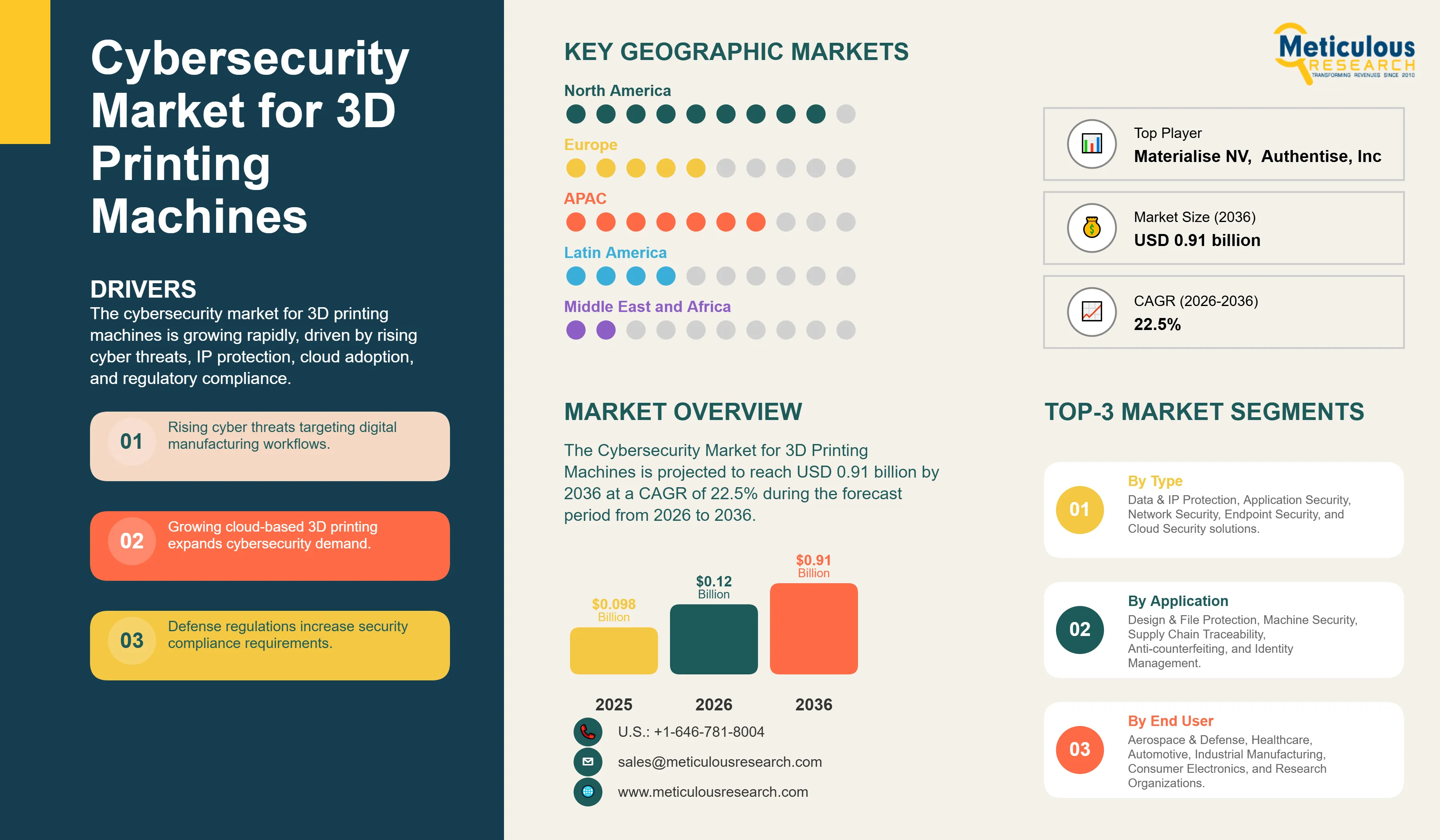
The Cybersecurity Market for 3D Printing Machines is projected to reach USD 0.91 billion by 2036 from an estimated USD 0.12 billion in 2026, at a CAGR of 22.5% during the forecast period from 2026 to 2036.
- Published
- Jul 2026
- Pages
- 180
- Format
- PDF + Excel
- Report ID
- MR-2106
- Base year
- 2025
- 2026 · ESTIMATED
- $120.0M
- 2036
- $910.0M
- CAGR 2026–2036
- 22.5%
2025 baseline · 2026–2036 forecast at 22.5% CAGR · hover a bar for the value
Key highlights
The global cybersecurity market for 3D printing machines is projected to reach USD 0.91 billion by 2036, growing at a CAGR of 22.5% during 2026 to 2036.
The rising risk and cost of cyberattacks on the digital thread, from design files to the printer, are pushing manufacturers to secure their additive workflows.
Growing use of cloud-based and distributed 3D printing is widening the attack surface and lifting demand for protection.
Rising regulatory and defense requirements, including NIST frameworks and CMMC, are making security a condition of doing business in additive manufacturing.
The solutions segment holds the largest market share in 2026, while services are expected to grow the fastest through 2036.
The data & IP protection segment holds the largest share in 2026, while cloud security is expected to grow the fastest.
The on-premise deployment segment holds the largest share in 2026, while cloud deployment is expected to grow the fastest.
The large enterprises segment holds the largest share in 2026, while small and mid-sized enterprises are expected to grow the fastest.
The design & file protection application holds the largest share in 2026, while supply chain traceability and anti-counterfeiting is expected to grow the fastest.
The aerospace & defense end user holds the largest share in 2026, while healthcare is expected to grow the fastest.
North America accounts for the largest share of the global market in 2026, supported by its large aerospace, defense, and manufacturing base.
Asia-Pacific is expected to witness the fastest growth over the forecast period, driven by expanding manufacturing and 3D printing adoption.
Report summary
| Particulars | Details |
|---|---|
| Forecast Period | 2026 to 2036 |
| Base Year | 2025 |
| Estimated Year | 2026 |
| CAGR (Value) | 22.5% |
| Format | PDF, Excel & Cloud Portal · 180 pages |
| Market Size (Value) in 2026 | USD 0.12 Billion |
| Market Size (Value) in 2036 | USD 0.91 Billion |
| Segments Covered | By Offering · - Solutions · - Services (Consulting, Integration & Deployment, Support) · By Security Type · - Data & IP Protection, Application Security, Network · Security, Endpoint Security, Cloud Security · By Deployment Mode · - On-premise, Cloud · By Organization Size · - Large Enterprises, Small & Medium Enterprises (SMEs) · By Application · - Design & File Protection, Machine & In-process Security, · Supply Chain Traceability & Anti-counterfeiting, IAM · By End User · - Aerospace & Defense, Healthcare, Automotive, Industrial & · Manufacturing, Consumer Electronics, Education & Research, Others |
| Countries Covered | North America (U.S., Canada), Europe (Germany, U.K., France, Italy, Spain, and Rest of Europe), Asia-Pacific (China, Japan, India, South Korea, Australia, and Rest of Asia-Pacific), Latin America (Brazil, Mexico, and Rest of Latin America), and the Middle East & Africa (Israel, Saudi Arabia, UAE, and Rest of Middle East & Africa) |
| Key Companies | Materialise NV (Belgium), Stratasys Ltd. (Israel/U.S.), Authentise, Inc. (U.S.), Assembrix Ltd. (Israel), 3YOURMIND GmbH (Germany), Create it REAL A/S (Denmark), WIBU-SYSTEMS AG (Germany), Fortra, LLC (Vera) (U.S.), Cubichain Technologies Ltd. (U.K.), and DEFEND3D (South Africa). |
Report overview
Segments covered: offering, security type, deployment mode, organization size, application, end user. Regions: North America, Europe, Asia-Pacific, Latin America, Middle East & Africa.
3D printing, also called additive manufacturing, builds a physical object layer by layer from a digital design file. Because the whole process runs on digital files and connected machines, it is open to the same kinds of cyber risks that affect any computer system, plus a few of its own. A stolen design file can be copied or counterfeited, a tampered file can produce a weak or defective part, and an unauthorized print can send a flawed component into a car, an aircraft, or a medical device. Cybersecurity for 3D printing machines covers the software and services used to protect this digital thread, from the design and the build file to the printer itself and the finished part.
The need for this protection has grown as 3D printing has moved from making prototypes to making real, load-bearing parts. When a printed component ends up in a jet engine or a spinal implant, the cost of a hacked or altered file is no longer a lost prototype but a safety risk. This has turned what used to be a nice-to-have into a requirement, especially in aerospace, defense, and healthcare, where the value of the parts and the sensitivity of the data are both high. Companies now use encryption, access controls, secure file transfer, and traceability tools to keep their designs and machines safe.
Two shifts in how 3D printing is done are driving demand. The first is the move to the cloud and to distributed manufacturing, where a design made in one place is printed in another, sometimes by an outside supplier on the other side of the world. This spreads valuable data across many hands and machines, and every handoff is a chance for something to go wrong. The second is the rise of clear rules and regulations. Government and defense buyers now expect suppliers to meet cybersecurity standards such as the NIST framework and CMMC before they can win contracts, which pushes the whole supply chain to invest in protection.
The market is still niche, which is part of why it is growing rapidly. Materialise has built security into its cloud CO-AM platform through its Identify3D suite, Nano Dimension has folded Markforged into a broader secure additive portfolio, and specialists such as Assembrix, Authentise, WIBU-SYSTEMS, and Create it REAL protect files and machines across the workflow. With attacks becoming more common, cloud and distributed printing spreading, and rules tightening, the cybersecurity market for 3D printing machines is set for strong growth over the coming decade.
Report infographic
Market dynamics
4 factors across 2 forcesRising Risk and Cost of Cyberattacks on Digital Manufacturing
The key driver of the market is the growing threat of cyberattacks aimed at digital manufacturing. Because 3D printing depends entirely on digital design files and connected machines, it is exposed to theft of intellectual property, tampering with build files, and unauthorized production. Researchers have shown that attackers can steal proprietary designs or subtly weaken a part by altering its file, and even bypass encryption through side-channel attacks that read a printer's behavior.
What raises the stakes is where these parts end up. As additive manufacturing shifts from prototypes to functional components used in aircraft, vehicles, and medical devices, a compromised file can create a genuine safety hazard rather than a spoiled test print. A weakened bracket or implant that looks correct but fails under load is exactly the kind of risk that companies cannot afford, so protecting the design and the print process has become essential.
This combination of a wide attack surface and high-value, safety-critical output gives manufacturers a strong reason to invest in security. As attacks on manufacturers grow more frequent and more sophisticated, the demand for tools that protect the digital thread rises with them, which places cyber risk at the center of the market's growth.
Growing Adoption of Cloud-Based and Distributed 3D Printing
A second major driver is the shift toward cloud-based and distributed additive manufacturing, which spreads valuable data far beyond a single factory. Instead of designing and printing in one place, companies now design in one location and print in another, often using outside suppliers closer to the customer. This model brings real benefits in speed and flexibility, but it also multiplies the points where a design file can be intercepted, copied, or altered.
Cloud platforms sit at the heart of this shift. Tools such as Materialise's CO-AM give manufacturers cloud-based access to plan, manage, and run their printing across many sites, and moving to the cloud makes protecting data in transit and at rest a central concern. Every file that travels between a designer, a platform, and a remote printer needs to stay confidential and unchanged, which is exactly what cybersecurity tools for additive manufacturing are built to ensure.
As more companies adopt cloud and distributed printing to build resilience against supply chain shocks, the need to secure that wider, more connected environment grows with it. This expansion of the attack surface is a durable driver, since the same features that make distributed manufacturing attractive also make security a requirement rather than an option.
Rising Regulatory and Defense Requirements Mandating Security
A third driver is the tightening of rules around manufacturing security, especially for government and defense work. Buyers in these sectors increasingly require their suppliers to meet defined cybersecurity standards before they can win or keep contracts, which turns security from a choice into a cost of entry.
The frameworks are becoming well established. In the United States, the NIST Cybersecurity Framework, NIST guidance on industrial control systems, and the Cybersecurity Maturity Model Certification set expectations that reach any contractor handling sensitive manufacturing data, including additive manufacturing. Standards bodies are adding to this, with ASTM International developing a dedicated guide for additive manufacturing security aimed at protecting part integrity, provenance across the production chain, and technical data. Export rules such as ITAR add further pressure to keep defense-related designs tightly controlled.
Because these requirements flow down through the supply chain, even small suppliers that want defense or aerospace work must invest in security to qualify. As standards mature and spread into more industries, regulatory and defense requirements are set to remain a dependable engine of demand for cybersecurity in 3D printing.
Table of contents
14 chapters · 120 sections · 180 pages · click to expandSegmental analysis
| Segment | Largest share (2026) | Fastest growth (2026–2036) |
|---|---|---|
| By Offering | Solutions | Services |
| By Security Type | Data & IP Protection | Cloud security |
| By Deployment Mode | On-premise | Cloud deployment |
| By Organization Size | Large Enterprises | Small and mid-sized enterprises |
| By Application | Design & File Protection | Supply chain traceability and anti-counterfeiting |
| By End User | Aerospace & Defense | Healthcare |
By Offering
- Solutions Lead the Market in 2026
- Solutions hold the largest share in 2026, at roughly 68%.
- The core software, covering encryption, access control, secure file transfer, and traceability, is what companies buy first to protect their designs and machines, so it makes up the bulk of spending.
- Services are expected to grow the fastest through 2036.
- As more companies adopt these tools, demand rises for the consulting, integration, and managed security services needed to fit protection into existing manufacturing systems and to run it day to day, which lifts the services segment.
By Security Type
- Data & IP Protection Leads the Market in 2026
- Data and IP protection holds the largest share in 2026, at about 34%.
- The design file is the crown jewel of additive manufacturing, so encrypting it, controlling who can use it, and tracing where it goes is the first and most important job of security in this field.
- Cloud security is expected to grow at the fastest CAGR through 2036.
- As printing moves onto cloud platforms and across distributed sites, protecting data as it travels and rests in the cloud is becoming a rising priority, which is driving quick growth in this segment.
By Deployment Mode
- On-premise Leads the Market in 2026
- On-premise holds the largest share in 2026, at roughly 52%.
- Aerospace, defense, and other sensitive users often keep their designs and machines in tightly controlled, sometimes air-gapped, environments, so on-premise deployment remains the default where secrecy matters most.
- Cloud deployment is expected to grow the fastest.
- As cloud-based additive platforms spread and as smaller companies look for security they can run without heavy infrastructure, cloud deployment is gaining ground quickly, even as on-premise stays strong in the most sensitive settings.
By Organization Size
- Large Enterprises Lead the Market in 2026
- Large enterprises hold the largest share in 2026, at close to 72%.
- The aerospace, defense, and automotive companies that lead industrial 3D printing have the most valuable designs, the strictest requirements, and the budgets to invest in security, so they account for most of the spending.
- Small and mid-sized enterprises are expected to grow the fastest.
- As affordable, cloud-based security tools lower the cost and complexity of protection, smaller print shops and suppliers, many of which must meet customer security requirements, are adopting these tools at a rapid pace.
By Application
- Design & File Protection Leads the Market in 2026
- The cybersecurity market for 3D printing machines covers design and file protection, machine and in-process security, supply chain traceability and anti-counterfeiting, and identity and access management.
- Design and file protection holds the largest share in 2026, at about 38%.
- Keeping the design and build files confidential and unaltered is the central security task in additive manufacturing, so it draws the most investment.
- Supply chain traceability and anti-counterfeiting is expected to grow the fastest from 2026 to 2036.
- As distributed manufacturing spreads and parts are increasingly made by outside suppliers, the need to prove a part's origin and confirm it has not been altered or counterfeited is rising quickly, which is driving growth in this application.
By End User
- Aerospace & Defense Leads the Market in 2026
- The cybersecurity market for 3D printing machines covers aerospace and defense, healthcare, automotive, industrial and manufacturing, consumer electronics, education and research, and other users.
- Aerospace and defense holds the largest share in 2026, at close to 40%.
- This sector uses 3D printing for high-value, safety-critical parts, handles highly sensitive designs, and faces the strictest security rules, so it leads demand for protection by a wide margin.
- Healthcare is expected to grow at the fastest CAGR from 2026 to 2036.
- As hospitals and device makers expand their use of 3D printing for implants, surgical guides, and custom devices, often produced closer to the patient, the need to protect patient data and guarantee part integrity is rising quickly, which is lifting demand in this segment.
Geographic analysis
North America
Largest shareBy region, the global cybersecurity market for 3D printing machines is split across North America, Europe, Asia-Pacific, Latin America, and the Middle East & Africa. North America holds the largest share in 2026, at roughly 42%. North America's lead rests on its large aerospace, defense, and manufacturing base, early adoption of industrial 3D printing, and strict government and defense security requirements such as NIST frameworks and CMMC. The United States is the dominant national market, home to a deep base of additive manufacturing users and security providers, and to defense programs that treat additive manufacturing security as a priority. North America Leads the Market in 2026
Asia-Pacific
Fastest growthThe Asia-Pacific cybersecurity market for 3D printing machines is expected to record the fastest growth over the forecast period. Rapidly expanding manufacturing, rising adoption of 3D printing across China, Japan, South Korea, and India, and growing awareness of cyber risk are driving demand.
Europe
Europe remains an important market, supported by strong aerospace, automotive, and industrial sectors and by security-focused vendors such as Materialise, Siemens, WIBU-SYSTEMS, and EOS.
Competitive landscape
Leading companies in the global cybersecurity market for 3D printing machines have grown through acquisitions, new product launches, platform integration, and partnerships. Building security into cloud additive platforms, adding traceability and anti-counterfeiting features, and integrating protection across the digital thread have been the most common ways players strengthen their position.
- May 2026
Nano Dimension announced a definitive agreement to sell Markforged to Stratasys, further consolidating the industrial additive manufacturing market.
- January 2026
Creality launched the SPARKX i7 at CES 2026, an AI-enabled desktop 3D printer designed to simplify model creation, print monitoring, and the overall creator workflow.
- January 2026
Velo3D announced a Cooperative Research and Development Agreement (CRADA) with the U.S. Army DEVCOM Ground Vehicle Systems Center to develop, qualify, and validate additively manufactured parts for defense applications.
- September 2025
UltiMaker launched its Secure Line of defense-ready 3D printers, including the S6 Secure and S8 Secure, featuring air-gapped USB-only workflows, tamper-resistant firmware, and enhanced cybersecurity for high-security environments.
- Materialise NV · Belgium
- Stratasys Ltd. (Israel/U.S.)
- Authentise, Inc. (U.S.)
- Assembrix Ltd. · Israel
- 3YOURMIND GmbH · Germany
- Create it REAL A/S · Denmark
- WIBU-SYSTEMS AG · Germany
- Fortra, LLC (Vera) (U.S.)
- Cubichain Technologies Ltd. (U.K.)
- DEFEND3D · South Africa
Frequently asked questions
The global cybersecurity market for 3D printing machines size is estimated at USD 0.12 billion in 2026.
Cite this report
Meticulous Research. (2026). Cybersecurity Market for 3D Printing Machines - Global Opportunity Analysis and Industry Forecast (2026-2036) (Report No. MR-2106). Meticulous Market Research Pvt. Ltd. https://www.meticulousresearch.com/product/cybersecurity-market-for-3d-printing-machines-6789