
Clinical Laboratory Services Market (2026-2036)
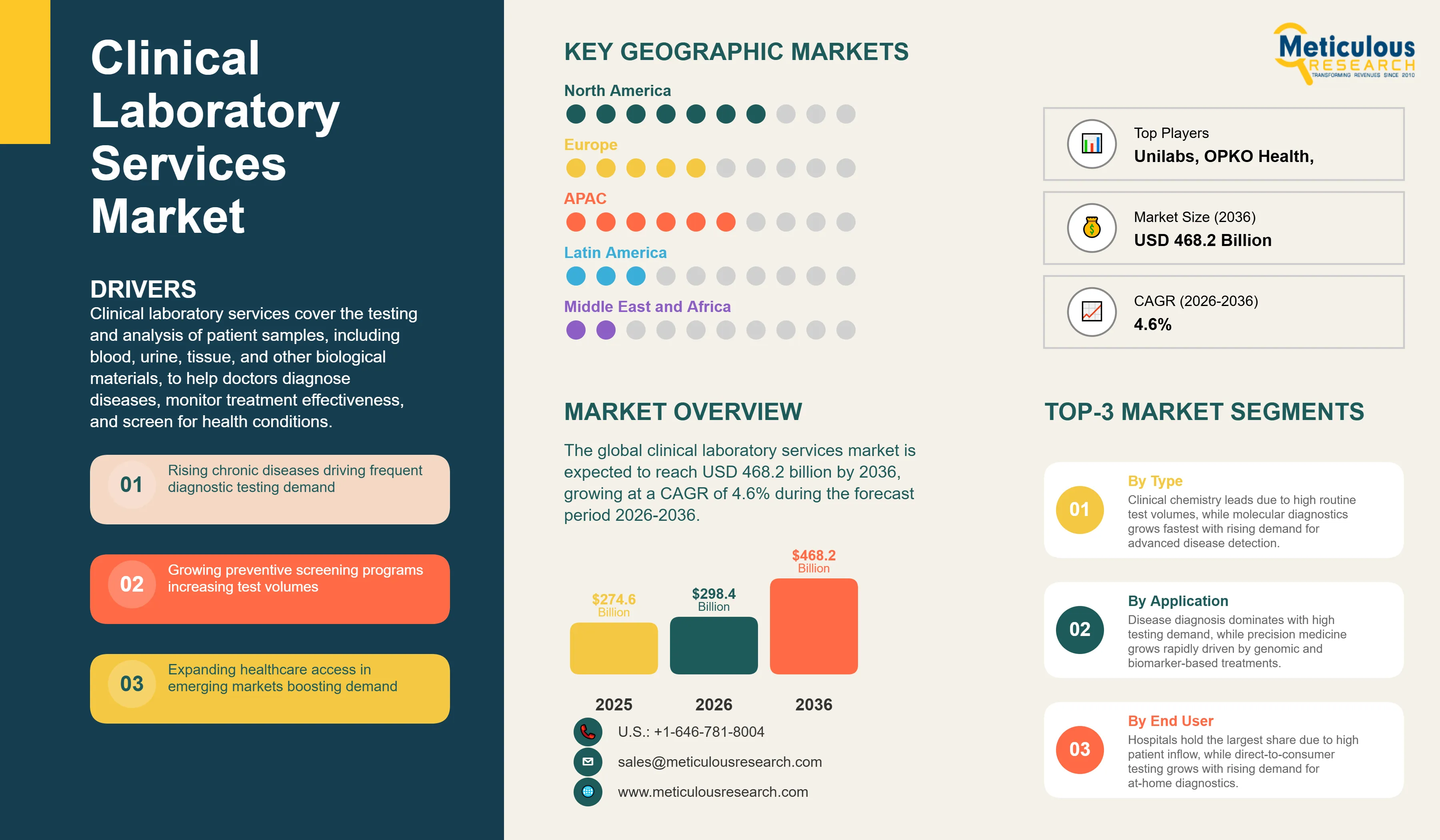
The global clinical laboratory services market was valued at USD 274.6 billion in 2025. This market is expected to reach USD 468.2 billion by 2036 from an estimated USD 298.4 billion in 2026, growing at a CAGR of 4.6% during the forecast period 2026-2036.
- Published
- Apr 2026
- Pages
- 290
- Format
- PDF + Excel
- Report ID
- MRHC - 1041940
- Base year
- 2025
- 2025 · BASELINE
- $274.6B
- 2036
- $468.2B
- CAGR 2026–2036
- 4.6%
2025 baseline · 2026–2036 forecast at 4.6% CAGR · hover a bar for the value
Key highlights
The global clinical laboratory services market is projected to reach USD 468.2 billion by 2036.
The market is expected to grow at a CAGR of 4.6% during the forecast period 2026-2036.
The global clinical laboratory services market was valued at USD 274.6 billion in 2025 and is estimated to reach USD 298.4 billion in 2026.
North America is expected to dominate the global clinical laboratory services market with the largest market share in 2026, while Asia-Pacific is projected to register the highest CAGR during the forecast period.
By test type, the clinical chemistry tests segment is expected to hold the largest share of the market in 2026, while the molecular diagnostics segment is projected to register the highest CAGR during the forecast period.
By service provider, the hospital-based laboratories segment is expected to hold the largest share in 2026, while the independent and reference laboratories segment is projected to register the highest CAGR during the forecast period.
By application, the disease diagnosis segment is expected to hold the largest share in 2026, while the personalized and precision medicine segment is projected to register the highest CAGR during the forecast period.
By end user, the hospitals segment is expected to hold the largest share in 2026, while the patients (direct-to-consumer testing) segment is projected to register the highest CAGR during the forecast period.
By mode of testing, the centralized laboratory testing segment is expected to hold the largest share in 2026, while the at-home testing segment is projected to register the highest CAGR during the forecast period.
By technology type, the automated testing segment is expected to hold the largest share in 2026, while the AI-enabled and digital diagnostics segment is projected to register the highest CAGR during the forecast period.
Report summary
| Particulars | Details |
|---|---|
| Market Size by 2036 | USD 468.2 Billion |
| Market Size in 2026 | USD 298.4 Billion |
| Market Size in 2025 | USD 274.6 Billion |
| Revenue Growth Rate (2026-2036) | CAGR of 4.6% |
| Format | PDF, Excel & Cloud Portal · 290 pages |
| Dominating Test Type | Clinical Chemistry Tests |
| Fastest Growing Test Type | Molecular Diagnostics |
| Dominating Service Provider | Hospital-Based Laboratories |
| Fastest Growing Service Provider | Independent and Reference Laboratories |
| Dominating Application | Disease Diagnosis |
| Fastest Growing Application | Personalized and Precision Medicine |
| Dominating End User | Hospitals |
| Fastest Growing End User | Patients (Direct-to-Consumer Testing) |
| Dominating Mode of Testing | Centralized Laboratory Testing |
| Fastest Growing Mode of Testing | At-Home Testing |
| Dominating Technology Type | Automated Testing |
| Fastest Growing Technology Type | AI-Enabled and Digital Diagnostics |
| Dominating Geography | North America |
| Fastest Growing Geography | Asia-Pacific |
| Base Year | 2025 |
| Forecast Period | 2026 to 2036 |
Report overview
Segments covered: test type, service provider, application, end user-.
Clinical laboratory services cover the testing and analysis of patient samples, including blood, urine, tissue, and other biological materials, to help doctors diagnose diseases, monitor treatment effectiveness, and screen for health conditions. These services are delivered through hospital labs, large independent diagnostic chains, physician office labs, and increasingly through at-home testing kits. Laboratory test results inform an estimated 70% of all clinical decisions, making this one of the most essential and high-volume components of the global healthcare system.
The market is growing because chronic diseases including diabetes, cardiovascular conditions, and cancer are increasing globally, each requiring regular laboratory monitoring. Rising awareness of preventive health screening and the growth of annual health checkup programs are generating higher test volumes. Government health programs in emerging markets are significantly expanding access to diagnostic services for previously underserved populations. The post-COVID period has also reinforced the critical role of diagnostics in public health management, driving sustained investment in laboratory capacity globally.
Two significant opportunities are shaping the market's next phase. Automation and AI are transforming laboratory workflows by reducing manual processing time, improving accuracy, and enabling labs to handle far higher test volumes without proportional staffing increases. Simultaneously, the rapid expansion of genomic and molecular diagnostics for cancer detection, infectious disease identification, and precision medicine is creating a high-growth, high-value segment that is broadening the total addressable market well beyond traditional biochemistry and blood count testing.
Report infographic
Market dynamics
7 factors across 3 forcesRising Prevalence of Chronic and Infectious Diseases
Chronic diseases including diabetes, cardiovascular disease, chronic kidney disease, and cancer require ongoing laboratory monitoring as essential components of patient management. The global diabetes population alone exceeds 530 million people, each requiring regular blood glucose monitoring, HbA1c testing, and kidney and cholesterol panels. Cancer incidence is growing globally, and each new cancer patient generates significant laboratory testing demand for initial diagnosis, treatment monitoring, and follow-up surveillance. The growing burden of chronic disease is therefore creating a structurally growing demand for laboratory services that increases proportionally with patient populations and extends over multi-year or lifetime treatment journeys rather than requiring only single-episode testing.
Expansion of Preventive Healthcare and Screening Programs
Government health agencies and private payers are increasingly recognizing that investing in preventive screening programs reduces the long-term cost of treating advanced disease. National cancer screening programs for colorectal, cervical, and breast cancer across developed markets generate very large volumes of laboratory tests annually, and the expansion of these programs to additional cancer types and to broader population age groups is growing test volumes progressively. Annual health checkup programs, employer wellness programs, and the growing consumer culture of proactive health monitoring are further expanding the population of people undergoing routine laboratory testing beyond the traditional patient-with-symptoms customer base.
Table of contents
14 chapters · 178 sections · 290 pages · click to expandSegmental analysis
| Segment | Largest share (2026) | Fastest growth (2026–2036) |
|---|---|---|
| By Test Type | Clinical Chemistry Tests | Molecular diagnostics |
| By Service Provider | Hospital-Based Laboratories | Independent and reference laboratories |
| By Application | Disease Diagnosis | Personalized and precision medicine |
| By End User | Hospitals | Patients (direct-to-consumer testing) |
| By Mode of Testing | Centralized Laboratory Testing | At-home testing |
By Test Type
- Clinical Chemistry Tests to Dominate
- The clinical chemistry tests segment is expected to account for the largest share of the global clinical laboratory services market.
- Clinical chemistry testing, covering metabolic panels, lipid profiles, liver function tests, kidney function markers, and blood glucose, is by far the highest-volume test category because virtually every clinical encounter involving a blood test includes at least one chemistry panel.
- The extremely high test frequency, driven by chronic disease monitoring and routine annual health checkups, makes this the largest segment by total test volumes and revenue.
- However, the molecular diagnostics segment is projected to register the highest CAGR during the forecast period.
- The proven value of molecular methods for infectious disease detection, oncology profiling, and precision medicine applications, combined with continuing reductions in the cost of molecular testing platforms and expanding clinical guidelines that recommend molecular testing for an increasing range of conditions, is driving double-digit growth in molecular diagnostics volumes across both developed and emerging markets.
By Service Provider
- Hospital-Based Laboratories to Hold the Largest Share
- The global market for clinical laboratory services is segmented into hospital-based laboratories, independent and reference laboratories, physician office laboratories, and public health laboratories.
- The hospital-based laboratories segment is expected to account for the largest share of the global clinical laboratory services market.
- Hospital labs serve the largest concentration of high-acuity patients requiring immediate test results for clinical decision-making, covering emergency, inpatient, and outpatient testing within the hospital system.
- The combination of high test volumes per facility and the essential role of on-site lab services for urgent clinical needs makes hospital-based labs the largest segment by revenue.
- However, the independent and reference laboratories segment is projected to register the highest CAGR during the forecast period.
- Large independent lab networks including Quest, Labcorp, Eurofins, and their equivalents in other markets are capturing an increasing share of routine outpatient and specialty testing as they offer lower costs through automation and scale, broader test menus including rare and specialized assays that most hospital labs cannot economically offer, and faster turnaround for many non-urgent tests through optimized logistics and high-capacity processing facilities.
By Application
- Disease Diagnosis to Hold the Largest Share
- The global market for clinical laboratory services is segmented into disease diagnosis, preventive screening, drug development and clinical trials, personalized and precision medicine, and other applications.
- The disease diagnosis segment is expected to account for the largest share of the global clinical laboratory services market.
- Diagnosing infectious and chronic diseases is the most common and highest-volume reason patients undergo laboratory testing globally.
- From confirming a bacterial infection to diagnosing diabetes or detecting cancer, disease diagnosis drives the majority of total test volumes and represents the established core of the clinical laboratory business.
- However, the personalized and precision medicine segment is projected to register the highest CAGR during the forecast period.
- Genomic profiling for cancer treatment selection, pharmacogenomic testing for drug dosing optimization, and biomarker testing for targeted therapy eligibility are all growing rapidly as oncology and other specialties adopt individualized treatment approaches that depend on high-complexity laboratory tests.
- These tests command significantly higher per-test pricing than routine diagnostics, making precision medicine an increasingly important revenue growth driver for leading laboratory providers.
By End User
- Hospitals to Hold the Largest Share
- The hospitals segment is expected to account for the largest share of the global clinical laboratory services market.
- Hospitals are the single largest source of laboratory test orders globally, generating very high test volumes from inpatient, outpatient, and emergency patients who require comprehensive diagnostic work-ups as part of their clinical care.
- The combination of 24/7 testing requirements, high per-patient test intensity, and the large number of hospitals globally makes this the dominant end-user category by revenue.
- However, the patients (direct-to-consumer testing) segment is projected to register the highest CAGR during the forecast period.
- The COVID-19 pandemic normalized direct laboratory test ordering by consumers, and the growing availability of convenient at-home sample collection kits and digital results delivery platforms is sustaining consumer demand for testing outside the traditional physician-ordered model.
- Wellness monitoring, preventive screening, and sensitive health topics are driving consumers to bypass traditional healthcare channels for laboratory testing.
By Mode of Testing
- Centralized Laboratory Testing to Hold the Largest Share
- The centralized laboratory testing segment is expected to account for the largest share of the global clinical laboratory services market.
- Centralized labs in hospitals and large independent reference facilities process the vast majority of clinical test volumes, offering the highest analytical accuracy, the broadest test menus, and the most cost-efficient processing for large sample batches.
- The infrastructure investment in high-throughput analyzers, quality control systems, and skilled staff makes centralized testing the current standard for most diagnostic applications.
- However, the at-home testing segment is projected to register the highest CAGR during the forecast period.
- The combination of improved at-home sample collection technology, digital connectivity for result reporting, and growing consumer preference for convenient and private health monitoring is driving rapid growth in this newer channel from a smaller current base.
- Regulatory frameworks are progressively adapting to enable more test types to be performed using at-home sample collection, expanding the addressable market for this segment.
Geographic analysis
North America
Largest shareIn 2026, North America is expected to account for the largest share of the global clinical laboratory services market. The United States has the world's largest clinical laboratory industry, anchored by Quest Diagnostics and Labcorp which together process billions of tests annually from their networks of patient service centers, hospital laboratory management contracts, and reference testing facilities. The U.S. laboratory market benefits from high healthcare spending per capita, the CLIA regulatory framework that establishes quality standards and patient confidence, robust health insurance coverage that reimburses most standard diagnostic tests, and a large and growing chronic disease patient population that generates sustained high test volumes. The U.S. is also the most advanced market for molecular and genomic testing adoption, with Mayo Clinic Laboratories, ARUP Laboratories, and several specialty molecular diagnostics companies offering highly differentiated test menus that serve both domestic and international physician customers. Canada's universal healthcare system generates significant laboratory test volumes through provincial laboratory networks and contracted independent labs.
Asia-Pacific
Fastest growthHowever, the Asia-Pacific clinical laboratory services market is expected to grow at the fastest CAGR during the forecast period. The region combines the world's two most populous countries in China and India with rapidly growing middle classes that are increasing their healthcare utilization and awareness, governments investing in healthcare infrastructure expansion, and large and worsening chronic disease burdens that are driving demand for diagnostic services. India is one of the most dynamic laboratory services markets in the world, with major domestic chains including Dr. Lal PathLabs, Metropolis Healthcare, and SRL Diagnostics serving hundreds of millions of patients through hub-and-spoke collection networks across the country. China's laboratory services market is large and growing, driven by the country's enormous population, rapidly expanding urban healthcare infrastructure, and significant government investment in primary healthcare capacity. Japan, South Korea, and Australia have sophisticated laboratory industries with high per-capita test utilization and growing adoption of advanced molecular and genomic testing.
Europe
Europe is a large and mature clinical laboratory market with distinctive national characteristics shaped by the healthcare systems of individual countries. Germany, France, the UK, and Italy all have large laboratory service industries covering both public health system testing and privately funded diagnostics. The European market has seen significant consolidation, with Eurofins Scientific having built a pan-European and global reference laboratory network through over 900 acquisitions, and SYNLAB becoming one of Europe's leading clinical laboratory networks. The growth of specialist and molecular testing, the aging of European populations driving higher chronic disease management test volumes, and the ongoing expansion of cancer screening programs are all supporting sustained market growth.
Latin America
Latin America and the Middle East and Africa are growing markets with significant investment in healthcare infrastructure and diagnostic services capacity building underway.
Competitive landscape
- Quest Diagnostics Incorporated (U.S.)
- Laboratory Corporation of America Holdings/Labcorp (U.S.)
- Sonic Healthcare Limited · Australia
- Eurofins Scientific SE · Luxembourg
- SYNLAB International GmbH · Germany
- BioReference Laboratories Inc. (U.S.)
- Mayo Clinic Laboratories (U.S.)
- ARUP Laboratories (U.S.)
- Unilabs · Sweden
- Cerba HealthCare · France
- Exact Sciences Corporation (U.S.)
- Fulgent Genetics Inc. (U.S.)
- OPKO Health Inc. (U.S.)
- Metropolis Healthcare Ltd. · India
- Dr. Lal PathLabs Limited · India
Frequently asked questions
The global clinical laboratory services market is expected to reach USD 468.2 billion by 2036 from an estimated USD 298.4 billion in 2026, at a CAGR of 4.6% during the forecast period 2026-2036.
Cite this report
Meticulous Research. (2026). Clinical Laboratory Services Market - Global Opportunity Analysis And Industry Forecasts (2026-2036) (Report No. MRHC - 1041940). Meticulous Market Research Pvt. Ltd. https://www.meticulousresearch.com/product/clinical-laboratory-services-market-6623