
Batch Ovens Market (2026-2036)
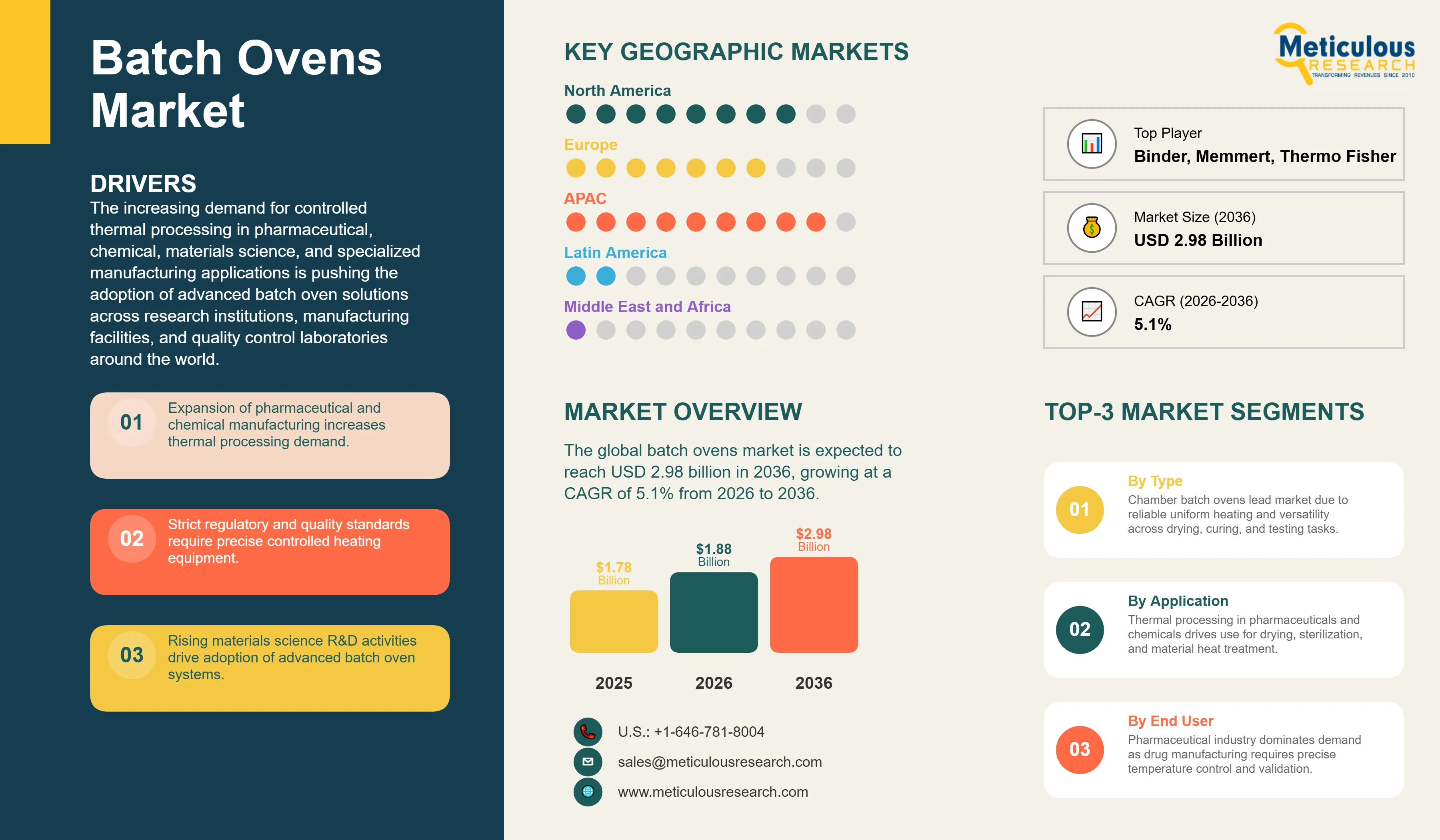
The global batch ovens market is valued at USD 1.78 billion in 2025. This market is expected to reach USD 2.98 billion in 2036 from USD 1.88 billion in 2026, growing at a CAGR of 5.1% from 2026 to 2036.
- Published
- Feb 2026
- Pages
- 205
- Format
- PDF + Excel
- Report ID
- MR-1772
- Base year
- 2025
- 2025 · BASELINE
- $1.78B
- 2036
- $2.98B
- CAGR 2026–2036
- 5.1%
2025 baseline · 2026–2036 forecast at 5.1% CAGR · hover a bar for the value
Key highlights
In terms of revenue, the global batch ovens market is valued at USD 1.88 billion in 2026 and is projected to reach USD 2.98 billion by 2036.
The market is expected to grow at a CAGR of 5.1% from 2026 to 2036.
Asia-Pacific dominates the global batch ovens market with the largest market share of 35-40% in 2026.
North America is expected to witness steady growth during the forecast period, driven by pharmaceutical and chemical manufacturing.
By type, the chamber batch ovens segment holds the largest market share of 40-45% in 2026.
By type, the vacuum batch ovens segment is expected to witness the fastest CAGR during the forecast period.
By end-user, the pharmaceutical segment contributes the highest market share in 2026.
By end-user, the materials science and research segment is expected to witness the fastest CAGR during the forecast period.
Report summary
| Particulars | Details |
|---|---|
| Market Size by 2036 | USD 2.98 Billion |
| Market Size in 2026 | USD 1.88 Billion |
| Market Size in 2025 | USD 1.78 Billion |
| Market Growth Rate (CAGR) 2026 to 2036 | 5.1% |
| Format | PDF, Excel & Cloud Portal · 205 pages |
| Dominating Region | Asia-Pacific |
| Fastest Growing Region | Asia-Pacific |
| Base Year | 2025 |
| Forecast Period | 2026 to 2036 |
| Segments Covered | Type, Technology, End-User, and Region |
| Regions Covered | North America, Europe, Asia-Pacific, Latin America, and Middle East & Africa |
Report overview
Segments covered: type, end‑user.
The increasing demand for controlled thermal processing in pharmaceutical, chemical, materials science, and specialized manufacturing applications is pushing the adoption of advanced batch oven solutions across research institutions, manufacturing facilities, and quality control laboratories around the world. The need for precise temperature control, uniform heat distribution, comprehensive process documentation, and compliance with stringent regulatory standards is driving investments in sophisticated batch oven technologies that can deliver reliable results and meet demanding application requirements.
The batch ovens are designed for processing discrete loads or batches of materials under controlled conditions. These systems are engineered to provide precise temperature control, uniform heat distribution, and comprehensive process monitoring, ensuring consistent results and meeting stringent regulatory requirements. Batch ovens are fundamental equipment in pharmaceutical manufacturing, chemical processing, materials science research, quality control laboratories, and specialized industrial applications where controlled thermal processing is critical.
The overall batch ovens market encompasses diverse types tailored to precise thermal processing needs across industries like manufacturing, pharmaceuticals, and laboratories.
Chamber batch ovens provide enclosed environments with uniform temperature control (typically ±1-5°C), making them versatile for general drying, curing, and baking applications.
Vacuum batch ovens operate under reduced pressure (down to 10^-3 mbar) to process sensitive materials without oxidation or contamination, ideal for electronics and pharmaceuticals.
Controlled atmosphere batch ovens maintain specific gas mixtures like nitrogen or argon, essential for metallurgy, annealing, or powder coating where inert conditions prevent reactions.
Programmable batch ovens support complex multi-ramp temperature profiles through digital controllers (up to 256 programs), enabling automated, repeatable cycles for R&D.
Benchtop batch ovens offer compact, plug-and-play solutions under 100L capacity with rapid heat-up times (30-60 minutes) for lab-scale testing and quality control.
Walk-in batch ovens deliver large-capacity processing (up to 50m³) with roll-in carts and filtered airflow, suited for high-volume production such as aerospace components.
The market is primarily driven by increasing pharmaceutical and chemical manufacturing, growing materials science research, technological advancements that improve control and monitoring, stringent regulatory compliance requirements, and the shift toward automation and Industry 4.0 integration. These systems find applications in pharmaceutical manufacturing, chemical processing, materials testing, heat treatment operations, sterilization, and specialized industrial applications where precise thermal processing is essential.
Shift Towards Energy-Efficient and Sustainable Thermal Processing: A significant trend in the batch ovens market is the growing preference for energy-efficient and sustainable thermal processing solutions. Regulatory agencies and environmental standards are pushing manufacturers to develop ovens that minimize energy consumption, reduce greenhouse gas emissions, and minimize environmental impact. Advanced insulation materials, efficient heating systems, and waste heat recovery systems can reduce energy consumption by 20-40% compared to conventional ovens, providing significant operational cost savings over equipment lifetime. Variable frequency drives enable operators to adjust heating intensity based on product characteristics and ambient conditions, further reducing energy consumption. Heat recovery systems capture waste heat for use in other processes or facility heating, improving overall energy efficiency.
The growing focus on sustainability is driving development of ovens powered by alternative energy sources including electric heating and renewable energy integration. Pharmaceutical companies and manufacturers are increasingly investing in energy-efficient oven solutions to meet environmental regulations and corporate sustainability commitments. The trend toward green manufacturing and carbon footprint reduction is driving investment in advanced batch oven technology. Life cycle assessment and environmental impact considerations are becoming increasingly important in equipment selection decisions. The development of ovens designed for extended service life and recyclability reflects the broader manufacturing shift toward sustainability.
Growing Demand for Customized and Multi-Functional Processing Solutions: Another important trend driving growth in the batch ovens market is the increasing demand for customized oven solutions tailored to specific product requirements and processing challenges. Manufacturers are no longer satisfied with one-size-fits-all equipment; instead, they seek ovens engineered for their unique thermal processing needs. This has led to the development of modular oven platforms that can be easily configured with different heating systems, control systems, and processing chambers to meet diverse application needs. Multi-functional systems that can perform drying, curing, sterilization, and heat treatment operations with flexible programming are gaining popularity as they reduce capital investment, save floor space, minimize product handling, and streamline manufacturing workflows.
Pharmaceutical companies are particularly driving this trend, requiring ovens that can handle diverse product types with precise temperature and humidity control. Chemical manufacturers need equipment that can process diverse chemical formulations while maintaining specific processing parameters. Materials science researchers require ovens capable of handling diverse material types and achieving specific processing conditions. The customization trend reflects the broader manufacturing shift toward flexibility, agility, and responsiveness to market demands. This trend is creating opportunities for batch oven manufacturers to develop innovative solutions and capture niche markets with higher margins.
Report infographic
Stringent Regulatory Compliance and Quality Assurance Requirements
Increasingly stringent regulatory compliance and quality assurance requirements are compelling manufacturers to adopt advanced batch oven technologies. Pharmaceutical manufacturing operates under strict Good Manufacturing Practice (GMP) regulations that mandate precise control over thermal processing parameters, comprehensive documentation, and equipment validation. The FDA and other regulatory agencies require manufacturers to demonstrate control over critical process parameters and maintain comprehensive audit trails. Environmental regulations limit emissions and energy consumption, pushing manufacturers toward more efficient oven designs.
Quality certifications including ISO 9001, ISO 14001, and industry-specific standards require manufacturers to implement robust quality control systems and continuous improvement processes. Advanced ovens equipped with monitoring and control systems enable manufacturers to meet these requirements while maintaining competitive production costs. The food and pharmaceutical industries particularly benefit from ovens with documented performance characteristics, validation capabilities, and traceability features that support regulatory compliance and product liability protection. The need to demonstrate process control and product safety drives investment in advanced oven technology with comprehensive monitoring and documentation capabilities.
Market dynamics
4 factors across 2 forcesIncreasing Pharmaceutical and Chemical Manufacturing
A key factor driving the growth of the batch ovens market is the increasing pharmaceutical and chemical manufacturing globally. The pharmaceutical industry continues to expand as healthcare spending increases and new drug development accelerates. Pharmaceutical manufacturers require advanced batch oven equipment for drying, sterilization, and heat treatment operations. The expansion of pharmaceutical manufacturing capacity globally, particularly in Asia-Pacific, is creating substantial demand for batch oven equipment. The trend toward contract manufacturing and outsourcing is further driving demand for manufacturing equipment including batch ovens.
The chemical industry is experiencing growth driven by demand for specialty chemicals, performance materials, and advanced chemical products. Chemical manufacturers require batch ovens for thermal processing, curing, and material development. The development of new chemical formulations and specialty products creates demand for flexible batch oven systems. The expansion of chemical manufacturing in emerging markets is creating significant demand for batch oven equipment. The trend toward process intensification and efficiency improvement drives investment in advanced batch oven technology.
Growing Materials Science Research and Development
The growing materials science research and development activities globally is driving demand for batch oven equipment. Universities, research institutions, and corporate research laboratories require batch ovens for materials characterization, heat treatment studies, and process development. The development of advanced materials including composites, ceramics, and specialty polymers requires sophisticated thermal processing equipment. The expansion of research and development activities in emerging markets is creating demand for laboratory and research-scale batch ovens.
The trend toward additive manufacturing and advanced materials processing creates demand for specialized batch ovens for sintering, curing, and heat treatment operations. The development of new materials for aerospace, automotive, and electronics applications requires extensive thermal processing research. The growth of nanotechnology and advanced materials research creates demand for specialized batch ovens with precise control capabilities. The expansion of university research programs and corporate research laboratories drives demand for batch oven equipment.
Table of contents
11 chapters · 113 sections · 205 pages · click to expandSegmental analysis
| Segment | Largest share (2026) | Fastest growth (2026–2036) |
|---|---|---|
| By Type | Chamber batch ovens | Vacuum Batch Ovens |
| By End-User | Pharmaceutical | Chemical and Materials Science |
By Type
- The chamber batch ovens segment commands the largest share of around 40-45% of the overall batch ovens market in 2026.
- Chamber batch ovens lead the market because they offer excellent processing performance for diverse applications, have proven and reliable designs, provide cost-effective solutions for many applications, and enable consistent product quality.
- These systems provide enclosed processing environments with precise temperature control, making them ideal for general thermal processing applications.
- This proven technology makes chamber batch ovens ideal for pharmaceutical, chemical, and materials processing applications where reliability and consistency are critical.
- Vacuum Batch Ovens: The Fastest Growing Segment
- While chamber batch ovens command the largest market share, vacuum batch ovens are expected to witness the fastest CAGR during the forecast period.
- Vacuum batch ovens are gaining rapid adoption due to their superior performance in applications requiring processing of sensitive materials, their ability to prevent oxidation and contamination, and their improved product quality compared to conventional ovens.
- These systems operate under reduced pressure conditions, enabling processing without oxidation or unwanted chemical reactions.
- Vacuum batch ovens are particularly valuable for pharmaceutical applications requiring sensitive material handling and for materials science applications requiring controlled processing environments.
By End-User
- The pharmaceutical segment holds the largest share of approximately 45-50% of the batch ovens market in 2026.
- The largest share of this end user segment is mainly due to its critical importance of batch ovens in pharmaceutical manufacturing.
- Pharmaceutical manufacturers use batch ovens extensively for drying active pharmaceutical ingredients, sterilizing products, and conducting heat treatment operations.
- The pharmaceutical industry requires precise temperature control, comprehensive documentation, and regulatory compliance capabilities that batch ovens provide.
- The expansion of pharmaceutical manufacturing globally, particularly in Asia-Pacific, is creating significant demand for batch oven equipment.
- Chemical and Materials Science Segment: The Fastest Growing End-User
- While the pharmaceutical segment dominates by volume, the chemical and materials science segment is expected to witness the fastest CAGR during the forecast period.
- The growth of this segment is driven by expanding research and development activities, development of advanced materials, and growing demand for specialty chemicals.
- Chemical manufacturers require batch ovens for thermal processing, curing, and material development.
- Materials science researchers require batch ovens for heat treatment studies, materials characterization, and process development.
- The trend toward advanced materials development including composites, ceramics, and specialty polymers creates demand for specialized batch ovens.
- The expansion of research and development activities in emerging markets is creating demand for laboratory and research-scale batch ovens.
- The development of new materials for aerospace, automotive, and electronics applications requires extensive thermal processing research.
- The growth of nanotechnology and advanced materials research creates further demand for specialized batch ovens with precise control capabilities.
Geographic analysis
North America
The U.S. represents a significant market for batch oven equipment driven by the presence of major pharmaceutical manufacturers, chemical companies, and research institutions. The U.S. pharmaceutical industry is one of the world's largest, with significant production of pharmaceutical products that require advanced batch oven technology. The chemical industry in the U.S. produces a wide range of specialty chemicals and materials that require sophisticated thermal processing capabilities. The research and development sector in the U.S. is highly developed with major universities and corporate research laboratories requiring batch oven equipment. Stringent regulatory requirements, including FDA regulations for pharmaceuticals and EPA environmental regulations, drive manufacturers to invest in advanced equipment that ensures compliance and product quality. The U.S. market benefits from a well-developed infrastructure including equipment manufacturers, service providers, and technical expertise. The presence of major pharmaceutical and chemical companies creates demand for high-performance equipment. The trend toward automation and Industry 4.0 integration is further driving adoption of advanced batch oven systems with monitoring and control capabilities. U.S. Batch Ovens Market Size and Growth 2026 to 2036
Asia-Pacific
Largest shareAsia-Pacific holds the largest share of around 40-45% of the global batch ovens market in 2026. This is mainly attributed to the rapid industrialization, significant pharmaceutical and chemical manufacturing expansion, and growing research and development activities across the region. China has emerged as a major pharmaceutical and chemical manufacturer, creating enormous demand for batch oven equipment. The expansion of pharmaceutical manufacturing in China to serve the growing domestic market and export markets drives significant equipment demand. India's pharmaceutical industry is one of the world's largest, with major manufacturers of generic drugs and active pharmaceutical ingredients requiring advanced batch oven equipment. Vietnam, Indonesia, Thailand, and other Southeast Asian countries are experiencing rapid pharmaceutical and chemical manufacturing growth driven by foreign direct investment and rising healthcare spending. The growing research and development activities across Asia-Pacific are creating demand for laboratory and research-scale batch ovens. Government initiatives promoting pharmaceutical and chemical manufacturing development are attracting investment and facility development. Infrastructure improvements including reliable power supply, transportation networks, and industrial parks are making these regions increasingly attractive for manufacturing and research operations. Key companies operating in Asia-Pacific market are Thermo Fisher Scientific, Memmert GmbH, Binder GmbH, Sheldon Manufacturing, and others.
Europe
Europe also represents a significant market for batch ovens. The region has a well-established pharmaceutical industry with significant production of pharmaceutical products. Germany is a major manufacturing hub with strong engineering capabilities and a large industrial base. France, Italy, and other countries have significant pharmaceutical and chemical manufacturing industries. The stringent regulatory standards, including EU regulations on pharmaceutical manufacturing and environmental protection, drive manufacturers to invest in advanced equipment. The European market is characterized by a focus on quality, sustainability, and environmental responsibility. Manufacturers are increasingly adopting advanced batch oven technologies to improve efficiency and reduce environmental impact. The mature pharmaceutical industry and competitive chemical sector in the region drive investment in advanced equipment for product quality and efficiency. The research and development sector in Europe is highly developed with major universities and corporate research laboratories requiring batch oven equipment. The region benefits from a well-developed infrastructure including equipment manufacturers, service providers, and technical expertise. The presence of major multinational corporations with European pharmaceutical and chemical manufacturing operations drives demand for high-performance equipment. Investment in pharmaceutical and chemical manufacturing facility upgrades to improve competitiveness and sustainability continues to support market growth. The trend toward automation and Industry 4.0 integration is driving adoption of advanced batch oven systems with monitoring and control capabilities.
Frequently asked questions
The global batch ovens market is valued at USD 1.78 billion in 2025 and is expected to reach USD 1.88 billion in 2026.
Cite this report
Meticulous Research. (2026). Batch Ovens Market - Global Opportunity Analysis and Industry Forecast (2026-2036) (Report No. MR-1772). Meticulous Market Research Pvt. Ltd. https://www.meticulousresearch.com/product/batch-ovens-market-6455