
Autoimmune Disease Diagnostics Market (2025-2032)
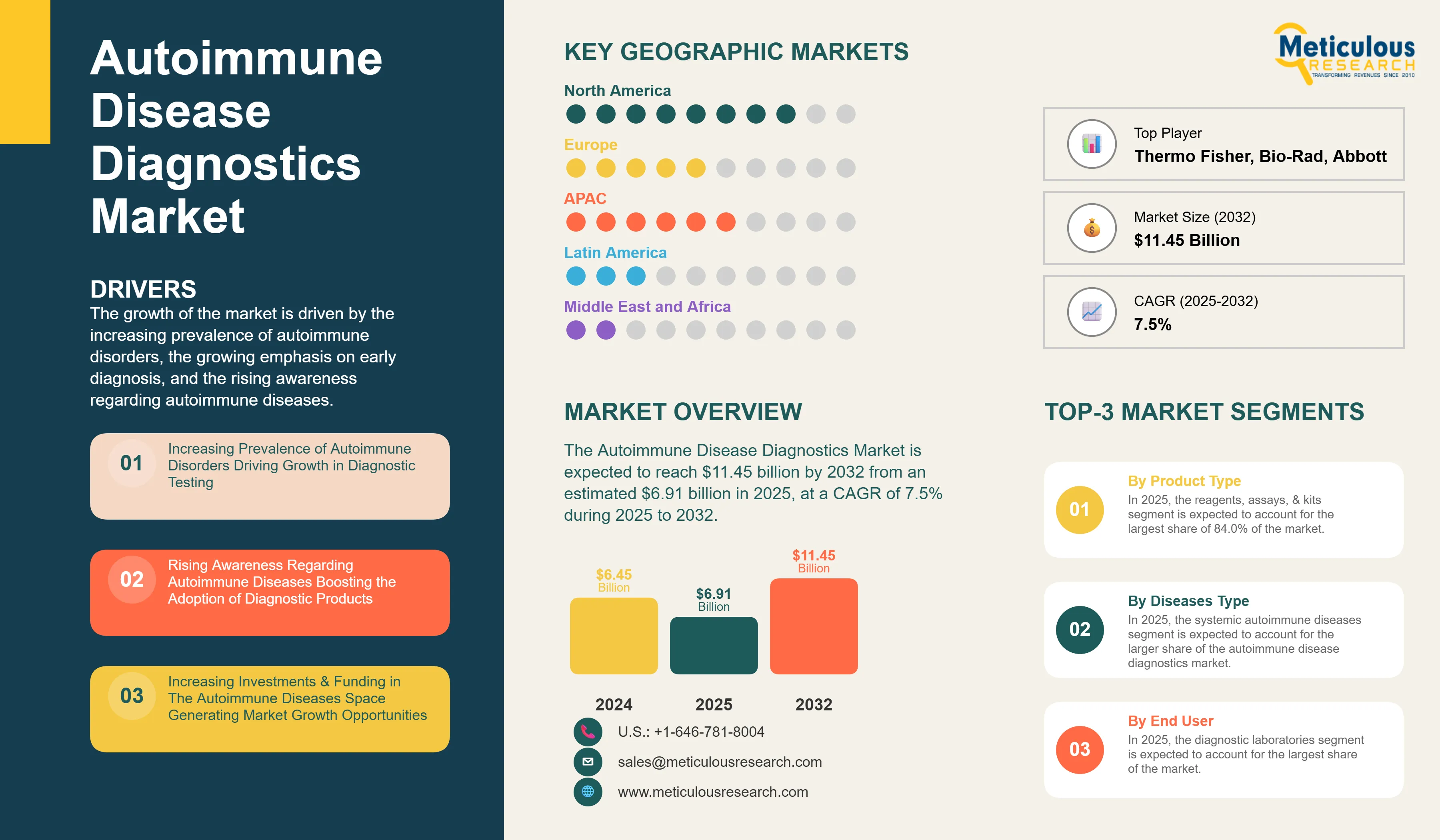
The Autoimmune Disease Diagnostics Market was valued at $6.45 billion in 2024. This market is expected to reach $11.45 billion by 2032 from an estimated $6.91 billion in 2025, at a CAGR of 7.5% during the forecast period from 2025 to 2032.
- Published
- Jun 2025
- Pages
- 255
- Format
- PDF + Excel
- Report ID
- MRHC - 104721
- Base year
- 2024
- 2024 · BASELINE
- $6.45B
- 2032
- $11.45B
- CAGR 2025–2032
- 7.5%
2024 baseline · 2025–2032 forecast at 7.5% CAGR · hover a bar for the value
Key highlights
By Product Type: In 2024, the Reagents, Assays, & Kits Segment is Expected to Dominate the Autoimmune Disease Diagnostics Market
By Test Type: In 2024, the Antinuclear Antibodies (ANA) Segment is Expected to Dominate the Autoimmune Disease Diagnostics Market
By Disease Type: In 2024, the Systemic Autoimmune Diseases Segment is Expected to Dominate the Autoimmune Disease Diagnostics Market
By End User: In 2024, the Diagnostic Laboratories Segment is Expected to Dominate the Autoimmune Disease Diagnostics Market
Report summary
| Particulars | Details |
|---|---|
| Number of Pages | 255 |
| Format | |
| Forecast Period | 2025–2032 |
| Base Year | 2024 |
| CAGR (Value) | 7.5% |
| Market Size (Value) | USD 11.45 Billion by 2032 |
| Segments Covered | By Product Type · Reagents, Assays, & Kits · Instruments · Software & Services · By Test Type · Antinuclear Antibodies (ANA) Test · Rheumatoid Factor Test · Immunoglobulins Test · Routine Blood Tests Test · C-reactive Protein (CRP) Test · Erythrocyte Sedimentation Rate (ESR) Test · Other Test Types · (Note: Other test types include (Anti-double stranded DNA, Extractable nuclear antigen, Anti-signal recognition particle tests, Ferritin, and Anti-cyclic Citrullinated Peptide (Anti-CCP) Antibodies) · By Disease Type · Systemic Autoimmune Diseases · Rheumatoid Arthritis · Psoriasis · Systemic Lupus Erythematosus · Multiple Sclerosis · Other Systemic Autoimmune Diseases · (Note: Other systemic autoimmune diseases include systemic scleroderma, dermatomyositis, Sjögren's syndrome, mixed connective tissue disease, Behçet syndrome, sarcoidosis, and myasthenia gravies, among others) · Organ-specific Autoimmune Diseases · Type-1 Diabetes · Celiac Diseases · Inflammatory Bowel Disease · Other Organ-Specific Diseases · (Note: Other organ-specific autoimmune diseases include Addison’s disease, Grave’s disease, Guillain-Barre syndrome, Hashimoto’s thyroiditis, and Sclerosing cholangitis, among others) · By End User · Hospitals & Clinics · Diagnostic Laboratories · Academic & Research Institutes |
| Countries Covered | North America (U.S. and Canada), Europe (Germany, France, U.K., Italy, Spain, and Rest of Europe), Asia-Pacific (China, Japan, India, and Rest of Asia-Pacific), Latin America, and the Middle East & Africa |
| Key Companies | Thermo Fisher Scientific Inc. (U.S.), Bio-Rad Laboratories, Inc. (U.S.), Beckman Coulter, Inc. (U.S.), Abbott Laboratories (U.S.), Becton, Dickinson, and Company (U.S.), PerkinElmer, Inc. (U.S.), F. Hoffmann-La Roche Ltd (Switzerland), Siemens Healthineers AG (Germany), Grifols, S.A. (Spain), and Creative Diagnostics (U.S.). |
Report overview
Segments covered: product type, reagent, assay, kit, instrument, software & service, test type, rheumatoid factor test, immunoglobulins test, routine blood tests test, other test type, disease type, systemic autoimmune disease, rheumatoid arthritis, psoriasis, systemic lupus erythematosus, multiple sclerosis, other systemic autoimmune disease, organ-specific autoimmune disease, type-1 diabete, celiac disease, inflammatory bowel disease, other organ-specific disease, end user, hospitals & clinic, diagnostic laboratory, academic & research institute. Regions: North America, Europe, Asia-Pacific.
The growth of the autoimmune disease diagnostics market is driven by the increasing prevalence of autoimmune disorders, the growing emphasis on early diagnosis, and the rising awareness regarding autoimmune diseases. However, difficulties in diagnosing autoimmune diseases restrain the growth of this market. Emerging economies and increasing investments & funding in the autoimmune diseases space are expected to generate growth opportunities for the players in this market. However, the unfavorable reimbursement scenario and high rate of delayed diagnosis or misdiagnosis are major challenges for market growth.
Report infographic
Market dynamics
3 factors across 3 forcesRising Awareness About Autoimmune Diseases
Stress, genetic mutations, unhealthy eating habits, and environmental factors are among the primary causes of autoimmune diseases. The high prevalence of these conditions worldwide has increased the demand for autoimmune disease diagnostics. For instance, the CDC's National Diabetes Statistics Report of 2020 indicates that approximately 1.4 million people in the U.S. have Type 1 diabetes, with this number projected to rise to 2.1 million by 2040.
Furthermore, growing awareness about the diagnosis and treatment of autoimmune diseases, driven by initiatives from various public and private organizations, has contributed to this demand. For example, the Autoimmune Association in the U.S. conducts events and campaigns every March to raise awareness, disseminate information, and enhance knowledge about autoimmune disorders.
Early diagnosis of autoimmune diseases is crucial for reducing disability, morbidity, and mortality, which is fueling the growth of the autoimmune disease diagnostics market.
Table of contents
12 chapters · 103 sections · 255 pages · click to expandSegmental analysis
| Segment | Largest share (2025) | Fastest growth (2025–2032) |
|---|---|---|
| By Product Type | Reagents, Assays, & Kits | — |
| By Test Type | Antinuclear Antibodies (ANA) | Antinuclear antibodies (ANA) |
| By Disease Type | Systemic Autoimmune Diseases | Systemic autoimmune diseases |
| By End User | Diagnostic Laboratories | Hospitals & clinics |
By Product Type
- The Reagents, Assays, & Kits Segment is Expected to Dominate the Autoimmune Disease Diagnostics Market
- The reagents, assays, & kits segment is expected to account for the largest share of 84.0% of the autoimmune disease diagnostics market.
- The large market share of this segment is attributed to factors such as the high diagnosis rate of autoimmune diseases in developed countries coupled with the recurring purchase of reagents and kits.
- Similarly, the growing availability of assays and kits, convenience & ease of use, cost-effectiveness, and product launches by the players operating in the market are the factors driving the growth of the segment at the highest CAGR of 7.4% during the forecast period of 2024 to 2031.
By Test Type
- The antinuclear antibodies (ANA) segment is expected to account for the largest share of the autoimmune disease diagnostics market.
- Antinuclear antibodies (ANA) tests detect autoantibodies in the blood that target healthy cells.
- These antibodies often appear well before the onset of symptoms, enabling the early diagnosis of autoimmune diseases.
- Early detection through ANA tests can significantly reduce morbidity and mortality associated with these conditions.
- Consequently, the high prevalence of autoimmune diseases and the critical need for early diagnosis are key factors driving the significant market share of this segment.
- Additionally, the antinuclear antibodies (ANA) segment is expected to register the highest CAGR of 8.3% during the forecast period.
- The advantages of the ANA test, including sensitivity, early detection of autoimmune disease, and the most preferred test for primary detection of autoimmune diseases, are the factors responsible for segment growth.
By Disease Type
- The systemic autoimmune diseases segment is expected to account for the larger share of the autoimmune disease diagnostics market.
- Systemic autoimmune diseases impact multiple organs or systems, in contrast to localized autoimmune diseases, which target a specific organ or region of the body.
- Some of the most prevalent autoimmune diseases are systemic, such as rheumatoid arthritis, multiple sclerosis, and systemic lupus erythematosus (SLE).
- For example, according to the World Health Organization, approximately 14 million people worldwide had rheumatoid arthritis as of 2021.
- The high prevalence of systemic autoimmune diseases is a key factor contributing to the significant share of this segment.
- Moreover, the systemic autoimmune diseases segment is expected to grow at the highest CAGR during the forecast period of 2024-2031.
- This growth is attributed to the growing prevalence of systemic autoimmune diseases and the growing availability of diagnostic tests for systemic autoimmune diseases.
By End User
- The diagnostic laboratories segment is expected to account for the largest share of the autoimmune disease diagnostics market.
- The large market share of this segment is attributed to the presence of skilled professionals, the capacity to process numerous samples efficiently, and the availability of well-equipped systems and instruments in diagnostics laboratories.
- Diagnostic labs are well equipped with a skilled workforce to conduct diagnostic testing.
- Additionally, these labs have instruments and systems required to carry out testing and can run multiple samples in a short amount of time.
- Therefore, patients and healthcare professionals prefer diagnostic labs, leading to a large share of the segment.
- However, the hospitals & clinics segment is slated to register the highest CAGR during the forecast period of 2024-2031.
- The growth of this segment is attributed to the growing adoption of point-of-care testing in hospitals, initiatives undertaken by the hospitals to expand diagnostic capabilities, and rising prevalence and awareness regarding autoimmune diseases coupled with hospitals & clinics being the first point of contact for patients.
Geographic analysis
North America
Largest shareIn 2024, North America is expected to account for the largest share of 39.6% of the global autoimmune disease diagnostics market. This large share of North America is attributed to the high prevalence of autoimmune diseases, technological advancements in diagnostics, the presence of key players, and high healthcare expenditure in the region.
Asia-Pacific
Fastest growthHowever, Asia-Pacific is slated to register the highest growth rate of 9.7% in the autoimmune disease diagnostics market during the forecast period. The high market growth in the Asia-Pacific region is attributed to the increasing prevalence and incidence of celiac disease and rheumatoid arthritis, unhealthy lifestyles, government initiatives addressing autoimmune diseases, and rising expenditure on autoimmune disease research. Autoimmune diseases are becoming more prevalent in the Asia-Pacific region. For example, psoriasis is one of the most common autoimmune skin conditions globally. According to the Global Psoriasis Atlas, around 3.59 million people in India have psoriasis, a number that is expected to rise.
Competitive landscape
- June 2023
EUROIMMUN Medizinische Labordiagnostika AG (Germany) launched a new automated indirect immunofluorescence test (IIFT) system, ‘UNIQO 160’. This system is used for the diagnosis of autoimmune diseases.
- May 2022
Thermo Fisher Scientific, Inc. (U.S.) launched an EliA-based instrument named Phadia 2500+. This system diagnoses autoimmune diseases, including connective tissue disease, antiphospholipid syndrome, celiac disease, rheumatoid arthritis, autoimmune liver disease, and autoimmune thyroid disease.
- December 2021
Grifols, S.A. (Spain) received its first European Union (EU) Technical Documentation Assessment and Quality Management System certificates under the In Vitro Diagnostics Medical Devices Regulation (IVDR) from EU-designated notified bodies under the new regulation. The company has received IVDR certifications for several products for immunohematology blood typing and detection of anti-erythrocyte antibodies, such as DG Gel cards, antisera, reagent red blood cells and ID HPA XT test, a human platelet antigen (HPA) genotyping assay.
- Thermo Fisher Scientific Inc. (U.S.)
- Bio-Rad Laboratories, Inc. (U.S.)
- Beckman Coulter, Inc. (U.S.)
- Abbott Laboratories (U.S.)
- Becton
- Dickinson, Company (U.S.)
- PerkinElmer, Inc. (U.S.)
- F. Hoffmann-La Roche Ltd · Switzerland
- Siemens Healthineers AG · Germany
- Grifols, S.A. · Spain
- Creative Diagnostics (U.S.)
Frequently asked questions
The Autoimmune Disease Diagnostics Market refers to the industry focused on developing, manufacturing, and providing diagnostic tools and tests used to detect and diagnose autoimmune diseases.
Cite this report
Meticulous Research. (2025). Autoimmune Disease Diagnostics Market - Global Opportunity Analysis and Industry Forecast (2025-2032) (Report No. MRHC - 104721). Meticulous Market Research Pvt. Ltd. https://www.meticulousresearch.com/product/autoimmune-disease-diagnostics-market-5405