Attack Surface Management Market (2026-2036)
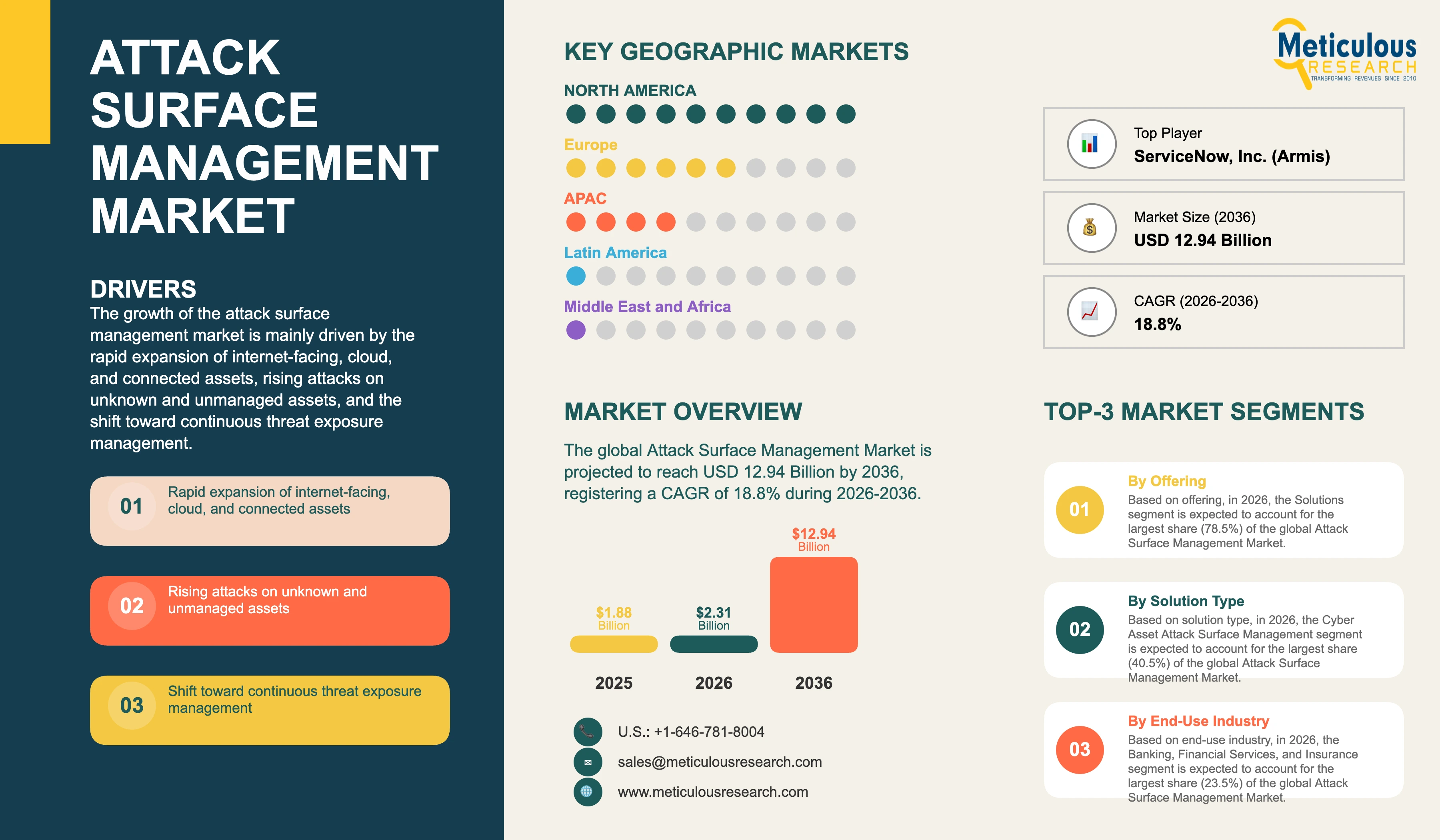
The global attack surface management market was valued at USD 1.88 billion in 2025. This market is expected to reach USD 12.94 billion by 2036 from an estimated USD 2.31 billion in 2026, registering a CAGR of 18.8% during the forecast period (2026-2036).
- Published
- Nov 2026
- Pages
- 320
- Format
- PDF + Excel
- Report ID
- MRICT - 1042500
- Base year
- 2025
- 2025 · BASELINE
- $1.88B
- 2036
- $12.94B
- CAGR 2026–2036
- 18.8%
2025 baseline · 2026–2036 forecast at 18.8% CAGR · hover a bar for the value
Key highlights
ServiceNow completed its acquisition of cyber exposure management company Armis for about USD 7.75 billion in April 2026, adding real-time visibility across IT, operational technology, IoT, medical devices, code, and cloud assets; Armis tracks nearly 7 billion devices and is used by nine of the Fortune 10.
Axonius, which created the cyber asset attack surface management (CAASM) category, surpassed USD 200 million in annual recurring revenue in May 2026, doubling ARR in two years, with nearly 1,000 customers including more than 90 U.S. federal agencies.
Arctic Wolf acquired exposure assessment platform Sevco Security in February 2026, and Tenable acquired Apex Security in 2025 to extend its exposure management platform to the AI attack surface.
Censys raised USD 70 million in March 2026, including USD 40 million in equity led by Morgan Stanley Expansion Capital, to expand its internet intelligence and external attack surface management platform, which is used by more than half of the Fortune 500.
Tenable launched Tenable One AI Exposure in January 2026 to bring AI usage, SaaS platforms, APIs, and agents into its exposure management platform, while Axonius launched AI-powered remediation and cyber-physical asset coverage in April 2026.
The U.S. Cybersecurity and Infrastructure Security Agency's Binding Operational Directive 23-01 requires federal civilian agencies to perform automated asset discovery every seven days, and regulations such as NIS2, DORA, and PCI DSS v4.0 require organizations to maintain accurate inventories of their systems.
Exposure validation and attack path analysis is the fastest-growing solution type, OT, IoT, and cyber-physical assets is the fastest-growing asset type, and healthcare and life sciences is the fastest-growing end-use industry.
By offering, solutions account for the larger share of 78.5% in 2026, while services register the higher CAGR.
By solution type, cyber asset attack surface management accounts for the largest share of 40.5% in 2026, while exposure validation and attack path analysis registers the highest CAGR.
By asset type, internal IT assets account for the largest share in 2026, while OT, IoT, and cyber-physical assets register the highest CAGR.
By deployment, cloud-based (SaaS) solutions account for the larger share in 2026 and also register the higher CAGR.
By organization size, large enterprises account for the larger share in 2026, while small and medium-sized enterprises register the higher CAGR.
By end-use industry, banking, financial services, and insurance accounts for the largest share of 23.5% in 2026, while healthcare and life sciences registers the highest CAGR.
By geography, North America accounts for the largest share of 46.0% in 2026, while Asia-Pacific registers the highest CAGR of 22.5%.
Report summary
| Particulars | Details |
|---|---|
| Base Year | 2025 |
| Estimated Year | 2026 |
| Forecast Period | 2026-2036 |
| Market Size in 2025 | USD 1.88 billion |
| Market Size in 2026 | USD 2.31 billion |
| Market Size by 2036 | USD 12.94 billion |
| CAGR (2026-2036) | 18.8% |
| Format | PDF, Excel & Cloud Portal · 320 pages |
| Largest Segment by Offering (2026) | Solutions (78.5%) |
| Largest Segment by Solution Type (2026) | Cyber Asset Attack Surface Management (40.5%) |
| Largest Segment by End-Use Industry (2026) | Banking, Financial Services, and Insurance (23.5%) |
| Largest Region (2026) | North America (46.0%) |
| Fastest-Growing Region | Asia-Pacific (CAGR 22.5%) |
| Companies Profiled | 16 companies and other companies |
| Segments Covered | Offering, Solution Type, Asset Type, Deployment, Organization Size, End-Use Industry, Geography |
| Countries Covered | U.S., Canada, Germany, U.K., France, Netherlands, Italy, Spain, Nordics, Rest of Europe, Japan, China, India, Australia, Singapore, South Korea, Rest of Asia-Pacific, Brazil, Mexico, Rest of Latin America, Saudi Arabia, U.A.E., Israel, South Africa, Rest of Middle East & Africa |
Report overview
Segments covered: offering, solution type, asset type, deployment, organization size, end-use industry.
The growth of this market is mainly driven by the rapid growth in the number of internet-facing, cloud, SaaS, and connected assets that organizations must protect, the rising number of attacks that exploit unknown or unmanaged assets, the shift of security programs toward continuous threat exposure management, and regulations that require organizations to maintain accurate asset inventories and manage exposures. However, factors such as the overlap of attack surface management with existing vulnerability management and security tools, which makes it hard for buyers to justify separate budgets, and the difficulty of turning large volumes of findings into actual remediation are expected to restrain the growth of this market to some extent.
Attack surface management (ASM) covers the software and services that help organizations continuously discover, inventory, and assess every asset an attacker could target, and then prioritize and fix the most dangerous exposures. An organization's attack surface includes internet-facing assets such as domains, IP addresses, web applications, APIs, and certificates; internal assets such as laptops, servers, and network devices; cloud workloads and SaaS applications; and connected operational technology, IoT, and medical devices. ASM tools find these assets, identify which ones are unknown, unmanaged, or misconfigured, and show which exposures are most likely to be exploited.
The market includes two main types of solutions, the first being external attack surface management (EASM) looks at the organization from the outside, scanning the internet to find assets that belong to it, including forgotten websites, exposed services, and assets created by subsidiaries or third parties, and testing them for weaknesses. Cyber asset attack surface management (CAASM) looks from the inside, connecting to existing IT, security, and cloud tools through APIs to build a single, accurate inventory of all assets and to find gaps in security coverage, such as devices without endpoint protection. Vendors increasingly combine both views, as shown by Rapid7's Surface Command, which brings EASM and CAASM together in one product.
Demand for ASM has grown because attack surfaces have expanded far faster than security teams' ability to track them. Cloud adoption, remote work, SaaS applications, mergers and acquisitions, and the connection of operational technology to IT networks have created large numbers of assets that are not recorded in any inventory. Attackers actively scan the internet for these assets and exploit exposed services and unpatched systems, and many major breaches have started on assets that the victim did not know it had. As a result, an accurate, continuously updated view of all assets has become a basic requirement for security programs.
The market is going through rapid consolidation, as large security and IT companies buy ASM specialists to add asset visibility to their platforms. ServiceNow completed its USD 7.75 billion acquisition of Armis in April 2026 and acquired identity intelligence company Veza in March 2026, Arctic Wolf acquired Sevco Security in February 2026, and earlier deals include Microsoft's acquisition of RiskIQ, Palo Alto Networks' acquisition of Expanse, Google's acquisition of Mandiant, CrowdStrike's acquisition of Reposify, Tenable's acquisition of Bit Discovery, Rapid7's acquisition of Noetic, and IBM's acquisition of Randori. Independent vendors such as Axonius, Censys, CyCognito, IONIX, and runZero continue to grow alongside these platforms. Many buyers still choose independent vendors for their neutrality and ability to work with any security stack.
ASM is also becoming part of a wider approach called continuous threat exposure management (CTEM), in which organizations continuously discover their attack surface, prioritize exposures based on business risk and attacker behavior, validate whether exposures can actually be exploited, and track remediation. This shift is moving spending from standalone scanning tools to exposure management platforms that combine asset discovery, vulnerability data, threat intelligence, attack path analysis, and remediation workflows. Tenable, Rapid7, Qualys, CrowdStrike, Palo Alto Networks, and Axonius all position their offerings around exposure management.
New types of assets are further widening the scope of the market. AI applications, models, agents, and the APIs they use are creating new exposures, and vendors are adding coverage for them, as shown by Tenable's launch of Tenable One AI Exposure in January 2026. Cyber-physical assets in manufacturing, healthcare, energy, and critical infrastructure are also coming into scope, supported by Armis's long focus on these devices and Axonius's launch of cyber-physical asset coverage in 2026. These developments are expanding ASM from an IT and internet-facing focus to all assets that create cyber risk. Buyers are also asking vendors to show how their tools help reduce risk over time, which is shifting product design from simple discovery dashboards to measurable exposure reduction and reporting for boards and regulators. This change is raising the value of exposure prioritization.
We do not have a team to run another security tool. Our managed security provider now watches our internet-facing systems and tells us exactly what to fix each week, which is what we needed.
Managed ASM services are making attack surface management accessible to mid-sized organizations, supporting the faster growth of services and small and medium-sized enterprises, and Asia-Pacific's position as the fastest-growing region at a CAGR of 22.5%.
Exposure validation and attack path analysis is projected to register the highest CAGR, while cyber asset attack surface management holds the largest share of 40.5% in 2026.
OT, IoT, and cyber-physical assets are projected to register the highest CAGR, while internal IT assets hold the largest share in 2026.
Banking, financial services, and insurance is expected to account for the largest share of 23.5% of the market in 2026, while healthcare and life sciences is projected to register the highest CAGR.
North America is expected to account for the largest share of 46.0% of the market in 2026.
Asia-Pacific is projected to register the highest CAGR of 22.5% during the forecast period, led by Japan, Australia, India, and Singapore.
The report profiles 16 companies, including ServiceNow, Inc. (Armis), Palo Alto Networks, Inc., Microsoft Corporation, CrowdStrike Holdings, Inc., Tenable Holdings, Inc., and Axonius Inc. The top five players account for an estimated 41.3% of the market in 2025.
Regulators and cyber insurers increasingly expect organizations to know what assets they own and to manage their exposures. Requirements such as CISA's Binding Operational Directive 23-01, NIS2, DORA, and PCI DSS v4.0 call for accurate asset inventories, and insurers often scan applicants' internet-facing assets before issuing policies, which makes ASM an important tool for both compliance and insurance.
What comes next: Continuous Threat Exposure Management and the Shift From Alerts to Exposure, a Meticulous Next™ foresight brief.
Report infographic
Market dynamics
15 factors across 5 forcesRapid expansion of internet-facing, cloud, and connected assets
Organizations now operate far more assets than they did a few years ago, and many of these assets sit outside traditional network boundaries. Cloud workloads, containers, SaaS applications, remote endpoints, APIs, and connected devices are created and changed constantly, often by business units, developers, or third parties without the knowledge of the security team. Armis alone tracks nearly 7 billion devices across its customer base, and Axonius connects to more than 1,000 IT and security tools to build its asset inventories, showing the scale and complexity of modern environments.
This growth makes it impossible to keep track of assets manually or through periodic audits, and unmanaged assets are often the weakest points in an organization's defenses. ASM tools provide continuous, automated discovery across all environments, which is why organizations of all sizes are adopting them as a foundation for their security programs. The rise of AI applications and agents, which add new models, data stores, and APIs, is expected to expand attack surfaces even further over the forecast period.
Rising attacks on unknown and unmanaged assets
Attackers use automated tools to scan the entire internet for exposed services, unpatched systems, misconfigured cloud storage, and forgotten web applications, and they can exploit newly disclosed vulnerabilities within hours or days. Ransomware groups and state-sponsored attackers have repeatedly targeted internet-facing systems such as VPNs, file transfer software, and remote access gateways, and many breaches start on assets that the victim organization did not know it owned or had not secured. Censys, which scans the entire public internet daily, provides this outside-in view to more than half of the Fortune 500.
These attacks have made it clear that organizations need to see their attack surface the way an attacker does, and to find and fix exposures before they are exploited. EASM tools address this need by continuously discovering internet-facing assets and testing them for weaknesses, while CAASM tools help organizations find internal assets that lack security controls. Boards and security leaders increasingly treat attack surface visibility as a basic element of cyber risk management. Cyber insurers also scan applicants' internet-facing assets before issuing policies, which encourages organizations to find and fix exposures themselves before insurers or attackers do.
Shift toward continuous threat exposure management
Security programs are moving from periodic vulnerability scanning to continuous threat exposure management, which combines asset discovery, risk prioritization, exposure validation, and remediation into a single, ongoing process. Traditional vulnerability management produces long lists of findings that teams cannot fix in full, so organizations need ways to focus on the exposures that matter most, based on asset importance, exploitability, and the paths an attacker could take. ASM provides the asset context that this approach requires.
Vendors are building exposure management platforms around this approach, as Tenable positions Tenable One as an exposure management platform, Rapid7 offers Exposure Command and Surface Command, Arctic Wolf added Sevco Security's exposure assessment capabilities to its Aurora platform, and Axonius has added AI-powered remediation to its Exposures product. This shift is increasing the strategic importance of ASM and moving it from a niche tool to a core part of security platforms. It is also increasing the involvement of IT operations teams in ASM programs, as remediation depends on them.
Regulatory requirements for asset inventory and exposure management
Regulations and security frameworks increasingly require organizations to know what assets they have and to manage their exposures. CISA's Binding Operational Directive 23-01 requires U.S. federal civilian agencies to perform automated asset discovery every seven days and vulnerability enumeration every 14 days, and the EU's NIS2 Directive and Digital Operational Resilience Act require organizations in critical sectors and financial services to manage ICT assets and risks. PCI DSS v4.0, the U.S. Securities and Exchange Commission's cybersecurity disclosure rules, and national critical infrastructure rules add similar expectations.
These requirements make an accurate, up-to-date asset inventory a compliance necessity rather than an optional security improvement, which supports budgets for ASM. Axonius reports that more than 90 U.S. federal agencies use its platform, reflecting demand driven by federal asset visibility requirements, and regulated industries such as financial services and healthcare are among the largest buyers of ASM. Auditors increasingly ask for evidence of continuous asset discovery rather than annual inventories, which further supports adoption.
Table of contents
14 chapters · 140 sections · 320 pages · click to expandSegmental analysis
By Offering
- Solutions are expected to account for the larger share of 78.5% of the market in 2026, while services are projected to register the higher CAGR.
Geographic analysis
North America
Largest shareIn 2026, North America is expected to account for the largest share of 46.0% of the global attack surface management market. The large share of this region is mainly due to high cybersecurity spending, the presence of leading ASM vendors such as Palo Alto Networks, Microsoft, CrowdStrike, Tenable, Rapid7, ServiceNow (Armis), Axonius, Censys, and CyCognito, and strict requirements for federal agencies under CISA's Binding Operational Directive 23-01. The U.S. is the largest single country market, supported by frequent high-profile attacks on internet-facing systems, the SEC's cybersecurity disclosure rules, and early adoption of continuous threat exposure management by large enterprises. U.S. federal agencies are major buyers of CAASM and EASM to meet asset discovery requirements, and large enterprises in financial services, healthcare, and technology have built dedicated exposure management programs. Canada adds demand from financial institutions, government, and critical infrastructure operators. Cyber insurance requirements and the growth of managed security providers are also extending ASM adoption to mid-sized U.S. organizations.
Asia-Pacific
Fastest growthAsia-Pacific is projected to register the highest CAGR of 22.5% during the forecast period. Growth is driven by rapid cloud adoption and digital transformation, rising cyberattacks on organizations in Japan, Australia, India, and Southeast Asia, and new cybersecurity regulations such as Australia's critical infrastructure security rules and Singapore's Cybersecurity Act. Searchlight Cyber's acquisition of Brisbane-based Assetnote shows the region's role in ASM innovation, and global vendors are expanding their local presence to serve growing demand. Japan and Australia are the most mature markets in the region, while India and Southeast Asia are growing fastest as banks, telecom operators, and digital service companies expand rapidly. Data localization rules in some countries are also increasing demand for locally hosted ASM services.
Europe
Europe holds a significant share of the market, supported by the NIS2 Directive, the Digital Operational Resilience Act, and GDPR, which require organizations to manage ICT assets and risks. The U.K., Germany, France, the Netherlands, and the Nordic countries are the largest markets, and European ASM providers include Darktrace, which acquired Dutch ASM company Cybersprint.
Latin America
Latin America and the Middle East & Africa account for smaller shares but are growing faster than the global average, led by Brazil and Mexico in Latin America and by Saudi Arabia, the U.A.E., and Israel in the Middle East & Africa, where national cybersecurity frameworks and digital government programs are driving demand.
Middle East & Africa
In the Middle East, large government digital programs and national cybersecurity authorities in Saudi Arabia and the U.A.E. are requiring critical sector organizations to maintain asset inventories and manage exposures, while Israel is home to several ASM and exposure management developers.
Competitive landscape
The attack surface management market includes large security and IT platform vendors and specialist ASM providers. Large platforms that have acquired ASM capabilities include ServiceNow (Armis), Palo Alto Networks (Cortex Xpanse), Microsoft (Defender External Attack Surface Management, from RiskIQ), Google (Mandiant Attack Surface Management), CrowdStrike (Falcon Exposure Management, including Reposify), Tenable (Tenable One, including Bit Discovery), Rapid7 (Surface Command, from Noetic), and IBM (Randori). These vendors can bundle ASM with endpoint, network, vulnerability, and security operations tools and sell it to large existing customer bases. Their main advantage is distribution, as many large enterprises can add ASM to existing contracts with little new procurement effort.
Specialist vendors compete on accuracy, depth of discovery, breadth of integrations, and coverage of new asset types. Axonius leads the CAASM segment and surpassed USD 200 million in annual recurring revenue in May 2026, Censys offers internet-wide scanning and external attack surface intelligence, and CyCognito, IONIX, and runZero focus on external and internal asset discovery. Qualys offers CyberSecurity Asset Management with EASM capabilities as part of its platform, Darktrace offers attack surface management based on its acquisition of Cybersprint, and Arctic Wolf has added Sevco Security's exposure assessment capabilities to its managed security services.
Consolidation is a defining feature of this market, with ServiceNow's acquisition of Armis the largest deal to date, followed by a steady flow of smaller acquisitions by security platforms and managed service providers. The top five players are estimated to account for 41.3% of the market in 2025, reflecting a market that remains relatively fragmented despite recent consolidation. Competition is expected to center on exposure validation, AI asset coverage, cyber-physical assets, and the ability to connect discovery to remediation workflows.
Vendors use several strategies to grow in this market, including acquisitions to add asset types and exposure validation capabilities, partnerships with IT service management and security operations platforms, expansion of channel and managed service provider programs, and the launch of AI-based prioritization and remediation features. Pricing is typically based on the number of assets, domains, or IP addresses covered, which allows vendor revenue to grow as customers' attack surfaces expand. Some vendors also offer free or low-cost external scans as an entry point, then expand into full platform subscriptions.
Some of the key players operating in the attack surface management market are ServiceNow, Inc. (Armis), Palo Alto Networks, Inc., Microsoft Corporation, Alphabet Inc. (Google/Mandiant), CrowdStrike Holdings, Inc., Tenable Holdings, Inc., Rapid7, Inc., Qualys, Inc., IBM Corporation, Axonius Inc., Censys, Inc., CyCognito Ltd., IONIX Inc., runZero, Inc., Darktrace Holdings Limited, and Arctic Wolf Networks, Inc., among others.
- —
ServiceNow completed its USD 7.75 billion acquisition of Armis in April 2026, Axonius surpassed USD 200 million in ARR in May 2026, Arctic Wolf acquired Sevco Security in February 2026, Censys raised USD 70 million in March 2026, and Tenable launched Tenable One AI Exposure in January 2026.
- ServiceNow, Inc. · Armis
- Palo Alto Networks, Inc.
- Microsoft Corporation
- Alphabet Inc. · Google/Mandiant
- CrowdStrike Holdings, Inc.
- Tenable Holdings, Inc.
- Rapid7, Inc.
- Qualys, Inc.
- IBM Corporation
- Axonius Inc.
- Censys, Inc.
- CyCognito Ltd.
- IONIX Inc.
- Darktrace Holdings Limited
- Arctic Wolf Networks, Inc.
Expert perspectives
Attack surface management has moved from a niche category into a foundation of modern security programs. The basic problem it solves, that organizations cannot protect assets they do not know they have, has grown sharply as cloud, SaaS, remote work, connected devices, and AI have expanded attack surfaces. Attackers' ability to scan the internet and exploit exposed systems within days has made continuous visibility a necessity rather than a nice-to-have.
ServiceNow's acquisition of Armis signals that asset visibility is becoming part of the core infrastructure for IT and security operations, rather than a standalone security tool. Over the forecast period, ASM is expected to become increasingly embedded in exposure management platforms, IT service management systems, and managed security services. This favors large platforms and well-funded specialists such as Axonius, while smaller vendors may be acquired or need to focus on specific asset types or industries.
Exposure validation and attack path analysis is the fastest-growing solution type, as organizations shift from counting exposures to fixing the ones that matter. OT, IoT, and cyber-physical assets are the fastest-growing asset type, driven by attacks on manufacturing, healthcare, and critical infrastructure, and healthcare and life sciences is the fastest-growing industry. Services grow faster than solutions as managed ASM reaches mid-sized organizations, and small and medium-sized enterprises are the faster-growing organization size.
North America remains the largest market, while Asia-Pacific is the fastest-growing region at a CAGR of 22.5%. The main swing factors are the speed at which organizations connect ASM findings to remediation, which determines how much value they see from the tools, and the growth of AI attack surfaces, which could greatly expand the number of assets that need to be discovered and managed.
For buyers, the key decision is shifting from which discovery tool to buy to how exposure management will work across the organization, including how asset data is shared between security and IT teams and how remediation is tracked. Vendors that provide accurate, complete asset data and strong links to remediation workflows will be best placed to win long-term platform decisions. Early platform choices are likely to be sticky, because asset data and integrations become central to many security and IT processes.
Overall, growth in this market rests on the continued expansion of attack surfaces and the shift to continuous threat exposure management. Vendors that combine broad asset coverage, reliable data, exposure validation, and automated remediation are expected to capture most of this growth. Platform consolidation is also expected to favor vendors with broad exposure management portfolios.
Customer perspectives
Head of Vulnerability and Exposure Management - global bank, U.K.
Our scanners and endpoint tools each told us a different story about how many servers we had. Putting all that data into one asset platform showed us thousands of machines with missing controls, and it gave us the inventory DORA expects us to maintain.
The need for a single, accurate asset inventory for regulatory and security purposes is why cyber asset attack surface management holds 40.5% of the market and why banking, financial services, and insurance is the largest end-use industry at 23.5%. Banks are now extending these inventories into exposure validation and cloud coverage.
Chief Information Security Officer - hospital group, U.S.
We had no reliable list of the infusion pumps, imaging systems, and building controllers on our network. Once we could see them and how they connected, we could finally segment the riskiest ones and plan patching with the vendors.
Visibility into connected medical and building devices is driving the fast growth of the healthcare and life sciences segment and of OT, IoT, and cyber-physical assets, the fastest-growing asset type in this market.
Frequently asked questions
The market was valued at USD 1.88 billion in 2025 and USD 1.53 billion in 2024, and is estimated at USD 2.31 billion in 2026.
The market is expected to reach USD 12.94 billion by 2036, supported by the expansion of internet-facing, cloud, and connected assets, rising attacks on unmanaged assets, and the shift to continuous threat exposure management.
The market is expected to register a CAGR of 18.8% from 2026 to 2036.
Growth is driven by the rapid expansion of internet-facing, cloud, and connected assets, rising attacks on unknown and unmanaged assets, the shift toward continuous threat exposure management, and regulatory requirements for asset inventory and exposure management.
Overlap with existing security tools and the difficulty of turning findings into remediation restrain growth, while data accuracy and asset correlation and market fragmentation and consolidation remain key challenges.
Key opportunities include exposure validation and attack path analysis, cyber-physical asset visibility in OT, IoT, and healthcare, AI application and agent attack surfaces, and managed ASM services for mid-sized organizations.
External attack surface management discovers and tests internet-facing assets from an attacker's point of view, while cyber asset attack surface management connects to existing IT, cloud, and security tools to build a complete internal inventory of assets and find gaps in security controls. Many vendors now combine both approaches.
AI is creating new assets to manage, such as AI applications, models, APIs, and agents, and vendors are adding coverage for them. AI is also being used within ASM tools to correlate asset data, identify owners, prioritize exposures, and recommend or automate remediation.
Solutions are expected to account for the larger share of 78.5% of the market in 2026, while services are projected to register the higher CAGR.
Exposure validation and attack path analysis is projected to register the highest CAGR, while cyber asset attack surface management holds the largest share of 40.5% in 2026.
OT, IoT, and cyber-physical assets are projected to register the highest CAGR, while internal IT assets hold the largest share in 2026.
Banking, financial services, and insurance is expected to account for the largest share of 23.5% of the market in 2026, while healthcare and life sciences is projected to register the highest CAGR.
North America is expected to account for the largest share of 46.0% of the market in 2026.
Asia-Pacific is projected to register the highest CAGR of 22.5% during the forecast period, led by Japan, Australia, India, and Singapore.
The report profiles 16 companies, including ServiceNow, Inc. (Armis), Palo Alto Networks, Inc., Microsoft Corporation, CrowdStrike Holdings, Inc., Tenable Holdings, Inc., and Axonius Inc. The top five players account for an estimated 41.3% of the market in 2025.
Regulators and cyber insurers increasingly expect organizations to know what assets they own and to manage their exposures. Requirements such as CISA's Binding Operational Directive 23-01, NIS2, DORA, and PCI DSS v4.0 call for accurate asset inventories, and insurers often scan applicants' internet-facing assets before issuing policies, which makes ASM an important tool for both compliance and insurance.
ServiceNow completed its USD 7.75 billion acquisition of Armis in April 2026, Axonius surpassed USD 200 million in ARR in May 2026, Arctic Wolf acquired Sevco Security in February 2026, Censys raised USD 70 million in March 2026, and Tenable launched Tenable One AI Exposure in January 2026.
Cite this report
Meticulous Research. (2026). Attack Surface Management Market - Global Opportunity Analysis and Industry Forecast (2026-2036) (Report No. MRICT - 1042500). Meticulous Market Research Pvt. Ltd. https://www.meticulousresearch.com/product/attack-surface-management-market-7183