Asia Pacific EV Battery Market (2022-2029)
The Asia-Pacific EV Battery Market is expected to reach a value of $120.9 billion by 2029, at a CAGR of 23.3% during the forecast period 2022–2029.
- Published
- Apr 2022
- Pages
- 215
- Format
- PDF + Excel
- Report ID
- MR-529
- Base year
- 2021
- 2029 · FORECAST
- $120.9B
- 2029
- $120.9B
- CAGR 2022–2029
- 23.3%
2021 baseline · 2022–2029 forecast at 23.3% CAGR · hover a bar for the value
Key highlights
The Solid-state Battery Segment Projected to Grow at Fastest Rate Once Commercialized
The 101kWh to 300kwh Segment Projected to Grow at Highest CAGR During Forecast Period
The Laser Bonding Segment to Grow at Significant Pace During Forecast Period
The Pouch Segment to Grow at Significant Pace During Forecast Period
Light Commercial Vehicle Segment Projected to Grow at Highest CAGR During Forecast Period
Battery Swapping Stations Segment Projected to Grow at Highest CAGR During Forecast Period
Thailand to Be the Fastest-growing Regional Market
Report summary
| Particulars | Details |
|---|---|
| Base Year | 2021 |
| Estimated Year | 2022 |
| Forecast Period | 2022–2029 |
| Market Size (2029) | USD 120.90 billion |
| CAGR (2022–2029) | 23.3% |
| Format | PDF, Excel & Cloud Portal · 215 pages |
| Segments Covered | By Type: Lithium-ion Batteries, Sealed Lead Acid Batteries, Nickel-Metal Hydride Batteries, Ultracapacitors, Solid-State Batteries, Other Batteries · By Capacity: Less Than 50 kWh, 51 kWh to 100 kWh, 101 kWh to 300 kWh, More Than 300 kWh · By Bonding Type: Wire Bonding, Laser Bonding · By Form: Prismatic, Cylindrical, Pouch · By Application: Electric Cars Battery Electric Vehicles Lithium-ion Batteries, Nickel-Metal Hydride Batteries, Ultracapacitors, Solid-state Batteries, Other Batteries, Lithium-ion Batteries, Solid-State Batteries · By End User: Electric Vehicle OEMs, Battery Swapping Stations |
| Countries Covered | Asia-Pacific (China, Japan, South Korea, Thailand, Indonesia, India, Taiwan, Philippines, Malaysia, Singapore, Australia, New Zealand, Rest of Asia-Pacific) |
| Key Companies | SK Innovations Co., Ltd., LG Chem, Ltd, SVOLT Energy Technology Co., Ltd., Samsung SDI Co., Ltd., GS Yuasa International Ltd., Vehicle Energy Japan Inc., A123 Systems, LLC, Exide Industries Ltd., Primearth EV Energy Co., Ltd., E-One Moli Energy Corp. |
Report overview
Segments covered: type, capacity, bonding type, form, application, end user. Regions: Asia-Pacific.
The increasing adoption of EVs in emerging economies, growing investments by leading automotive OEMs to set up battery manufacturing facilities in the region, and rising government initiatives to support EV and EV battery manufacturing in the region are some of the major factors driving the growth of this market. The growing deployment of battery-as-a-service provides significant growth opportunities for players operating in this market.
The COVID-19 pandemic has severely impacted several sectors, including the automotive sector, with major manufacturers temporarily shutting down their operations or operating with limited capacities in accordance with the directives issued by their respective governments. The energy materials and renewable generation and conversion industry are no exception, including battery-powered electric vehicles, grid storage, and personal electronic devices. These factors caused a severe decline in overall electric vehicle sales, which directly affected the sales of EV batteries.
The electric vehicle batteries market in Asia-Pacific was severely affected as developing countries in the Asia-Pacific region witnessed a sharp decline in their economy due to low consumer demands, disrupted supply chain of batteries and other materials, and increased prices for essential commodities. The adoption of EVs also decreased significantly, thereby affecting the EV batteries market.
In addition, various automotive OEMs halted their plans due to the pandemic. For instance, LG Chem halted its lithium-ion battery project in India as the auto sector struggled amidst the ongoing COVID-19 pandemic. Also, in April 2020, Ford Motor Co. and Plymouth-based electric vehicle startup Rivian Automotive LLC canceled their plans to develop a new electric vehicle for the Lincoln luxury brand due to the COVID-19 outbreak.
EVs have witnessed rapid evolution due to the ongoing developments in the automotive sector. The rising consumer preference for shared mobility, growing adoption of mobility-as-a-service (MaaS), declining costs of high-capacity batteries, and significant investments by EV manufacturers are fueling the adoption of electric mobility in emerging economies.
Supportive government incentives in the form of tax reductions and grants for residential and commercial infrastructure are encouraging the adoption of electric mobility. These developments are expected to support the growth of EVs across the globe in the coming years. China’s EV market is growing significantly with extensive government support and expansion in charging infrastructures. In 2020, China recorded sales of 1.3 million EVs, attributing to an increase in the adoption of the Tesla Model 3 and the Hongguang Mini. Increasing government efforts to push EV sales to 25% of the car sales by 2025 has driven this market’s growth considerably in China. To achieve the set target, the government had extended the tax exemptions for purchasing an EV by 2023.
Similarly, South Korea is a growing automobile market and a leading country in Asia-Pacific. The sales of electric and hybrid vehicles in South Korea reached 17,992 units in January 2021, and exports reached 32,053 units. The country's electric and hybrid vehicle exports reached a record-high of 276,000 units in 2020. Moreover, automotive OEMs are increasingly launching new EVs in the market. For instance, Tesla launched the Model–Y and updated Tesla Model 3 in 2021. Additionally, Tesla Korea announced plans to establish supercharger stations in 27 locations across the country and eight maintenance centers nationwide. In 2021, Hyundai launched its Ioniq 5 midsize electric crossover with a maximum driving range of about 480 km (298 miles).
Growing investments by leading investors worldwide in the Indian EV market are anticipated as opportunities for this market's stakeholders. In 2019, India's EV start-ups' investment soared to $406 million from $20 million in 2017. Ola Electric raised around $300 million of that investment leading the company to establish its mark in the Indian EV market. Also, the company has partnered with numerous battery manufacturers and OEMs to work in accordance with the automotive industry and create seamless solutions for EV operations. These developments are expected to support the growth of EVs across the globe in the coming years, which will boost the demand for electric batteries in the market.
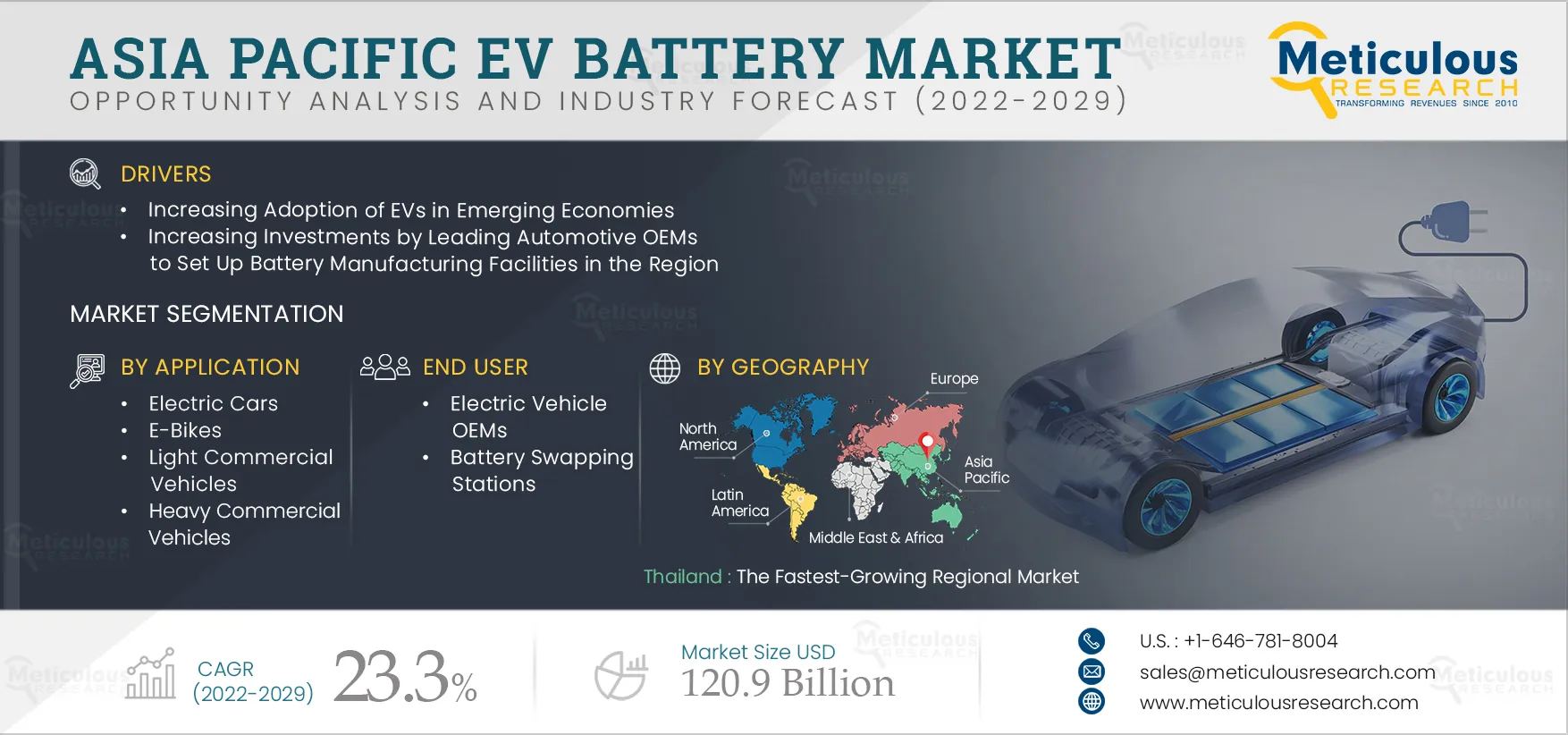
Table of contents
15 chapters · 98 sections · 215 pages · click to expandSegmental analysis
| Segment | Largest share (2022) | Fastest growth (2022–2029) |
|---|---|---|
| By Type | — | — |
| Other segments | — | 101kWh |
| By Bonding Type | — | Laser bonding |
| By Form | — | Pouch |
| By Application | — | Light commercial vehicle |
| By End User | — | Battery swapping stations |
By Type
- The solid-state battery segment is expected to grow faster once it gets commercialized.
- As per Meticulous Research Analysis, the commercialization of solid-state batteries is expected to occur from 2025.
- A solid-state battery has a higher energy density than a Li-ion battery that uses liquid electrolyte solution.
- The solid electrolyte used in a solid-state battery provides increased safety due to its non-volatile and non-flammable components, in contrast to the liquid electrolytes found in lithium-ion batteries.
- A solid-state battery also effectively increases the energy density per unit area as compared to lithium-ion batteries.
- Due to such properties, a solid-state battery pack has a higher capacity than a lithium-ion battery of the same size.
Other segments
- The 101kWh to 300kwh Segment Projected to Grow at Highest CAGR During Forecast Period
- The 101kWh to 300kWh segment is expected to grow at the highest CAGR during the forecast period.
- The high growth rate of this segment is mainly because 101kWh to 300kWh power capacity batteries are widely used in medium EVs such as light commercial vehicles and utility vehicles.
- The adoption of EVs is increasing due to the rise in fuel prices and government initiatives to lower fleet emissions of logistics and public transportation.
- Also, the increasing launch of new EVs by automotive OEMs for electrification of logistics and public transport fleets and increasing adoption of electric vehicles by e-commerce companies such as Amazon and UPS are expected to support the growth of the market during the forecast period.
By Bonding Type
- The Laser Bonding Segment to Grow at Significant Pace During Forecast Period
- The laser bonding segment is expected to grow at the highest CAGR during the forecast period.
- The high market growth of this segment is mainly attributed to the numerous advantages of laser-welded bonds, such as its ability to withstand higher currents, offer narrow welds, high welding speed, and low heat level, which is important for battery tab welding since the chemicals within the batteries are heat-sensitive.
- Laser welding is a reliable technology to connect battery cells and achieve fast, automated, precise production of battery pack conductive joints.
- Lasers also offer the advantages of precision and non-contact welding, which can be adapted to fit small areas with low accessibility using a concentrated heat source.
By Form
- The Pouch Segment to Grow at Significant Pace During Forecast Period
- The pouch segment is expected to grow at the highest CAGR during the forecast period.
- The high market growth of this segment is attributed to its higher energy density compared to the same weight of prismatic cells, more safety performance, and lower internal resistance.
- A pouch cell’s energy storage capacity is much greater in a given physical space than cylindrical cells.
- Leading automotive and battery OEMs are investing in pouch cell formats for powering their upcoming EVs.
- For instance, in April 2020, General Motors and LG Energy Solution announced a joint venture to supply large-format pouch cells for GM’s Ultium battery strategy to power the upcoming GMC Hummer EV models and a Chevrolet Silverado EV in 2023.
By Application
- Light Commercial Vehicle Segment Projected to Grow at Highest CAGR During Forecast Period
- The light commercial vehicle segment is expected to grow at the highest CAGR during the forecast period.
- The high growth rate of this segment during the forecast period is attributed to the increasing shift of retail MNCs and transport fleet operators to electric light commercial vehicles, growing awareness regarding the role of electric vehicles in reducing emissions, increase in demand for electric vehicles to reduce fleet emissions, and stringent government rules and regulations towards vehicle emissions.
- The mass production of batteries and the attractive tax incentives offered by governments have further brought down vehicle costs, making electric light commercial vehicles much more cost-effective.
By End User
- Battery Swapping Stations Segment Projected to Grow at Highest CAGR During Forecast Period
- The battery swapping stations segment is expected to grow at the highest CAGR during the forecast period.
- The high growth rate of this segment is attributed to the benefits offered by battery swapping services, such as reduction of EV acquisition costs and increased battery lifespan.
- The increase in battery swapping services by various automotive start-up companies also contributes to the market growth of this segment.
- Also, other mobility stakeholders such as oil refining companies are partnering with e-mobility start-ups to set up battery swapping stations, which is expected to significantly boost the market growth of this segment.
Geographic analysis
Asia-Pacific
Fastest growthChina is expected to account for the largest share of the APAC EV battery market in 2021, followed by Japan, South Korea, and Thailand. However, Thailand is expected to witness the fastest market growth during the forecast period, followed by Indonesia. The major factor attributed to Thailand’s high market growth rate is the growing production of EV batteries through manufacturing plants operated by SAIC, Honda, Toyota, and Mercedes. Indonesia is also expected to witness significant market growth during the forecast period. The factors attributed to the high market growth in this country are the availability of raw availability needed for EV batteries production and growing company initiatives for the development of EV batteries. Thailand to Be the Fastest-growing Regional Market
Competitive landscape
- SK Innovations Co., Ltd.
- LG Chem, Ltd
- SVOLT Energy Technology Co., Ltd.
- Samsung SDI Co., Ltd.
- GS Yuasa International Ltd.
- Vehicle Energy Japan Inc.
- A123 Systems, LLC
- Exide Industries Ltd.
- Primearth EV Energy Co., Ltd.
- E-One Moli Energy Corp.
Frequently asked questions
Cite this report
Meticulous Research. (2022). Asia-Pacific EV Battery Market - Opportunity Analysis and Industry Forecast (2022-2029) (Report No. MR-529). Meticulous Market Research Pvt. Ltd. https://www.meticulousresearch.com/product/asia-pacific-ev-battery-market-5217