
Smart Cities Market (2024-2031)
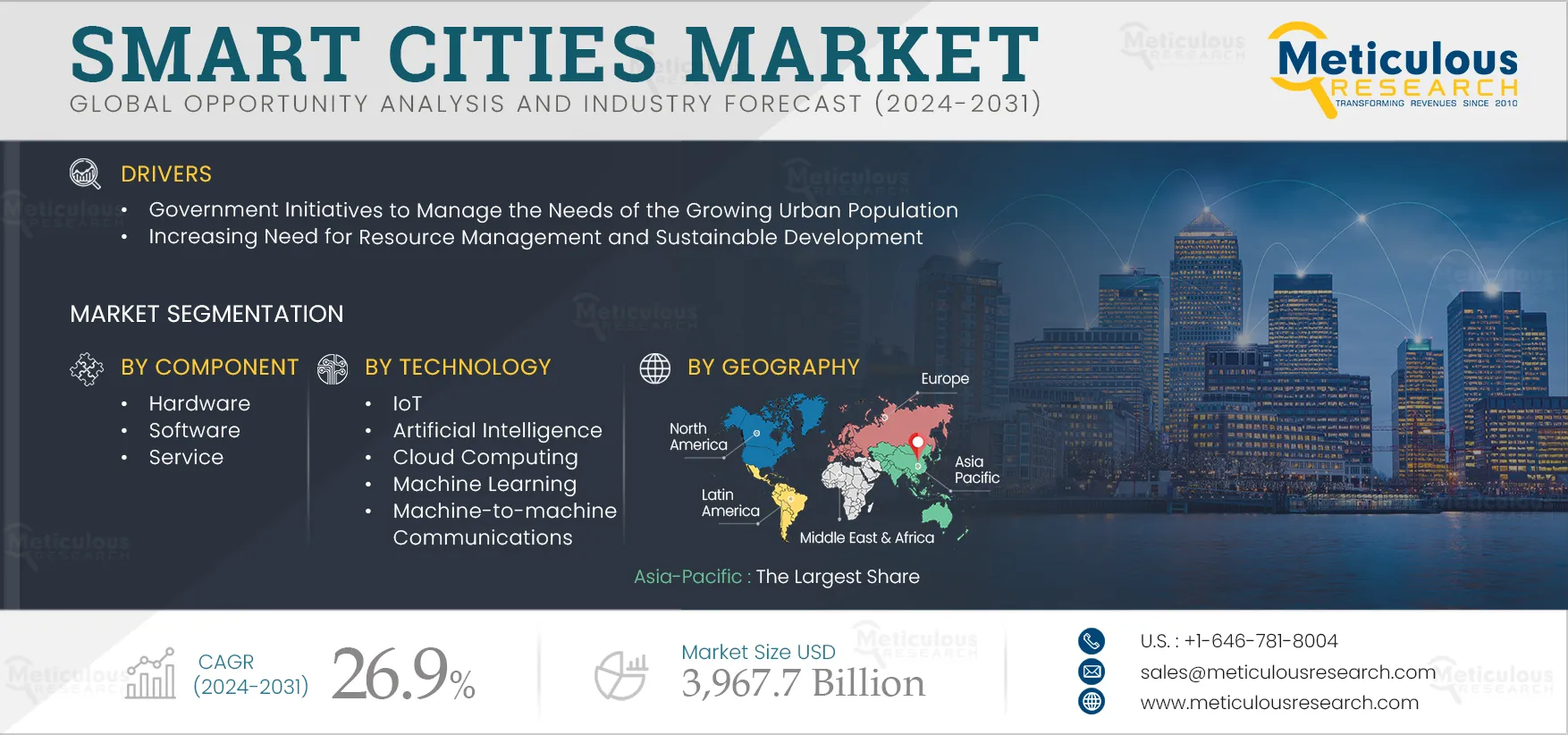
The Smart Cities Market was valued at $622.3 billion in 2023. This market is expected to reach $3,967.7 billion by 2031 from an estimated $748.3 billion in 2024, at a CAGR of 26.9% during the forecast period from 2024 to 2031. Smart Cities Market Size & Forecast The growth of the smart cities market
- Published
- Sep 2024
- Pages
- 450
- Format
- PDF + Excel
- Report ID
- MRICT - 104388
- Base year
- 2023
- 2023 · BASELINE
- $622.3B
- 2031
- $3.97T
- CAGR 2024–2031
- 26.9%
2023 baseline · 2024–2031 forecast at 26.9% CAGR · hover a bar for the value
Key highlights
The Smart Citizen Services Segment to Dominate the Smart Cities Market in 2024
The Hardware is Segment to Dominate the Smart Cities Market in 2024
The IoT is Segment to Dominate the Smart Cities Market in 2024
Report summary
| Particulars | Details |
|---|---|
| Number of Pages | 450 |
| Format | |
| Forecast Period | 2024–2031 |
| Base Year | 2023 |
| CAGR (Value) | 26.9% |
| Market Size (Value) | $3,967.7 Billion by 2031 |
| Segments Covered | By Solutions · Smart Citizen Services · Smart Public Safety · Surveillance · Command & Control Centers · Smart Governance · Smart Emergency Management · Smart Law Enforcement · E-governance · Smart Street Lighting · Smart Education · Smart Healthcare · Connected Healthcare Solutions · Telemedicine · Smart Environment · Climate Monitoring · Smart Waste Management · Air Quality Monitoring · Noise Mapping & Monitoring · Smart Buildings · Smart Building Market, by Solution · Smart Energy Management · Smart Facility Management · Safety & Security Management · Smart Lighting Control Systems · Elevators & Escalators Management Systems · Smart Buildings Market Size, by Type · Commercial Buildings · Public Buildings · Residential Buildings · Smart Transportation · Smart Transportation Market, by Solution · Smart Ticketing & Toll · Parking Management · Traffic Management · Passenger Information · Freight Information · Telematics · Other Smart Transportation Solutions · Smart Transportation Market Size, by Application · Roadways · Railways · Airways · Maritime · Smart Utilities · Smart Energy Management · Smart Grids · Smart Meters · Smart Energy Storage · PV Monitoring · Meter Data Management · Power Electronics Converters · Other Smart Utility Solutions · Smart Water Management · Smart Distribution Management · Other Smart Cities Solutions · By Component · Hardware · Endpoint Devices · Processing Devices · Network Devices · Other Hardware Devices · Software · IoT Device Software · Gateway Software · Cloud Software · Computing Device Software · Other Software · Services · Consulting Services · System Integration & Deployment Services · Infrastructure Monitoring & Management Services · Network Services · Other Services · By Technology · IoT · Artificial Intelligence · Cloud Computing · Machine Learning · Machine-to-machine Communications · Other Technologies |
| Countries Covered | North America (U.S. and Canada), Europe (Germany, U.K., France, Italy, Spain, Switzerland, Poland, Netherlands, Sweden, and Rest of Europe), Asia-Pacific (China, India, Japan, South Korea, Singapore, Malaysia, Thailand, Indonesia Australia & New Zealand, and Rest of Asia-Pacific), Latin America (Brazil, Mexico, Rest of Latin America) and Middle East & Africa (UAE, Israel, Rest of Middle East & Africa) |
| Key Companies | Cisco Systems, Inc. (U.S.), Huawei Technologies Co., Ltd. (China), IBM Corporation (US.), Siemens AG (Germany), Cognizant Technology Solutions Corporation (U.S.), Schneider Electric SE (France), Intel Corporation (U.S.), Qualcomm Technologies, Inc. (U.S.), Fujitsu Ltd. (Japan), Robert Bosch GmbH (Germany), Atos SE (France), Foxconn Electronics Inc. (Hon Hai Precision Industry Co. Ltd.) (China), LTlMindtree Limited (India), General Electric Company (U.S.), Capgemini SE (France), Microsoft Corporation (U.S.), ABB Ltd. (Switzerland), Oracle Corporation (U.S.), Honeywell International, Inc. (U.S.), and NEC Corporation (Japan) |
Report overview
Segments covered: solution, component, technology. Regions: North America, Europe, Asia-Pacific, Latin America.
The growth of the smart cities market is primarily driven by government initiatives to manage the needs of the rising urban population and the growing need for resource management & sustainable development. Moreover, the integration of artificial intelligence and the increasing use and wide applications of IoT technology are expected to generate growth opportunities for the players operating in this market.
Report infographic
Market dynamics
2 factors across 2 forcesGovernment Initiatives to Manage the Needs of the Rising Urban Population
Rapid urbanization has presented new challenges, such as addressing the increasing demand for housing and developing infrastructure, transportation systems, basic services, and job opportunities. Effective planning and provision of these essential services are crucial to meet the needs of the growing population. To tackle these challenges, government agencies globally are launching initiatives to create interconnected smart cities, utilizing technologies like the Internet of Things (IoT), Artificial Intelligence (AI), Machine Learning (ML), M2M communication, and cloud computing. These technologies aim to provide residents with advanced infrastructure, a cleaner and more sustainable environment and improved living standards.
For instance, in March 2023, the Indian government allocated ₹16,000 crore (USD 1.9 billion) to its Smart Cities Mission for the fiscal year 2024. The Union Budget for 2023–24 focuses on developing sustainable cities of the future by encouraging states and cities to implement urban planning reforms. These reforms include efficient land use, transit-oriented development, increased availability and affordability of urban land, and equitable opportunities for all. Such initiatives are fostering economic growth and enhancing quality of life by supporting local infrastructure development and leveraging technology-based solutions to improve urban sustainability.
Table of contents
11 chapters · 196 sections · 450 pages · click to expandSegmental analysis
| Segment | Largest share (2024) | Fastest growth (2024–2031) |
|---|---|---|
| By Solution | Smart Citizen Services | — |
| By Component | Hardware | Services |
| By Technology | IoT | Cloud computing |
By Solution
- The smart citizen services segment is expected to account for the largest share of over 48.0% of the smart cities market.
- This segment’s substantial market share is attributed to the rising demand for smart street lighting, the increasing adoption of connected healthcare solutions, the need for more efficient and scalable public services, and the growing concern for public safety and security.
- Moreover, this segment is expected to register the highest CAGR during the forecast period.
By Component
- The Hardware is Segment to Dominate the Smart Cities Market in 2024
- The hardware segment is expected to account for the largest share of over 40.0% of the smart cities market.
- This segment's substantial market share is due to the increasing need to upgrade infrastructure with sensors, smart grids, and automated systems, as well as the rising demand for advanced sensors and data management systems.
- Additionally, the growing need for smart traffic management systems, automated parking solutions, and vehicle tracking systems contributes significantly.
- The high demand for hardware used in surveillance cameras, emergency response systems, and smart street lighting to enhance urban safety further supports this segment's large market share.
- However, the services segment is expected to register the highest CAGR during the forecast period.
- The growing need for system integration and deployment services in various smart city applications, coupled with the rising demand for network services in smart buildings, is expected to drive growth in this segment.
By Technology
- The IoT is Segment to Dominate the Smart Cities Market in 2024
- The IoT segment is expected to account for the largest share of over 37.0% of the smart cities market.
- This segment’s substantial market share is attributed to the growing demand for IoT solutions to efficiently manage infrastructure, services, and resources; advancements in IoT devices, sensors, and connectivity technologies; the increasing prevalence of connected vehicles and autonomous drones; and the rising need for advanced security measures, such as smart surveillance.
- However, the cloud computing segment is expected to witness the highest CAGR during the forecast period.
- The rising demand for cloud platforms to handle real-time data processing and analytics, coupled with the increasing need for effective resource management and sustainable development, is anticipated to drive growth in this segment.
- Additionally, the advantages provided by cloud computing—including real-time data processing, scalability, advanced analytics, enhanced security, disaster recovery, and backup, and cost efficiency—further support the growth of this segment.
Geographic analysis
Asia-Pacific
Largest shareIn 2024, Asia-Pacific is expected to account for the largest share of over 30.8% of the smart cities market. The region's substantial market share is attributed to the presence of major players in the smart cities sector. Additionally, rapid urbanization, increasing government initiatives for smart city projects, and a rise in demand for cost-effective IoT solutions further contribute to the region's large market share. Partnerships among market players aimed at developing smart city solutions are also driving market growth in Asia-Pacific. For example, in December 2021, Dassault Systèmes SE (France) signed a Memorandum of Understanding (MoU) with NTT Communications Corporation (Japan) to advance the development and management of sustainable smart cities in Japan. Asia-Pacific is also slated to register the highest CAGR of 38.0% during the forecast period. This region's growth is driven by the rising demand for smart building solutions, the integration of IoT technology and cloud computing in smart cities, and the growing government initiatives and funding for smart city applications. Asia-Pacific to Dominate the Smart Cities Market
Competitive landscape
- March 2023
Siemens AG (Germany) launched Connect Box, an open and easy-to-use IoT solution designed to manage small- to medium-sized buildings.
- March 2023
Honeywell International, Inc. (U.S.) implemented phase one of the Bangalore Safe City project, which aims to build a safe & secure environment through Honeywell’s smart and connected safety & security technology.
- Cisco Systems, Inc. (U.S.)
- Huawei Technologies Co., Ltd. · China
- IBM Corporation (US.)
- Siemens AG · Germany
- Cognizant Technology Solutions Corporation (U.S.)
- Schneider Electric SE · France
- Intel Corporation (U.S.)
- Qualcomm Technologies, Inc. (U.S.)
- Fujitsu Ltd. · Japan
- Robert Bosch GmbH · Germany
- Atos SE · France
- LTlMindtree Limited · India
- General Electric Company (U.S.)
- Capgemini SE · France
- Microsoft Corporation (U.S.)
- ABB Ltd. · Switzerland
- Oracle Corporation (U.S.)
- Honeywell International, Inc. (U.S.)
- NEC Corporation · Japan
Frequently asked questions
The smart cities market study focuses on market assessment and opportunity analysis based on the sales of smart cities products and services across various countries, regions, and market segments. The study includes a competitive analysis based on an extensive assessment of the leading players’ product portfolios, geographic presence, and key growth strategies adopted in the last three to four years.
Cite this report
Meticulous Research. (2024). Smart Cities Market - Global Opportunity Analysis and Industry Forecasts (2024-2031) (Report No. MRICT - 104388). Meticulous Market Research Pvt. Ltd. https://www.meticulousresearch.com/product/smart-cities-market-5087