Multi-Cancer Early Detection (MCED) Market (2026-2036)
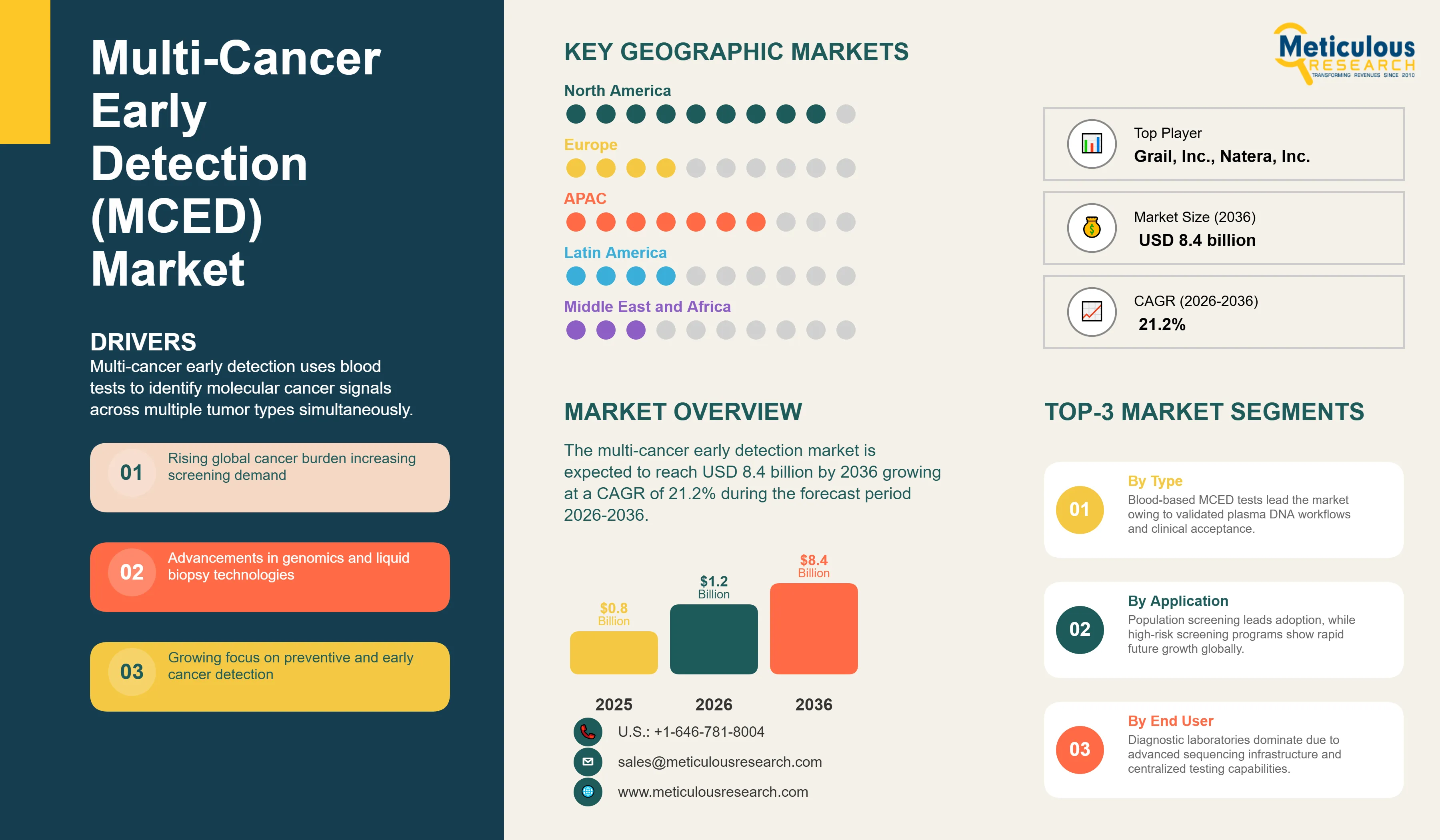
The global multi-cancer early detection market was valued at USD 0.8 billion in 2025. This market is expected to reach USD 8.4 billion by 2036 from an estimated USD 1.2 billion in 2026, growing at a CAGR of 21.2% during the forecast period 2026-2036.
- Published
- May 2026
- Pages
- 310
- Format
- PDF + Excel
- Report ID
- MRHC - 1041968
- Base year
- 2025
- 2025 · BASELINE
- $800.0M
- 2036
- $8.40B
- CAGR 2026–2036
- 21.2%
2025 baseline · 2026–2036 forecast at 21.2% CAGR · hover a bar for the value
Key highlights
The global MCED market is projected to reach USD 8.4 billion by 2036.
The market is expected to grow at a CAGR of 21.2% during the forecast period 2026-2036.
The global market for MCED was valued at USD 0.8 billion in 2025 and is estimated to reach USD 1.2 billion in 2026.
North America is expected to dominate the global MCED market with the largest market share in 2026, while Asia-Pacific is projected to register the highest CAGR during the forecast period.
By technology, the DNA methylation-based tests segment is expected to hold the largest share of the market in 2026, while the multi-omics approaches segment is projected to register the highest CAGR during the forecast period.
By cancer type coverage, the pan-cancer detection segment is expected to hold the largest share in 2026, while the organ-specific detection segment is projected to register the highest CAGR during the forecast period.
By sample type, the blood (plasma/serum) segment is expected to hold the largest share in 2026, while the urine segment is projected to register the highest CAGR during the forecast period.
By product type, the assays and kits segment is expected to hold the largest share in 2026, while the software and data analytics platforms segment is projected to register the highest CAGR during the forecast period.
By application, the population screening segment is expected to hold the largest share in 2026, while the high-risk population screening segment is projected to register the highest CAGR during the forecast period.
By end user, the diagnostic laboratories segment is expected to hold the largest share in 2026, while the government and public health programs segment is projected to register the highest CAGR during the forecast period.
Report summary
| Particulars | Details |
|---|---|
| Market Size by 2036 | USD 8.4 Billion |
| Market Size in 2026 | USD 1.2 Billion |
| Market Size in 2025 | USD 0.8 Billion |
| Revenue Growth Rate (2026-2036) | CAGR of 21.2% |
| Format | PDF, Excel & Cloud Portal · 310 pages |
| Dominating Technology | DNA Methylation-based Tests |
| Fastest Growing Technology | Multi-omics Approaches |
| Dominating Cancer Coverage | Pan-cancer Detection |
| Fastest Growing Cancer Coverage | Organ-specific Detection |
| Dominating Sample Type | Blood (Plasma/Serum) |
| Fastest Growing Sample Type | Urine |
| Dominating Product Type | Assays & Kits |
| Fastest Growing Product Type | Software & Data Analytics Platforms |
| Dominating Application | Population Screening |
| Fastest Growing Application | High-risk Population Screening |
| Dominating End User | Diagnostic Laboratories |
| Fastest Growing End User | Government & Public Health Programs |
| Dominating Geography | North America |
| Fastest Growing Geography | Asia-Pacific |
| Base Year | 2025 |
| Forecast Period | 2026 to 2036 |
Report overview
Segments covered: technology, cancer type coverage, sample type, product type, end user.
According to the World Health Organization's World Cancer Report 2024, approximately 20 million new cancer cases were diagnosed globally in 2022, of which approximately 77% were detected at advanced stages where curative treatment is significantly more difficult and expensive than at Stage I. This detection gap is the fundamental clinical and commercial imperative for multi-cancer early detection: a single blood test that can simultaneously identify cancer signals across dozens of tumor types before symptoms appear could meaningfully shift the proportion of cancers caught at an actionable early stage.
The market is in its earliest commercial stages but is growing very rapidly from a small base because the clinical need is enormous and several commercial products have now demonstrated sufficient analytical and clinical validity to enter commercial deployment and the first clinical validation studies. Grail's Galleri test, which uses methylation sequencing to detect signals across more than 50 cancer types, has been commercially available in the United States since June 2021 under a laboratory-developed test model and has been ordered for hundreds of thousands of patients. According to Grail's 2025 clinical communications, the NHS-Galleri trial conducted in partnership with the UK National Health Service enrolled approximately 140,000 participants, making it the world's largest prospective MCED validation study and the most commercially significant clinical trial in the MCED market's history. Results from this study, expected through 2025 and 2026, will directly inform NHS coverage decisions and the FDA regulatory pathway for Galleri.
Two forces are shaping the market's trajectory toward the extraordinary growth rate projected through 2036. First, a landmark economic analysis published in Nature Medicine in 2024 modeled the cost-effectiveness of an MCED screening program at a test cost of USD 500 in the United States and concluded that such a program could reduce cancer mortality by a clinically meaningful percentage while generating net economic savings from the reduction in advanced-stage treatment costs, establishing a health economics foundation that supports insurance coverage arguments. Second, the announcement by Illumina, the world's largest DNA sequencing company, that it had reacquired Grail in late 2024 following regulatory resolution and would accelerate the commercialization of Galleri through Illumina's global laboratory and channel infrastructure, signals that the world's leading genomics company is fully committed to the MCED category.
Report infographic
Market dynamics
7 factors across 3 forcesNeed for Early Detection to Improve Survival Rates
The clinical case for MCED is built on the well-established and profound relationship between cancer stage at diagnosis and treatment outcome. According to the National Cancer Institute's SEER database 2025 data, the five-year survival rate for Stage I colorectal cancer is approximately 91.6%, dropping to approximately 16.5% for Stage IV disease. For pancreatic cancer, Stage I five-year survival approaches 80% while Stage IV is approximately 3%. According to ovarian cancer survival data, Stage I disease has a five-year survival rate of about 93%, while advanced-stage ovarian cancer falls to roughly 31% overall, with Stage III around 41% and Stage IV lower. These survival gradients, which are consistent across most major cancer types, mean that detecting cancer one to three stages earlier translates directly into tens of percentage points of additional survival probability per patient. According to the American Cancer Society's 2025 Cancer Facts and Figures, approximately 2 million new cancer cases were expected in the United States in 2025, with the majority still detected at advanced stages for cancers like ovarian, pancreatic, and lung cancer that lack effective conventional screening tools. MCED addresses this unmet need directly by providing a single test mechanism to detect signals from these underscreened cancer types alongside the cancer types that already have conventional screening.
Advancements in Genomics and Liquid Biopsy Technologies
The technical capability to detect cancer-derived methylation patterns, mutation signals, and multi-omics features in cell-free DNA at the very low concentrations present in the blood of early-stage cancer patients has only become commercially feasible through the combination of ultra-high-depth next-generation sequencing, advanced bioinformatics algorithms, and large machine learning training datasets that are all products of the genomics technology advances of the past decade. Illumina's sequencing platforms, which underpin Grail's Galleri test and many competing MCED platforms, have decreased the cost of sequencing a human genome from USD 100 million in 2001 to below USD 1,000 in 2025 according to the National Human Genome Research Institute's 2025 sequencing cost database, enabling the depth and breadth of genomic analysis that MCED requires at commercially viable per-test costs. This technology cost curve has been the enabling condition for the entire MCED category.
Table of contents
14 chapters · 155 sections · 310 pages · click to expandSegmental analysis
| Segment | Largest share (2026) | Fastest growth (2026–2036) |
|---|---|---|
| By Technology | DNA Methylation-based Tests | Multi-omics approaches |
| By Cancer Type Coverage | Pan-cancer Detection | Organ-specific detection |
| By Sample Type | Blood (Plasma/Serum) | Urine |
| By Product Type | Assays & Kits | Software and data analytics platforms |
| By Application | Population Screening | High-risk population screening |
| By End User | Diagnostic Laboratories | Government and public health programs |
By Technology
- DNA Methylation-based Tests to Hold the Largest Share
- The DNA methylation-based tests segment is expected to account for the largest share of the global MCED market.
- DNA methylation analysis, which examines the patterns of methylation on cytosine residues in cell-free DNA fragments that are characteristically altered in cancerous tissue, provides the highest cancer-type prediction accuracy of any single molecular analyte currently employed in MCED platforms.
- Grail's Galleri test, the world's leading commercial MCED product, is based on whole-genome methylation sequencing, and its commercial deployment provides the DNA methylation segment with the largest current revenue base in the MCED technology market.
- According to Grail's published PATHFINDER study data, the methylation-based approach achieves tissue-of-origin prediction accuracy above 88% when a cancer signal is detected, which is a clinically critical capability for directing appropriate follow-up investigation.
- However, the multi-omics approaches segment is projected to register the highest CAGR during the forecast period.
- MCED platforms that simultaneously analyze multiple molecular classes including DNA methylation, cell-free RNA transcriptomics, protein biomarkers, and microRNA signatures are expected to achieve higher sensitivity across a broader range of cancer types than any single-analyte approach, because different cancer types shed different molecular signatures most prominently and a multi-omics platform can capture the strongest signal from each cancer type.
- Freenome and several academic programs are developing multi-omics MCED platforms in active clinical development.
By Cancer Type Coverage
- Pan-cancer Detection to Hold the Largest Share
- The pan-cancer detection segment is expected to account for the largest share of the global MCED market.
- Pan-cancer platforms that simultaneously screen for signals across 50 or more cancer types in a single test represent the defining commercial proposition of the MCED category and are embodied by Grail's Galleri test, which is currently the most commercially deployed MCED product globally.
- The single-test, multiple-cancer approach is precisely the clinical capability that distinguishes MCED from existing single-cancer screening programs and is the value proposition most compelling to healthcare providers and health systems seeking to improve cancer detection efficiency.
- However, the organ-specific detection segment is projected to register the highest CAGR during the forecast period.
- Organ-specific MCED products, which focus analytical depth and sensitivity on a defined set of high-priority cancer types such as lung, colorectal, and liver cancer, can achieve higher sensitivity for those specific cancer types than a pan-cancer platform that distributes analytical resources across a broader range of signals.
- As the regulatory pathway for MCED clarifies, organ-specific products targeting well-defined high-risk populations are expected to move through approval and coverage processes more quickly than pan-cancer tests, creating faster near-term commercial growth in this subsegment.
By Sample Type
- Blood (Plasma/Serum) to Hold the Largest Share
- The global market for MCED is segmented into blood (plasma/serum), urine, saliva, and other sample types.
- The blood (plasma/serum) segment is expected to account by far the largest share of the global MCED market.
- Blood-based MCED testing via plasma cell-free DNA analysis is the universal standard across all leading commercial MCED platforms including Galleri, and for good clinical reason: the concentration of tumor-derived circulating DNA is highest in plasma, the analytical techniques for plasma cfDNA are the most mature and validated, and a blood draw is a routine clinical procedure that integrates seamlessly into annual health check workflows.
- The entire clinical validation evidence base for commercial MCED products, including the NHS-Galleri trial data, is built on blood plasma samples, establishing this as the regulatory-validated sample type.
- However, the urine segment is projected to register the highest CAGR during the forecast period.
- Urine-based liquid biopsy is an area of active research interest for specific cancer types including bladder, kidney, prostate, and cervical cancer, where tumor-derived DNA and cells are shed directly into the urinary tract at concentrations that can be clinically informative.
- The non-invasive and self-collection nature of urine sampling is attractive for population screening programs, and several research programs are developing urine-based MCED approaches for urological and gynecological cancer types that could complement blood-based pan-cancer detection.
By Product Type
- Assays & Kits to Hold the Largest Share
- The global market for MCED is segmented into assays and kits, instruments, software and data analytics platforms, and services.
- The assays and kits segment is expected to account for the largest share of the global MCED market.
- Sample preparation kits, cell-free DNA extraction reagents, library preparation kits for next-generation sequencing, and methylation sequencing assay kits are the consumable products consumed in every MCED test, creating a large and recurring revenue stream that grows directly with test volume.
- QIAGEN's cfDNA extraction kits and Illumina's library preparation reagents are widely used across MCED laboratory workflows, and the high per-test consumable content of deep whole-genome methylation sequencing makes assays and kits a very high-value product category per test.
- However, the software and data analytics platforms segment is projected to register the highest CAGR during the forecast period.
- The AI and machine learning algorithms that interpret raw sequencing data and produce the clinically actionable cancer signal detection and tissue-of-origin prediction are the most proprietary and highest-margin components of the MCED value chain.
- As MCED test volumes scale and as the software platforms that interpret test results expand their clinical functionality and integration with electronic health records and patient management systems, software and analytics will represent a growing and increasingly valuable product segment with strong recurring subscription revenue characteristics.
By Application
- Population Screening to Hold the Largest Share
- The global market for MCED is segmented into population screening, high-risk population screening, early diagnosis, and monitoring and recurrence detection.
- The population screening segment is expected to account for the largest share of the global MCED market.
- Population-level screening, where MCED testing is offered to all adults above a specified age threshold regardless of specific cancer risk factors, is the application that defines the long-term commercial opportunity and is where current commercial deployment is most concentrated.
- Grail's Galleri test is positioned as a population screening tool for adults aged 50 and above, and its current commercial deployment across the United States is primarily in this general population screening context, often as a complement to existing single-cancer screening tests.
- However, the high-risk population screening segment is projected to register the highest CAGR during the forecast period.
- High-risk population screening, targeting individuals with specific cancer predispositions including BRCA gene carriers, Lynch syndrome patients, heavy smokers, individuals with chronic hepatitis B or C, and those with family histories of certain cancers, represents the application where MCED sensitivity and specificity requirements can be most readily met at early stages of the technology's development, because the higher pre-test cancer probability in these populations improves the positive predictive value of the test.
- Insurance coverage for MCED in high-risk populations is likely to precede population-level coverage, creating an early revenue-generating market segment that grows rapidly as the high-risk indication expands.
By End User
- Diagnostic Laboratories to Hold the Largest Share
- The diagnostic laboratories segment is expected to account for the largest share of the global MCED market.
- MCED tests require central laboratory infrastructure including high-throughput next-generation sequencing platforms, bioinformatics pipelines, and clinical interpretation capabilities that are concentrated in large reference and specialty clinical laboratories.
- Grail operates its own laboratory in Menlo Park, California, where all Galleri tests are currently processed, and Foundation Medicine's clinical laboratory in Cambridge, Massachusetts, is a key node in the commercial delivery of comprehensive genomic profiling and MCED-adjacent liquid biopsy tests.
- This central laboratory model reflects the current technical maturity of MCED, where the sequencing and analysis infrastructure has not yet miniaturized to point-of-care deployment.
- However, the government and public health programs segment is projected to register the highest CAGR during the forecast period.
- National and regional public health programs that incorporate MCED into organized cancer screening frameworks represent the application with the highest potential test volumes per program, and the NHS-Galleri trial is itself a government-funded public health program that models this approach at scale.
- If the NHS announces national coverage for Galleri and if CMS finalizes a positive U.S. National Coverage Determination, government and public health programs will rapidly become the largest end user category by volume, driving above-average revenue growth in this segment.
Geographic analysis
North America
Largest shareIn 2026, North America is expected to account for the largest share of the global MCED market. The United States is the world's most commercially advanced MCED market, home to Grail as the global MCED leader and to Exact Sciences, Freenome, Guardant Health, and Natera as significant competing MCED development programs. Grail's Galleri test has been commercially available since June 2021 and has been ordered for hundreds of thousands of U.S. patients, primarily through physician recommendation under a laboratory-developed test model that allows commercial deployment prior to FDA approval. According to Grail's 2025 communications, the test is available through leading oncology centers, primary care physician networks, and direct-to-consumer ordering in states where permitted. The CMS's proposed National Coverage Determination framework published in 2024 signals that the largest U.S. payer is actively developing reimbursement infrastructure for MCED, with a positive final determination potentially unlocking access for millions Medicare beneficiaries in the U.S.'s highest cancer-incidence age group. The American Cancer Society's 2025 Cancer Facts and Figures estimating approximately 2 million new U.S. cancer cases in 2025 confirms the clinical imperative that sustains U.S. investment in MCED development and deployment. MCED Market by Region: North America Leading by Share, Asia-Pacific by Growth
Asia-Pacific
Fastest growthHowever, the Asia-Pacific MCED market is expected to grow at the fastest CAGR during the forecast period. Asia carries the world's largest absolute cancer burden: the WHO's World Cancer Report 2024 identifies Asia as accounting for approximately 49% of global cancer cases, with China and India each having very large cancer patient populations and significant proportions of cancers detected at late stages due to limited routine screening. China is the most commercially active Asia-Pacific MCED market, with domestic companies including Burning Rock Biotech, Singlera Genomics, and Genetron Health all developing and commercially advancing MCED tests specifically for the Chinese market. According to Singlera's published research, its PanSeer MCED test detected cancer signals an average of four years before clinical diagnosis in a prospective study of Chinese participants, and the Chinese government's Healthy China 2030 initiative and National Cancer Plan specifically prioritize early cancer detection as a public health goal, creating government-level demand signals for MCED adoption. Japan's aging population, with over 29% aged 65 and above per Japan's Statistics Bureau 2025 data, creates an epidemiologically compelling MCED market, and Japan's well-developed preventive medicine and health check culture provides a natural uptake pathway for annual MCED screening.
Competitive landscape
- Grail Inc. (U.S.)
- Guardant Health Inc. (U.S.)
- Exact Sciences Corporation (U.S.)
- Freenome Holdings Inc. (U.S.)
- Illumina Inc. (U.S.)
- Roche Diagnostics · Switzerland
- Natera Inc. (U.S.)
- Burning Rock Biotech Ltd. · China
- QIAGEN N.V. · Netherlands
- Thermo Fisher Scientific Inc. (U.S.)
- NeoGenomics Laboratories (U.S.)
- Foundation Medicine/Roche (U.S.)
- Genetron Health · China
- Singlera Genomics · China
- Bio-Rad Laboratories Inc. (U.S.)
Frequently asked questions
The global MCED market is expected to reach USD 8.4 billion by 2036 from an estimated USD 1.2 billion in 2026, at a CAGR of 21.2% during the forecast period 2026-2036.
Cite this report
Meticulous Research. (2026). Multi-Cancer Early Detection (MCED) Market - Global Opportunity Analysis and Industry Forecast (2026-2036) (Report No. MRHC - 1041968). Meticulous Market Research Pvt. Ltd. https://www.meticulousresearch.com/product/multi-cancer-early-detection-market-6651