
Medical Ceramics Market (2025-2032)
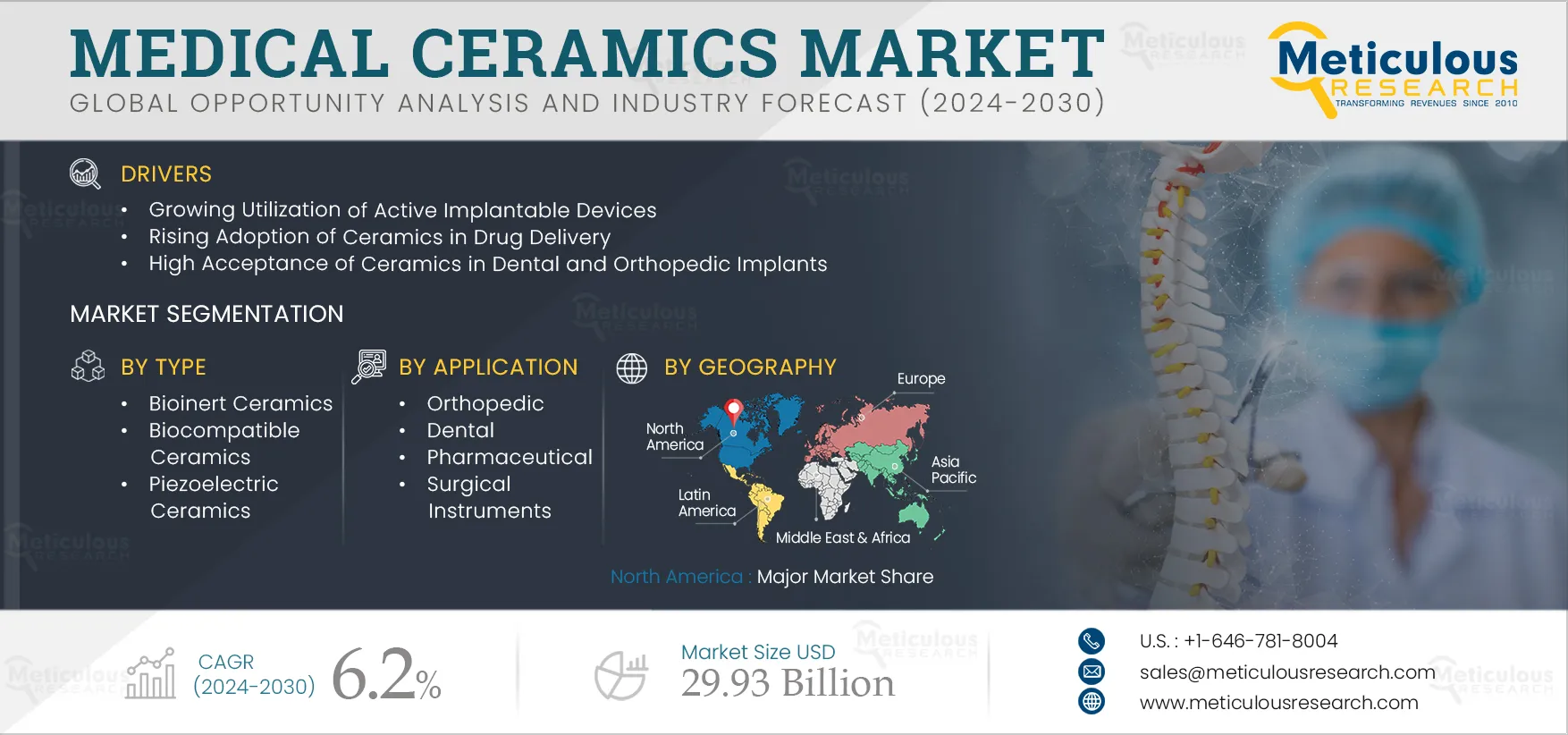
The Medical Ceramics Market is expected to reach $29.93 billion by 2032, at a CAGR of 6.2% from 2025 to 2032.
- Published
- Jan 2025
- Pages
- 450
- Format
- PDF + Excel
- Report ID
- MR-855
- Base year
- 2022
- 2032 · FORECAST
- $29.93B
- 2032
- $29.93B
- CAGR 2025–2032
- 6.2%
2022–2024 baseline · 2025–2032 forecast at 6.2% CAGR · hover a bar for the value
Key highlights
The Medical Ceramics Market is expected to reach $29.93 billion by 2032, at a CAGR of 6.2% from 2025 to 2032.
The bioinert ceramics segment is expected to account for the largest share of 56% of the medical ceramics market.
The Orthopedic Segment to Dominate the Medical Ceramics Market in 2025
In 2025, North America is expected to account for the largest share of 32.9% of the medical ceramics market, followed by Europe and Asia-Pacific.
Moreover, Asia-Pacific is slated to register the highest growth rate during the forecast period 2025–2032 due to growing economies such as India (CAGR 8.1%) and China (CAGR 7.3%).
Report summary
| Particulars | Details |
|---|---|
| Number of Pages | ~450 |
| Format | |
| Forecast Period | 2025–2032 |
| Base Year | 2022 |
| CAGR (Value) | 6.2% |
| Market Size (Value) | USD 29.93 Billion by 2032 |
| Segments Covered | By Type · Bioinert Ceramics · Alumina · Zirconia · Carbon · Biocompatible Ceramics · Bioactive Ceramics · Hydroxyapatite · Bioactive Glass · Glass Ceramics · Bioresorbable Ceramics · Gypsum · Calcium Carbonate · Carbonate Apatite · β-tricalcium Phosphate · Piezoelectric Ceramics · By Application · Orthopedic · Joint Replacement · Knee Replacement · Hip Replacement · Shoulder Replacement · Other Joint Replacements · Bone Defects Treatment · Synthetic Orthopedic Implants · Dental · Dental Implants · Restorative Dentistry · Bridges & Crowns · Inlays & Onlays · Endodontic Therapy · Braces · Dental Bone Grafts & Substitutes · Hemostatic Agents · Cosmetic/Plastic Surgery · Orbital Implants · Dermal Fillers · Surgical Instruments · Cutting Surgical Instruments · Grasping Surgical Instruments · Retracting Surgical Instruments · Other Applications · (Note: Other applications include cardiovascular implant coatings, drug delivery device coatings, medical imaging components, robotic & electrosurgical tools, and labware.) |
| Countries Covered | North America (U.S., Canada), Europe (France, Germany, U.K., Italy, Spain, Switzerland, Austria, and Rest of Europe), Asia-Pacific (China, India, Japan, and Rest of Asia-Pacific), Latin America (Brazil, Mexico, and Rest of Latin America), and the Middle East & Africa |
| Key Companies Profiled | 3M Company (U.S.), De Puy Synthes (U.S.), CoorsTek, Inc. (U.S.), CeramTec GmbH (Germany), KYOCERA Corporation (U.S.), Institut Straumann AG (Switzerland), Morgan Advanced Materials (U.K.), APC International, Ltd. (U.S.), Materion Corporation (U.S.), and Elan Technology (U.S.) |
Report overview
Segments covered: type, application. Regions: North America, Europe, Asia-Pacific, Latin America.
The growth of this market can be primarily attributed to the growing utilization of active implantable devices, the rising adoption of ceramics in drug delivery, the high acceptance of ceramics in dental and orthopedic implants, the rising demand for bio-ceramics in cosmetic dentistry, and the increasing demand for custom engineered medical implants. Moreover, emerging economies and technological advancements in ceramics, such as high heat-compatible ceramics, chemical-resistant ceramics, complex geometric medical ceramics, and technical ceramics, are expected to offer growth opportunities for the players operating in this market.
Market dynamics
5 factors across 3 forcesHigh Adoption of Ceramics in Dental and Orthopedic Implant Manufacturing
Ceramics or bio-ceramics have gained acceptance in the dental and orthopedic fields due to their excellent mechanical properties, biocompatibility, and aesthetic appeal. In dental practices, ceramics or bio-ceramics are widely used in restorative dentistry and have emerged as an attractive alternative to traditional materials like metal or composite resin. Ceramics are commonly used in dental implants, veneers, crowns, and bridges.
In orthopedics, ceramics are used for various applications due to their excellent biocompatibility, strength, wear resistance, and low-friction properties. Ceramic materials like alumina and zirconia are used in total hip, knee, and shoulder replacements. Ceramic implants provide better wear resistance than traditional metal or polyethylene components, offering increased implant lifespan.
Porous ceramics, such as hydroxyapatite and tricalcium phosphate, are used as bone graft substitutes. These materials promote bone growth and gradually resorb, allowing new bone formation. Ceramic implants are used in spinal fusion surgeries to promote bone growth and stabilize the spine.
Growing Adoption of Ceramics in Drug Delivery Systems
Ceramic-based drug carriers have gained much attention with advancements in medicine, pharmaceutics, and material science. Popular bio-ceramics include beta-tricalcium phosphate (β-TCP), hydroxyapatite, mesoporous silica, and zirconia hydroxyapatite composite. Bio-ceramics are important parts of some inorganic-organic composites used as drug carriers.
The advantages of ceramic-based drug carriers include low toxicity and adjustable sizes and structures that are favorable for loading nano-sized drugs. Ceramics have good biocompatibility, biodegradability, and biological stability. Some ceramics are environmentally sensitive and can respond to light, magnetism, or heat. These characteristics make them feasible for accurate targeted drug delivery.
Additionally, increasing funding and research grants to develop ceramic-based drug delivery systems are expected to further drive the adoption of ceramics in the pharmaceutical industry. For instance, in 2025, Aldena Therapeutics Inc. (U.K.), a developer of siRNA-based therapies for dermatological indications, and Empa, the Swiss Federal research institute for material science and technology, received a grant of $656,221.2 (CHF 600,000) from Innosuisse, the Swiss Innovation Agency. This grant was aimed at co-developing microneedle particles as a new skin delivery system. This microneedle-particle technology, called STAR particles, are star-shaped ceramic microparticles that enable the delivery of large, water-soluble molecules into the skin at the site of application.
Table of contents
10 chapters · 133 sections · 450 pages · click to expandSegmental analysis
| Segment | Largest share (2025) | Fastest growth (2025–2032) |
|---|---|---|
| By Type | Bioinert Ceramics | Biocompatible ceramics |
| By Application | Orthopedic | Dental |
By Type
- The bioinert ceramics segment is expected to account for the largest share of 56% of the medical ceramics market.
- Alumina and zirconia are the most widely used ceramics in orthopedic and dental implants and restorations.
- These ceramics are inert in nature, meaning that they do not react with tissues in the body.
- The growing number of dental restorations and the rising adoption of orthopedic implants are key factors contributing to the large market share of the bioinert ceramics segment.
- Furthermore, the increasing prevalence of arthritis is also expected to drive the segment’s growth.
- However, the biocompatible ceramics segment is projected to record the highest growth rate of 6.9% during the forecast period 2025–2032.
- The growth of this segment is driven by the increasing demand for high-quality biocompatible medical ceramics and the high intrinsic strength of ceramics.
By Application
- The Orthopedic Segment to Dominate the Medical Ceramics Market in 2025
- The orthopedic segment is expected to account for the largest share of the medical ceramics market.
- The large market share of this segment can be attributed to the high adoption of ceramics in orthopedic implants, the growing use of bio-ceramics in skeletal injuries, and the increasing prevalence of musculoskeletal disorders like osteoarthritis and rheumatoid arthritis.
- However, the dental segment is projected to register the highest growth rate of 6.3% during the forecast period 2025–2032.
- The growth of this segment is driven by the increasing demand for clear and invisible dental prostheses, advancements in mechanical properties and fabrication methods of dental ceramic materials, and the high compressive strength of ceramics in dental applications.
Geographic analysis
North America
Largest shareIn 2025, North America is expected to account for the largest share of 32.9% of the medical ceramics market, followed by Europe and Asia-Pacific. In North America, the U.S. is expected to account for the major market share in 2025, mainly due to the development of advanced ceramics for use in dental and orthopedic procedures, high healthcare expenditures, increasing awareness, and the rising demand for custom-engineered medical implants.
Asia-Pacific
Fastest growthMoreover, Asia-Pacific is slated to register the highest growth rate during the forecast period 2025–2032 due to growing economies such as India (CAGR 8.1%) and China (CAGR 7.3%). The growth of the medical ceramics market in APAC is also driven by the increasing adoption of medical ceramics for dental procedures owing to an increasing number of people needing restorative dentistry, the growth in cosmetic dentistry in countries such as India and China and rising medical tourism for orthopedic procedures in the region.
Competitive landscape
- March 2025
Lithoz GmbH (Austria) announced the launch of 3D-printed ceramic serial production at Ceramitec 2025.
- December 2025
Kuraray Noritake Dental Inc. (Japan) expanded the production capacity for ceramic dental materials at its Miyoshi Plant (Miyoshi City, Aichi Prefecture) to accelerate the expansion of its dental materials business.
- August 2025
Smith & Nephew plc (U.K.), a medical technology company, launched the OR3O Dual Mobility System for use in primary and revision hip arthroplasty in India.
- August 2025
3DCeram Sinto, Inc. (U.S.) and SINTX Technologies, Inc. (U.S.) collaborated to develop technologies and materials for additive manufacturing of advanced ceramics.
- June 2022
CeramTec GmbH (Germany) received the FDA’s approval for CeramTec’s novel ceramic total knee replacement device. The device will support joint replacement patients with the company’s high-performance, metal-free materials.
- March 2022
Tata Steel Limited (India) acquired Ceramat Pvt Ltd (India), a company focusing on advanced healthcare ceramics through its wholly owned subsidiary, Tata Steel Advanced Materials.
- 3M Company (U.S.)
- De Puy Synthes (U.S.)
- CoorsTek, Inc. (U.S.)
- CeramTec GmbH · Germany
- KYOCERA Corporation (U.S.)
- Institut Straumann AG · Switzerland
- Morgan Advanced Materials (U.K.)
- APC International, Ltd. (U.S.)
- Materion Corporation (U.S.)
- Elan Technology (U.S.)
Frequently asked questions
This study offers a detailed assessment of the medical ceramics market, including the market sizes & forecasts for market segments by type and application. The study also provides an in-depth analysis of various segments & subsegments of the medical ceramics market at the regional and country levels.
Cite this report
Meticulous Research. (2025). Medical Ceramics Market - Global Opportunity Analysis And Industry Forecast (2025-2032) (Report No. MR-855). Meticulous Market Research Pvt. Ltd. https://www.meticulousresearch.com/reports/medical-ceramics-market-5538