Low-Carbon Cement Alternatives Market (2025-2032)
The global low-carbon cement alternatives market was valued at $8.4 billion in 2024. This market is expected to reach $30.2 billion by 2032 from an estimated $10.3 billion in 2025, at a CAGR of 14.4% during the forecast period of 2025–2032. Market Size & Growth Forecast Report Overview This comprehensive
- Published
- Apr 2025
- Pages
- 225
- Format
- PDF + Excel
- Report ID
- MR-1479
- Base year
- 2024
- 2024 · BASELINE
- $8.40B
- 2032
- $30.20B
- CAGR 2025–2032
- 14.4%
2024 baseline · 2025–2032 forecast at 14.4% CAGR · hover a bar for the value
Key highlights
The global low-carbon cement alternatives market was valued at $8.4 billion in 2024.
This market is expected to reach $30.2 billion by 2032 from an estimated $10.3 billion in 2025, at a CAGR of 14.4% during the forecast period of 2025–2032.
Europe is expected to hold the largest share of the global low-carbon cement alternatives market in 2025, driven by stringent carbon regulations, well-established carbon pricing mechanisms, and ambitious climate targets across the region.
North America follows as the second-largest market, bolstered by corporate sustainability initiatives and growing state-level procurement policies requiring low-carbon materials.
However, the Asia-Pacific region is witnessing the fastest growth rate during the forecast period, primarily driven by rapid urbanization, massive infrastructure development, and increasingly stringent environmental regulations in countries like China and India.
Report summary
| Particulars | Details |
|---|---|
| Number of Pages | 225 |
| Format | PDF & Excel |
| Forecast Period | 2025–2032 |
| Base Year | 2024 |
| CAGR (Value) | 14.4% |
| Market Size (Value) in 2025 | USD 10.3 billion |
| Market Size (Value) in 2032 | USD 30.2 Billion |
| Segments Covered | Market Assessment, by Product Type · Supplementary Cementitious Materials (SCM) Blends · Geopolymer Cement · Calcium Sulfoaluminate Cement (CSA) · Alkali-Activated Materials · Magnesium-Based Cement · Market Assessment, by Raw Material · Industrial By-products (Fly Ash, Slag, Silica Fume) · Natural Pozzolans · Calcined Clays · Alternative Calcium Sources · Novel Binding Materials · Others · Market Assessment, by Application · Structural Concrete · Non-structural Applications · Precast Concrete Products · Ready-Mix Concrete · Others · Market Assessment, by End User · Commercial Construction · Residential Construction · Infrastructure Development · Industrial Facilities · Others |
| Countries Covered | North America (U.S., Canada), Europe (Germany, France, U.K., Italy, Spain, Rest of Europe), Asia-Pacific (China, Japan, India, Australia, South Korea, Rest of Asia-Pacific), Latin America (Brazil, Mexico, Rest of Latin America), Middle East & Africa (Saudi Arabia, United Arab Emirates, Rest of Middle East & Africa) |
| Key Companies | Holcim Group, HeidelbergCement AG, CEMEX S.A.B. de C.V., CRH plc, Solidia Technologies, Carbicrete, CarbonCure Technologies Inc., Ecocem Materials Ltd., Calix Limited, Ceratech Inc., BioMason Inc., Terra CO2 Technologies, CarbiCrete, Zeobond Pty Ltd, and LC3 Technology |
Report overview
Segments covered: product type, raw material, end user. Regions: North America, Europe, Asia-Pacific, Latin America, Middle East & Africa.
This comprehensive market research report analyzes the rapidly expanding low-carbon cement alternatives market, evaluating how emerging sustainable materials are addressing carbon emission challenges across the construction industry. The report provides a strategic analysis of market dynamics, market size and forecast till 2032, and competitive positioning across global and regional/country-level markets.
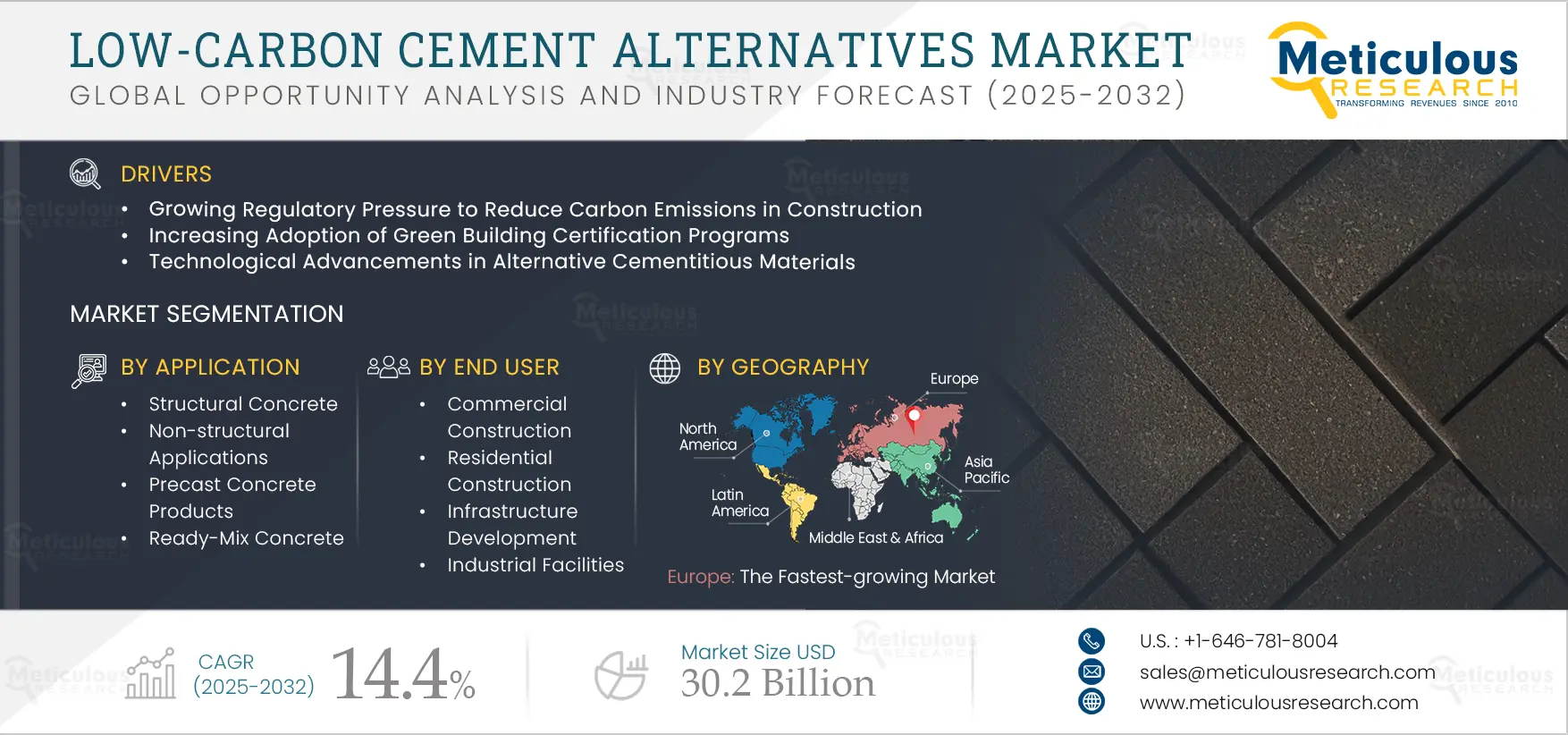
The low-carbon cement alternatives market is primarily driven by growing regulatory pressure to reduce carbon emissions in construction, increasing adoption of green building certification programs, rising corporate sustainability commitments in the construction sector, technological advancements in alternative cementitious materials, and growing awareness of embodied carbon in building materials. The shift toward blended cements with reduced clinker content is reshaping the industry, while increasing research in alkali-activated materials and geopolymers is gaining significant traction. Additionally, integration of digital technologies for optimized mix designs, emergence of carbon curing technologies, and rise of bio-based additives and alternative activators are further driving market growth, especially in Europe and North America.
Market dynamics
2 factors across 2 forcesThe low-carbon cement alternatives market offers
several high-growth opportunities. Carbon pricing and taxation mechanisms favoring low-carbon materials are creating economic incentives for wider adoption. Another major opportunity lies in public infrastructure projects specifying low-carbon concrete. Additionally, valorization of industrial by-products in cement production is creating circular economy benefits while reducing costs. The development of carbon capture and utilization technologies and growing market for carbon-negative construction materials further expand the growth landscape for both established manufacturers and innovative startups.
Table of contents
12 chapters · 140 sections · 225 pages · click to expandGeographic analysis
Europe
Largest shareEurope is expected to hold the largest share of the global low-carbon cement alternatives market in 2025, driven by stringent carbon regulations, well-established carbon pricing mechanisms, and ambitious climate targets across the region. Additionally, strong green building certification programs and consumer awareness contribute significantly to market dominance.
North America
North America follows as the second-largest market, bolstered by corporate sustainability initiatives and growing state-level procurement policies requiring low-carbon materials.
Asia-Pacific
Fastest growthHowever, the Asia-Pacific region is witnessing the fastest growth rate during the forecast period, primarily driven by rapid urbanization, massive infrastructure development, and increasingly stringent environmental regulations in countries like China and India.
Competitive landscape
The global low-carbon cement alternatives market features a diverse competitive landscape with established cement manufacturers pivoting toward sustainable solutions, specialized green material startups, technology providers focused on carbon capture and utilization, and research institutions commercializing novel binding technologies.
The broader manufacturing landscape is categorized into industry leaders, market differentiators, vanguards, and contemporary stalwarts, with each group employing distinctive strategies to advance sustainable construction materials. Leading manufacturers are balancing incremental improvements to existing cement formulations with investments in breakthrough technologies that promise deeper decarbonization.
The key players operating in the global low-carbon cement alternatives market are Holcim Group, HeidelbergCement AG, CEMEX S.A.B. de C.V., CRH plc, Solidia Technologies, Carbicrete, CarbonCure Technologies Inc., Ecocem Materials Ltd., Calix Limited, Ceratech Inc., BioMason Inc., Terra CO2 Technologies, CarbiCrete, Zeobond Pty Ltd, and LC3 Technology among others
- Holcim Group
- HeidelbergCement AG
- CEMEX S.A.B. de C.V
- CRH plc
- Solidia Technologies
- Carbicrete
- CarbonCure Technologies Inc.
- Ecocem Materials Ltd.
- Calix Limited
- Ceratech Inc.
- BioMason Inc.
- Terra CO2 Technologies
- Zeobond Pty Ltd
- LC3 Technology
Frequently asked questions
The global low-carbon cement alternatives market was valued at $8.4 billion in 2024. This market is expected to reach $30.2 billion by 2032 from an estimated $10.3 billion in 2025, at a CAGR of 14.4% during the forecast period of 2025–2032.
Cite this report
Meticulous Research. (2025). Low-Carbon Cement Alternatives Market - Global Opportunity Analysis and Industry Forecast (2025-2032) (Report No. MR-1479). Meticulous Market Research Pvt. Ltd. https://www.meticulousresearch.com/product/low-carbon-cement-alternatives-market-6162