
In-Orbit Servicing Market (2026-2036)
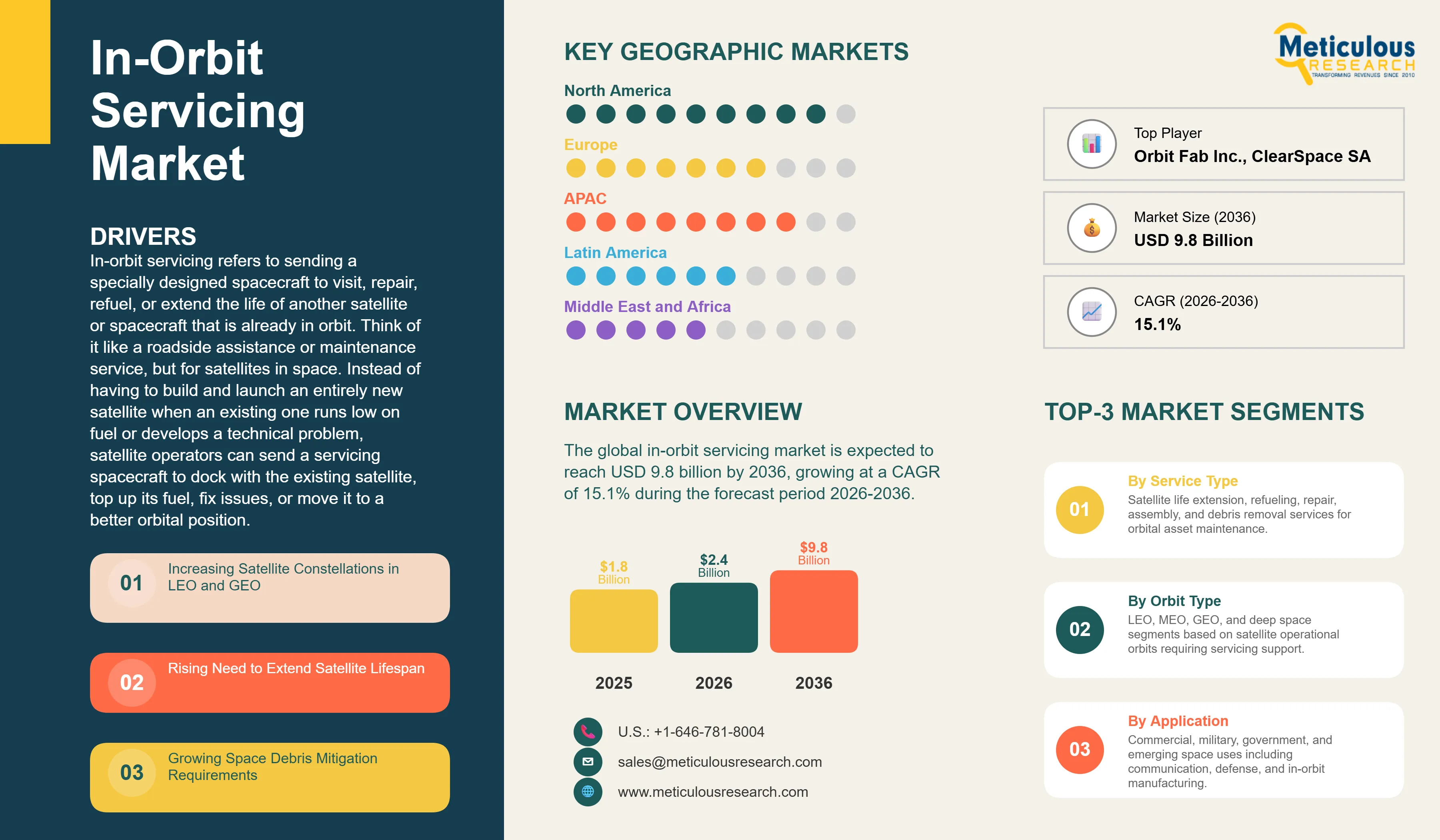
The global in-orbit servicing market was valued at USD 1.8 billion in 2025. This market is expected to reach USD 9.8 billion by 2036 from an estimated USD 2.4 billion in 2026, growing at a CAGR of 15.1% during the forecast period 2026-2036.
- Published
- Apr 2026
- Pages
- 285
- Format
- PDF + Excel
- Report ID
- MR-1915
- Base year
- 2025
- 2025 · BASELINE
- $1.80B
- 2036
- $9.80B
- CAGR 2026–2036
- 15.1%
2025 baseline · 2026–2036 forecast at 15.1% CAGR · hover a bar for the value
Key highlights
The global in-orbit servicing market is projected to reach USD 9.8 billion by 2036.
The market is expected to grow at a CAGR of 15.1% during the forecast period 2026-2036.
The global in-orbit servicing market was valued at USD 1.8 billion in 2025 and is estimated to reach USD 2.4 billion in 2026.
North America is expected to dominate the global in-orbit servicing market with the largest market share in 2026, while Asia-Pacific is projected to register the highest CAGR during the forecast period.
By service type, the satellite life extension services segment is expected to hold the largest share of the market in 2026, while the active debris removal segment is projected to register the highest CAGR during the forecast period.
By orbit type, the GEO segment is expected to hold the largest share in 2026, while the LEO segment is projected to register the highest CAGR during the forecast period.
By application, the commercial applications segment is expected to hold the largest share in 2026, while the military and defense applications segment is projected to register the highest CAGR during the forecast period.
By end user, the satellite operators segment is expected to hold the largest share in 2026, while the commercial space companies segment is projected to register the highest CAGR during the forecast period.
By vehicle type, the servicing satellites segment is expected to hold the largest share in 2026, while the refueling vehicles segment is projected to register the highest CAGR during the forecast period.
By operation type, the semi-autonomous operations segment is expected to hold the largest share in 2026, while the autonomous operations segment is projected to register the highest CAGR during the forecast period.
Report summary
| Particulars | Details |
|---|---|
| Market Size by 2036 | USD 9.8 Billion |
| Market Size in 2026 | USD 2.4 Billion |
| Market Size in 2025 | USD 1.8 Billion |
| Revenue Growth Rate (2026-2036) | CAGR of 15.1% |
| Format | PDF, Excel & Cloud Portal · 285 pages |
| Dominating Service Type | Satellite Life Extension Services |
| Fastest Growing Service Type | Active Debris Removal (ADR) |
| Dominating Orbit Type | Geostationary Orbit (GEO) |
| Fastest Growing Orbit Type | Low Earth Orbit (LEO) |
| Dominating Application | Commercial Applications |
| Fastest Growing Application | Military & Defense Applications |
| Dominating End User | Satellite Operators |
| Fastest Growing End User | Commercial Space Companies |
| Dominating Vehicle Type | Servicing Satellites (Servicers) |
| Fastest Growing Vehicle Type | Refueling Vehicles |
| Dominating Operation Type | Semi-Autonomous Operations |
| Fastest Growing Operation Type | Autonomous Operations |
| Dominating Geography | North America |
| Fastest Growing Geography | Asia-Pacific |
| Base Year | 2025 |
| Forecast Period | 2026 to 2036 |
Report overview
Segments covered: service type, orbit type, application, end user.
In-orbit servicing refers to sending a specially designed spacecraft to visit, repair, refuel, or extend the life of another satellite or spacecraft that is already in orbit. Think of it like a roadside assistance or maintenance service, but for satellites in space. Instead of having to build and launch an entirely new satellite when an existing one runs low on fuel or develops a technical problem, satellite operators can send a servicing spacecraft to dock with the existing satellite, top up its fuel, fix issues, or move it to a better orbital position. This concept makes the entire satellite industry significantly more economical, because satellites represent investments of hundreds of millions to billions of dollars and being able to service rather than replace them extends their commercial lives and improves the return on that investment.
The market is growing because the number of satellites in orbit is growing very rapidly, particularly in low earth orbit where companies like SpaceX, Amazon, and OneWeb are deploying thousands of satellites for broadband internet services. This rapid growth of the satellite population is creating two related business opportunities. First, all these satellites will eventually need servicing, refueling, or repositioning, creating a large and growing addressable market for in-orbit servicing providers. Second, the growing number of satellites is contributing to a serious and worsening space debris problem, with thousands of defunct satellites and fragments of old spacecraft cluttering orbital paths and creating collision risks for active satellites. Cleaning up this debris requires specialized active debris removal missions, which is an entirely new and commercially significant service category that is attracting both government funding and private investment.
Two major opportunities are shaping the market going forward. The development of in-orbit refueling infrastructure, essentially orbital filling stations where servicing vehicles can pick up propellant to deliver to satellites, would transform the economics of satellite operations by making it routine and affordable to extend satellite lifetimes through regular refueling rather than relying on a single fuel load at launch. Orbit Fab and several competitors are working on exactly this concept. In addition, as the commercial space economy expands to include in-orbit manufacturing, space tourism, and eventually lunar operations, the need for space logistics and assembly services in orbit is expected to grow into a major new market category well beyond today's satellite servicing applications.
Report infographic
Market dynamics
7 factors across 3 forcesRising Need to Extend Satellite Lifespan
A large geostationary communication satellite costs between USD 200 million and USD 500 million to build and an additional USD 80 million to USD 150 million to launch. The commercial life of these satellites is determined primarily by how much fuel they carry for station-keeping, which keeps them in the correct orbital position relative to the Earth and the antenna beams serving customer ground stations. When a satellite runs out of fuel, it drifts out of its operational slot and must be retired, even though all of its electronic systems may still be working perfectly. Being able to refuel or take over the station-keeping function of a satellite that has run out of propellant but is otherwise fully operational is therefore an enormously valuable service that allows the satellite operator to continue generating revenue from a USD 200 million plus asset for years longer than the original fuel load would permit. The commercial logic of this service is so compelling that even early-adopter in-orbit servicing missions priced at several tens of millions of dollars have provided positive economic returns to satellite operators compared with the cost of replacing the served satellite.
Growing Space Debris Mitigation Requirements
The orbital debris problem has reached a point where national space agencies, regulators, and the satellite industry are treating it as a serious business and safety risk rather than a long-term theoretical concern. The Federal Communications Commission in the United States has tightened deorbit requirements for satellites in low earth orbit, reducing the required deorbit timeline from 25 years to 5 years, and is developing rules that will mandate debris mitigation plans for new satellite licenses. The European Space Agency and European national space agencies are funding active debris removal demonstration contracts, and the UK Space Agency has made debris removal a priority area for national space program investment. For satellite constellation operators who are deploying thousands of satellites in low earth orbit, the growing regulatory requirements for debris management and the reputational and liability risks associated with satellite collisions or debris generation are creating direct financial incentives to invest in debris removal and satellite disposal services. These regulatory and liability drivers are converting what was previously a discretionary activity into a commercially mandatory service category.
Table of contents
15 chapters · 182 sections · 285 pages · click to expandSegmental analysis
| Segment | Largest share (2026) | Fastest growth (2026–2036) |
|---|---|---|
| By Service Type | Satellite Life Extension Services | Active debris removal |
| By Orbit Type | GEO | LEO |
| By Application | Commercial | Military and defense applications |
| By End User | Satellite Operators | Commercial space companies |
| By Vehicle Type | Servicing Satellites | Refueling vehicles |
| By Operation Type | Semi-Autonomous Operations | Autonomous operations |
By Service Type
- Satellite Life Extension Services to Dominate
- The satellite life extension services segment is expected to account for the largest share of the global in-orbit servicing market.
- Life extension services, which include Northrop Grumman's commercially proven Mission Extension Vehicle approach of docking with fuel-depleted satellites and taking over their station-keeping and orbit-raising functions, currently represent the most commercially mature and highest-revenue segment of the in-orbit servicing market.
- The compelling economics of extending the life of high-value geostationary satellites rather than replacing them have driven multiple commercial contracts and established this as a proven revenue-generating service with a clear and growing customer base among satellite fleet operators.
- However, the active debris removal segment is projected to register the highest CAGR during the forecast period.
- The combination of tightening regulatory requirements, growing funding from national space agencies for demonstration programs, and the increasing urgency of the orbital debris problem as satellite numbers grow is expected to drive rapid growth in ADR services from a currently small base.
- The first commercial ADR demonstration contracts, including ESA's ClearSpace-1 mission, are establishing the technical and commercial foundations for a large-scale debris removal service industry that is expected to develop substantially through the forecast period.
By Orbit Type
- GEO to Hold the Largest Share
- The GEO segment is expected to account for the largest share of the global in-orbit servicing market.
- Geostationary orbit is home to the world's most valuable commercial communication satellites, which generate the highest revenue per satellite of any orbital class and represent the clearest and most immediate economic case for in-orbit servicing.
- The proven commercial transactions for GEO satellite life extension through Northrop Grumman's MEV services and the high value per customer satellite make GEO the current revenue leader despite hosting fewer satellites than LEO.
- However, the LEO segment is projected to register the highest CAGR during the forecast period.
- The rapid growth of large satellite constellations in low earth orbit for broadband internet, earth observation, and other services is creating a very large and growing population of LEO satellites that will need inspection, repositioning, and eventually end-of-life disposal services.
- The active debris removal challenge is also primarily concentrated in low earth orbit, where most debris and most new satellite deployments are located, making LEO the focus of the fastest-growing servicing categories.
By Application
- Commercial Applications to Hold the Largest Share
- The commercial applications segment is expected to account for the largest share of the global in-orbit servicing market, accounting for approximately 47% of total market revenue.
- Commercial satellite operators, including communication satellite fleet operators and earth observation constellation operators, represent the largest and most commercially active customer base for in-orbit servicing services.
- The very high value of commercial geostationary communication satellites makes life extension services economically compelling, and commercial operators have been the first customers for commercially contracted in-orbit servicing missions.
- The broadband mega-constellation operators in LEO, including SpaceX Starlink, Amazon Kuiper, and OneWeb, are expected to become important future customers as their satellite populations grow and satellite replacement and debris management needs increase.
- However, the military and defense applications segment is projected to register the highest CAGR during the forecast period.
- Military satellites are among the most strategically valuable and expensive assets in any national space program, and the ability to service, repair, and extend the life of military satellites rather than replacing them represents a significant cost saving and strategic advantage.
- The U.S. Space Force's growing interest in satellite servicing and the increasing recognition across allied defense establishments that space asset resilience requires the ability to repair and reconstitute satellites on orbit are expected to drive rapid growth in government-contracted military satellite servicing programs.
By End User
- Satellite Operators to Hold the Largest Share
- The satellite operators segment is expected to account for the largest share of the global in-orbit servicing market.
- Commercial satellite fleet operators including Intelsat, SES, Inmarsat, and Eutelsat have been the first paying customers for in-orbit servicing services, recognizing the financial benefit of extending the operational lives of high-value satellites rather than replacing them.
- The growing number of satellite operators managing large fleets of both GEO and LEO satellites creates a large and expanding potential customer base for in-orbit servicing providers as the technology matures and prices become more competitive.
- However, the commercial space companies segment is projected to register the highest CAGR during the forecast period.
- The rapid expansion of commercial space activities including satellite constellation deployment, commercial space station development, and the growth of the broader commercial space economy is creating growing demand for in-orbit logistics, servicing, and support services from commercial companies that are not traditional satellite operators.
- New commercial space companies need orbital transportation, satellite deployment optimization, and servicing support in ways that traditional government space programs and established satellite operators did not.
By Vehicle Type
- Servicing Satellites to Hold the Largest Share
- The servicing satellites segment is expected to account for the largest share of the global in-orbit servicing market.
- Servicing satellites, which are purpose-built spacecraft designed to rendezvous and dock with client satellites to provide life extension and other services, represent the most commercially advanced vehicle category in the market.
- Northrop Grumman's Mission Extension Vehicle is the most commercially established example, but several other companies are developing competing servicing satellite concepts targeting different orbital classes and service types.
- However, the refueling vehicles segment is projected to register the highest CAGR during the forecast period.
- The development of dedicated spacecraft designed to carry and transfer propellant to client satellites is a newer but potentially transformative service category that could enable a much larger scale of satellite life extension if standardized refueling interfaces become common on new satellites.
- The growing investment in refueling vehicle development from Orbit Fab, Starfish Space, and several other companies indicates the strong commercial interest in this category.
By Operation Type
- Semi-Autonomous Operations to Hold the Largest Share
- The semi-autonomous operations segment is expected to account for the largest share of the global in-orbit servicing market.
- Most current in-orbit servicing missions combine automated proximity operations and docking with ground-based monitoring and human oversight for critical decisions.
- This semi-autonomous approach reflects where the technology currently is: autonomous rendezvous and docking has been demonstrated and works reliably, but operators and mission designers prefer to maintain human decision-making authority for actions that could have irreversible consequences such as physically docking with a client satellite.
- However, the autonomous operations segment is projected to register the highest CAGR during the forecast period.
- As the volume of servicing missions grows, particularly for debris removal and constellation servicing where large numbers of relatively routine missions need to be completed cost-effectively, full autonomy becomes increasingly important.
- Ground-controlled operations are expensive and slow relative to the economics that large-scale servicing businesses would require, and fully autonomous servicing will be essential for making in-orbit servicing economically viable at the scale the growing satellite population demands.
Geographic analysis
North America
Largest shareIn 2026, North America is expected to account for the largest share of the global in-orbit servicing market. The United States is home to the majority of the world's leading in-orbit servicing companies, including Northrop Grumman through its SpaceLogistics subsidiary which operates the commercially proven Mission Extension Vehicle service, Orbit Fab which is developing the orbital propellant depot infrastructure, Starfish Space, Redwire Corporation, Altius Space Machines, Honeybee Robotics, and Momentus. The U.S. Space Force's growing investment in satellite servicing and space domain awareness, DARPA's in-orbit servicing technology programs, and NASA's interest in servicing capabilities for future space exploration infrastructure collectively represent very large government program budgets that sustain the U.S. in-orbit servicing industry's technical development. The U.S. commercial satellite operator community, which includes some of the world's largest GEO communication satellite fleets, provides the paying customer base for commercial servicing missions. Canada's expertise in space robotics through the Canadarm heritage and its continued participation in space station and orbital infrastructure programs contributes additional North American capability to the market.
Asia-Pacific
Fastest growthHowever, the Asia-Pacific in-orbit servicing market is expected to grow at the fastest CAGR during the forecast period. Japan has been particularly active in in-orbit servicing development, with JAXA conducting important proximity operations research and the Japanese commercial space sector developing servicing concepts targeting both commercial and government customers. Astroscale, a Japanese company with headquarters in Tokyo and operations in the UK, US, and Israel, is one of the global leaders in debris removal technology and has completed in-orbit demonstration missions. China's large and growing satellite program and its increasing ambitions in space infrastructure create both domestic demand for servicing capabilities and government investment in servicing technology development. India's growing commercial space sector and its ambitious national space exploration program are creating demand for space logistics and servicing capabilities. South Korea and Australia are also investing in space technology programs that include servicing and inspection capabilities.
Europe
Europe is a significant and active in-orbit servicing market, with the European Space Agency playing a particularly important role as a customer and program manager for commercial servicing demonstrations. ESA's ClearSpace-1 active debris removal mission, contracted to the Swiss startup ClearSpace SA, is the most prominent European-led commercial in-orbit servicing contract and represents ESA's strategy of purchasing commercial services rather than building government-only programs. Airbus Defence and Space, Thales Alenia Space, and the European space industry supply chain have strong capabilities relevant to in-orbit servicing including robotic systems, rendezvous and docking technology, and satellite interface hardware. Luxembourg and Belgium, despite their small sizes, host important space industry players and commercial space investment funds that contribute to the European in-orbit servicing ecosystem.
Competitive landscape
- Northrop Grumman Corporation (U.S.)
- Airbus SE · Netherlands
- Astroscale Holdings Inc. (Japan/UK)
- Maxar Technologies Inc. (U.S.)
- Thales Alenia Space · France/Italy
- Orbit Fab Inc. (U.S.)
- Redwire Corporation (U.S.)
- Altius Space Machines (U.S.)
- Honeybee Robotics/Blue Origin (U.S.)
- SpaceLogistics LLC (U.S.)
- ClearSpace SA · Switzerland
- D-Orbit S.p.A · Italy
- Rocket Lab USA Inc. (U.S./New Zealand)
- Starfish Space Inc. (U.S.)
- Momentus Inc. (U.S.)
Frequently asked questions
The global in-orbit servicing market is expected to reach USD 9.8 billion by 2036 from an estimated USD 2.4 billion in 2026, at a CAGR of 15.1% during the forecast period 2026-2036.
Cite this report
Meticulous Research. (2026). In-Orbit Servicing Market - Global Opportunity Analysis and Industry Forecast (2026-2036) (Report No. MR-1915). Meticulous Market Research Pvt. Ltd. https://www.meticulousresearch.com/product/in-orbit-servicing-market-6598