Digital Transformation Market (2024-2031)
The Digital Transformation Market is projected to reach $5275.7 billion by 2031, at a CAGR of 22.4% from 2024–2031.
- Published
- Aug 2024
- Pages
- 350
- Format
- PDF + Excel
- Report ID
- MR-279
- Base year
- 2023
- 2031 · FORECAST
- $5.28T
- 2031
- $5.28T
- CAGR 2024–2031
- 22.4%
2023 baseline · 2024–2031 forecast at 22.4% CAGR · hover a bar for the value
Key highlights
By Offering: In 2024, the Services Segment to Dominate the Digital Transformation Market
By Organization Size: In 2024, the Large Enterprises Segment to Dominate the Digital Transformation Market
By Deployment Mode: In 2024, the Cloud-based Deployment Segment to Dominate the Digital Transformation Market
By Technology: In 2024, the Cloud Computing Segment to Dominate the Digital Transformation Market
By End-use Industry: In 2024, the BFSI Segment to Dominate the Digital Transformation Market
In 2024, North America Region to Dominate the Digital Transformation Market
Report summary
| Particulars | Details |
|---|---|
| Number of Pages | 350 |
| Format | |
| Forecast Period | 2024–2031 |
| Base Year | 2023 |
| CAGR (Value) | 22.4% |
| Market Size (Value) | USD 5275.7 Billion by 2031 |
| Segments Covered | By Offering · Solutions · Services · Consulting Services · Planning and Designing Services · Engineering Services · Support and Maintenance Services · Application Development Services · Network Infrastructure Management Services · Other Services · By Organization Size · Large Enterprises · Small & Medium-sized Enterprises · By Deployment Mode · Cloud-based Deployment · On-premise Deployment · By Technology · Mobile Technology · Internet-of-Things (IoT) · Network Connectivity · Digital Twin & Simulation · Robotic Process Automation · Cloud Computing · Artificial Intelligence & Machine Learning · AR & VR · Additive Manufacturing & 3D Printing · Big Data & Real-time Analytics · Cybersecurity · Other Technologies · By End-use Industry · Retail & E-commerce · Government & Public Sector · Healthcare · Supply Chain & Logistics · Energy & Utility · Manufacturing · BFSI · IT & Telecommunications · Media & Entertainment · Education · Transportation · Other End-use Industries |
| Countries Covered | North America (U.S., Canada), Europe (Germany, U.K., France, Italy, Netherlands, Spain, Sweden, and Rest of Europe), Asia-Pacific (China, India, Japan, South Korea, Singapore, Australia & New Zealand, Indonesia, and Rest of Asia-Pacific), Latin America (Brazil, Mexico, and Rest of Latin America), and Middle East & Africa (Saudi Arabia, UAE, Israel, and Rest of Middle East & Africa) |
| Key Companies | International Business Machines Corporation (U.S.), Siemens AG (Germany), Microsoft Corporation (U.S.), SAP SE (Germany), Capgemini SE (France), ABB Ltd. (Switzerland), Deutsche Telekom AG (Germany), Telefónica, S.A. (Spain), Accenture plc (Ireland), TE Connectivity Ltd. (Switzerland), NXP Semiconductors N.V. (Netherlands), Telefonaktiebolaget LM Ericsson (Sweden), Intel Corporation (U.S.), Tata Consultancy Services Limited (India), and Cisco Systems, Inc. (U.S.). |
Report overview
Segments covered: offering, organization size, deployment mode, technology, end use industry. Regions: North America, Europe, Asia-Pacific, Latin America, Middle East & Africa.
The growth of the digital transformation market is driven by the high acceptance of smart devices and apps, and the increasing adoption of artificial intelligence & machine learning. Furthermore, the increasing adoption of blockchain as an important technology is expected to generate growth opportunities for the players operating in this market.
Market dynamics
3 factors across 3 forcesIncreasing Adoption of Artificial Intelligence and Machine Learning
Artificial intelligence (AI) and machine learning (ML) are growing technologies accelerating and enhancing the process of digital transformation within organizations. The integration of AI in digital transformation allows businesses to automate routine processes, streamline operations, and enhance decision-making with tools such as machine learning, natural language processing, and computer vision. Additionally, businesses are increasingly integrating AI into digital transformation due to its numerous benefits such as improved efficiency in decision-making, increased profitability, enriched analytics, and a more comprehensive understanding of customer needs leading to better customer experiences.
Moreover, the growing use of AI in digital transformation helps businesses optimize product timelines and transforms business strategies using advanced algorithms, data analytics, and machine learning. Thus, several companies are launching platforms to help organizations confidently adopt artificial intelligence (AI).
For instance, in September 2023, Ernst & Young Global Limited (U.K.) launched EY.ai, a unifying platform that brings together human capabilities and AI, to assist clients in revolutionizing their businesses through the assured and ethical integration of AI. EY.ai leverages leading-edge EY technology platforms and AI capabilities, with deep experience in strategy, transactions, transformation, risk, assurance, and tax, all augmented by a robust AI ecosystem. Such developments help boost the demand of AI & ML in digital transformation during the forecast period.
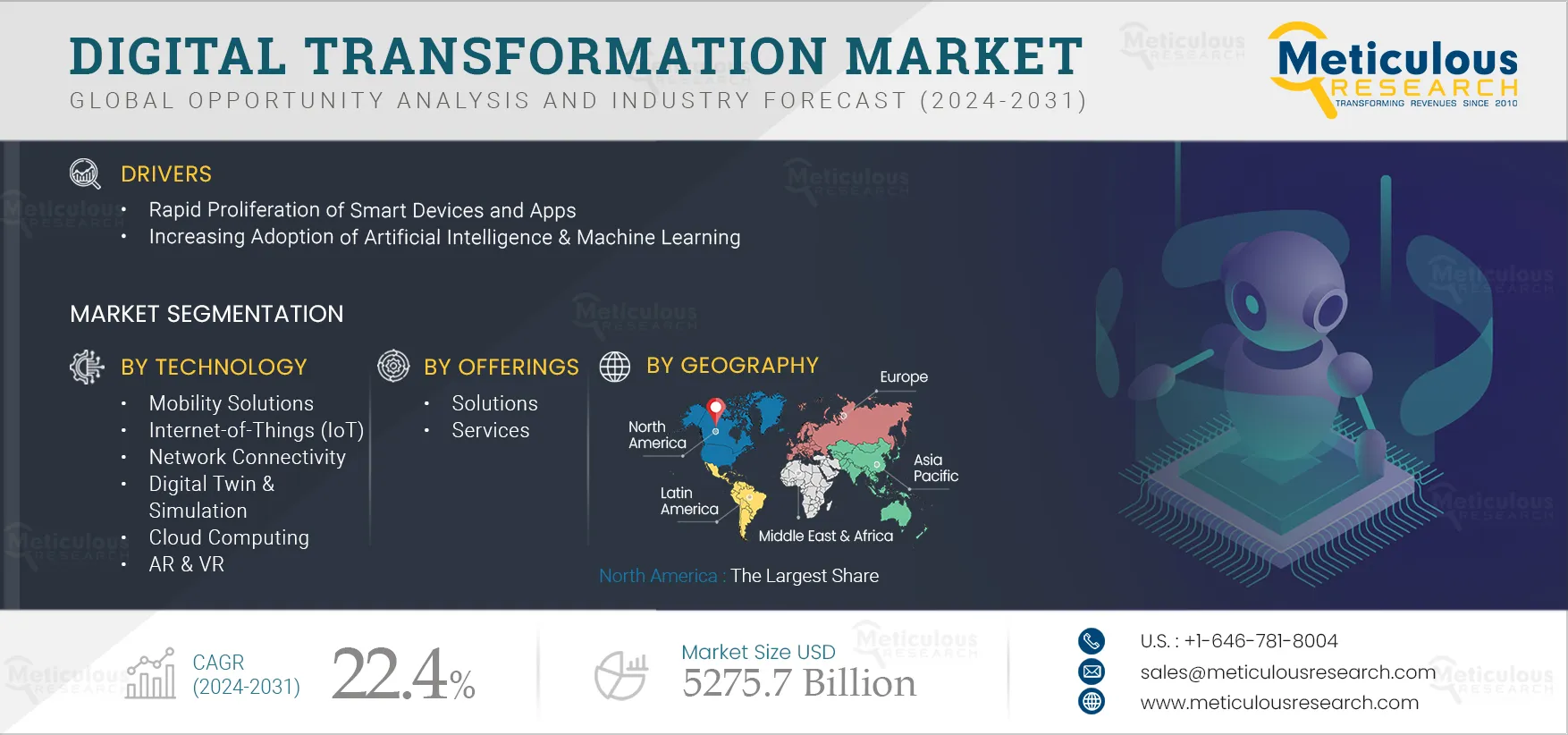
Table of contents
13 chapters · 138 sections · 350 pages · click to expandSegmental analysis
| Segment | Largest share (2024) | Fastest growth (2024–2031) |
|---|---|---|
| By Offering | Services | Services |
| By Organization Size | Large Enterprises | — |
| By Deployment Mode | Cloud-based Deployment | — |
| By Technology | Cloud Computing | Artificial intelligence & machine learning |
| By End-use Industry | BFSI | Healthcare |
By Offering
- The Services Segment to Dominate the Digital Transformation Market
- The services segment is expected to account for the large share of over 57.0% of the global digital transformation market.
- The segment's large market share is attributed to the growing need to improve productivity and profitability through improved resource management using digital transformation services; the growing adoption of digital transformation services, aiming to enhance organizational agility and resilience in business operations.
- Digital transformation is increasingly utilized to prevent errors by eliminating time-consuming manual data entry and addressing human inefficiencies.
- Furthermore, the increasing use of digital transformation services includes reducing overhead costs through integration with back-office systems, automating delivery processes and product updates, and facilitating inter-device activation.
- The services segment is expected to register the highest CAGR during the forecast period.
By Organization Size
- The large enterprises segment is expected to account for the larger share of over 58.0% of the global digital transformation market.
- The segment's large market share is attributed to the growing adoption of digital transformation in large enterprises to automate process and workflows, thereby enhancing operational efficiency.
- Digital transformation allows large enterprises to provide personalized experiences to customers through data analytics and targeted marketing strategies.
- This digital transformation helps to enhance security measures ensuring data protection in large enterprises to mitigate risks associated with cyberthreats.
- However, the small & medium-sized enterprises segment is expected to register a higher CAGR during the forecast period.
- The growth of this segment is attributed to the growing adoption of digital transformation in SMEs to reduce operational costs and improve productivity by automating routine tasks and processes, and the rising use of digital technologies in SMEs helps to adapt changing market conditions and customer demands for better agility in decision-making and operations.
- Moreover, the digital transformation helps SME’s to streamlines their operations and enhance customer relationship that aid them in achieving sustainable growth and success in their respective industries.
By Deployment Mode
- The cloud-based deployment segment is expected to account for the larger share of over 56.0% of the global digital transformation market.
- The segment's large market share is attributed to the growing adoption of cloud-based digital transformation systems, helping in improving access to data, allowing collaboration and communication of business process in real-time.
- The cloud-based digital transformation provides robust security measures such as data encryption, multi-factor authentication, and regular security audits to protect data and applications.
- Additionally, there is an increasing adoption of cloud architecture by organizations to enhance IT compliances and lower complexity of IT infrastructure management.
- The cloud-based segment is expected to register a higher CAGR during the forecast period.
By Technology
- The Cloud Computing Segment to Dominate the Digital Transformation Market
- The cloud computing segment is expected to account for the largest share of over 26.0% of the global digital transformation market.
- The segment's large market share is attributed to the growing adoption of cloud computing in digital transformation for enhancing collaboration within and outside an organization by enabling seamless access and sharing of data & applications across devices and departments, and the growing use cloud computing in digital transformation providing automation advantages that enhance efficiency, agility, and cost-effectiveness in multiple areas of business operations.
- Moreover, cloud computing offers access to high-speed servers, up-to-date databases, and the latest new-age technology tools crucial for driving digital transformations.
- However, the artificial intelligence & machine learning segment is expected to register the highest CAGR during the forecast period.
- The growth of this segment is attributed to the growing adoption of AI in digital transformation to facilitate better decision-making through advanced analytics and predictive modelling; the rising integration of AI in digital renovation caused by advanced machine learning algorithms to analyze patterns and predict potential security threats.
- Additionally, the growing use of AI to gain a comprehensive understanding of customers by collecting real-time data that helps enhance customer engagement and automate routine CRM tasks.
By End-use Industry
- The BFSI Segment to Dominate the Digital Transformation Market
- The BFSI segment is expected to account for the largest share of over 29.0% of the global digital transformation market.
- The segment's large market share is attributed to the growing adoption of digital transformation in BFSI to streamline processes, improve customer services, and offer personalized experiences; the increasing integration of digital technologies such as AI & ML in banks and financial institutions to detect anomalous activity and prevent fraud.
- Moreover, the increasing adoption of cloud computing in banks & financial institutions to store & manage large volumes of information, increase productivity, and scale operations.
- However, the healthcare segment is expected to register the highest CAGR during the forecast period.
- The growth in this sector is attributed to the increasing adoption of digital transformation in healthcare facilities.
- This includes streamlining appointment scheduling and maintaining patient records.
- The rising use of digital technologies in healthcare aims to enhance patient outcomes, such as improved care coordination and personalized treatment regimens.
- Additionally, the increasing adoption of telehealth and virtual care allows patients to receive remote monitoring and healthcare services from the comfort of their homes.
Geographic analysis
North America
Largest shareIn 2024, North America is expected to account for the largest share of over 44.0% of the global digital transformation market. North America’s significant market share can be attributed to the increasing investments in digital technologies such as cloud computing, IoT, and AI & ML in the region; the rising integration of robotic process automation (RPA) in retail & E-commerce companies in North America; and the increasing integration of digital technologies such as AI & ML in BFSI sector of the region to detect anomalous activity and prevent fraud. In 2024, North America Region to Dominate the Digital Transformation Market
Asia-Pacific
Fastest growthHowever, the Asia-Pacific market is expected to register the highest CAGR of over 24.0% during the forecast period. The growth of this market is attributed to the increasing government initiatives & policies towards digitization in developing nations in Asia-Pacific; the increasing adoption of AI & robotics in manufacturing industries in the region; the growing integration of AR & VR to enhance consumer experience in retail & E-commerce sector; and the rapid proliferation of smart devices and apps in business operation in the region.
Competitive landscape
- February 2023
Siemens AG (Germany) launched Tecnomatix Process Simulate Collaborate, a web-based application designed to maximize productivity on Process Simulate studies. The use of 3D simulation and visualization help improve digital environment, design, safety and quality of products.
- February 2023
General Electric Company (U.S.) announced new enhancements to its cloud-based Manufacturing Execution Systems (MES) software in the Proficy Smart Factory portfolio. With MES as a Service, manufacturers can fast track modern manufacturing operations and frontline guidance, enabling connected workers across the enterprise.
- October 2022
Rockwell Automation, Inc. (U.S.) partnered with Cognite A.S. (Norway) to unlock the value of manufacturing data and accelerate technological change for the industry. The Rockwell’s FactoryTalk® software offering of next-generation edge connectivity to plant assets, operations management applications, and industry-tailored analytics with Cognite’s leading Industrial DataOps platform, Cognite Data Fusion, to create an industrial data hub ready for enterprise-wide scaling.
- International Business Machines Corporation (U.S.)
- Siemens AG · Germany
- Microsoft Corporation (U.S.)
- SAP SE · Germany
- Capgemini SE · France
- ABB Ltd. · Switzerland
- Deutsche Telekom AG · Germany
- Telefónica, S.A. · Spain
- Accenture plc · Ireland
- TE Connectivity Ltd. · Switzerland
- NXP Semiconductors N.V. · Netherlands
- Telefonaktiebolaget LM Ericsson · Sweden
- Intel Corporation (U.S.)
- Tata Consultancy Services Limited · India
- Cisco Systems, Inc. (U.S.)
Frequently asked questions
The digital transformation market study focuses on the market assessment and opportunity analysis through the sales of digital transformation solutions across various regions and countries through different market segments. This study is also focused on competitive analysis for digital transformation based on an extensive assessment of the leading players’ product portfolios, geographic presence, and key growth strategies.
Cite this report
Meticulous Research. (2024). Digital Transformation Market - Global Opportunity Analysis and Industry Forecast (2024-2031) (Report No. MR-279). Meticulous Market Research Pvt. Ltd. https://www.meticulousresearch.com/reports/digital-transformation-market-4980