
Vision Inspection Systems Market (2025-2032)
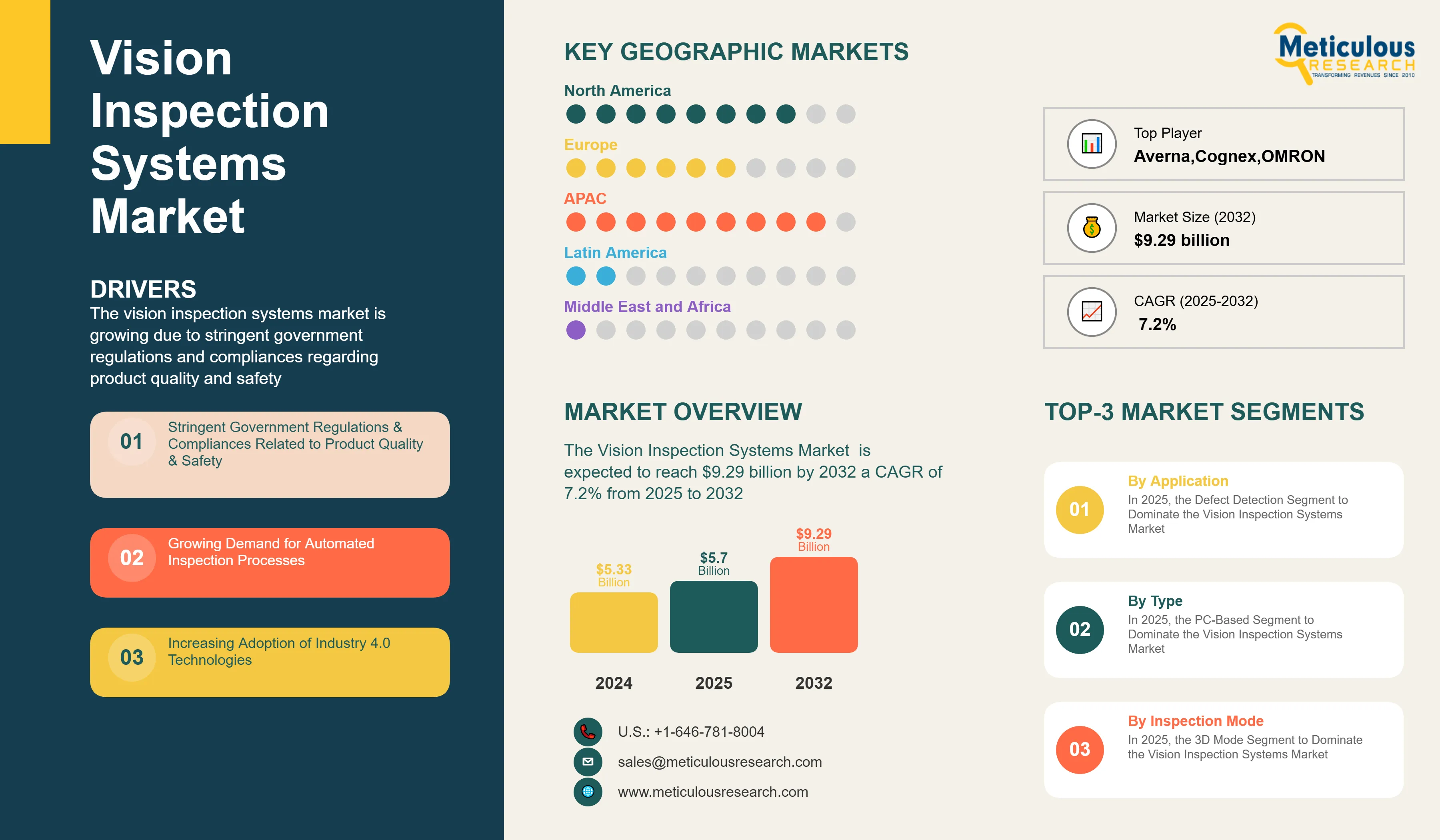
The Vision Inspection Systems Market was valued at $5.33 billion in 2024. This market is expected to reach $9.29 billion by 2032 from an estimated $5.70 billion, at a CAGR of 7.2% from 2025 to 2032. Vision Inspection Systems Market Size & Forecast The vision inspection systems market is growing due
- Published
- Feb 2025
- Pages
- 304
- Format
- PDF + Excel
- Report ID
- MR-1290
- Base year
- 2024
- 2024 · BASELINE
- $5.33B
- 2032
- $9.29B
- CAGR 2025–2032
- 7.2%
2024 baseline · 2025–2032 forecast at 7.2% CAGR · hover a bar for the value
Key highlights
By Offering: In 2025, the Hardware Segment to Dominate the Vision Inspection Systems Market
By Application: In 2025, the Defect Detection Segment to Dominate the Vision Inspection Systems Market
By Type: In 2025, the PC-Based Segment to Dominate the Vision Inspection Systems Market
By Inspection Mode: In 2025, the 3D Mode Segment to Dominate the Vision Inspection Systems Market
By End User: In 2025, the Electronics & Semiconductor Segment to Dominate the Vision Inspection Systems Market
Report summary
| Particulars | Details |
|---|---|
| Number of Pages | 307 |
| Format | |
| Forecast Period | 2025–2032 |
| Base Year | 2024 |
| CAGR | 7.2% |
| Market Size in 2025 | USD 5.70 Billion |
| Market Size in 2032 | USD 9.29 Billion |
| Segments Covered | By Offering · Hardware · Cameras · Vision Sensors · Lighting · Processors · Lenses · Peripheral Devices · Software · Services · Deployment & Integration Services · Consulting Services · Support & Maintenance Services · By Type · PC Based · Smart Camera-based · Compact · By Application · Defect Detection · Dimension Measurement · Appearance Inspection · Positioning/Alignment · Verification · Quantity Inspection · Identification Inspection · By Inspection Mode · 2D Mode · 3D Mode · By End User · Electronics & Semiconductor · Automotive · Pharmaceutical · Consumer Goods · Food & Beverages · Aerospace & Defense · Healthcare · Transportation & Logistics · Other End Users |
| Countries Covered | North America (U.S., Canada), Europe (Germany, France, Italy, U.K., Spain, Sweden, Switzerland, Netherlands, Norway, Austria, Denmark, Rest of Europe), Asia-Pacific (China, Japan, India, South Korea, Singapore, Australia, Malaysia, Taiwan, and Rest of Asia-Pacific), Latin America (Brazil, Mexico, Rest of Latin America), and the Middle East & Africa (Israel, UAE, Rest of Middle East & Africa) |
| Key Companies | Teledyne Technologies Incorporated (U.S.), OMRON Corporation (Japan), Optel Vision Inc. (Canada), Cognex Corporation (U.S.), KEYENCE CORPORATION (Japan), FANUC CORPORATION (Japan), Mettler-Toledo International Inc. (U.S.), Antares Vision S.p.A. (Italy), Datalogic SpA (Italy), Averna Technologies Inc. (Canada), National Instruments Corporation (U.S.), Pleora Technologies Inc. (Canada), USS Vision LLC (U.S.), ISRA VISION GmbH (Germany), Basler AG (Germany), and Qualitas Technologies (India). |
Report overview
Segments covered: offering, application, type, inspection mode. Regions: North America, Europe, Asia-Pacific, Latin America, Middle East & Africa.
The vision inspection systems market is growing due to stringent government regulations and compliances regarding product quality and safety, rising need for automated inspection processes, and increased adoption of Industry 4.0 technologies. However, the large initial investment needs limit the market's growth.
Additionally, technical improvements in inspection systems and the increasing deployment of robot-assisted inspection systems are likely to create potential opportunities for market players. However, compatibility and interoperability issues are important impediments to industry growth. Furthermore, the integration of AI technology is a major trend in the vision inspection systems market.
Report infographic
Market dynamics
4 factors across 3 forcesStringent Government Regulations & Compliances Regarding Product Quality & Safety
FDA rules, GMP (Good Manufacturing Practices), ISO standards, HACCP (Hazard Analysis and Critical Control Points), EPA laws, OSHA standards, CPSC regulations, and CE marking are some of the most significant guidelines governing product quality and safety. These regulations contribute to the safety and quality of food goods, medications, medical devices, electronics, cosmetics, and other products. Companies use vision inspection systems to ensure that their products meet quality and safety norms. These systems use advanced technologies like machine vision, artificial intelligence, and vision sensors to analyze products during the production & packaging processes. Visual inspection devices aid in the detection of mechanical and dimensional shortcomings alongside additional risks to consumer safety.
These benefits, combined with rising customer demand for safe and high-quality products, drive the visual inspection systems market.
Increased Adoption of Industry 4.0 Technologies
Industry 4.0 leverages advanced digital technologies such as the Internet of Things (IoT), robotics, cloud computing, artificial intelligence (AI), automation, and big data analytics to enhance traditional manufacturing operations. These aid in the production of smart systems that enable automation, data exchange, and real-time insights. The adoption of Industry 4.0 technologies enables the development of intelligent inspection systems equipped with machine vision, smart cameras, AI, and IoT connectivity for real-time quality control and defect detection.
Industry 4.0 technologies are becoming increasingly utilized, as various businesses are focused on the advancement of vision inspection. For example, in January 2021, Cognex Corporation (U.S.), a leader in industrial machine vision, introduced the In-Sight 3DL4000 embedded vision system to enable inspections in full 3D space. This smart camera uses 3D laser displacement technology and enables engineers to handle a variety of checks on automated manufacturing lines, which are contributing to the market’s growth.
Table of contents
13 chapters · 137 sections · 304 pages · click to expandSegmental analysis
| Segment | Largest share (2025) | Fastest growth (2025–2032) |
|---|---|---|
| By Offering | Hardware | Software |
| By Application | Defect Detection | Identification inspection |
| By Type | PC-Based | Smart camera-based |
| By Inspection Mode | 3D Mode | 3D mode |
| By End User | Electronics & Semiconductor | Electronics & semiconductors |
By Offering
- The Hardware Segment to Dominate the Vision Inspection Systems Market
- The hardware segment is expected to account for the largest share of over 58.5% of the global vision inspection systems market.
- The hardware segment is further segmented into vision sensors, lenses, lighting, cameras, processors, and peripheral devices.
- This segment’s large market share is mainly attributed to factors such as the increased adoption of machine vision inspection for ensuring product quality, the rising need for inspection systems to optimize workflow efficiency for quality control, to enhance the quality of products during the development and production stages, increasing R&D expenditure of key players, the rapid growth of industrial sectors such as automotive, packaging, pharmaceuticals, electronics, and other industrial applications and increasing focus of key players on the development of vision inspection systems.
- However, the software segment is expected to register the highest CAGR during the forecast period.
- This segment’s growth is primarily driven by the growing demand for vision inspection software, stringent regulations regarding product quality, the rising need for efficient, accurate, and reliable inspection processes, and the growing focus of players on the development of AI vision inspection software.
- For instance, Cohu, Inc. (U.S.) debuted its artificial intelligence (AI) inspection software in November 2023 as part of the company's DI-Core analytics platform.
- The AI inspection software does real-time computations, allowing semiconductor manufacturers to increase visual inspection accuracy at production speeds.
By Application
- The Defect Detection Segment to Dominate the Vision Inspection Systems Market
- The defect detection segment is expected to account for the largest share of over 27.0% of the global vision inspection systems market.
- This segment’s large market share is primarily attributed to factors such as the growing development of advanced vision inspection systems to ensure accurate detection of defects, the increasing focus of manufacturers on improving production efficiency and product quality, and increased integration of AI technology in vision inspection systems.
- However, the identification inspection segment is expected to register the highest CAGR during the forecast period.
- This segment's growth is mainly driven by the F&B industry's rising focus on leveraging vision technology to identify leaked packaging and damaged products, the growing need for faster inspection processing in fast-paced environments, and the increasing use of identification inspection to categorize products across several manufacturing industries.
By Type
- The PC-Based Segment to Dominate the Vision Inspection Systems Market
- The PC-based segment is expected to account for the largest share of over 52.6% of the global vision inspection systems market.
- This segment’s large market share is primarily attributed to benefits such as high flexibility, greater power, and speed of PC-based systems, growing adoption of PC-based vision inspection systems in fast-paced manufacturing environments, and a rise in manufacturing activities across several countries.
- However, the smart camera-based segment is expected to register the highest CAGR during the forecast period.
- This segment's growth is mainly driven by the increasing use of AI technology in vision inspection systems and the growing focus of key players on the development of AI vision camera systems for inspection.
By Inspection Mode
- The 3D Mode Segment to Dominate the Vision Inspection Systems Market
- The 2D mode segment is expected to account for a larger share of over 66.5% of the global vision inspection systems market.
- This segment’s large market share is attributed to factors such as the increased focus of businesses on improving product quality due to their affordability and less complexity than 3D systems, the rising use of 2D vision inspection systems for barcode reading, pattern recognition, and quality inspection across F&B, pharmaceutical industry, growing adoption of 2D systems for high-speed image acquisition and processing and growing demand of modern manufacturing processes.
- However, the 3D mode segment is expected to register the highest CAGR during the forecast period.
- This segment’s growth is driven by the growing adoption of multi-camera inspection systems across manufacturing industries, advancements in 3D imaging technology, and businesses' focus on intricate geometries and complex product manufacturing.
By End User
- The electronics & semiconductors segment is expected to account for the largest share of over 18.9% of the global vision inspection systems market.
- This segment’s large market share is attributed to the demand for vision inspection system market in the electronics and semiconductor industry.
- This is majorly attributed to the growing demand for miniaturization, precision, and high-quality standards.
- In electronics manufacturing, vision systems are extensively used for inspecting printed circuit boards (PCBs), where they help detect defects such as misalignment, soldering issues, and component placement errors.
- With components becoming smaller and more complex, traditional inspection methods are no longer adequate, and vision systems, which offer high-resolution imaging, have become indispensable.
- These systems are capable of identifying minute defects that could affect the functionality of the end product, such as poor solder joints, which could lead to circuit malfunctions.
- Additionally, electronics & semiconductors are projected to record the highest growth rate during the forecast period.
Geographic analysis
Asia-Pacific
Largest shareIn 2025, Asia-Pacific is expected to account for the largest share of over 38.2% of the global vision inspection systems market. This segment’s large market share is attributed to factors such as the wide presence of the manufacturing industry, growing investment across industries for digital transformation, increasing safety and consumer protection requirements, and stringent safety regulations. Moreover, the Asia-Pacific region is estimated to register the highest CAGR of 8.8% during the forecast period. This region's growth is mainly driven by rising industrialization, growing adoption of automation systems by manufacturers, growing demand for quality products, and increasing manufacturing activities across several industries, including pharmaceutical, automotive, food and beverage, and cosmetics. The growing demand for quality products from these industries creates potential opportunities for the players in this market. Asia-Pacific to Dominate the Vision Inspection Systems Market in 2025
Competitive landscape
- April 2024
Cognex Corporation (U.S.) launched the In-Sight L38 3D Vision System, which combines AI, 2D, and 3D vision technologies to solve a range of inspection and measurement applications.
- October 2023
KEYENCE CORPORATION (Japan) launched a new smart camera vision system line, the VS Series. The VS Series incorporates advanced lens control technology, effectively managing 19 lenses within an IP67 smart camera.
- Teledyne Technologies Incorporated (U.S.)
- OMRON Corporation · Japan
- Optel Vision Inc. · Canada
- Cognex Corporation (U.S.)
- KEYENCE CORPORATION · Japan
- FANUC CORPORATION · Japan
- Mettler-Toledo International Inc. (U.S.)
- Antares Vision S.p.A · Italy
- Datalogic SpA · Italy
- Averna Technologies Inc. · Canada
- National Instruments Corporation (U.S.)
- Pleora Technologies Inc. · Canada
- USS Vision LLC (U.S.)
- ISRA VISION GmbH · Germany
- Basler AG · Germany
- Qualitas Technologies · India
Frequently asked questions
The vision inspection systems market study focuses on market assessment and opportunity analysis through sales of vision inspection systems across different regions and countries. This study is also focused on competitive analysis for vision inspection systems based on an extensive assessment of the leading players’ product portfolios, geographic presence, and key growth strategies.
Cite this report
Meticulous Research. (2025). Vision Inspection Systems Market - Global Opportunity Analysis and Industry Forecast (2025-2032) (Report No. MR-1290). Meticulous Market Research Pvt. Ltd. https://www.meticulousresearch.com/product/vision-inspection-systems-market-5973