Sequencing Kits Market (2024-2031)
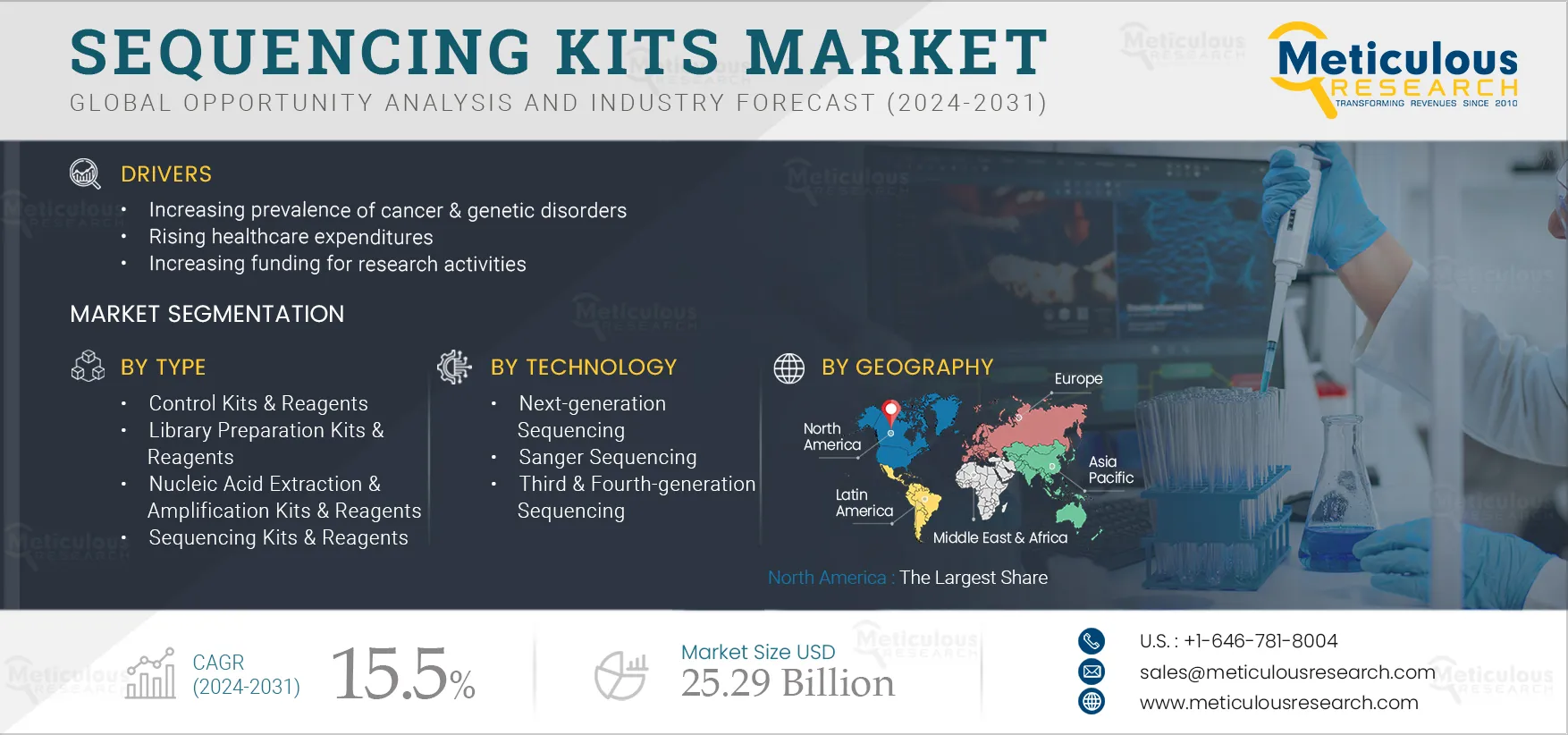
The Sequencing Kits Market was valued at $8.09 billion in 2023. This market is expected to reach $25.29 billion by 2031, from an estimated $9.23 billion in 2024, at a CAGR of 15.5% during the forecast period 2024-2031. Sequencing Kits Market Size & Forecast The growth of the sequencing kits market
- Published
- Jan 2024
- Pages
- 258
- Format
- PDF + Excel
- Report ID
- MR-973
- Base year
- 2023
- 2023 · BASELINE
- $8.09B
- 2031
- $25.29B
- CAGR 2024–2031
- 15.5%
2023 baseline · 2024–2031 forecast at 15.5% CAGR · hover a bar for the value
Key highlights
By Type: In 2024, the Nucleic Acid Extraction & Amplification Kits & Reagents Segment is Expected to Dominate the Sequencing Kits Market
Based on Technology: In 2024, the Next-Generation Sequencing (NGS) Segment is Expected to Dominate the sequencing kits market
Based on Application: In 2024, the Research Applications Segment is Expected to Dominate the sequencing kits market
Based on End User: In 2024, the Pharmaceutical & Biotechnology Companies is Expected to Dominate the sequencing kits market
Report summary
| Particulars | Details |
|---|---|
| Page No | 258 |
| Format | |
| Forecast Period | 2024-2031 |
| Base Year | 2023 |
| CAGR | 15.5% |
| Market Size (Value) | USD 25.29 billion by 2031 |
| Segments Covered | By Type · Control Kits & Reagents · Library Preparation Kits & Reagents · Nucleic Acid Extraction & Amplification Kits & Reagents · Sequencing Kits & Reagents · Other Kits & Reagents · (Note: Other kits & reagents include fluorescent dye, polyacrylamide gel, adenosine phosphosulphate (APS), luciferin, apyrase, probes, barcode kits, flow cells, trays, and beads) · By Technology · Next-generation Sequencing · Sanger Sequencing · Third & Fourth-generation Sequencing · Other Sequencing Technologies · (Note: Other technologies include pyro sequencing, degradome sequencing, chromatin immunoprecipitation (ChIP) sequencing, and methylation sequencing) · By Application · Research Applications · Drug Discovery · Agricultural & Animal Research · Other Research Applications · Clinical Applications · Reproductive Health · Oncology · Infectious Diseases · Other Clinical Applications · (Note 1: Other research applications include food microbiology, microbial analysis in the beverage industry, and environmental studies.) · Note 2: Other clinical applications include the detection of genetic aberrations in neurological disorders, rare diseases, and metabolic and immune disorders) · By End User · Pharmaceutical & Biotechnology Companies · Hospitals & Diagnostic Laboratories · Academic & Research Institutes · Other End Users · (Note: Other end users include forensic laboratories & security agencies, food & beverage companies, and agriculture companies) |
| Countries Covered | North America (U.S. and Canada), Europe (Germany, France, U.K., Italy, Spain, and Rest of Europe), Asia-Pacific (China, Japan, India, and Rest of Asia-Pacific), Latin America (Brazil, Mexico, Rest of Latin America) and the Middle East & Africa. |
| Key Companies | Illumina, Inc. (U.S.), Thermo Fisher Scientific Inc. (U.S.), F. Hoffmann-La Roche Ltd. (Switzerland), PerkinElmer, Inc. (U.S.), QIAGEN N.V. (Netherlands), Agilent Technologies, Inc. (U.S.), Pacific Biosciences of California, Inc. (U.S.), Danaher Corporation (U.S.), Bio-Rad Laboratories, Inc. (U.S.), Oxford Nanopore Technologies Plc. (U.K.), 10X Genomics, Inc. (U.S.), and Beijing Genomics Institute (BGI) (China). |
Report overview
Segments covered: type, control kits & reagent, library preparation kits & reagent, sequencing kits & reagent, other kits & reagent, technology, next-generation sequencing, sanger sequencing, third & fourth-generation sequencing, other sequencing technology, application, research application, drug discovery, agricultural & animal research, other research application, clinical application, reproductive health, oncology, infectious disease, other clinical application, rare disease, metabolic and immune disorders), end user, pharmaceutical & biotechnology company, hospitals & diagnostic laboratory, academic & research institute, other end user. Regions: North America, Europe, Asia-Pacific.
The growth of the sequencing kits market is driven by the increasing prevalence of cancer & genetic disorders, rising healthcare expenditures, increasing funding for research activities, the surge in genome mapping programs, the decreasing costs of sequencing procedures, the growing need for the early detection & prevention of diseases, technological advancements in sequencing products, the improving regulatory and reimbursement scenarios for NGS-based diagnostic tests, and government initiatives promoting the use of sequencing in clinical & research applications.
Moreover, government support for large-scale genomic sequencing projects, the increasing applications of genome sequencing in disease diagnostics and precision medicine, emerging economies, and advancements in genomics & proteomics are expected to generate growth opportunities for market stakeholders.
Market dynamics
4 factors across 2 forcesIncreasing Applications of Genome Sequencing in Disease Diagnostics and Precision Medicine
Personalized/precision medicine uses an individual’s genomic information to offer targeted treatment. The synthesis of genes can rapidly sequence large sections of a person’s genome and aid in the formulation of precision medicine, generating cost-effective alternatives for existing therapies and allowing for novel treatments in multiple areas, including infectious diseases, drug discovery, and reproductive health, among others. Personalized medicine analyzes molecules, individual genes, and networks and translates them into an overall output for the systems of the human body.
Furthermore, with the utilization of sequencing technologies in precision medicine, cancer treatment and diagnosis are also advancing significantly. New targeted cancer treatments that use genomic data to provide patient-specific treatments are known as precision oncology, a rapidly developing field that has already become a part of mainstream clinical practices. It involves the molecular profiling of cancer cells to identify targetable alterations, also known as biomarkers. Quick and reliable sequencing of multiple genes at once is possible with sequencing. Thus, the increasing inclination toward personalized medicine-based diagnosis and treatment is expected to create opportunities for market growth.
Decreasing Costs of Sequencing Procedures
Sequencing is the process of determining the nucleic acid sequence in a DNA or RNA sample. The advent of advanced sequencing technologies such as NGS, nanopore, and single-molecule real-time (SMRT) sequencing has accelerated biological and medical research and discovery, allowing biologists and medical scientists to collect massive amounts of DNA sequence data rapidly and cost-effectively. In the past few years, the availability of advanced sequencing technologies has lowered sequencing costs and significantly reduced the time required for genome sequencing. According to the National Human Genome Research Institute (NHGRI), the cost of sequencing a human genome decreased from USD 29,092 in 2010 to USD 562 in 2021, significantly increasing the adoption of sequencing kits & reagents.
Table of contents
12 chapters · 112 sections · 258 pages · click to expandSegmental analysis
| Segment | Largest share (2024) | Fastest growth (2024–2031) |
|---|---|---|
| By Type | Nucleic Acid Extraction & Amplification Kits & Reagents | Sequencing kits & reagents |
| By Technology | Next-Generation Sequencing (NGS) | — |
| By Application | Research Applications | — |
| By End User | Pharmaceutical & Biotechnology Companies | — |
By Type
- The Nucleic Acid Extraction & Amplification Kits & Reagents Segment is Expected to Dominate the Sequencing Kits Market
- Nucleic acid extraction & amplification kits segments is expected to account for the largest share of 33.0% of the sequencing kits market.
- The large market share of this segment is attributed to the growing adoption of sequencing-based research and development by various end users, such as pharmaceutical & biopharmaceutical companies and academic & research institutes.
- Also, the increasing applications of sequencing in reproductive health, oncology, agriculture, and animal research have triggered the demand for nucleic acid extraction & amplification kits & reagents.
- Furthermore, the sequencing kits & reagents segment is projected to witness the highest growth rate of 16.9% during the forecast period of 2024–2031.
- This is due to the increasing genome sequencing activities and increasing pharmaceutical research and development.
By Technology
- The Next-Generation Sequencing (NGS) Segment is Expected to Dominate the sequencing kits market
- Next-Generation Sequencing (NGS) segments is expected to account for the largest share of 78.2% the sequencing kits market.
- The large market share of this segment is attributed to the benefits offered by NGS, such as high-throughput production, efficient instrument runs, and cost-effectiveness compared to traditional first-generation sequencing methods.
- Additionally, NGS is highly preferred for large-scale genomic profiling and transcriptomic sequencing.
By Application
- The Research Applications Segment is Expected to Dominate the sequencing kits market
- Research applications segments is expected to account for the largest share of the sequencing kits market.
- The largest share of this segment is attributed to the decreasing cost of sequencing procedures, the rising research and development efforts by pharmaceutical and biopharmaceutical companies in drug and biomarker discovery, the high sensitivity and throughput offered by advanced sequencing technologies, and the expanding applications of sequencing in various clinical and research areas.
By End User
- The Pharmaceutical & Biotechnology Companies is Expected to Dominate the sequencing kits market
- Pharmaceutical & biotechnology segments is expected to account for the largest share of the sequencing kits market.
- The large market share of this segment is attributed to the declining costs of sequencing, the increase in research and development activities by pharmaceutical and biotechnology companies, and the extensive utilization of advanced sequencing products for cancer studies.
Geographic analysis
North America
Largest shareIn 2024, North America is expected to account for the largest share of 50.8% of the sequencing kits market, followed by Europe, Asia-Pacific, Latin America, and the Middle East & Africa. North America’s significant market share can be attributed to several key factors, increasing R&D expenditure by the pharmaceutical & biotechnology industry, the presence of leading sequencing kits & reagents market players in the region, favorable government initiatives for genomics research, growing applications of sequencing for diagnostic purposes in genetic diseases, oncology, and several other chronic conditions, rising awareness of NGS-based sequencing, increasing demand for precision medicine and favorable reimbursement scenario for DNA sequencing in the region. North America to Dominate the Sequencing Kits Market
Asia-Pacific
Fastest growthMoreover, the market in Asia-Pacific is slated to register the highest growth rate of 17.3% during the forecast period. The growth of this regional market is attributed to the accelerated economic growth in many countries across the region, which has increased the focus of governments in these countries on improving the healthcare sector. These government initiatives have led to increased investment to enhance the accessibility of healthcare services, healthcare infrastructure improvements, and biomarker discovery programs. The other key factors supporting the market's growth across this region include the rising prevalence of cancer, the growing adoption of advanced diagnostic and therapeutic technologies, and government initiatives to support genome sequencing programs.
Competitive landscape
- —
In July, QIAGEN launched its QIAseq Normalizer Kits, expanding its next-generation sequencing products portfolio. These kits enable convenient, cost-effective, fast DNA library preparation for high-quality results.
- April 2023
Thermo Fisher Scientific partnered with ALPCO-GeneProof (Czech Republic) to launch their TaqPath Menu and GeneProof PCR kits. The kits will be launched in phases for bloodborne and sexually transmitted infections (STIs). Also, panels for respiratory infections, transplant and thrombotic mutations, immunocompromised infections, and vector-borne diseases will follow.
- May 2022
Illumina launched its TruSight Oncology Comprehensive (EU) test kit that assesses multiple tumor biomarkers and genes to reveal specific molecular profiles of cancer patients.
- September 2020
Agilent Technologies launched its SureSelect XT HS2 RNA Reagent Kit to develop NGS workflows and applications by leveraging the versatility and performance of XT HS2 chemistry. Additionally, the kit expands NGS applications of XT HS2 chemistry, allowing customers to precisely and accurately profile gene expression and detect RNA fusions using lowinput FFPE samples.
- Illumina, Inc. (U.S.)
- Thermo Fisher Scientific Inc. (U.S.)
- F. Hoffmann-La Roche Ltd. · Switzerland
- PerkinElmer, Inc. (U.S.)
- QIAGEN N.V. · Netherlands
- Agilent Technologies, Inc. (U.S.)
- Pacific Biosciences of California, Inc. (U.S.)
- Danaher Corporation (U.S.)
- Bio-Rad Laboratories, Inc. (U.S.)
- Oxford Nanopore Technologies Plc. (U.K.)
- 10X Genomics, Inc. (U.S.)
- Beijing Genomics Institute (BGI) · China
Frequently asked questions
This study offers a detailed assessment of the cancer/tumor profiling market based on type, technology, application, and end user. This report also involves the value analysis of various segments and subsegments of the sequencing kits market at the regional and country levels.
Cite this report
Meticulous Research. (2024). Sequencing Kits Market - Global Opportunity Analysis and Industry Forecast (2024-2031) (Report No. MR-973). Meticulous Market Research Pvt. Ltd. https://www.meticulousresearch.com/product/sequencing-kits-market-5656